


When to Plant Corn: Match the Date to the Type, Not Just the Frost
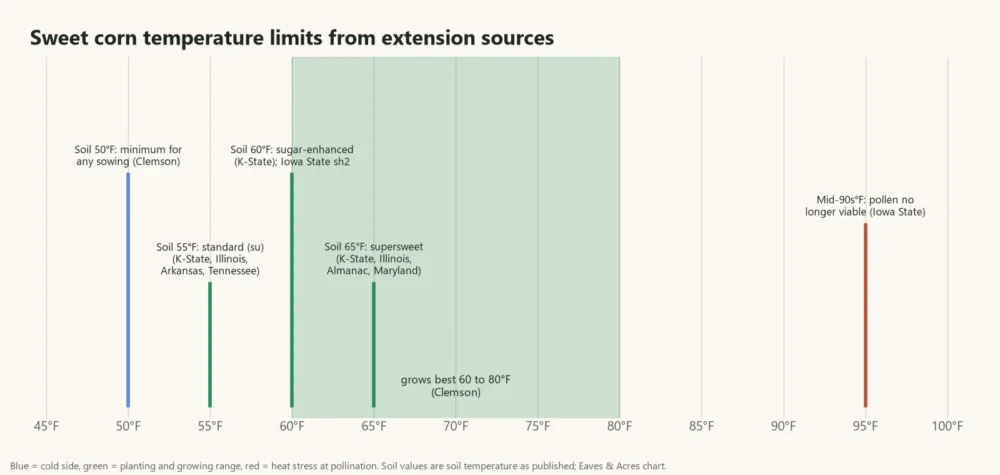
Standard, sugar-enhanced and supersweet corn need soil of 55, 60 and 65°F, so one date cannot fit them all. We tested “two weeks after the last frost” against NOAA normals for 37,563 ZIP codes and set local extension dates beside ours.
- Last reviewed Oct 23, 2026
- 21 cited sources
- 15 min read

Set your ZIP to see dates for your area.
- 1Sow standard sweet corn once the soil reaches about 55°F, sugar-enhanced at 60°F and supersweet at 65°F (K-State). In a typical ZIP code that is April 25, May 9 and May 25: April 28, May 11 and May 26 in Chicago; March 2, March 17 and April 7 in Dallas.
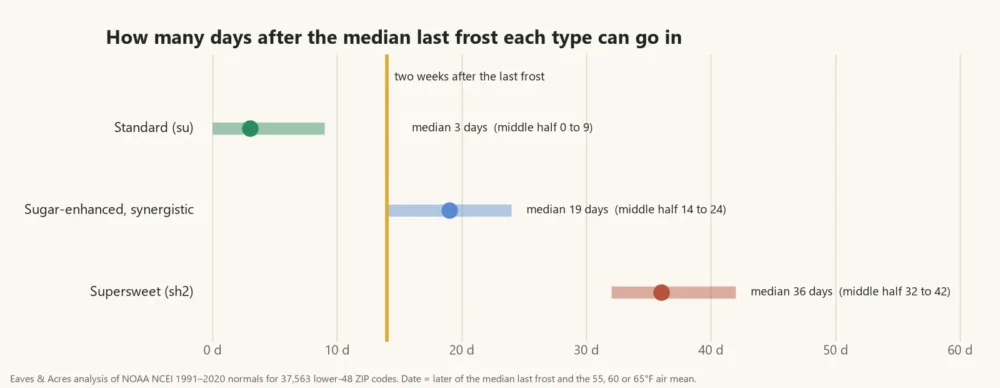
- 2“Two weeks after the last frost” fits no type. It is later than our standard-corn date in 88.2% of ZIP codes and earlier than our supersweet date in 99.7%, which falls a median 36 days after the median last frost.
- 3Corn takes a light frost better than beans or cucumbers (Iowa State: the growing point stays below ground until the six-leaf stage), so frost sets the standard-corn date in only 38.0% of ZIP codes; warmth sets it in the rest.
- 4For a late sowing, stop 98 days before the median first frost for a 70-day variety, 111 for an 83-day one: July 30 or July 17 in Chicago, August 23 or August 10 in Dallas. By August 1 the 70-day date has passed in 74.8% of ZIP codes.
Sow standard sweet corn outdoors once the soil reaches about 55°F, which in a typical US ZIP code is late April. Sugar-enhanced types wait for 60°F (about May 9) and supersweet types for 65°F (about May 25). In Chicago those dates are April 28, May 11 and May 26; in Dallas they are March 2, March 17 and April 7. For a late sowing, stop about 98 days before your median first frost for a 70-day variety: July 30 in Chicago, August 23 in Dallas.
Most guides give one rule for all corn: sow two to three weeks after the last frost. We tested that against NOAA 1991–2020 normals1 for 37,563 lower-48 ZIP codes, built spring dates for 28 cities and fall dates for 21, and set the dates beside local dates published by eight extension services and the Nebraska Corn Board. Everything uses air temperature as a stand-in for soil temperature, because our NOAA data has no soil readings.
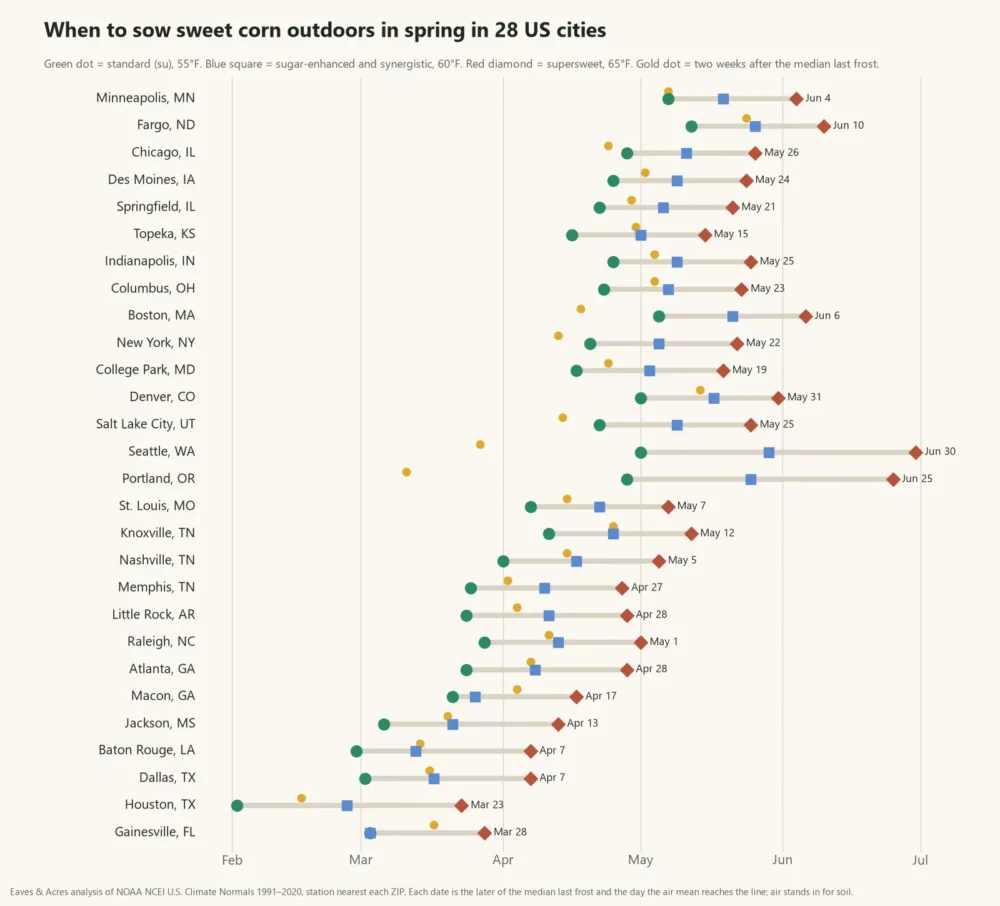
Spring sowing dates for 28 cities, by type of sweet corn
Sweet corn is not one crop for planting purposes. Iowa State lists five types and says standard (su), sugar-enhanced (se) and synergistic (syn) seed germinates well at soil temperatures of 55 to 60°F, while supersweet (sh2) and augmented supersweet seed is the least tolerant of cold soil.2 K-State sets the lines at 55°F for standard, 60°F for sugar-enhanced and 65°F for supersweet seed.4 Illinois and the Old Farmer’s Almanac also put supersweet at 65°F,3,12 and Tennessee says se and sh2 types prefer soil around 65°F.5 Each date in Table 1 is the later of our median last-frost date and the day the normal daily mean air temperature reaches the line for that type.
| City (ZIP) | Median last frost | Standard (su) 55°F | Sugar-enhanced (se), synergistic (syn) 60°F | Supersweet (sh2) 65°F | What sets the standard date |
|---|---|---|---|---|---|
| Minneapolis, MN (55401) | Apr 23 | May 7 | May 19 | Jun 4 | 55°F air mean |
| Fargo, ND (58102) | May 10 | May 12 | May 26 | Jun 10 | 55°F air mean |
| Chicago, IL (60601) | Apr 10 | Apr 28 | May 11 | May 26 | 55°F air mean |
| Des Moines, IA (50309) | Apr 18 | Apr 25 | May 9 | May 24 | 55°F air mean |
| Springfield, IL (62701) | Apr 15 | Apr 22 | May 6 | May 21 | 55°F air mean |
| Topeka, KS (66603) | Apr 16 | Apr 16 | May 1 | May 15 | Median last frost |
| Indianapolis, IN (46204) | Apr 20 | Apr 25 | May 9 | May 25 | 55°F air mean |
| Columbus, OH (43215) | Apr 20 | Apr 23 | May 7 | May 23 | 55°F air mean |
| Boston, MA (02108) | Apr 4 | May 5 | May 21 | Jun 6 | 55°F air mean |
| New York, NY (10001) | Mar 30 | Apr 20 | May 5 | May 22 | 55°F air mean |
| College Park, MD (20742) | Apr 10 | Apr 17 | May 3 | May 19 | 55°F air mean |
| Denver, CO (80202) | Apr 30 | May 1 | May 17 | May 31 | 55°F air mean |
| Salt Lake City, UT (84101) | Mar 31 | Apr 22 | May 9 | May 25 | 55°F air mean |
| Seattle, WA (98101) | Mar 13 | May 1 | May 29 | Jun 30 | 55°F air mean |
| Portland, OR (97201) | Feb 25 | Apr 28 | May 25 | Jun 25 | 55°F air mean |
| St. Louis, MO (63101) | Apr 1 | Apr 7 | Apr 22 | May 7 | 55°F air mean |
| Knoxville, TN (37902) | Apr 11 | Apr 11 | Apr 25 | May 12 | Median last frost |
| Nashville, TN (37201) | Apr 1 | Apr 1 | Apr 17 | May 5 | Median last frost |
| Memphis, TN (38103) | Mar 19 | Mar 25 | Apr 10 | Apr 27 | 55°F air mean |
| Little Rock, AR (72201) | Mar 21 | Mar 24 | Apr 11 | Apr 28 | 55°F air mean |
| Raleigh, NC (27601) | Mar 28 | Mar 28 | Apr 13 | May 1 | Median last frost |
| Atlanta, GA (30303) | Mar 24 | Mar 24 | Apr 8 | Apr 28 | Median last frost |
| Macon, GA (31201) | Mar 21 | Mar 21 | Mar 26 | Apr 17 | Median last frost |
| Jackson, MS (39201) | Mar 6 | Mar 6 | Mar 21 | Apr 13 | Median last frost |
| Baton Rouge, LA (70802) | Feb 28 | Feb 28 | Mar 13 | Apr 7 | Median last frost |
| Dallas, TX (75201) | Mar 2 | Mar 2 | Mar 17 | Apr 7 | Median last frost |
| Houston, TX (77002) | Feb 2 | Feb 2 | Feb 26 | Mar 23 | Median last frost |
| Gainesville, FL (32601) | Mar 3 | Mar 3 | Mar 3 | Mar 28 | Median last frost |
Choosing a type moves your date by a month
Across the 37,563 ZIP codes, the median standard-corn date is April 25, the sugar-enhanced date May 9 and the supersweet date May 25. The supersweet date falls a median 32 days after the standard one, and 14 or more days after it in 99.7% of ZIP codes. Supersweet seed goes in a median 36 days after the median last frost (middle half 32 to 42).
The usual rule does not fit any type. The University of Georgia says to wait until at least two weeks after the last average killing frost,7 and the Almanac says two to three weeks.12 That is later than our standard-corn date in 88.2% of ZIP codes (by a week or more in 70.7%), but earlier than our supersweet date in 99.7% (by a week or more in 98.6%). Frost sets the standard-corn date in 38.0% of ZIP codes, as in Nashville, Atlanta and Dallas, and warmth sets it in the other 62.0%; for sugar-enhanced and supersweet seed, warmth sets it in 98.4% and 100%. Iowa State gives 60°F for supersweet soil;2 if you prefer that line, use the sugar-enhanced column.
Corn takes a light frost better than beans or cucumbers
Corn seedlings recover from frost more often than most warm-season crops. Iowa State agronomists say the growing point stays below the soil until the six-leaf stage, and that after a moderate freeze, recovery:13
usually is rapid and almost complete
Recovery slows when air temperatures stay below normal afterward, and soft rot can follow. That is why published frost rules range from permissive to cautious. K-State puts the earliest sowing at
one week before the average frost date in your area
while Illinois says early standard corn goes in at or just before the mean frost-free date,3 Tennessee says some gardeners seed slightly before it and plan on seedlings emerging after the final frosts,5 and Georgia warns that too-early planting can leave weak stands and frost-killed seedlings.7 We use the median last frost as the floor. In 89.4% of ZIP codes our standard-corn date falls before the 10% last-frost date, which comes a median 16 days after the median one, so keep a cover handy; see our frost-cover guide.
Cold soil is the bigger risk. Purdue’s newsletter says corn needs about 115 growing degree days to emerge, so in soil averaging 50°F emergence can take upwards of 35 days, while in 65°F soil it can occur in 7 days or less.15 That is field-corn research, but seed in cold, wet soil rots the same way: Iowa State warns of seed rot and notes that most seed is treated and dyed pink.2 Air is not soil, so check the soil at planting depth.
Temperature rules compared across ten sources
Table 2 lines up what each publication says. The soil lines cluster at 55, 60 and 65°F by type, the frost-date rules span a month, from a week before to two or three weeks after the last frost, and days to maturity run from 60 to 100.
| Source | Soil temperature rule | Frost-date or calendar rule | Days to maturity |
|---|---|---|---|
| Iowa State Extension | 55 to 60°F for su, se and syn seed; at least 60°F for sh2 and augmented supersweet | Central Iowa: late April for su, a week later for se and syn, mid-May for sh2; July 1 last practical date for early cultivars | — |
| University of Illinois Extension | Above 55°F for standard; about 65°F for supersweet | Early standard corn at or just before the mean frost-free date; as late as the first week of July | Examples: 69, 75 and 83 |
| K-State Research and Extension | 55°F su; 60°F se; 65°F sh2 | Earliest one week before the average frost date; mid-April to early May in eastern and central Kansas | — |
| University of Tennessee | Minimum 55°F; se and sh2 around 65°F | Some gardeners seed slightly before the frost-free date; East Tennessee April 15 to June 30, West Tennessee April 15 to June 15 | — |
| University of Arkansas | Above 55°F for normal sugary; above 60°F for se and sh2 | Early planting mid-March if weather permits; early spring to early August | 63 to 100 |
| University of Georgia | 60 to 90°F | At least two weeks after the last average killing frost; no later than July 20 in the middle Georgia calendar | 60 to 100 |
| Clemson Extension | At least 50°F at 4 inches; 65°F for extra-sweet | — | 80 to 95 |
| University of Maryland Extension | 65°F for super-sweet | After the danger of frost is past | 63 to 100 |
| Mississippi State Extension | Soil approaching 68°F | As early as possible | — |
| Old Farmer’s Almanac | At least 60°F; 65°F for supersweet | Two to three weeks after the last spring frost | 60 to 100 frost-free days |
Starting indoors, covers and seed treatment
Direct sowing is standard. The Almanac says starting corn indoors gives a three-to-four-week head start in the North, in 4-inch biodegradable pots, with seedlings at least 6 inches tall and soil warm before transplanting;12 our seed-starting guide lists other crops. Illinois says early standard corn can go in at or just before the mean frost-free date unless you use clear polyethylene mulch to warm the soil,3 and the Almanac suggests black plastic in the North.12 The dates in Table 1 assume no cover.
Succession sowing and keeping types apart
Iowa State suggests planting early, mid-season and late cultivars, or sowing the same cultivar in blocks every two weeks.2 Illinois says to make the next planting when the previous one has three to four leaves,3 Georgia says successive two-week plantings,7 Clemson every 10 to 14 days9 and the Almanac every two to three weeks.12 Between our standard-corn date and the last sowing for a 70-day variety, the median ZIP code has room for 7 sowings 14 days apart, or 5 at 21 days; the window is under 30 days in 4.9% of ZIP codes and over 100 days in 37.0%.
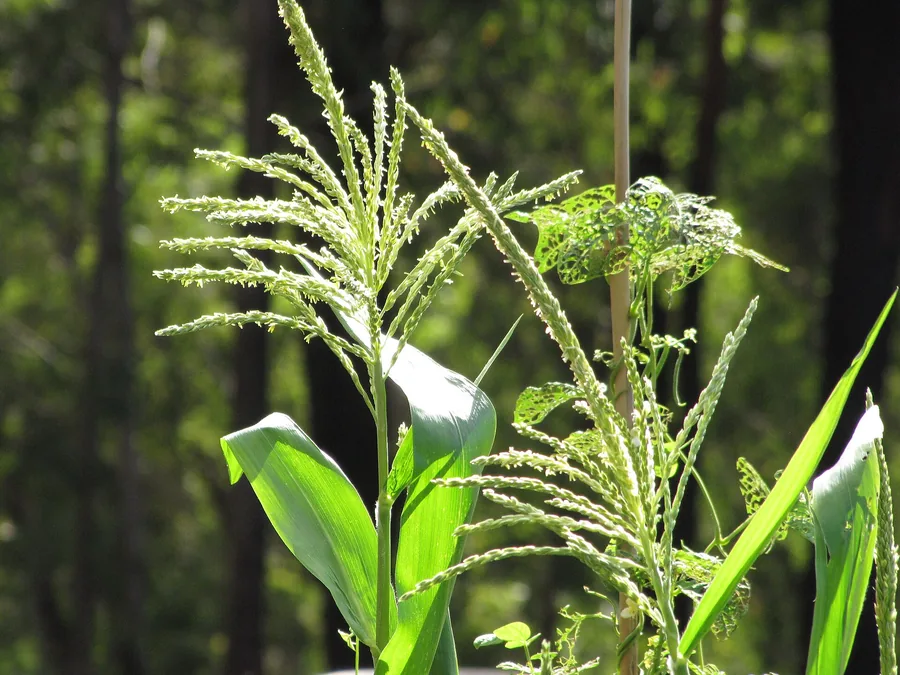

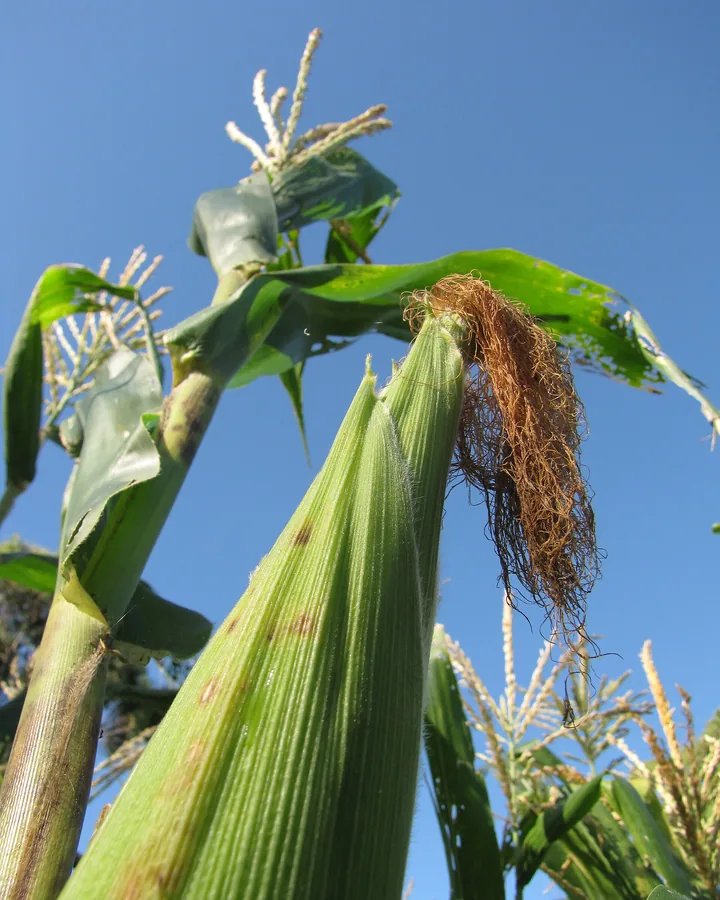
Timing also keeps types from crossing. Iowa State says supersweet types need isolation from standard, sugar-enhanced and synergistic types, that 250 feet is not practical for most home gardens, and that a minimum of 14 days should separate the tasseling time of different types.2 Maryland and Clemson give two weeks or a month of planting time as the alternative to 400 yards of distance.10,9 Because our supersweet date is 14 or more days after the standard date in 99.7% of ZIP codes, sowing each type on its own date produces a stagger in most places, but days to maturity matter too, so check the packet.
Heat at pollination
Corn is wind-pollinated, so plant blocks of at least four short rows rather than one long row.2 Heat matters when the plants tassel and silk, about 50 days after sowing for a 70-day variety by our estimate, since silks to harvest takes 18 to 23 days.2 Iowa State agronomists say:14
Pollen is no longer viable once temperatures reach the mid 90’s or greater
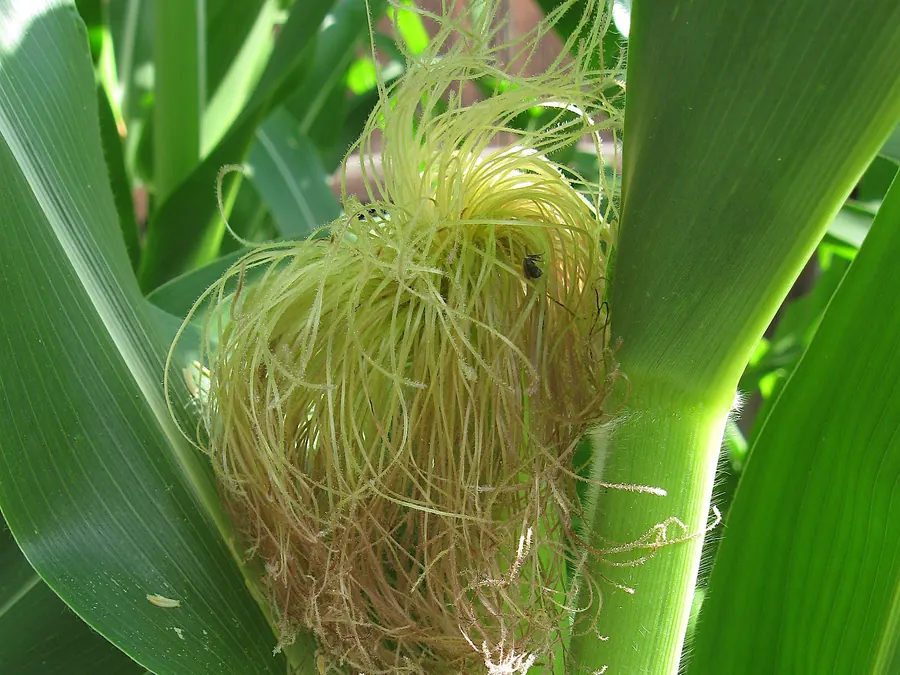
The same page adds that pollen usually sheds in the morning, and that high temperatures will not severely stress pollination if soil moisture is adequate; drought with heat is the problem.14 Heat rarely touches the first sowing: a standard-corn sowing on our date silks into a normal daily high of 90°F or more in 0.7% of ZIP codes. It touches mid-season sowings in the hot South and Southwest. A normal July high of 90°F or more occurs in 27.0% of ZIP codes, and a June 1 sowing silks into 90°F highs in 24.9%. A normal high of 90°F means many days reach the mid-90s, so treat Table 3 as a flag, not a ban, and water through silking.
| City (ZIP) | Normal high at 90°F or more | First sowing (standard) | Sow by (silks before the heat) | Sow from (silks after the heat) | Last sowing (70-day) |
|---|---|---|---|---|---|
| Denver, CO (80202) | Jul 9 to Aug 8 | May 1 | May 20 | Jun 19 | Jul 6 |
| Salt Lake City, UT (84101) | Jul 11 to Aug 9 | Apr 22 | May 22 | Jun 20 | Aug 2 |
| Memphis, TN (38103) | Jul 8 to Aug 16 | Mar 25 | May 19 | Jun 27 | Aug 4 |
| Little Rock, AR (72201) | Jul 1 to Aug 22 | Mar 24 | May 12 | Jul 3 | Aug 4 |
| Macon, GA (31201) | Jun 10 to Aug 29 | Mar 21 | Apr 21 | Jul 10 | Aug 4 |
| Jackson, MS (39201) | Jun 15 to Aug 30 | Mar 6 | Apr 26 | Jul 11 | Aug 13 |
| Baton Rouge, LA (70802) | Jul 3 to Aug 23 | Feb 28 | May 14 | Jul 4 | Aug 20 |
| Dallas, TX (75201) | Jun 5 to Sep 15 | Mar 2 | Apr 16 | Jul 27 | Aug 23 |
| Houston, TX (77002) | Jun 8 to Sep 13 | Feb 2 | Apr 19 | Jul 25 | Sep 18 |
| Gainesville, FL (32601) | Jun 12 to Aug 21 | Mar 3 | Apr 23 | Jul 2 | Aug 26 |

Late sowings: the last date before fall frost
Frost ends the crop, so the last sowing date counts back from the median first 32°F frost. Our count is days to maturity plus 14 for slower fall growth plus 14 for a frost-tender crop, the same method as our fall vegetable planting guide, which uses 98 days for sweet corn: a 70-day variety needs 98 days and an 83-day variety, the main-crop example in the Illinois guide,3 needs 111. Days to maturity run from 60 to 100 in the Georgia and Almanac guides,7,12 so find the number on your packet and add 28.
| City (ZIP) | Median first frost (32°F) | Last sowing 70-day corn | Last sowing 83-day corn | Mean air temp on the 70-day date | Mean air temp 70 days later |
|---|---|---|---|---|---|
| Fargo, ND (58102) | Sep 30 | Jun 24 | Jun 11 | 68°F | 64°F |
| Minneapolis, MN (55401) | Oct 16 | Jul 10 | Jun 27 | 73°F | 61°F |
| Chicago, IL (60601) | Nov 5 | Jul 30 | Jul 17 | 75°F | 58°F |
| Des Moines, IA (50309) | Oct 20 | Jul 14 | Jul 1 | 76°F | 63°F |
| Springfield, IL (62701) | Oct 22 | Jul 16 | Jul 3 | 76°F | 63°F |
| Topeka, KS (66603) | Oct 22 | Jul 16 | Jul 3 | 78°F | 65°F |
| Indianapolis, IN (46204) | Oct 21 | Jul 15 | Jul 2 | 74°F | 63°F |
| Columbus, OH (43215) | Oct 24 | Jul 18 | Jul 5 | 75°F | 62°F |
| Boston, MA (02108) | Nov 9 | Aug 3 | Jul 21 | 73°F | 56°F |
| New York, NY (10001) | Nov 20 | Aug 14 | Aug 1 | 76°F | 55°F |
| Denver, CO (80202) | Oct 12 | Jul 6 | Jun 23 | 75°F | 66°F |
| Salt Lake City, UT (84101) | Nov 8 | Aug 2 | Jul 20 | 80°F | 58°F |
| Knoxville, TN (37902) | Oct 28 | Jul 22 | Jul 9 | 77°F | 65°F |
| Nashville, TN (37201) | Oct 31 | Jul 25 | Jul 12 | 78°F | 65°F |
| Memphis, TN (38103) | Nov 10 | Aug 4 | Jul 22 | 81°F | 64°F |
| Little Rock, AR (72201) | Nov 10 | Aug 4 | Jul 22 | 81°F | 63°F |
| Raleigh, NC (27601) | Nov 8 | Aug 2 | Jul 20 | 79°F | 63°F |
| Atlanta, GA (30303) | Nov 8 | Aug 2 | Jul 20 | 80°F | 64°F |
| Macon, GA (31201) | Nov 10 | Aug 4 | Jul 22 | 82°F | 67°F |
| Dallas, TX (75201) | Nov 29 | Aug 23 | Aug 10 | 85°F | 63°F |
| Houston, TX (77002) | Dec 25 | Sep 18 | Sep 5 | 80°F | 60°F |
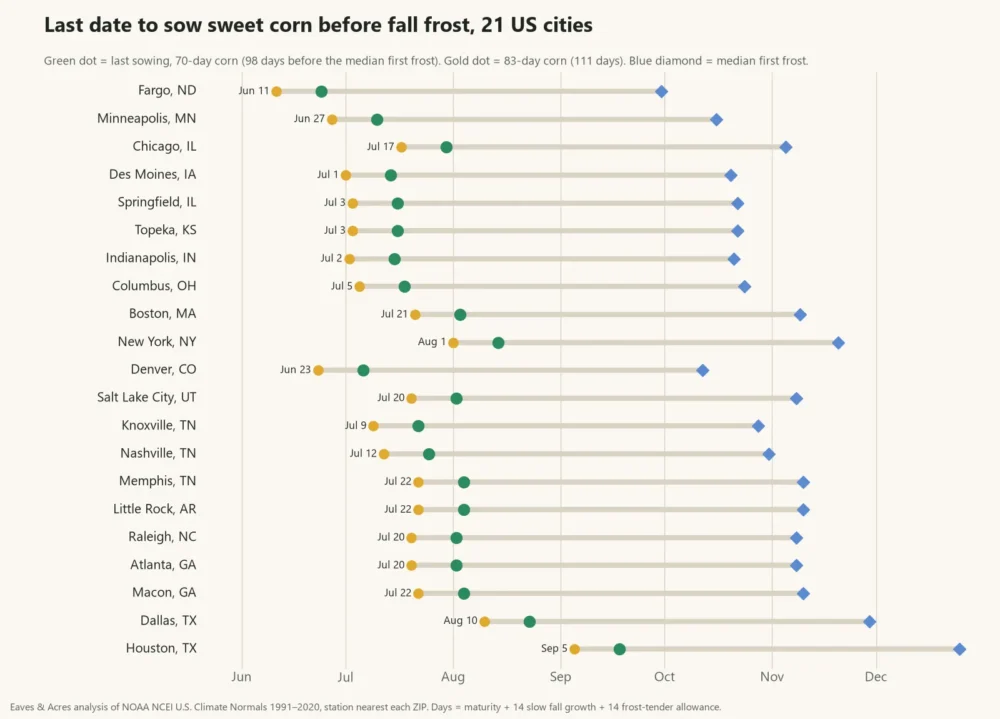
Across all ZIP codes the median last sowing date is July 18 for 70-day corn and July 5 for 83-day corn. It has passed by July 1 in 15.5% and 37.4% of ZIP codes, and by August 1 in 74.8% and 88.8%. A July 1 sowing fits the 70-day count in 84.5% of ZIP codes and the 83-day count in 62.6%. Late sowings ripen in cooling air: on the last sowing date the median normal daily mean is 74.8°F, but 70 days later it is 63.0°F, below 65°F in 80.2% of ZIP codes and below 60°F in 14.5%. Mississippi State warns that late-planted sweet corn has serious corn earworm problems,11 and Illinois that later harvests usually have severe earworm damage unless timely control measures are followed;3 our dates are a frost limit, not a pest limit.

How published local calendars compare
Table 5 converts published dates to our cities. Spring dates mostly agree: Topeka’s standard date is inside K-State’s window and Des Moines’s inside Iowa State’s, though Memphis is 21 days earlier than Tennessee’s April 15 and Little Rock 9 days later than Arkansas’s mid-March. For fall, Iowa State’s July 1 and Illinois’s first week of July match our 83-day column, and Georgia’s July 20 is within two days of it.8 The Tennessee end dates, June 30 in the east and June 15 in the west, are 9 and 37 days earlier than our 83-day dates for Knoxville and Memphis; the publication does not say why, and our count is a frost limit only.5 Arkansas allows planting to early August,6 which matches our Little Rock 70-day date.
| Place | Published guidance | Dates it gives | Our date | Comparison |
|---|---|---|---|---|
| Des Moines, IA (spring, standard) | Iowa State Extension: standard (su), central Iowa | Late April | Apr 25 | Inside the range |
| Des Moines, IA (spring, supersweet) | Iowa State Extension: supersweet (sh2), central Iowa | Mid-May | May 24 | Ours is 6 to 12 days later at 65°F (at 60°F it is May 9) |
| Topeka, KS (spring, standard) | K-State: eastern and central Kansas | Mid-April to early May | Apr 16 | Inside the range |
| Springfield, IL (spring, standard) | University of Illinois Extension: early standard corn | At or just before the mean frost-free date | Apr 22 (median last frost Apr 15) | Ours is 7 days after the median last frost, when the air mean reaches 55°F |
| Knoxville, TN (spring, standard) | University of Tennessee: East Tennessee typical dates | From April 15 | Apr 11 | Ours is 4 days earlier |
| Memphis, TN (spring, standard) | University of Tennessee: West Tennessee recommended dates | From April 15 | Mar 25 | Ours is 21 days earlier |
| Little Rock, AR (spring, standard) | University of Arkansas: early planting if weather permits | Mid-March | Mar 24 | Ours is 9 days later |
| Jackson, MS (spring) | Mississippi State Extension: as early as possible | Soil approaching 68°F | Mar 6 at 55°F; the air mean reaches 68°F on Apr 24 | A different line: 68°F, not 55°F |
| Des Moines, IA (fall) | Iowa State Extension: last practical date for early cultivars | July 1 | Jul 14 (70-day) Jul 1 (83-day) | Equals our 83-day date |
| Springfield, IL (fall) | University of Illinois Extension: as late as | First week of July | Jul 16 (70-day) Jul 3 (83-day) | Our 83-day date is inside the range |
| Knoxville, TN (fall) | University of Tennessee: East Tennessee typical dates | To June 30 | Jul 22 (70-day) Jul 9 (83-day) | Our 83-day date is 9 days later |
| Memphis, TN (fall) | University of Tennessee: West Tennessee recommended dates | To June 15 | Aug 4 (70-day) Jul 22 (83-day) | Our 83-day date is 37 days later |
| Macon, GA (fall) | University of Georgia Extension: middle Georgia calendar | No later than July 20 | Aug 4 (70-day) Jul 22 (83-day) | Our 83-day date is 2 days later |
| Little Rock, AR (fall) | University of Arkansas: may be planted to | Early August | Aug 4 (70-day) Jul 22 (83-day) | Our 70-day date is within 3 days |
| Indianapolis, IN (field corn) | Purdue: optimum window for maximum field-corn yield | April 20 to May 10 | Apr 25 | Inside the range |
| Lincoln, NE (field corn) | Nebraska Corn Board: statewide average last freeze | April 23 to 25 | Median last frost Apr 24 | Matches |
Field corn, popcorn and other kinds
Many search results are farm pages, which give earlier windows for yield: Purdue says Indiana’s optimum for maximum corn yield potential is April 20 to May 10, a week earlier in the south and a week later in the north,15 and the Nebraska Corn Board gives ideal soil as 50 to 55°F and the statewide average last freeze as April 23 to 25.16 Our Indianapolis standard date, April 25, is inside Purdue’s window, and Lincoln’s median last frost is April 24. Those are field-corn windows judged on yield, not on a home harvest of sweet corn, and field corn takes 95 to 115 days to mature, Nebraska says. Sweet corn should also be isolated from popcorn and field corn, Iowa State says, by 250 feet or by staggering the planting dates;2 popcorn has its own timing, which this page does not cover.
Hot summers, mild winters and frost-free ZIP codes
Frost-free ZIP codes have no frost count, so use the months. In Phoenix (ZIP 85001) the normal mean stays at or above 55°F in all twelve months and at or above 65°F from March through November, but normal highs reach 90°F from May through September. San Francisco (94103) reaches 55°F from March to November and 65°F in no month, so supersweet seed never meets its line there. Miami (33101) is above 65°F all year. Our table has no frost dates for 104 of Hawaii’s 135 ZIP codes, so we give no Hawaii dates; ask your county extension office.
How we calculated these dates
Daily temperatures are NOAA’s monthly normals placed on the 15th of each month and interpolated linearly, for the station nearest each ZIP code.1 Frost dates are the median and 10% 32°F dates. The 55, 60 and 65°F lines are the published rules above, applied to air temperature, not soil. Silking is 50 days after sowing for a 70-day variety. Individual years vary by weeks; a warm or cold spring will move every date, and a cold snap after sowing can set corn back even when it survives.
Next steps
Look up your own frost dates with our frost date lookup and read what a last frost date means. Sweet corn shares its warm soil with tomatoes, green beans and cucumbers, which are more frost-tender than corn, and the vegetable guides cover more crops.
Frequently asked questions
Once the soil reaches about 55°F for standard sweet corn, 60°F for sugar-enhanced and 65°F for supersweet seed. Our dates are the later of the median last frost and the day the air mean reaches that line: April 28, May 11 and May 26 in Chicago; March 2, March 17 and April 7 in Dallas; May 7, May 19 and June 4 in Minneapolis.
Corn seedlings take a light frost better than most warm-season crops: Iowa State says the growing point stays below ground until the six-leaf stage, and K-State puts the earliest sowing a week before the average frost date. Cold, wet soil is the bigger risk, because seed rots, and Georgia warns of weak stands and frost-killed seedlings if you sow too early.
Above 55°F for standard types (Illinois, K-State, Arkansas, Tennessee), 60°F for sugar-enhanced (K-State, Arkansas) and 65°F for supersweet (K-State, Illinois, Almanac, Maryland). Clemson’s floor for any sowing is 50°F at 4 inches, and Mississippi State says soil approaching 68°F.
When the soil is about 65°F, a median 36 days after your median last frost (middle half 32 to 42 days): May 26 in Chicago, June 4 in Minneapolis, April 7 in Dallas. In 2.5% of ZIP codes the normal air never reaches 65°F.
Often not. A July 1 sowing fits our 70-day count in 84.5% of ZIP codes and the 83-day count in 62.6%, and Iowa State calls July 1 the last practical date for early cultivars in central Iowa. For 83-day corn it has passed by July 1 in Fargo, Minneapolis and Denver.
Only where frost comes late. Our last 70-day dates are August 4 in Memphis, August 23 in Dallas and September 18 in Houston, and by October 1 the date has passed in every ZIP code we tested. Late sowings ripen in cooling air and meet more corn earworm, according to Mississippi State and Illinois.
Every two weeks is the usual advice (Iowa State, Georgia, Maryland), or every 10 to 14 days (Clemson) or two to three weeks (Almanac). Between our standard-corn date and the last sowing for a 70-day variety, the median ZIP code has room for 7 sowings 14 days apart.
A zone cannot decide it: the USDA map is based on the average annual extreme minimum winter temperature, not spring warmth. Use your ZIP code’s dates instead; Table 1 gives April 1 for standard corn and May 5 for supersweet in Nashville, and March 28 and May 1 in Raleigh.
Sources
- 1.U.S. Climate Normals 1991–2020. NOAA National Centers for Environmental Information, 2021. Used for: median and 10% last- and first-frost dates and monthly temperature normals for every ZIP code Back to text
- 2.Growing Sweet Corn in the Home Garden, Aaron Steil and Richard Jauron. Iowa State University Extension and Outreach, 2026. Used for: types and germination soil 55 to 60°F; central Iowa dates; July 1 last date; blocks every two weeks; 14 days between tasseling; silk to harvest 18 to 23 days Back to text
- 3.Corn (Home Vegetable Gardening). University of Illinois Extension, n.d. Used for: soil above 55°F standard and about 65°F supersweet; early planting at or just before the mean frost-free date; as late as the first week of July; 69, 75 and 83-day examples; earworm Back to text
- 4.Sweet Corn (MF669), Ward Upham. Kansas State University Research and Extension, 2020. Used for: soil 55°F standard, 60°F sugar-enhanced, 65°F supersweet; earliest one week before the average frost date; mid-April to early May in eastern and central Kansas Back to text
- 5.Sweet Corn for the Tennessee Vegetable Garden (D 61), Natalie Bumgarner. University of Tennessee Institute of Agriculture, 2018. Used for: minimum soil 55°F; se and sh2 around 65°F; seeding slightly before the frost-free date; East Tennessee April 15 to June 30, West Tennessee April 15 to June 15 Back to text
- 6.Sweet Corn (FSA6008), Craig R. Andersen. University of Arkansas Cooperative Extension Service, n.d. Used for: above 55°F normal sugary and above 60°F se and sh2; early planting mid-March; early spring to early August; 63 to 100 days Back to text
- 7.Growing Home Garden Sweet Corn (C 905), Robert R. Westerfield. University of Georgia Cooperative Extension, n.d. Used for: soil 60 to 90°F; wait until at least two weeks after the last average killing frost; 60 to 100 days; successive two-week plantings Back to text
- 8.Vegetable Garden Calendar (Circular 943). University of Georgia Cooperative Extension, n.d. Used for: middle Georgia: corn no later than July 20 to mature before frost Back to text
- 9.Sweet Corn. Clemson Cooperative Extension Home & Garden Information Center, n.d. Used for: soil at least 50°F at 4 inches; extra-sweet 65°F; plantings every 10 to 14 days; 80 to 95 days; isolation 400 yards or one month apart Back to text
- 10.Growing Sweet Corn in a Home Garden. University of Maryland Extension, n.d. Used for: super-sweet at 65°F; 63 to 100 days; plantings every two weeks; isolation by distance or two weeks of planting time Back to text
- 11.When should sweet corn be planted?. Mississippi State University Extension Service, n.d. Used for: seed when soil approaches 68°F; late-planted sweet corn has serious corn earworm problems Back to text
- 12.Sweet Corn: How to Plant, Grow, and Harvest Sweet Corn at Home. The Old Farmer’s Almanac, 2026. Used for: soil at least 60°F, supersweet 65°F; 2 to 3 weeks after the last spring frost; indoors 3 to 4 weeks; black plastic in the North; 60 to 100 days Back to text
- 13.Frost: Impact on Early Corn Growth (before V4). Iowa State University Extension and Outreach, Crop Production, n.d. Used for: growing point below ground until V6; recovery from a moderate freeze rapid; slowed by cool weather and soft rot Back to text
- 14.Corn Pollination: Effect of High Temperature and Stress. Iowa State University Extension and Outreach, Crop Production, n.d. Used for: pollen not viable at mid-90s°F or greater; adequate soil moisture; drought plus heat is the problem Back to text
- 15.When Is The Best Time To Plant Corn?, Dan Quinn. Purdue University Pest&Crop newsletter, 2022. Used for: Indiana field-corn window April 20 to May 10; 115 growing degree days to emerge; 7 days at 65°F soil, up to 35 days at 50°F Back to text
- 16.Why Farmers Plant Corn in April (or May). Nebraska Corn Board, 2026. Used for: ideal soil 50 to 55°F; statewide average last freeze April 23 to 25; field corn 95 to 115 days Back to text
- 17.USDA Plant Hardiness Zone Map. USDA Agricultural Research Service, 2023. Used for: zones are based on average annual extreme minimum winter temperature
- 18.Photo: Starr-090707-2392 Zea mays in vegetable garden, Forest and Kim Starr (CC BY 3.0 US). Wikimedia Commons, 2009. Used for: hero photo
- 19.Photo: Starr-090707-2394 Zea mays male flowers, Forest and Kim Starr (CC BY 3.0 US). Wikimedia Commons, 2009. Used for: tassel photo
- 20.Photo: Corn Silk, 2020-08-03, Beechview, Cbaile19 (CC0). Wikimedia Commons, 2020. Used for: silk photo
- 21.Photo: Starr-090801-3520 Zea mays fruit, Forest and Kim Starr (CC BY 3.0 US). Wikimedia Commons, 2009. Used for: ear photo
How this guide was made
- Written by the Yard & Garden Desk and reviewed by the Data & Methodology Desk.
- Data: median and 10% last-frost dates, median first-frost dates and monthly temperature normals from NOAA NCEI U.S. Climate Normals 1991–2020 for the station nearest each ZIP code, with daily values interpolated from the monthly normals; planting rules and published calendars from Iowa State, Illinois, Kansas State, Tennessee, Arkansas, Georgia, Clemson, Maryland, Mississippi State and Purdue extension, the Nebraska Corn Board and the Old Farmer’s Almanac. Air temperature stands in for soil temperature. See our methodology.
- AI use: AI tools help us research, draft and check this guide. Every figure is checked against the source cited for it, and calculated figures come from our own code, described on the methodology page.
- Spotted an error? Tell us — the form opens with this page’s address filled in.
Change log
- Oct 23, 2026Drafted. Spring sowing dates by sweet corn type for 28 cities and last-sowing dates for 21 cities from NOAA 1991–2020 normals, local extension dates compared, and the rules tested across 37,563 lower-48 ZIP codes.
Covers lawns, gardens, frost and planting. We write the guides and maintain the tools that tell you when to seed, feed and plant for your ZIP.
Keep reading
When to Plant Pumpkins: Count Back From Halloween, Not Forward From Frost
Sow pumpkins once the soil reaches about 65°F, a median 37 days after the last frost, then count back 90 to 120 days from Halloween or the first frost. Dates for 24 cities.
When to Harvest Pumpkins: Ripeness Signs and the Freeze Deadline
Pick pumpkins when the rind resists a fingernail and the stem is dry, before a 28°F hard freeze. Median frost and freeze dates for 23 cities, plus curing and storage.

When to Plant Asparagus: Crown Dates by Region and Zone
Plant asparagus crowns in early spring while dormant: May in Minnesota, January to March in the South. 17 city dates from NOAA frost data, and a zone test across 39,904 ZIP codes.
Seasonal reminders for your ZIP
Get a short email when it’s time to overseed, start seeds, open the pool or service your furnace — timed to your climate.