When to Plant Cucumbers: Wait for Warm Soil, Finish Before Frost
Cucumbers wait for warm soil, not just the last frost, and the fall crop must finish before the first one. We tested the common planting rules against NOAA normals for 37,563 ZIP codes and set nine published local dates beside them.
- Last reviewed Oct 27, 2026
- 18 cited sources
- 11 min read

Set your ZIP to see dates for your area.
- 1Sow outdoors once frost has passed and the soil is about 65°F (Utah State and Oregon State; Iowa State says 60 to 70°F). In 94.2% of ZIP codes the 65°F air mean sets the date, not the frost date: May 26 in Chicago, April 7 in Dallas.
- 2The usual “two weeks after the last frost” is earlier than that in all but 7 of 36,271 ZIP codes, by a week or more in 99.4%. Our dates fall a median 37 days after the median last frost.
- 3For fall, the last sowing date is 83 days before your median first frost: August 14 in Chicago, September 7 in Dallas. It has already passed by August 15 in 73.5% of ZIP codes.
- 4Plastic mulch and row covers allow sowing 2 to 3 weeks before the last frost, and transplants mature about 2 weeks sooner than seed (both Utah State), but cucumbers are tender: a light frost can kill them (Clemson).
Sow cucumbers outdoors after the danger of frost has passed and the soil has warmed to about 65°F, which in a typical US ZIP code is late May, about five weeks after the median last frost. For a fall crop, the last sowing date is about 83 days before your median first frost. In Chicago that is May 26 to August 14; in Dallas it is April 7 to September 7.
Most guides say to wait two weeks after the last frost. We tested that against NOAA 1991–2020 normals1 for 37,563 lower-48 ZIP codes, set six published local calendars beside our dates, and built spring dates for 24 cities and fall dates for 20. Everything uses air temperature as a stand-in for soil temperature, because our NOAA data has no soil readings.
Spring cucumber sowing dates for 24 cities
Cucumbers are tender: Clemson says light frosts can kill them and that seed will not germinate in soil below 50°F.3 The published start rules differ. The Old Farmer’s Almanac says to sow no earlier than two weeks after the last frost, or when the soil is around 70°F,13 and Bonnie Plants gives the same two weeks.14 Iowa State puts it this way:2
soil temperatures have warmed to 60 to 70°F
Utah State says 65°F,4 and the Almanac says to move transplants out only when nights stay above 50°F.13 Each date below is the latest of three: our 10% last-frost date, the day the normal daily mean air temperature reaches 65°F, and the day the normal daily low reaches 50°F.
| City (ZIP) | Median last frost | 10% last frost | Two weeks after median last frost | Our date | What sets our date |
|---|---|---|---|---|---|
| Minneapolis, MN (55401) | Apr 23 | May 7 | May 7 | Jun 4 | 65°F air mean |
| Chicago, IL (60601) | Apr 10 | Apr 25 | Apr 24 | May 26 | 65°F air mean |
| Des Moines, IA (50309) | Apr 18 | May 2 | May 2 | May 24 | 65°F air mean |
| Boston, MA (02108) | Apr 4 | Apr 17 | Apr 18 | Jun 6 | 65°F air mean |
| New York, NY (10001) | Mar 30 | Apr 9 | Apr 13 | May 22 | 65°F air mean |
| College Park, MD (20742) | Apr 10 | May 1 | Apr 24 | May 19 | 65°F air mean |
| Richmond, VA (23219) | Apr 3 | Apr 18 | Apr 17 | May 9 | 65°F air mean |
| Columbus, OH (43215) | Apr 20 | May 7 | May 4 | May 23 | 65°F air mean |
| St. Louis, MO (63101) | Apr 1 | Apr 18 | Apr 15 | May 7 | 65°F air mean |
| Denver, CO (80202) | Apr 30 | May 13 | May 14 | May 31 | 65°F air mean |
| Salt Lake City, UT (84101) | Mar 31 | Apr 19 | Apr 14 | May 25 | 65°F air mean |
| Portland, OR (97201) | Feb 25 | Mar 21 | Mar 11 | Jun 25 | 65°F air mean |
| Seattle, WA (98101) | Mar 13 | Apr 1 | Mar 27 | Jun 30 | 65°F air mean |
| Nashville, TN (37201) | Apr 1 | Apr 16 | Apr 15 | May 5 | 65°F air mean |
| Raleigh, NC (27601) | Mar 28 | Apr 12 | Apr 11 | May 1 | 65°F air mean |
| Greenville, SC (29601) | Mar 28 | Apr 12 | Apr 11 | May 8 | 65°F air mean |
| Atlanta, GA (30303) | Mar 24 | Apr 10 | Apr 7 | Apr 28 | 65°F air mean |
| Macon, GA (31201) | Mar 21 | Apr 7 | Apr 4 | Apr 17 | 65°F air mean |
| Charleston, SC (29401) | Feb 4 | Mar 4 | Feb 18 | Apr 11 | 65°F air mean |
| Baton Rouge, LA (70802) | Feb 28 | Mar 21 | Mar 14 | Apr 7 | 65°F air mean |
| Dallas, TX (75201) | Mar 2 | Mar 19 | Mar 16 | Apr 7 | 65°F air mean |
| Austin, TX (78701) | Mar 10 | Mar 31 | Mar 24 | Mar 31 | 10% last frost |
| Houston, TX (77002) | Feb 2 | Mar 5 | Feb 16 | Mar 23 | 65°F air mean |
| Gainesville, FL (32601) | Mar 3 | Mar 23 | Mar 17 | Mar 28 | 65°F air mean |
Frost, warm soil or warm nights: which rule sets the date
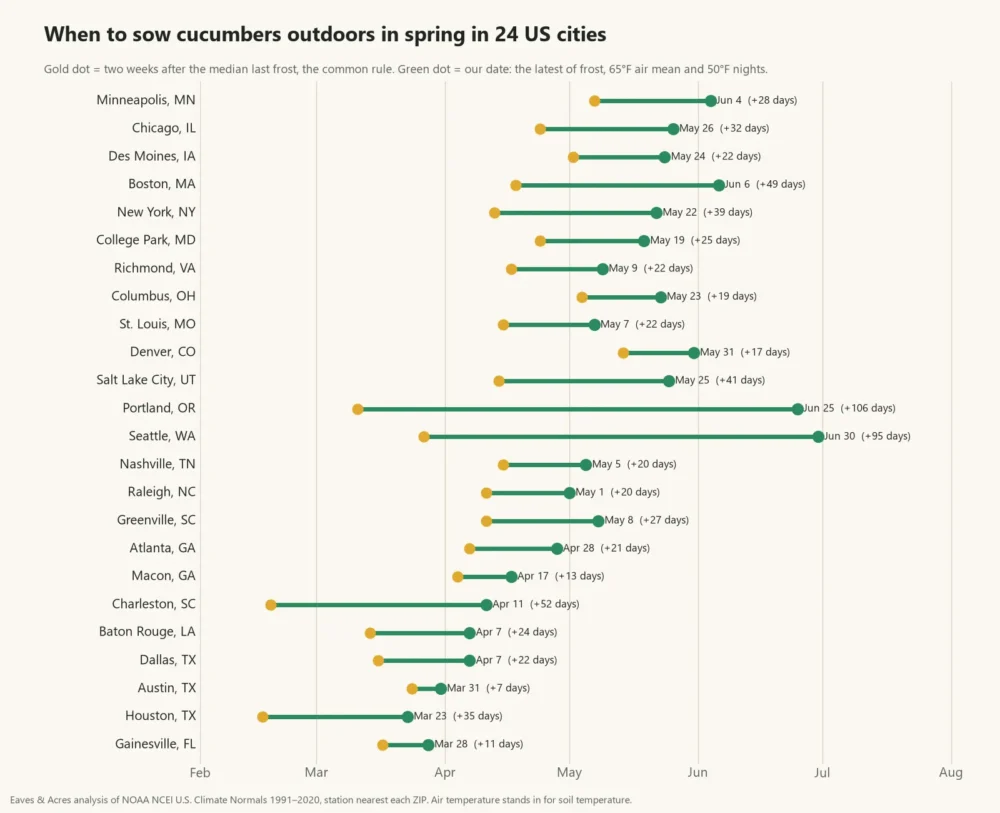
Warmth, not frost. Across the 36,271 ZIP codes whose normals reach both lines, the 65°F mean sets the date in 94.2%, the 50°F night in 4.9% and the frost date in only 0.9%. Our date falls a median 37 days after the median last frost (middle half 33 to 42), so the two-weeks-after rule is earlier than ours in all but 7 of those ZIP codes, by a week or more in 99.4%. Cities show the same pattern: Chicago’s date is 32 days later than the two-week rule, Boston’s 49 and Salt Lake City’s 41.
The result does not hinge on the 65°F line. At Iowa State’s lower 60°F end, the two-week rule is still earlier than the warmth rules in 99.9% of ZIP codes, and by a week or more in 83.0%. At 70°F, the line Clemson and the Almanac use, our date moves a median 19 days later and 15.4% of ZIP codes never reach it. Air is not soil: soil can lag a cold spring, so measure it. Utah State says seed germinates in 5 to 10 days at 65 to 85°F.4

Temperature rules compared across nine sources
Oregon State’s germination table shows why the line sits near 65°F: cucumber seed shows little or no germination at 50°F, takes 13 days to appear at 59°F, 6 days at 68°F and 3 at 86°F.6 Table 2 sets the published limits side by side and the chart puts them on one scale.
| Source | When to sow or plant | Growth range | Cold and heat limits |
|---|---|---|---|
| Iowa State Extension | After the danger of frost is past and soil is 60 to 70°F; seed indoors 2 to 3 weeks ahead | — | — |
| Clemson Extension | After frost fears pass and soil reaches 70°F | Grows best at 75 to 85°F | Light frosts can kill; no germination in soil below 50°F |
| Utah State Extension | Soil at 65°F or after frost danger; plastic mulch and covers allow 2 to 3 weeks before the last frost | Seed germinates in 5 to 10 days at 65 to 85°F | Hot temperatures reduce fruit set; organic mulch only above 75°F soil |
| Oregon State Extension | Soil at least 65°F after frost danger; germination minimum 60°F (table) | Early varieties need about 50 days at 75 to 85°F | Stress below 60°F or above 90°F can cause bitterness; little or no germination at 50°F |
| Virginia Tech Extension | After frost danger has passed and soil has warmed | Hot, 65 to 80°F | — |
| University of Maryland Extension | After frost danger has passed and soil has warmed | — | Frost injures top growth; needs warm weather |
| UF/IFAS | After frost danger (spring); August and September in north Florida | Grows best at 80 to 85°F | Very sensitive to temperatures below 31°F |
| Old Farmer’s Almanac | At least 2 weeks after the last frost or soil near 70°F; transplant when nights stay above 50°F | — | — |
| Bonnie Plants | At least 2 weeks after the last frost; average daily temperatures in the mid-70s°F | — | Very sensitive to frost |
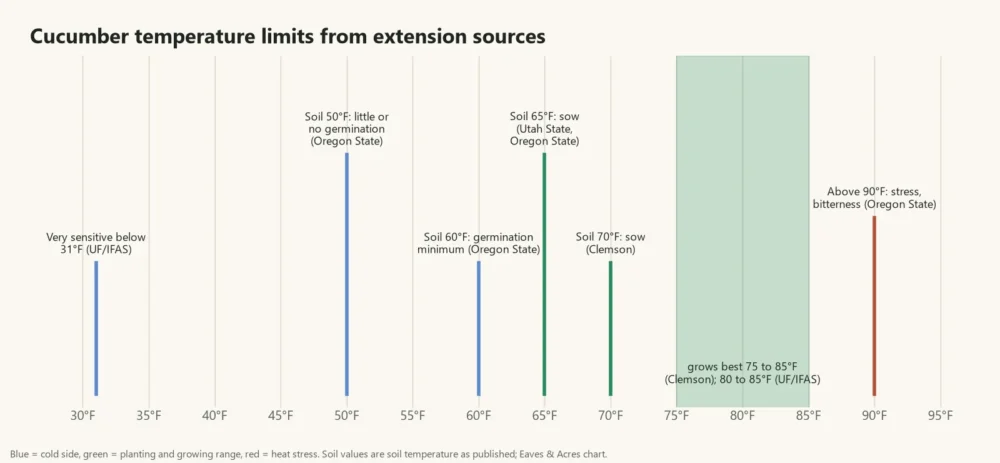
Early cucumbers are ready in about 50 days at 75 to 85°F, Oregon State says, and late varieties in up to 70.5 Utah State adds that hot temperatures reduce fruit set.4 Heat is rarely the planting problem. A normal July high of 90°F or more occurs in 27.0% of ZIP codes and 95°F or more in 5.5%.
Direct sow or transplant
Sources start seed indoors two to six weeks ahead: Iowa State, Clemson and Oregon State say two to three weeks,2,3,5 Maryland three,8 Virginia Tech three to four in peat pots7 and Utah State four to six.4 Transplants buy a little time:
Transplants mature about 2 weeks before seeded cucumbers.
Iowa State sets plants out at one or two true leaves, after hardening them outdoors for a few days.2 UF/IFAS does not recommend transplanting cucumbers at all.9 Indoor start dates are on our seed-starting guide; set plants out on the dates in Table 1, not earlier.
Covers and a second sowing
Warm-up tricks move the date only so far. Utah State says plastic mulch and row covers allow setting seed or plants out 2 to 3 weeks before the last frost, and advises checking the temperature under a cover with a thermometer, venting when air temperatures pass 80°F and removing covers when plants flower or the air under them passes 90°F.4 The dates in Table 1 assume no cover.
A second sowing is worth planning. Virginia Tech says a crop planted around July 1 has fewer disease problems than an early planting kept going until frost,7 and Iowa State says plantings made after mid-June are less likely to be damaged by cucumber beetles, because fewer adult beetles are around.2 A July 1 sowing fits inside our 83-day count-back in all but 2.4% of ZIP codes.
Fall cucumbers: the last sowing date
A fall crop starts when summer crops finish and ends with frost, which kills the vines. Our last sowing date is 83 days before the median first 32°F frost: 55 to 65 days to maturity, plus 14 for slower fall growth and 14 for a frost-tender crop, the same count-back as the cucumber row of our fall vegetable planting guide. Cornell Cooperative Extension in Warren County, New York, lands close by, listing cucumbers 12 and 11 weeks before a first killing frost.12 Google’s AI Overview for “when to plant cucumbers for fall harvest” counts back 50 to 70 days when we checked on October 14, 2026; that leaves first fruit only about 15 days before the median frost, and half of years are colder than the median.
| City (ZIP) | Median first frost (32°F) | Last sowing date | Mean air temp that day | Mean air temp 55 days later |
|---|---|---|---|---|
| Minneapolis, MN (55401) | Oct 16 | Jul 25 | 73°F | 61°F |
| Chicago, IL (60601) | Nov 5 | Aug 14 | 75°F | 58°F |
| Des Moines, IA (50309) | Oct 20 | Jul 29 | 75°F | 63°F |
| Boston, MA (02108) | Nov 9 | Aug 18 | 72°F | 56°F |
| New York, NY (10001) | Nov 20 | Aug 29 | 73°F | 55°F |
| Glens Falls, NY (12801) | Sep 29 | Jul 8 | 69°F | 64°F |
| Dover, DE (19901) | Nov 4 | Aug 13 | 76°F | 62°F |
| College Park, MD (20742) | Nov 1 | Aug 10 | 76°F | 62°F |
| Columbus, OH (43215) | Oct 24 | Aug 2 | 74°F | 62°F |
| Denver, CO (80202) | Oct 12 | Jul 21 | 76°F | 66°F |
| Salt Lake City, UT (84101) | Nov 8 | Aug 17 | 78°F | 58°F |
| Nashville, TN (37201) | Oct 31 | Aug 9 | 78°F | 65°F |
| Raleigh, NC (27601) | Nov 8 | Aug 17 | 78°F | 63°F |
| Greenville, SC (29601) | Nov 7 | Aug 16 | 76°F | 62°F |
| Atlanta, GA (30303) | Nov 8 | Aug 17 | 79°F | 64°F |
| Macon, GA (31201) | Nov 10 | Aug 19 | 81°F | 67°F |
| Charleston, SC (29401) | Dec 30 | Oct 8 | 71°F | 56°F |
| Dallas, TX (75201) | Nov 29 | Sep 7 | 82°F | 63°F |
| Houston, TX (77002) | Dec 25 | Oct 3 | 76°F | 60°F |
| Gainesville, FL (32601) | Dec 2 | Sep 10 | 79°F | 66°F |
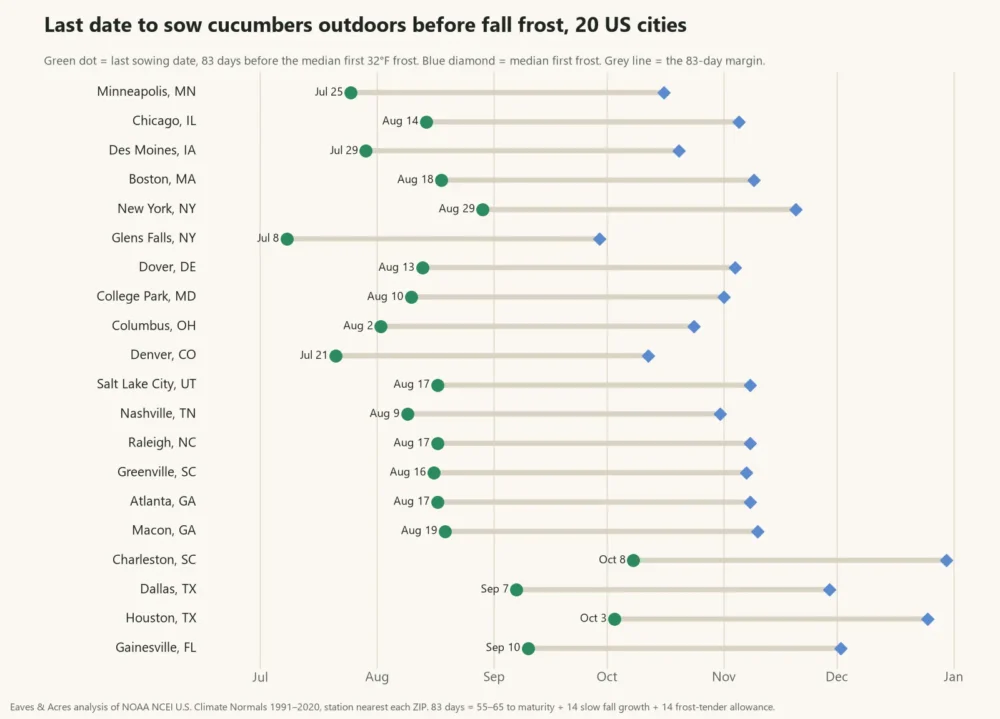
Dates in the table are the last day to sow, not the best day. Across all ZIP codes the median last sowing date is August 2; it has passed by August 1 in 45.2%, by August 15 in 73.5% and by September 1 in 91.6%. The median window from our spring date to the last sowing date is 70 days, under 30 days in 12.3% and over 100 in 25.4%.

Why the margin: Rutgers Cooperative Extension names daylength, heat units and frost as the three main fall factors, and says lower temperatures and shortening days make a few days of planting date matter:11
make a big difference in days to maturity in the fall
The cooling is visible in the normals. On the last sowing date the median normal daily mean is 74.2°F, but 55 days later, when the first fruit is due, it is 63.0°F, below 65°F in 80.2% of ZIP codes and below 60°F in 14.5%. A sowing on July 10, Iowa State’s last practical date and the start of Delaware’s window, fits inside the count-back in 92.7% of ZIP codes, and August 7, the end of Delaware’s window, in 40.8%.
How published local calendars compare
Six places have published dates we could convert, nine in all. Our spring dates sit inside the University of Georgia’s and UF/IFAS’s months and nine days after Iowa State’s mid-May. The fall dates are less uniform, as a single count-back should be: Iowa State’s July 10 is 19 days earlier than ours, Cornell’s July 17 to 24 is later than our July 8, the University of Georgia’s August 31 is 12 days later than ours,10 and Delaware’s window ends 6 days before our date. Maryland’s “second crop around July 1” is a recommended date, not a deadline.8
| Place | Published guidance | Dates it gives | Our date | Comparison |
|---|---|---|---|---|
| Des Moines, IA (spring) | Iowa State Extension: central Iowa | Mid-May | May 24 | Ours is 9 days later |
| Macon, GA (spring) | University of Georgia Extension: middle Georgia calendar | April | Apr 17 | Ours is inside the month |
| Gainesville, FL (spring) | UF/IFAS: north Florida | February to April | Mar 28 | Ours is inside the range |
| Des Moines, IA (fall) | Iowa State Extension: last practical sowing date | July 10 | Jul 29 | Ours is 19 days later |
| College Park, MD (fall) | University of Maryland Extension: second crop | Around July 1 (a recommended date, not a deadline) | Aug 10 | Not comparable as a deadline |
| Dover, DE (fall) | Delaware planting windows on the Rutgers site | July 10 to August 7 | Aug 13 | Ours is 6 days after the window ends |
| Glens Falls, NY (fall) | Cornell Cooperative Extension, Warren County: 12 and 11 weeks before a 28°F frost around Oct 9 | July 17 to July 24 | Jul 8 | Ours is 9 days before the start |
| Macon, GA (fall) | University of Georgia Extension: middle Georgia | No later than August 31 | Aug 19 | Ours is 12 days earlier |
| Gainesville, FL (fall) | UF/IFAS: north Florida | August and September | Sep 10 | Ours is inside the range |
Hot summers, mild winters and frost-free ZIP codes
In the Gulf and Texas cities a normal July high of 90°F or more runs from June through September (Dallas, Austin) or June to August (Houston, Gainesville). Our spring dates there are in March and April, and the fall dates run to September and October. UF/IFAS gives north Florida February to April and again August and September, and central Florida January to March and September.9 Frost-free ZIP codes have no frost count, so use the months: the normal mean stays at or above 65°F from March through November in Phoenix (ZIP 85001) and in all twelve months in Miami (33101), but in none in San Francisco (94103). Our table has no frost dates for 104 of Hawaii’s 135 ZIP codes, so we give no Hawaii dates; ask your county extension office.
How we calculated these dates
Daily temperatures are NOAA’s monthly normals placed on the 15th of each month and interpolated linearly, for the station nearest each ZIP code.1 Frost dates are the median and 10% 32°F dates. The 65°F and 50°F lines are the published rules above, applied to air temperature, not soil. Individual years vary by weeks, and a warm or cold spring will move every date.
Next steps
Look up your own dates with our frost date lookup and read what a last frost date means. Cucumbers wait for the same warm nights as tomatoes, and green beans use a lower 60°F soil line. Cover young vines when a late frost is forecast using our frost-cover guide, and see more crops in our vegetable guides.
Frequently asked questions
After the danger of frost has passed and the soil is at least 65°F. Our dates are the latest of the 10% last-frost date, a 65°F air mean and 50°F nights: May 26 in Chicago, May 5 in Nashville and April 7 in Dallas.
Only with protection. Utah State says plastic mulch and row covers let you set out seed or plants 2 to 3 weeks before the last frost date, and Clemson says cucumbers are very tender and can be killed by light frosts.
Usually not in the northern and central US: a July 10 sowing fits inside our 83-day count-back in 92.7% of ZIP codes, and Iowa State calls July 10 the last practical date in central Iowa. By August 1 the last date has already passed in 45.2% of ZIP codes.
Only where frost comes late. Our last sowing dates are September 7 in Dallas, September 10 in Gainesville, October 3 in Houston and October 8 in Charleston, and UF/IFAS lists September for central Florida. In Chicago the last date is August 14.
Utah State and Oregon State say 65°F, Iowa State 60 to 70°F and Clemson 70°F. Oregon State’s germination table shows little or no germination at 50°F and 13 days to appear at 59°F.
A zone cannot decide it: the USDA map is based on the average annual extreme minimum winter temperature, not spring warmth. Use your ZIP code’s dates instead; Table 1 gives May 5 for Nashville and May 1 for Raleigh.
Clemson and Virginia Tech say 50 to 70 days, Maryland 50 to 65 from seed and UF/IFAS 40 to 65. Oregon State says early varieties can be ready in about 50 days at 75 to 85°F.
Sources
- 1.U.S. Climate Normals 1991–2020. NOAA National Centers for Environmental Information, 2021. Used for: median and 10% last- and first-frost dates and monthly temperature normals for every ZIP code Back to text
- 2.Growing Cucumbers in the Home Garden, Richard Jauron and Aaron Steil. Iowa State University Extension and Outreach, 2026. Used for: plant after frost danger is past and soil is 60 to 70°F; central Iowa mid-May; last practical sowing date July 10; seed indoors 2 to 3 weeks before planting out Back to text
- 3.Cucumber. Clemson Cooperative Extension Home & Garden Information Center, 2025. Used for: grows best at 75 to 85°F; very tender, killed by light frost; plant after frost and soil at 70°F; no germination below 50°F soil; 50 to 70 days to harvest Back to text
- 4.How to Grow Cucumber in Your Garden. Utah State University Extension, n.d. Used for: sow at soil 65°F; germination 5 to 10 days at 65 to 85°F; transplants mature about 2 weeks before seed; plastic mulch and covers allow 2 to 3 weeks before last frost; hot temperatures reduce fruit set; transplants 4 to 6 weeks Back to text
- 5.Grow Your Own Cucumbers. Oregon State University Extension Service, n.d. Used for: soil at least 65°F; seed indoors 2 to 3 weeks before transplanting; 50 days at 75 to 85°F for early varieties, up to 70 for late; stress below 60°F or above 90°F can cause bitterness Back to text
- 6.Soil Temperature Conditions for Vegetable Seed Germination, J. F. Harrington. Oregon State University Extension Service, 2024. Used for: cucumber germination minimum 60°F, optimum range 60 to 95°F; little or no germination at 50°F; 13 days to appear at 59°F, 6 at 68°F, 3 at 86°F Back to text
- 7.Cucumbers, Melons and Squash (426-406). Virginia Cooperative Extension, Virginia Tech, n.d. Used for: hot, 65 to 80°F; sow after frost danger and soil warm; indoors 3 to 4 weeks in peat pots; 50 to 70 days to maturity Back to text
- 8.Growing Cucumbers in a Home Garden. University of Maryland Extension, n.d. Used for: frost injures top growth; sow after frost danger and soil warm; plants 3 weeks indoors; second crop around July 1; 50 to 65 days from seed Back to text
- 9.Cucumbers. UF/IFAS Gardening Solutions, n.d. Used for: Florida dates for spring and fall; grows best at 80 to 85°F; very sensitive below 31°F; 40 to 65 days to harvest; transplanting not recommended Back to text
- 10.Vegetable Garden Calendar (Circular 943). University of Georgia Cooperative Extension, n.d. Used for: middle Georgia: warm-season crops including cucumbers in April; cucumbers no later than August 31 Back to text
- 11.Summer Vegetable Plantings For Fall Harvest. Rutgers Cooperative Extension, Cumberland County, 2026. Used for: daylength, heat units and frost as fall factors; Delaware windows for fall warm-season crops, cucumbers direct seeded July 10 to August 7 Back to text
- 12.Fall Planting for the Vegetable Garden. Cornell Cooperative Extension of Warren County, n.d. Used for: count back from the first killing frost (28°F around October 9); cucumbers 12 and 11 weeks before frost Back to text
- 13.How to Plant and Grow Cucumbers. The Old Farmer’s Almanac, 2026. Used for: sow no earlier than 2 weeks after the last frost or at soil near 70°F; transplant when nights stay above 50°F; 50 to 70 days Back to text
- 14.Growing Cucumbers. Bonnie Plants, n.d. Used for: at least two weeks after the last frost; average daily temperatures in the mid-70s°F; very sensitive to frost Back to text
- 15.USDA Plant Hardiness Zone Map. USDA Agricultural Research Service, 2023. Used for: zones are based on average annual extreme minimum winter temperature
- 16.Photo: Cucumber Seedlings (32108679), Breanna Larow (CC BY 3.0). Wikimedia Commons, 2013. Used for: hero photo
- 17.Photo: Cucumber Seedling, Peter Chastain (public domain). Wikimedia Commons, 2009. Used for: seedling photo
- 18.Photo: Green cucumber growing from a vine on a wooden trellis, National Park Service (public domain). Wikimedia Commons, 2023. Used for: trellis photo
How this guide was made
- Written by the Yard & Garden Desk and reviewed by the Data & Methodology Desk.
- Data: median and 10% last-frost dates, median first-frost dates and monthly temperature normals from NOAA NCEI U.S. Climate Normals 1991–2020 for the station nearest each ZIP code, with daily values interpolated from the monthly normals; planting rules and published calendars from Iowa State, Clemson, Utah State, Oregon State, Virginia Tech, Maryland, UF/IFAS, Georgia, Rutgers and Cornell extension, the Old Farmer’s Almanac and Bonnie Plants. Air temperature stands in for soil temperature. See our methodology.
- AI use: AI tools help us research, draft and check this guide. Every figure is checked against the source cited for it, and calculated figures come from our own code, described on the methodology page.
- Spotted an error? Tell us — the form opens with this page’s address filled in.
Change log
- Oct 27, 2026Corrected a date-handling error in the fall figures: first-frost dates that NOAA lists in January to June (mostly Gulf Coast and Florida ZIP codes; they belong to the following winter) were placed in the same calendar year, which overstated how many last-sowing dates had already passed. Each figure moved by 0.1 point: passed by July 1 (all but) 2.4% (was 2.5%), by August 1 45.2% (45.3%), by August 15 73.5% (73.6%), by September 1 91.6% (91.7%); window under 30 days 12.3% (12.4%), over 100 days 25.4% (25.3%); a July 10 sowing fits in 92.7% (92.6%) and an August 7 sowing in 40.8% (40.7%). The spring statistics are unchanged.
- Oct 14, 2026Published. Spring sowing dates for 24 cities and fall last-sowing dates for 20 cities from NOAA 1991–2020 normals, nine published local dates compared, and the rules tested across 37,563 lower-48 ZIP codes.
Covers lawns, gardens, frost and planting. We write the guides and maintain the tools that tell you when to seed, feed and plant for your ZIP.
Keep reading
When to Plant Pumpkins: Count Back From Halloween, Not Forward From Frost
Sow pumpkins once the soil reaches about 65°F, a median 37 days after the last frost, then count back 90 to 120 days from Halloween or the first frost. Dates for 24 cities.
When to Plant Corn: Match the Date to the Type, Not Just the Frost
Sow standard sweet corn once the soil reaches about 55°F, sugar-enhanced at 60°F and supersweet at 65°F: a median April 25, May 9 and May 25. Dates for 28 spring and 21 fall cities.
When to Harvest Pumpkins: Ripeness Signs and the Freeze Deadline
Pick pumpkins when the rind resists a fingernail and the stem is dry, before a 28°F hard freeze. Median frost and freeze dates for 23 cities, plus curing and storage.
Seasonal reminders for your ZIP
Get a short email when it’s time to overseed, start seeds, open the pool or service your furnace — timed to your climate.