When to Plant Pumpkins: Count Back From Halloween, Not Forward From Frost
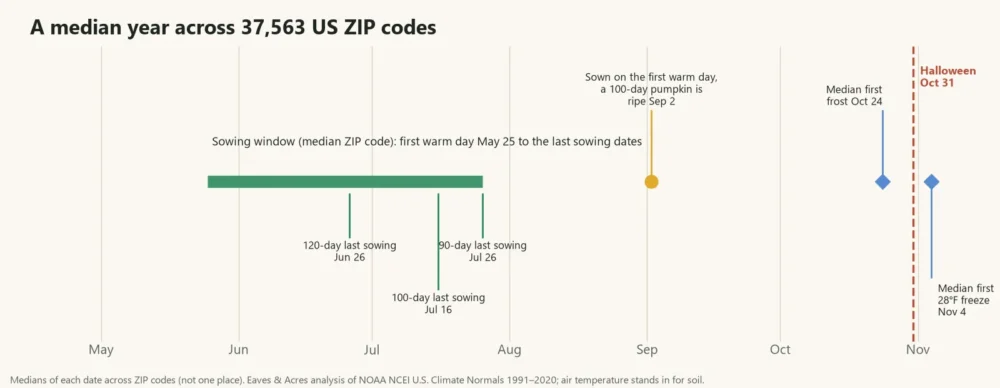
Pumpkins need warm soil to start and a count back from Halloween or the first frost to finish. We tested the common planting rules against NOAA normals for 37,563 ZIP codes and set 14 published local dates beside them.
- Last reviewed Oct 26, 2026
- 26 cited sources
- 14 min read

Set your ZIP to see dates for your area.
- 1Sow once frost has passed and the soil is about 65°F (Penn State, Utah State and Arkansas; Cornell says 65°F minimum, 70°F preferred). In 94.2% of ZIP codes the 65°F air mean sets the date, a median May 25, which is 37 days after the median last frost.
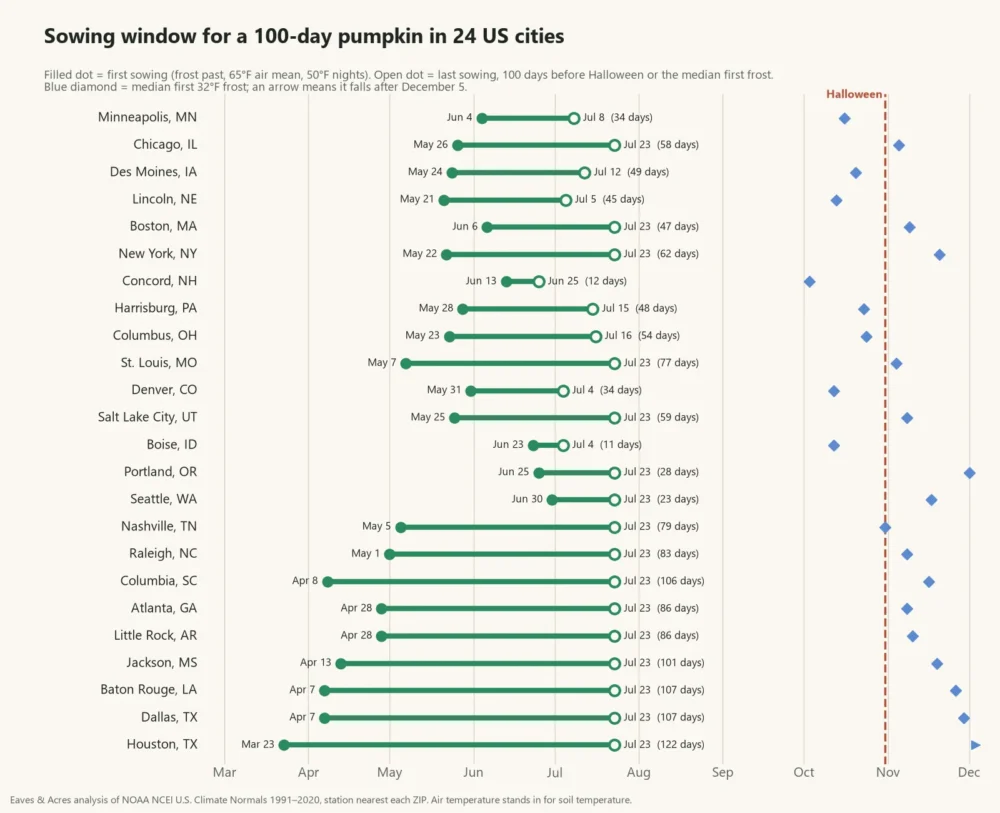
- 2For Halloween, count back 90 to 120 days from October 31: July 3 for a 120-day pumpkin, July 23 for a 100-day and August 2 for a 90-day. Where the median first frost comes first, as in 62.7% of ZIP codes, count back from it: July 8 in Minneapolis for a 100-day pumpkin.
- 3The Fourth of July rule is a southern rule. A pumpkin sown July 4 ripens after the median first frost in 64.5% of ZIP codes if it takes 120 days, 22.5% if it takes 100 and 9.2% if it takes 90.
- 4Earlier is not safer. Sown on the first warm day, a 100-day pumpkin is ripe 30 or more days before Halloween in 91.3% of ZIP codes, and Illinois Extension warns that early-planted pumpkins may soften and rot before Halloween.
Plant pumpkins after the last frost, once the soil is at least 65°F, and count back from Halloween: sow about 90 to 120 days before October 31, which is July 3 to August 2, unless your median first frost comes sooner. In Chicago a 100-day pumpkin can go in from May 26 to July 23; in Minneapolis only from June 4 to July 8.
Extension sources agree on the warmth rule and on 90 to 120 days to maturity, then give windows that run from late May to early July without saying where each one applies. We turned each rule into dates using NOAA 1991–2020 normals1 for 37,563 lower-48 ZIP codes, built tables for 24 cities and set 14 published local dates beside them. Everything uses air temperature as a stand-in for soil temperature, because our NOAA data has no soil readings. Ripeness signs, the hard-freeze line and curing are in our guide to when to harvest pumpkins.
When the ground is warm enough to sow
Pumpkins are tender. Penn State’s commercial guide says plants and fruit show injury from even a slight frost and that growth slows below 50°F,3 and the extension sources set the soil line in three places. Penn State’s garden guide says soil should be at least 65°F for germination,2 as do Utah State and the University of Arkansas.4,5 Clemson, the University of New Hampshire and Penn State’s commercial guide use 60°F,8,9,3 and Nebraska and Mississippi State say 70°F.7,15 Oregon State’s germination table lists a 60°F minimum and a 70 to 90°F optimum range.10 Cornell’s growing guide gives 65°F as the minimum and 70°F as the preference, then adds a calendar shortcut:6
or about 2 weeks after the last frost date
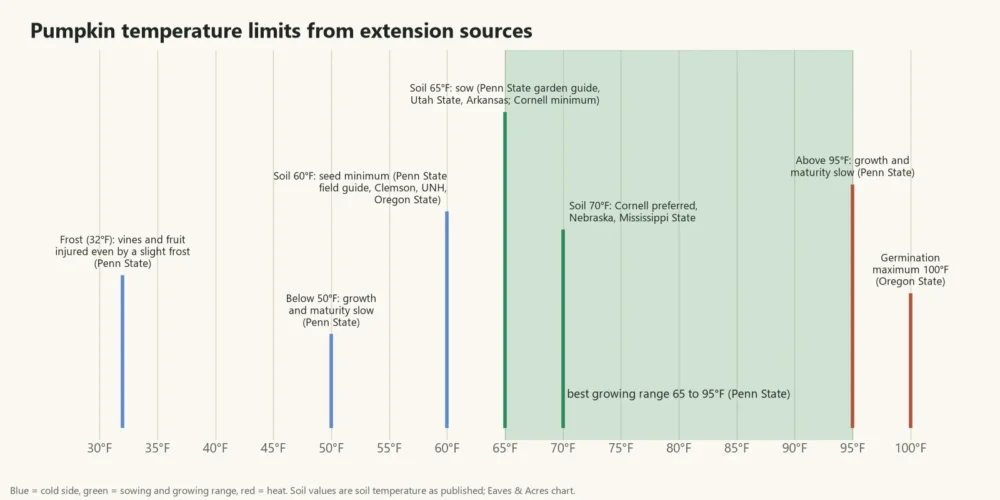
We tested the shortcut. Each date in Table 1 is the latest of three: our 10% last-frost date, the day the normal daily mean air temperature reaches 65°F, and the day the normal daily low reaches 50°F. Measure the real thing before you sow: Penn State takes soil temperature three inches down and Clemson four.3,8
| City (ZIP) | Median last frost | 10% last frost | Two weeks after median last frost | Our first sowing date | What sets our date |
|---|---|---|---|---|---|
| Minneapolis, MN (55401) | Apr 23 | May 7 | May 7 | Jun 4 | 65°F air mean |
| Chicago, IL (60601) | Apr 10 | Apr 25 | Apr 24 | May 26 | 65°F air mean |
| Des Moines, IA (50309) | Apr 18 | May 2 | May 2 | May 24 | 65°F air mean |
| Lincoln, NE (68508) | Apr 24 | May 7 | May 8 | May 21 | 65°F air mean |
| Boston, MA (02108) | Apr 4 | Apr 17 | Apr 18 | Jun 6 | 65°F air mean |
| New York, NY (10001) | Mar 30 | Apr 9 | Apr 13 | May 22 | 65°F air mean |
| Concord, NH (03301) | May 8 | May 22 | May 22 | Jun 13 | 65°F air mean |
| Harrisburg, PA (17101) | Apr 15 | May 2 | Apr 29 | May 28 | 65°F air mean |
| Columbus, OH (43215) | Apr 20 | May 7 | May 4 | May 23 | 65°F air mean |
| St. Louis, MO (63101) | Apr 1 | Apr 18 | Apr 15 | May 7 | 65°F air mean |
| Denver, CO (80202) | Apr 30 | May 13 | May 14 | May 31 | 65°F air mean |
| Salt Lake City, UT (84101) | Mar 31 | Apr 19 | Apr 14 | May 25 | 65°F air mean |
| Boise, ID (83702) | May 17 | Jun 10 | May 31 | Jun 23 | 65°F air mean |
| Portland, OR (97201) | Feb 25 | Mar 21 | Mar 11 | Jun 25 | 65°F air mean |
| Seattle, WA (98101) | Mar 13 | Apr 1 | Mar 27 | Jun 30 | 65°F air mean |
| Nashville, TN (37201) | Apr 1 | Apr 16 | Apr 15 | May 5 | 65°F air mean |
| Raleigh, NC (27601) | Mar 28 | Apr 12 | Apr 11 | May 1 | 65°F air mean |
| Columbia, SC (29201) | Mar 16 | Apr 3 | Mar 30 | Apr 8 | 65°F air mean |
| Atlanta, GA (30303) | Mar 24 | Apr 10 | Apr 7 | Apr 28 | 65°F air mean |
| Little Rock, AR (72201) | Mar 21 | Apr 6 | Apr 4 | Apr 28 | 65°F air mean |
| Jackson, MS (39201) | Mar 6 | Mar 24 | Mar 20 | Apr 13 | 65°F air mean |
| Baton Rouge, LA (70802) | Feb 28 | Mar 21 | Mar 14 | Apr 7 | 65°F air mean |
| Dallas, TX (75201) | Mar 2 | Mar 19 | Mar 16 | Apr 7 | 65°F air mean |
| Houston, TX (77002) | Feb 2 | Mar 5 | Feb 16 | Mar 23 | 65°F air mean |
Warmth, not frost, sets the date
Across the 36,271 ZIP codes whose normals reach both lines, the 65°F air mean sets the date in 94.2%, the 50°F night in 4.9% and the frost date in only 0.9%. Our date falls a median 37 days after the median last frost (middle half 33 to 42), so Cornell’s two-weeks-after shortcut points to an earlier date than the warmth lines in all but 7 of those ZIP codes, by a week or more in 99.4%. In Chicago the gap is 32 days, in Boston 49 and in Salt Lake City 41.
The result does not hinge on the 65°F line. At the 60°F line the shortcut is still earlier in 99.9%, and by a week or more in 83.0%. At 70°F our date moves a median 19 days later, and 15.4% of ZIP codes never reach it. The median first-sowing date is May 25, on or before it in 51.6% of ZIP codes and after June 15 in 13.3%. The rule is the same as in our cucumber guide; pumpkins differ in what comes next, because the finish line is Halloween.
Count back from Halloween: the last sowing date
Most gardeners want a pumpkin for October 31, and the sources count back from it. The University of Arkansas says pumpkins need 90 to 120 days, about 100 for a medium carving type such as Spirit and 120 for a large one such as Big Moon, and gives a rule of thumb:5
plant your pumpkins and then invite your guests back for Halloween to harvest
The other calendars cluster around the same weeks: Clemson says to plant most varieties by early July,8 UF/IFAS by early July,16 Mississippi State early to mid-July15 and LSU mid to late July, with the third week better and the end of July the limit.14 Illinois Extension runs from late May in the north to early July in the far south.11 Counting back from October 31, a 120-day pumpkin goes in by July 3, a 100-day by July 23 and a 90-day by August 2.
Frost moves that earlier. Arkansas warns that planting too late risks frost damage,5 and in 62.7% of lower-48 ZIP codes the median first frost comes before Halloween, the same figure as in our harvest guide. Table 2 therefore counts back from the earlier of Halloween and the median first 32°F frost. Across all ZIP codes the median last sowing date is June 26 for a 120-day pumpkin, July 16 for a 100-day and July 26 for a 90-day.
| City (ZIP) | Median first frost (32°F) | Last sowing, 90-day | Last sowing, 100-day | Last sowing, 120-day | First to last sowing, 100-day |
|---|---|---|---|---|---|
| Minneapolis, MN (55401) | Oct 16 | Jul 18 | Jul 8 | Jun 18 | 34 days |
| Chicago, IL (60601) | Nov 5 | Aug 2 | Jul 23 | Jul 3 | 58 days |
| Des Moines, IA (50309) | Oct 20 | Jul 22 | Jul 12 | Jun 22 | 49 days |
| Lincoln, NE (68508) | Oct 13 | Jul 15 | Jul 5 | Jun 15 | 45 days |
| Boston, MA (02108) | Nov 9 | Aug 2 | Jul 23 | Jul 3 | 47 days |
| New York, NY (10001) | Nov 20 | Aug 2 | Jul 23 | Jul 3 | 62 days |
| Concord, NH (03301) | Oct 3 | Jul 5 | Jun 25 | Jun 5 | 12 days |
| Harrisburg, PA (17101) | Oct 23 | Jul 25 | Jul 15 | Jun 25 | 48 days |
| Columbus, OH (43215) | Oct 24 | Jul 26 | Jul 16 | Jun 26 | 54 days |
| St. Louis, MO (63101) | Nov 4 | Aug 2 | Jul 23 | Jul 3 | 77 days |
| Denver, CO (80202) | Oct 12 | Jul 14 | Jul 4 | Jun 14 | 34 days |
| Salt Lake City, UT (84101) | Nov 8 | Aug 2 | Jul 23 | Jul 3 | 59 days |
| Boise, ID (83702) | Oct 12 | Jul 14 | Jul 4 | Jun 14 | 11 days |
| Portland, OR (97201) | Dec 1 | Aug 2 | Jul 23 | Jul 3 | 28 days |
| Seattle, WA (98101) | Nov 17 | Aug 2 | Jul 23 | Jul 3 | 23 days |
| Nashville, TN (37201) | Oct 31 | Aug 2 | Jul 23 | Jul 3 | 79 days |
| Raleigh, NC (27601) | Nov 8 | Aug 2 | Jul 23 | Jul 3 | 83 days |
| Columbia, SC (29201) | Nov 16 | Aug 2 | Jul 23 | Jul 3 | 106 days |
| Atlanta, GA (30303) | Nov 8 | Aug 2 | Jul 23 | Jul 3 | 86 days |
| Little Rock, AR (72201) | Nov 10 | Aug 2 | Jul 23 | Jul 3 | 86 days |
| Jackson, MS (39201) | Nov 19 | Aug 2 | Jul 23 | Jul 3 | 101 days |
| Baton Rouge, LA (70802) | Nov 26 | Aug 2 | Jul 23 | Jul 3 | 107 days |
| Dallas, TX (75201) | Nov 29 | Aug 2 | Jul 23 | Jul 3 | 107 days |
| Houston, TX (77002) | Dec 25 | Aug 2 | Jul 23 | Jul 3 | 122 days |
The Fourth of July rule, tested
Arkansas’s rhyme is a southern rule. Where frost comes before Halloween, the count-back date moves into June: for a 120-day pumpkin, June 18 in Minneapolis and June 14 in Denver and Boise, against July 3 in Chicago and Dallas. Nationally, a pumpkin sown July 4 ripens after the median first frost in 64.5% of ZIP codes if it takes 120 days, in 22.5% if it takes 100 and in 9.2% if it takes 90. Sown August 1, even a 90-day pumpkin ripens after the median frost in 60.9%. Chicago, New York and the Gulf Coast are exceptions where Halloween, not frost, sets the date.
Planting too early: pumpkins that ripen in August
A May sowing is not safer. Illinois Extension says so directly:11
If pumpkins are planted too early, they may soften and rot before Halloween.
Epic Gardening tells readers to start no later than the beginning of June and ideally by May for Halloween.21 On our numbers that is early for most places. A 100-day pumpkin sown on the first warm day ripens a median September 2, and 30 or more days before Halloween in 91.3% of ZIP codes and 60 or more in 49.8%. In Raleigh it is ripe August 9, in Chicago September 3 and in Dallas July 16. The Old Farmer’s Almanac sets the late limit instead: seeds in by late May in northern climates, or as late as early July in the deep South, should leave most varieties time to mature before frost.20
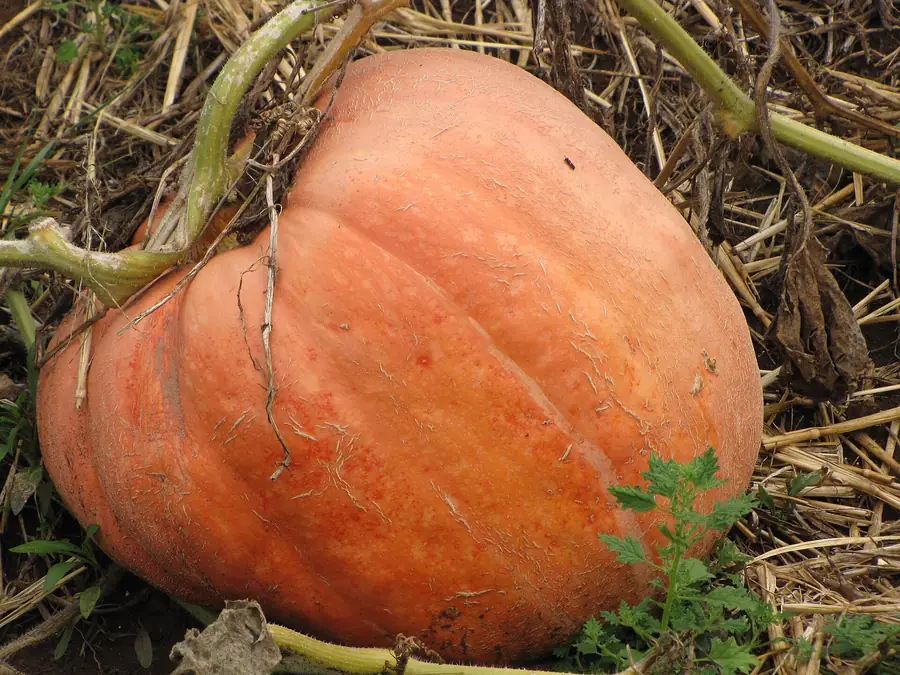

The sweet spot is a sowing date that ripens the fruit in the last weeks before Halloween, not on the earliest warm day. Our harvest guide covers curing and storing a pumpkin that is ready early.

Short seasons in the North and mountain West
In cold places the window is short. A pumpkin sown on the first warm day ripens after the median first frost in 3.2% of ZIP codes if it takes 90 days, 6.6% if it takes 100 and 16.6% if it takes 120, and a further 11.8% of 120-day sowings leave less than two weeks to spare. Concord, New Hampshire, opens June 13 and has a median first frost on October 3, so a 100-day pumpkin has 12 days to go in and a 120-day pumpkin cannot fit in the median year. Boise has 11 days, and Minneapolis and Denver 34.
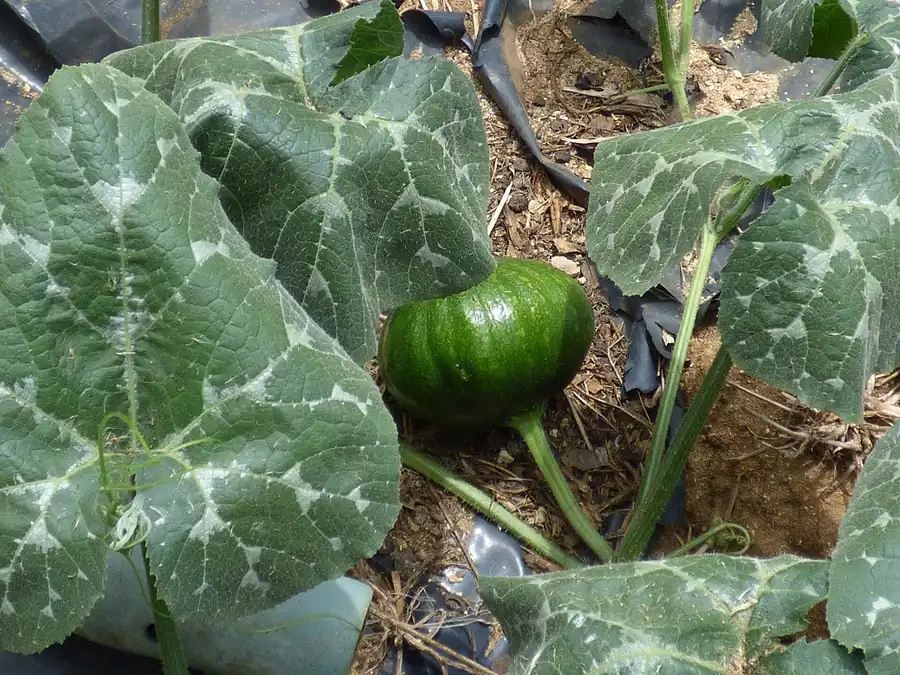

The sources offer four ways to buy time. Choose a shorter variety: Arkansas lists 90-day types for pies and decorating.5 Start seeds indoors: Cornell and Iowa State say to start them 3 to 4 weeks before planting out,6,12 though Arkansas does not recommend transplanting because of the taproot5 and UNH says pumpkins dislike root disturbance.9 Use plastic: Penn State says plastic mulch warms soil 8 to 12 degrees over bare soil,3 and Utah State says plastic and row covers allow seeds or plants to go out two weeks before the last frost.4 Our dates assume no cover. On the Pacific coast the limit is warmth, not frost: Portland opens June 25 and Seattle June 30, and their first frosts come in December and November.
Hot summers and planting into July
Penn State gives 65 to 95°F as the best growing range and says growth and maturity slow above 95°F.3 Oregon State’s table puts the germination maximum at 100°F.10 In Texas, Texas A&M AgriLife says pumpkins thrive in early summers there and puts the best planting from early May through June.18 In 5.2% of ZIP codes the normal daily high on the 100-day count-back date, July 23, is 95°F or more, and in 24.7% it is 90°F or more; Dallas is at 97.0°F and Columbia, South Carolina, at 95.1°F. These are normals, and individual days run hotter.
Frost-free ZIP codes have no frost count, so use the months: Phoenix (ZIP 85001) has normal highs of 95°F or more from June through September. Florida’s advice conflicts on a single page: UF/IFAS Gardening Solutions says to plant by early July for Halloween, and also that pumpkins do best planted in late March and early April, with later plantings smaller and more affected by virus and fungal disease.16 North Florida’s county office says early July for Halloween.17 Our table has no frost dates for 104 of Hawaii’s 135 ZIP codes, so we give no Hawaii dates.

What extension sources say, side by side
Table 3 lines up the published rules. Soil lines range from 60 to 70°F and calendars from late May in the north to mid-July in the Gulf states, which is why a single rule cannot work everywhere.
| Source | When to sow | Dates it gives | Days to maturity and temperature limits |
|---|---|---|---|
| Penn State Extension (garden guide) | After frost danger; soil at least 65°F for germination | Late May through early June in Pennsylvania | Some varieties need over 100 days |
| Penn State Extension (Pumpkin Production) | Soil 60°F three inches down; injured by even a slight frost | Generally the first couple of weeks of July | Best range 65 to 95°F; growth slows above 95°F or below 50°F |
| Utah State Extension | Soil 65°F or after frost danger | Plastic and row covers allow seed or plants two weeks before the last frost | 45 to 55 days from flowering to maturity |
| University of Arkansas | Soil above 65°F | Mid-June to early July for Halloween; 120-day types from late May | 90 to 120 days |
| Clemson Extension | After frost danger; soil above 60°F at 4 inches | Most varieties by early July for Halloween | 70 to 120 days |
| University of New Hampshire Extension | After frost is gone; top few inches at least 60°F | Late May or early June in New Hampshire | 90 to 120 days |
| Cornell University | Soil at least 65°F, preferably 70°F, or about 2 weeks after the last frost | — | Germination 60 to 105°F, best at 95°F |
| Nebraska Extension (Backyard Farmer) | After the last frost; soil consistently above 70°F | — | 75 to 100 days |
| Mississippi State Extension | After frost danger; soil at least 70°F to germinate | Early to mid-July for Halloween | — |
| Illinois Extension | After all frost danger; soil thoroughly warmed | Late May in the north to early July in the far south, for Halloween | — |
| Oregon State Extension (germination table) | Soil minimum 60°F | — | Optimum range 70 to 90°F; maximum 100°F |
How published local calendars compare
Fourteen published dates from 12 extension offices could be converted; Table 4 sets each beside ours. Our spring dates sit inside the ranges of Illinois, Penn State and Colorado State, nine days after Iowa State’s mid-May, three days after the end of New Hampshire’s range and four days before Texas A&M’s early May. For the Halloween rows we compare against our count-back range of 120 to 90 days. The southern windows begin at or before our 120-day date, and Georgia’s calendar for an early October harvest falls inside our count-back from October 1.13 Iowa State’s mid-June last practical date is a week before our 120-day date in Des Moines.
| Place | Published guidance | Dates it gives | Our date | Comparison |
|---|---|---|---|---|
| Des Moines, IA (first sowing) | Iowa State Extension: central Iowa, sow seed in mid-May | Mid-May | May 24 | Ours is 9 days later |
| Chicago, IL (first sowing) | Illinois Extension: Halloween pumpkins from late May in northern locations | Late May | May 26 | Ours is inside the range |
| Concord, NH (first sowing) | UNH Extension: late May or early June | Late May to early June | Jun 13 | Ours is 3 days after the range |
| Harrisburg, PA (first sowing) | Penn State Extension: direct seeding late May through early June | Late May to early June | May 28 | Ours is inside the range |
| Denver, CO (first sowing) | Colorado State PlantTalk: plant in late May | Late May | May 31 | Ours is on the last day of the range |
| Lubbock, TX (first sowing) | Texas A&M AgriLife: best time is early May through June | Early May to June | Apr 27 | Ours is 4 days before the range |
| Little Rock, AR (last sowing) | Arkansas Extension: mid-June to early July for Halloween (90 to 120 days) | Mid-June to early July | Jul 3 to Aug 2 (120 to 90 days) | Their window ends on our 120-day date |
| Macon, GA (last sowing) | UGA Extension: early October harvest, plant mid- to late June (90 to 120 days) | Mid- to late June | Jun 3 to Jul 3 (120 to 90 days from Oct 1) | Inside our count-back from October 1 |
| Columbia, SC (last sowing) | Clemson Extension: plant most pumpkins by early July for Halloween | By early July | Jul 3 to Aug 2 (120 to 90 days) | Matches our 120-day date |
| Jackson, MS (last sowing) | Mississippi State Extension: early to mid-July for Halloween | Early to mid-July | Jul 3 to Aug 2 (120 to 90 days) | Starts at our 120-day date |
| Baton Rouge, LA (last sowing) | LSU AgCenter: mid- to late July; third week better, end of July at the latest | Mid- to late July | Jul 3 to Aug 2 (120 to 90 days) | Inside our range |
| Panama City, FL (last sowing) | UF/IFAS Bay County: early July for a Halloween harvest | Early July | Jul 3 to Aug 2 (120 to 90 days) | Starts at our 120-day date |
| Harrisburg, PA (last sowing) | Penn State Extension (Pumpkin Production): seeded in the first couple of weeks of July | First two weeks of July | Jun 25 to Jul 25 (120 to 90 days) | Inside our range |
| Des Moines, IA (last sowing) | Iowa State Extension: last practical planting date is mid-June | Mid-June | Jun 22 to Jul 22 (120 to 90 days) | 7 days before our 120-day date |
How we calculated these dates
Daily temperatures are NOAA’s monthly normals placed on the 15th of each month and interpolated linearly, for the station nearest each ZIP code.1 Frost dates are the median and 10% 32°F dates. The 65°F and 50°F lines come from the sources above and are applied to air temperature, not soil. Last sowing is October 31 or the median first frost, whichever is earlier, minus the days to maturity; it assumes no slowdown in cool autumn weather, which the sources do not quantify. Individual years vary by weeks, and the seed packet’s number is a guide, not a promise. The USDA hardiness zone map cannot decide any of this: it is based on the average annual extreme minimum winter temperature.22
Next steps
Look up your own dates with our frost date lookup and read what a last frost date means. Pumpkins share their warm-soil start with cucumbers and tomatoes; green beans use a lower 60°F soil line. To start seeds indoors, count back on our seed-starting guide, and for late sowings use the formula in our fall vegetable planting guide. Cover young vines on a cold night using our frost-cover guide, and see more crops in our vegetable guides.
Frequently asked questions
After the last frost, once the soil is at least 65°F, and early enough to ripen before Halloween or the first frost. That means counting back 90 to 120 days from October 31 (July 3 to August 2), or from your median first frost if it comes sooner: Chicago May 26 to July 23 for a 100-day pumpkin, Minneapolis June 4 to July 8.
Not always in July. A July 4 sowing of a 90-day pumpkin ripens before the median first frost in 90.8% of ZIP codes, a 100-day in 77.5% and a 120-day in 35.5%. By August 1 it is usually too late: a 90-day pumpkin sown that day ripens after the median first frost in 60.9%, though not in the Gulf states, where frost comes after Halloween.
You can, but they may ripen too soon. Illinois Extension says pumpkins planted too early may soften and rot before Halloween, and a 100-day pumpkin sown on the first warm day is ripe 30 or more days before Halloween in 91.3% of ZIP codes.
Penn State, Utah State and Arkansas say 65°F, Clemson, the University of New Hampshire and Penn State’s commercial guide say 60°F, and Cornell says 65°F at minimum and 70°F preferably. Oregon State’s germination table lists a 60°F minimum and a 70 to 90°F optimum range.
A zone cannot decide it: the USDA map is based on the average annual extreme minimum winter temperature, not on spring warmth or the first fall frost. Use your ZIP code’s dates instead; Table 1 gives May 1 for Raleigh and May 5 for Nashville, and Table 2 the last sowing dates.
They tolerate heat but slow down: Penn State says the best range is 65 to 95°F and that growth and maturity slow above 95°F, and Texas A&M AgriLife says pumpkins thrive in early Texas summers. Oregon State puts the germination maximum at 100°F. The normal high on July 23 is 95°F or more in 5.2% of ZIP codes.
Arkansas, New Hampshire and the Old Farmer’s Almanac say 90 to 120 days, Clemson says 70 to 120 and Nebraska says 75 to 100. UF/IFAS says about four months. Check the days to maturity on your seed packet and count back from there.
Sources
- 1.U.S. Climate Normals 1991–2020. NOAA National Centers for Environmental Information, 2021. Used for: median and 10% last- and first-frost dates and monthly temperature normals for every ZIP code Back to text
- 2.Pumpkins and Winter Squash in the Garden and the Kitchen. Penn State Extension, n.d. Used for: warm-season crop; soil at least 65°F for germination; direct seeding late May through early June in Pennsylvania; some varieties over 100 days Back to text
- 3.Pumpkin Production. Penn State Extension, n.d. Used for: very sensitive below 50°F and to even a slight frost; seed when soil is 60°F three inches down; generally seeded the first couple weeks of July; best growing range 65 to 95°F; plastic mulch warms soil 8 to 12 degrees Back to text
- 4.How to Grow Pumpkins in Your Garden. Utah State University Extension, n.d. Used for: plant when soils are 65°F or after frost danger; plastic mulch and row covers allow seeds or plants two weeks before the last frost; 45 to 55 days from flowering to maturity Back to text
- 5.Mid-June: Plant pumpkins soon for Halloween arrival, Berni Kurz. University of Arkansas System Division of Agriculture, 2020. Used for: 90 to 120 days; mid-June to early July for Halloween; 120-day types from late May; soil above 65°F; Fourth of July rule; does not recommend transplanting; too late risks frost damage Back to text
- 6.Growing Guide: Pumpkins. Cornell University, Garden-Based Learning, n.d. Used for: germination 60 to 105°F, best 95°F; plant when soil is at least 65°F, preferably 70°F, or about 2 weeks after the last frost; start inside 3 to 4 weeks only for long-season varieties in early-frost areas; black plastic in short-season areas Back to text
- 7.Pumpkins. University of Nebraska–Lincoln Extension, Backyard Farmer, n.d. Used for: plant after the last frost when soil is consistently above 70°F; 75 to 100 days to mature Back to text
- 8.Pumpkins and Winter Squash. Clemson Cooperative Extension Home & Garden Information Center, n.d. Used for: seed after frost danger when soil at 4 inches is above 60°F; maturity 70 to 120 days; most varieties planted by early July for Halloween Back to text
- 9.How can I successfully grow my own pumpkins for Halloween?. University of New Hampshire Extension, 2019. Used for: top few inches of soil at least 60°F after frost is gone; late May or early June in New Hampshire; 90 to 120 days; roots dislike disturbance Back to text
- 10.Soil temperature conditions for vegetable seed germination, J. F. Harrington. Oregon State University Extension Service, 2024. Used for: pumpkin germination minimum 60°F, optimum range 70 to 90°F, optimum 95°F, maximum 100°F Back to text
- 11.Growing Pumpkins. University of Illinois Extension, n.d. Used for: do not plant until all danger of frost has passed and soil has warmed; Halloween pumpkins from late May in the north to early July in the far south; early planting may soften and rot before Halloween Back to text
- 12.All about Pumpkins. Iowa State University Extension and Outreach, 2026. Used for: sow mid-May in central Iowa; last practical planting date mid-June; start plants indoors 3 to 4 weeks before planting out in plantable containers Back to text
- 13.Homegrown Pumpkins (Circular 1206), Robert Westerfield and Makenzie English. University of Georgia Cooperative Extension, 2024. Used for: early October harvest: plant mid- to late June; maturity 85 to 120 days; planting dates May 15 to July 1 Back to text
- 14.Time To Plant Pumpkins. LSU AgCenter, 2014. Used for: mid- to late July plantings give Halloween pumpkins; third week of July better; end of July the limit Back to text
- 15.Growing Pumpkins for the Home Garden. Mississippi State University Extension, n.d. Used for: soil at least 70°F to germinate; for Halloween plant early to mid-July depending on variety Back to text
- 16.Pumpkins. UF/IFAS Gardening Solutions, n.d. Used for: about 4 months to grow; plant by early July for Halloween; best planted late March and early April; later plantings smaller and affected by virus and fungal disease Back to text
- 17.Growing Pumpkins in North Florida. UF/IFAS Extension Bay County, 2026. Used for: early July is the time to plant in North Florida for a Halloween harvest Back to text
- 18.Want pumpkins this fall? Time to get planting, Abby Read. Texas A&M AgriLife Today, 2020. Used for: pumpkins thrive in early Texas summers; best time from early May through June; 85 to 120 days Back to text
- 19.Growing Great Pumpkins (PlantTalk 1807). Colorado State University PlantTalk Colorado, n.d. Used for: plant pumpkins in late May
- 20.How to Plant, Grow, and Harvest Pumpkins. The Old Farmer’s Almanac, 2026. Used for: sow after frost and soil near 65 to 95°F; seeds in by late May in northern climates or early July in the deep South; 90 to 120 days Back to text
- 21.When to Plant Pumpkins for Halloween (Hint: It’s Sooner Than You Think). Epic Gardening, 2025. Used for: start no later than the beginning of June and ideally plant by May for Halloween; 80 to 150 days Back to text
- 22.USDA Plant Hardiness Zone Map. USDA Agricultural Research Service, 2023. Used for: zones are based on average annual extreme minimum winter temperature Back to text
- 23.Photo: Pumpkin.JPG, Hilar (author assumed by Commons; public domain). Wikimedia Commons, 2006. Used for: hero photo
- 24.Photo: Starr-121108-0753 Cucurbita pepo pumpkin patch, Forest and Kim Starr (CC BY 3.0 US). Wikimedia Commons, 2012. Used for: vines photo
- 25.Photo: Starr-170614-0955 Cucurbita maxima fruit leaves, Forest and Kim Starr (CC BY 3.0 US). Wikimedia Commons, 2017. Used for: green pumpkin photo
- 26.Photo: Starr-111004-0578 Cucurbita pepo pumpkin on vine, Forest and Kim Starr (CC BY 3.0 US). Wikimedia Commons, 2011. Used for: ripe pumpkin photo
How this guide was made
- Written by the Yard & Garden Desk and reviewed by the Data & Methodology Desk.
- Data: median and 10% last-frost dates, median first-frost dates and monthly temperature normals from NOAA NCEI U.S. Climate Normals 1991–2020 for the station nearest each ZIP code, with daily values interpolated from the monthly normals; planting rules and published calendars from Penn State, Utah State, Arkansas, Cornell, Nebraska, Clemson, New Hampshire, Oregon State, Illinois, Iowa State, Georgia, LSU, Mississippi State, UF/IFAS, Texas A&M and Colorado State extension, the Old Farmer’s Almanac and Epic Gardening. Air temperature stands in for soil temperature. See our methodology.
- AI use: AI tools help us research, draft and check this guide. Every figure is checked against the source cited for it, and calculated figures come from our own code, described on the methodology page.
- Spotted an error? Tell us — the form opens with this page’s address filled in.
Change log
- Oct 26, 2026First version. Spring first-sowing dates and Halloween or first-frost count-back dates for 24 cities from NOAA 1991–2020 normals, 14 published local dates compared, and the rules tested across 37,563 lower-48 ZIP codes.
Covers lawns, gardens, frost and planting. We write the guides and maintain the tools that tell you when to seed, feed and plant for your ZIP.
Keep reading
When to Plant Corn: Match the Date to the Type, Not Just the Frost
Sow standard sweet corn once the soil reaches about 55°F, sugar-enhanced at 60°F and supersweet at 65°F: a median April 25, May 9 and May 25. Dates for 28 spring and 21 fall cities.
When to Harvest Pumpkins: Ripeness Signs and the Freeze Deadline
Pick pumpkins when the rind resists a fingernail and the stem is dry, before a 28°F hard freeze. Median frost and freeze dates for 23 cities, plus curing and storage.

When to Plant Asparagus: Crown Dates by Region and Zone
Plant asparagus crowns in early spring while dormant: May in Minnesota, January to March in the South. 17 city dates from NOAA frost data, and a zone test across 39,904 ZIP codes.
Seasonal reminders for your ZIP
Get a short email when it’s time to overseed, start seeds, open the pool or service your furnace — timed to your climate.