When to Plant Asparagus: Crown Dates by Region and Zone
Asparagus is a perennial, so the planting date starts a two-to-three-year clock. We checked 13 extension calendars against NOAA frost dates and tested the hardiness-zone ranges against 39,904 ZIP codes.
- Last reviewed Oct 14, 2026
- 23 cited sources
- 10 min read

Set your ZIP to see dates for your area.
- 1Plant one-year-old crowns in early spring while dormant: the Almanac says two to four weeks before your last frost, but extension calendars run from January in Texas to early June in Minnesota.
- 2The frost count-back overlaps the published calendar in only 8 of 13 cities; in Minneapolis, Harrisburg, Salt Lake City, Charleston and Amarillo it does not.
- 3Zone sets a limit, not a date: 83.8% of ZIP codes with a 2023 zone are in zones 3 to 8, and 641 ZIP codes crossed into zone 10 or warmer between the 2012 and 2023 maps.
- 4Some ZIP codes have no zone: 1,584 in our table, including all 135 in Hawaii, so ask your county extension office there.
- 5Expect a light harvest in year two at best and full seasons from year three: Clemson and Texas A&M both say two to three years.
Plant asparagus crowns in early spring while they are still dormant: about two to four weeks before your last frost in much of the country, in January to March in the South, and not until May in Minnesota. Asparagus is a perennial, so the planting date only starts a clock that runs for years. Extension services put the first full harvest two to three years after you set out crowns.8,9
Guides that say “two to four weeks before your last frost” treat the whole country alike. We put 13 published extension calendars next to NOAA median last-frost dates for their cities, and tested the hardiness-zone ranges that asparagus guides use against 39,904 ZIP codes that have a 2023 USDA zone.
Crowns, not seed: what goes in the ground
Most gardeners plant crowns, which are one-year-old root systems with buds. The Old Farmer’s Almanac does not recommend seed because it takes about three years to reach a harvestable plant.3 Seed adds a year at every stage: the University of Minnesota starts harvest two years after crowns and three years after seed,2 and Oregon State puts seed-grown plants at about four years in total.4 The University of Maryland says seedlings should go out in June, after a slow start,7 and Utah State sows seed in January for transplanting in April.13

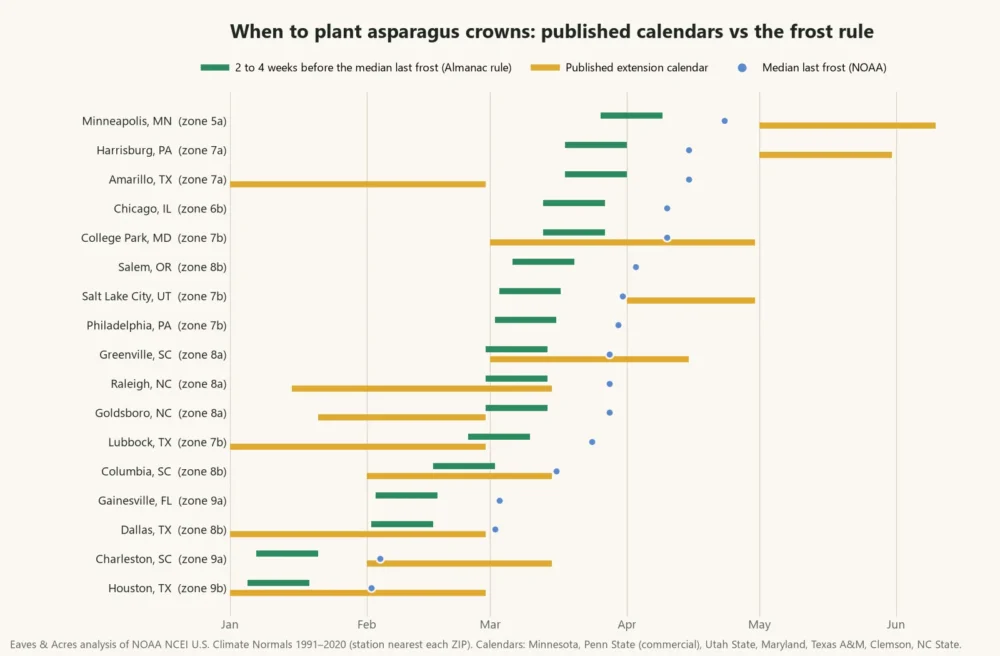
Asparagus planting dates for 17 US cities
Almanac and Oregon State both give a frost count-back: crowns go in about two to four weeks before the last spring frost (Oregon State says three to four).3,4 The table shows that window for the NOAA median last frost of each city,1 next to the calendar each state’s extension service publishes, where we found one. We read “early” as the first ten days of a month and “late” as the last ten. Penn State’s calendar is written for commercial growers.
| City (ZIP) | Zone 2023 | Median last frost | 2–4 weeks before frost | Published calendar | Published, in weeks from median frost |
|---|---|---|---|---|---|
| Minneapolis, MN (55401) | 5a (was 4b) | Apr 23 | Mar 26 – Apr 9 | Early May to early June University of Minnesota | 1.1 after to 6.9 after |
| Harrisburg, PA (17101) | 7a | Apr 15 | Mar 18 – Apr 1 | May (commercial guide) Penn State | 2.3 after to 6.6 after |
| Amarillo, TX (79101) | 7a | Apr 15 | Mar 18 – Apr 1 | January or February Texas A&M AgriLife | 14.9 before to 6.6 before |
| Chicago, IL (60601) | 6b (was 6a) | Apr 10 | Mar 13 – Mar 27 | No dated calendar found | — |
| College Park, MD (20742) | 7b (was 7a) | Apr 10 | Mar 13 – Mar 27 | March or April University of Maryland | 5.7 before to 2.9 after |
| Salem, OR (97301) | 8b | Apr 3 | Mar 6 – Mar 20 | No dated calendar found | — |
| Salt Lake City, UT (84101) | 7b | Mar 31 | Mar 3 – Mar 17 | April Utah State | 0.1 after to 4.3 after |
| Philadelphia, PA (19103) | 7b | Mar 30 | Mar 2 – Mar 16 | No dated calendar found | — |
| Greenville, SC (29601) | 8a | Mar 28 | Feb 28 – Mar 14 | March 1 to April 15 Clemson | 3.9 before to 2.6 after |
| Raleigh, NC (27601) | 8a (was 7b) | Mar 28 | Feb 28 – Mar 14 | Mid-January to mid-March NC State Extension | 10.3 before to 1.9 before |
| Goldsboro, NC (27530) | 8a | Mar 28 | Feb 28 – Mar 14 | Late January into February NC State, Wayne County | 9.4 before to 4 before |
| Lubbock, TX (79401) | 7b | Mar 24 | Feb 24 – Mar 10 | January or February Texas A&M AgriLife | 11.7 before to 3.4 before |
| Columbia, SC (29201) | 8b (was 8a) | Mar 16 | Feb 16 – Mar 2 | February 1 to March 15 Clemson | 6.1 before to 0.1 before |
| Gainesville, FL (32601) | 9a | Mar 3 | Feb 3 – Feb 17 | No dated calendar found | — |
| Dallas, TX (75201) | 8b | Mar 2 | Feb 2 – Feb 16 | January or February Texas A&M AgriLife | 8.6 before to 0.3 before |
| Charleston, SC (29401) | 9a | Feb 4 | Jan 7 – Jan 21 | February 1 to March 15 Clemson | 0.4 before to 5.6 after |
| Houston, TX (77002) | 9b (was 9a) | Feb 2 | Jan 5 – Jan 19 | January or February Texas A&M AgriLife | 4.6 before to 3.7 after |
The count-back window overlaps the published calendar in 8 of the 13 cities that have one. In the other five it does not overlap at all, and the published dates run from 14.9 weeks before the median last frost (Amarillo, January 1) to 6.9 weeks after it (Minneapolis, June 10).
Cold North: wait for May
Minnesota waits longest. Its median last frost in Minneapolis is April 23, so the count-back window is March 26 to April 9, but the university says:
In Minnesota, asparagus is planted between early May and early June.
It also warns that late spring frosts can kill emerged spears, so it advises a spot that is not low-lying or exposed to frost.2 Penn State’s commercial guide plants in May so the ferns can grow before winter,15 and Utah State says April.13 Illinois Extension and Oregon State plant as soon as the soil can be worked, without a date.14,4 Where the ground thaws late, go with the later calendar.
The dates follow the spears. The Almanac says the edible shoot emerges as soil temperatures rise above 50°F,3 and the University of Minnesota says small spears appear two to three weeks after planting, depending on rain, temperature and soil cover.2 A crown set out in warm weather sends up spears quickly, which is why the late-frost warning matters most for the northern calendars.
Mid-South and South: winter planting while dormant
Farther south, crowns go in during winter. NC State’s publication is explicit:
Plant asparagus in winter, between mid-January and mid-March, while the plants are dormant.
NC State’s Wayne County office plants in late January into February in eastern North Carolina.6 Clemson gives March 1 to April 15 in the Piedmont and February 1 to March 15 on the Coastal Plain, and warns that crowns planted too late in spring may start sprouting before they are in the ground.8 Texas A&M AgriLife plants in January or February, or as soon as the ground can be worked.9 Maryland sets crowns out in March or April.7
Does your hardiness zone matter?
Zone matters, but as a limit rather than a date. Asparagus needs a cold, dormant winter, and the extension services in the South say so. UF/IFAS puts it this way:
Without a certain dormant period, asparagus has trouble putting up stalks.
Mississippi State says performance in south Mississippi is likely to be disappointing because the plants may not go fully dormant,11 and Texas A&M calls asparagus best suited to the cooler areas of North and West Texas, adding that it can be grown in Dallas and Houston but produces poorly in areas with mild winters and extremely long, hot summers.9 UC Master Gardeners say it does best where soil occasionally freezes a few inches deep.12
Popular guides turn that into zone ranges that disagree. The Almanac lists zones 3 to 8.3 Bonnie Plants gives dated calendars for zones 3 to 9 and marks zone 10 and warmer “not recommended.”16 We tested that against the 2023 USDA map in our ZIP table:17
| Zone | ZIP codes, 2012 map | ZIP codes, 2023 map | Share of ZIP codes with a 2023 zone |
|---|---|---|---|
| 3 to 8 | 35,262 | 33,427 | 83.8% |
| 9 | 3,640 | 4,284 | 10.7% |
| 10 and warmer | 1,620 | 2,193 | 5.5% |
| No zone in our table | 966 | 1,584 | — |
Most of the country sits inside the Almanac’s range: 83.8% of ZIP codes with a zone are in zones 3 to 8. Zone 9 holds 10.7%, and zone 10 or warmer holds 5.5%, mostly California (1,178 ZIP codes) and Florida (841 of its 1,473), with 96 in Texas and 71 in Arizona. The cutoff also moves with the map. Between the 2012 and 2023 maps, 641 ZIP codes crossed from zone 9 or colder into zone 10 or warmer (312 in Florida, 181 in California, 84 in Texas, 58 in Arizona), so a gardener in one of them can be inside Bonnie’s range or outside it depending on which map a guide uses. Another 1,076 crossed from zone 4 into zone 5, which on Bonnie’s calendar moves the planting date back a full month. Minneapolis is one: zone 4b in 2012, 5a in 2023.

Zone calendars also aren’t frost-based. In 32% of zone 5 to 7 ZIP codes, Bonnie’s March 15 to April 1 window closes more than four weeks before the median last frost, and in zone 9 that is true for 39%.
For Florida, UF/IFAS tells gardeners that asparagus grows best in colder climates; if you try it, it suggests one- or two-year-old crowns in rich soil and a wait of at least two years before harvest.10 Freezing nights are rare in 1,540 lower-48 ZIP codes, according to NOAA’s normals; there, expect the problem UF/IFAS describes, smaller and more spindly spears. For more on why zone and frost date measure different things, see planting zone vs. last frost date.

Can you plant asparagus in fall?
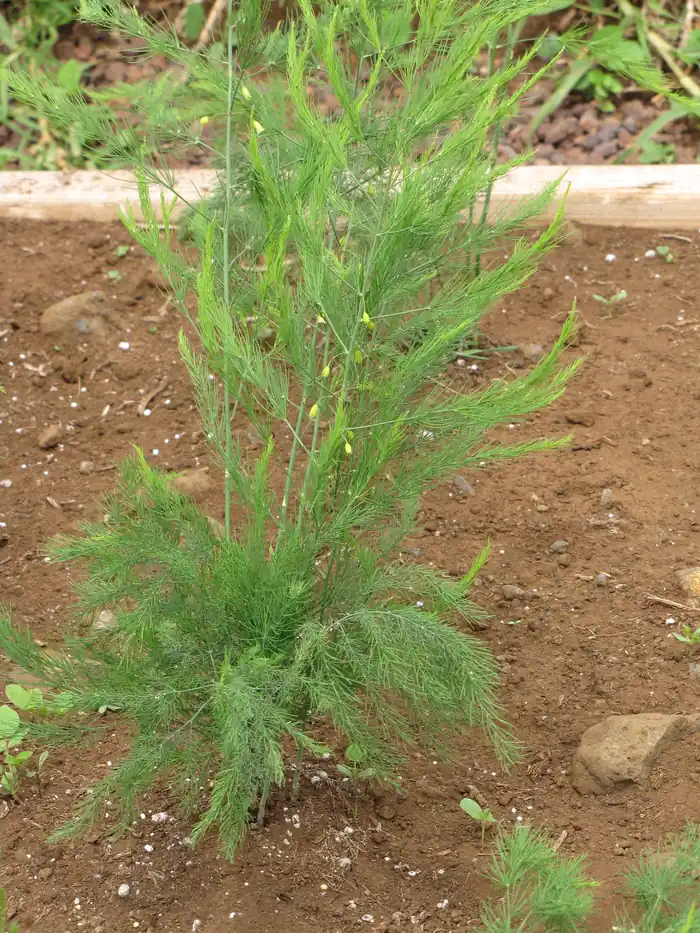
For a new bed in a cold-winter climate, we found no extension page that recommends fall crowns. The Almanac tells gardeners who must move an existing bed to do it in early spring while the crowns are dormant or in late fall before the first frost,3 which is transplanting, not starting a bed. UC Master Gardeners say seedlings may be transplanted in fall, and crowns are usually set out in winter or early spring.12 A garden writer at Harvest to Table says fall planting is possible in very mild climates with good drainage, without citing a study.18 The safe use of fall is preparation. Clemson says the bed is best prepared in fall,8 and Texas A&M spreads compost over the planting area in late fall.9
If crowns arrive before the ground is ready, the University of Minnesota says to refrigerate them until planting, and Oregon State to keep them cool and moist.2,4
How long until you can harvest?
Plan on a light cut in year two at best and a real harvest in year three. The services differ on when to start:
| Source | First harvest | Harvest length |
|---|---|---|
| Oregon State | Do not harvest in year 1; harvest sparingly in year 2 | 1 to 2 weeks in year 2; until mid-June from year 3 |
| University of Minnesota | Two years after crowns, three after seed | Until June 30 |
| NC State, Wayne County | Lightly in year 2 | 2 weeks in year 2; 6 to 8 weeks after year 2 |
| University of Maryland | Lightly in year 2 | 3 to 4 weeks in year 2; 8 to 10 weeks in the fourth season |
| Almanac | Skip years 1 and 2 if possible; ideally wait 3 seasons | Sparingly in year 3 |
| Mississippi State | Third year; earlier reportedly weakens plants | 2 to 3 weeks on young beds; up to 8 weeks when established |
| Penn State (commercial) | About 7 days in year 1 | 14 days in year 2, 3 weeks in year 3, 30 to 36 days in year 4, 6 to 7 weeks in year 5 |
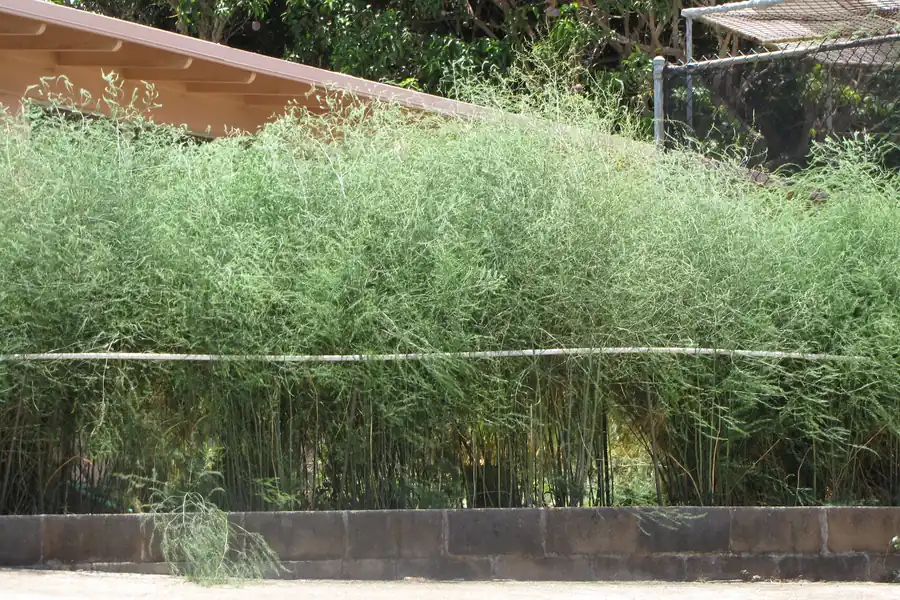
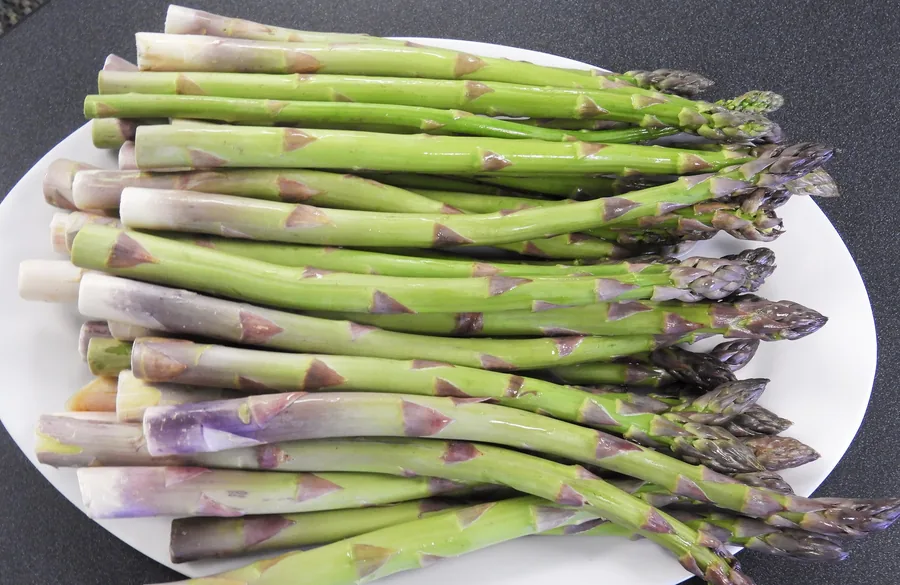
For a bed planted in April 2027, that means no spears in 2027, a few weeks of light picking in spring 2028 if your service allows it, and full seasons from 2029. After each harvest, leave the ferns alone: Oregon State says to let them grow so the crown stays healthy,4 and NC State says cutting them before frost reduces next year’s harvest.6


If you are also planning other perennials and early crops, our guides to strawberries, peas and onions use the same last-frost data, and you can look up your own date with the frost dates by ZIP code tool. Garlic is the fall-planted crop in the same garden; see our fall vegetable planting dates. The other vegetable guides cover the annual crops.
Frequently asked questions
Plant them in early spring while they are dormant, but the month depends on where you live. The University of Minnesota plants between early May and early June, the University of Maryland in March or April, Clemson from March 1 to April 15 in the Piedmont and February 1 to March 15 on the Coastal Plain, NC State from mid-January to mid-March, and Texas A&M in January or February.
For a new bed in a cold-winter climate, we found no extension page that recommends it. UC Master Gardeners say crowns are usually set out in winter or early spring, and that seedlings may be transplanted in fall. Fall is the time to prepare the bed: Clemson says bed preparation is best done in fall.
From crowns it takes two to three years. Clemson says asparagus takes two to three years to begin production, and Texas A&M says it takes 2 to 3 years from planting a crown until the bed is in full production. The University of Minnesota starts harvest two years after crowns and three years after seed.
Yes, it is a perennial. The University of Minnesota says a plant can last 15 years, NC State says a well-managed bed can produce for 15 years or more, and Texas A&M says a crown can last 15 to 25 years in a suitable climate.
In spring, but crowns are the usual choice. The University of Minnesota sows seed in a nursery bed in spring and moves the plants in early April of the next year. Utah State sows seed in January for transplanting in April, and the University of Maryland transplants seedlings in June. Seed adds a year before harvest.
Zone alone does not set the date. The zone 7 cities in our table range from Salt Lake City (April, Utah State) and College Park, Maryland (March or April) to Amarillo and Lubbock, Texas (January or February, Texas A&M). Use your local extension calendar, or count back two to four weeks from your median last frost date.
The latest published dates we found are early June in Minnesota (University of Minnesota) and May in Penn State’s commercial guide. In the South the windows close earlier: March 15 on Clemson’s Coastal Plain calendar and the end of February for Texas A&M. We found no extension page that recommends planting crowns after those dates.
NC State’s Wayne County office suggests 10 crowns for each family member, or around 25 per person if you want extra to freeze, and half as many of the male hybrids such as Jersey Knight. Texas A&M says 20 crowns in a 20-foot row suit a family of four.
Sources
- 1.U.S. Climate Normals 1991–2020. NOAA National Centers for Environmental Information, 2021. Used for: median last-frost dates and frost frequency for every ZIP and city Back to text
- 2.Growing asparagus in home gardens, Cindy Tong, Marissa Schuh and others. University of Minnesota Extension, 2026. Used for: planted early May to early June in Minnesota; harvest two years after crowns, three after seed; late frosts kill emerged spears; refrigerate crowns until planting Back to text
- 3.How to Plant, Grow, and Harvest Asparagus, Catherine Boeckmann. The Old Farmer’s Almanac, 2026. Used for: crowns planted 2 to 4 weeks before the last spring frost; seed not recommended; zones 3 to 8; wait three seasons; moving a bed in early spring or late fall Back to text
- 4.Growing asparagus takes patience but rewards gardeners for years. Oregon State University Extension Service, 2025. Used for: plant as soon as the soil is workable, 3 to 4 weeks before the last frost; harvest schedule; seed adds a year; ferns 5 to 6 feet; store crowns cool and moist Back to text
- 5.Asparagus. NC State Extension, 2026. Used for: plant in winter between mid-January and mid-March while dormant; light harvest in year 2
- 6.Time for Planting Asparagus, Jessica Strickland. NC State Extension, Wayne County Center, 2021. Used for: eastern North Carolina late January into February; harvest schedule; do not cut ferns before frost; 10 crowns per family member Back to text
- 7.Growing Asparagus in a Home Garden. University of Maryland Extension, 2023. Used for: crowns set out in March or April; seed transplanted in June; harvest schedule Back to text
- 8.Asparagus. Clemson Cooperative Extension Home & Garden Information Center, 2025. Used for: crown planting dates: Piedmont Mar 1 to Apr 15, Coastal Feb 1 to Mar 15; two to three years to begin production; fall bed preparation Back to text
- 9.Easy Gardening: Asparagus, Joseph Masabni (EHT-066). Texas A&M AgriLife Extension Service (PDF copy hosted by LSU AgCenter), 2014. Used for: January or February planting; best in North and West Texas; poor where winters are mild; 2 to 3 years to full production; 20 crowns for a family of four Back to text
- 10.Asparagus. UF/IFAS Gardening Solutions, n.d. Used for: Florida limits: needs a dormant period; wait at least two years before harvest Back to text
- 11.Asparagus. Mississippi State University Extension Service, n.d. Used for: disappointing in south Mississippi; may not go dormant; harvest from the third year Back to text
- 12.Asparagus. UC Master Gardener Program, UC Agriculture and Natural Resources, n.d. Used for: cool-winter crop; crowns set out in winter or early spring; seedlings may be transplanted in fall Back to text
- 13.How to Grow Asparagus in Your Garden. Utah State University Extension, 2025. Used for: crowns in April; seed sown in January for April transplanting Back to text
- 14.Asparagus (Home Vegetable Gardening). University of Illinois Extension, n.d. Used for: plant as soon as the ground can be worked; one-year crowns preferred Back to text
- 15.Asparagus Production. Penn State Extension, n.d. Used for: commercial guide: usually planted in May; harvest length by year Back to text
- 16.Asparagus planting guide by zone. Bonnie Plants, 2022. Used for: zone-by-zone planting dates; zones 10 and 11 not recommended Back to text
- 17.USDA Plant Hardiness Zone Map. USDA Agricultural Research Service, 2023. Used for: the 2023 and 2012 hardiness zones used for every ZIP code Back to text
- 18.When to Plant Asparagus by USDA Zone, Stephen Albert. Harvest to Table, 2025. Used for: fall planting possible in very mild climates (garden writer, no citation) Back to text
- 19.Photo: Starr 120406-4324 Asparagus officinalis raised bed, Forest & Kim Starr (CC BY 3.0 US). Wikimedia Commons, 2012. Used for: hero photo
- 20.Photo: Starr 130618-5212 Asparagus officinalis new shoot, Forest & Kim Starr (CC BY 3.0 US). Wikimedia Commons, 2013. Used for: spear photo
- 21.Photo: Starr 111004-0591 Asparagus officinalis habit, Forest & Kim Starr (CC BY 3.0 US). Wikimedia Commons, 2011. Used for: young plant photo
- 22.Photo: Starr 090721-3256 Asparagus officinalis habit, Forest & Kim Starr (CC BY 3.0 US). Wikimedia Commons, 2009. Used for: summer ferns photo
- 23.Photo: Fresh asparagus spears on plate, Nutrition, Food Safety & Health (CC0). Wikimedia Commons, 2017. Used for: harvested spears photo


How this guide was made
- Written by the Yard & Garden Desk and reviewed by the Data & Methodology Desk.
- Data: median last-frost dates and frost frequency from NOAA NCEI U.S. Climate Normals 1991–2020 for the station nearest each ZIP code; USDA hardiness zones from the 2023 map with the 2012 map for comparison, as stored in our ZIP table (1,584 ZIP codes have no 2023 zone, including all of Hawaii); planting calendars and harvest schedules from Minnesota, Oregon State, NC State, Maryland, Clemson, Texas A&M AgriLife, Utah State, Penn State, Illinois, Mississippi State, UF/IFAS and UC extension publications. See our methodology.
- AI use: AI tools help us research, draft and check this guide. Every figure is checked against the source cited for it, and calculated figures come from our own code, described on the methodology page.
- Spotted an error? Tell us — the form opens with this page’s address filled in.
Change log
- Oct 14, 2026Published. Crown planting dates for 17 cities from 13 extension calendars measured against NOAA 1991–2020 median last frost, and the Almanac and Bonnie Plants zone ranges tested against the 2023 and 2012 USDA zones of 39,904 ZIP codes.
Covers lawns, gardens, frost and planting. We write the guides and maintain the tools that tell you when to seed, feed and plant for your ZIP.
Keep reading
When to Plant Pumpkins: Count Back From Halloween, Not Forward From Frost
Sow pumpkins once the soil reaches about 65°F, a median 37 days after the last frost, then count back 90 to 120 days from Halloween or the first frost. Dates for 24 cities.
When to Plant Corn: Match the Date to the Type, Not Just the Frost
Sow standard sweet corn once the soil reaches about 55°F, sugar-enhanced at 60°F and supersweet at 65°F: a median April 25, May 9 and May 25. Dates for 28 spring and 21 fall cities.
When to Harvest Pumpkins: Ripeness Signs and the Freeze Deadline
Pick pumpkins when the rind resists a fingernail and the stem is dry, before a 28°F hard freeze. Median frost and freeze dates for 23 cities, plus curing and storage.
Seasonal reminders for your ZIP
Get a short email when it’s time to overseed, start seeds, open the pool or service your furnace — timed to your climate.