When to Plant Trees and Shrubs: Fall Dates Counted From Your Freeze
Extension says finish fall planting six weeks before the freeze. We counted that for 40,557 ZIP codes, tested it against nine published calendars and found where it runs weeks too early.
- Last reviewed Oct 27, 2026
- 23 cited sources
- 15 min read

Set your ZIP to see dates for your area.
- 1Finish fall planting about six weeks before the first hard freeze (Purdue, UMass, UNH). Counted from NOAA normals, that is September 23 for the median of 37,563 lower-48 ZIP codes with a hard freeze, and September 1 to October 23 for the middle 80%.
- 2All nine published last-planting dates run 21 to 59 days later than that count. The day the air falls below 50°F, Missouri’s soil line, lands within nine days of six of them; the median ZIP code that cools below 50°F reaches it on October 28.
- 3Evergreens need an earlier fall date or spring: Wisconsin says not after early October in the north or mid-October in the south, and Iowa State says mid-August through September for pine and spruce.
- 4Summer is the risk: Maryland says avoid it. Extension asks for about 1 inch of water a week, and normal July rain falls short of that in 66.5% of ZIP codes.
- 5Magnolia, tuliptree, dogwood, sweetgum and many oaks wait for spring in the sources we read. Spring planting opens at the thaw, March 1 for the median ZIP code that freezes.
Plant shade trees, ornamental trees and most shrubs in fall, early enough for roots to grow before the ground freezes, or in early spring before the buds open. Extension services say to finish fall planting about six weeks before the first hard freeze, to plant evergreens earlier than that or wait for spring, and to avoid midsummer. Counted from NOAA normals, the six-week date falls on September 23 for the median of the 37,563 lower-48 ZIP codes that have a hard freeze, yet nine published calendars let planting run 3 to 8 weeks later, and the median of the 35,804 ZIP codes that cool below 50°F gets there on October 28.
This guide covers landscape trees and shrubs. Fruit trees have their own dormant-season rules, which our fruit tree planting guide covers with spring and fall dates by city and zone. Here we turned the fall rule into dates for 30 cities and 40,557 ZIP codes using NOAA 1991–2020 normals1 and tested it against nine published last-planting dates. Air temperature stands in for soil temperature throughout, because our NOAA data has no soil readings.
How the plant is sold changes the window
Container-grown plants arrive with their roots in a pot, balled-and-burlapped (B&B) plants with a dug root ball, and bare-root plants with no soil at all. The University of Maryland says most B&B and container-grown trees can be planted any time the soil is not frozen, while bare-root plants are shipped and planted dormant and fail mostly through root drying.8 Table 1 sets out what each form gets in the sources we read.
| Form | Window in the sources | Why | Sources |
|---|---|---|---|
| Container-grown | Any time the soil is not frozen; best in fall in South Carolina; summer needs steady watering | Roots are in a pot, so circling roots and drought are the hazards | Maryland, Clemson, Wisconsin, Holden |
| Balled-and-burlapped | Any time the soil is not frozen; most are dug and planted in the cooler months after leaf drop; some species are dug only in spring or late summer | The root ball keeps soil, but roots are cut when it is dug | Maryland, Clemson, Holden, Purdue |
| Bare-root | Dormant: late winter or early spring; root-washed shrubs in fall in South Carolina | Roots are uncovered, and drying is largely responsible for failure | Purdue, Maryland, Clemson |
Purdue’s advice for fall is to choose B&B or container plants over bare-root stock, and to plant bare-root plants only in late winter or early spring while dormant.9 Bare-root fruit trees follow the same rule, with dates in the fruit tree guide linked above.
Fall: finish about six weeks before the freeze
Four extension sources give nearly the same rule. Purdue’s forestry specialist describes the common recommendation this way:3
approximately six weeks between planting and the first hard freeze
UMass says plants need at least six weeks to establish before the ground freezes and suggests planting by Columbus Day weekend.4 UNH asks for six weeks of mild weather for root growth and offers early October as a deadline.5 The wording differs in one word that matters: Purdue counts to the first hard freeze, while UMass counts to the ground freezing, which comes weeks later. Roots keep growing, UNH adds, until the soil dips below 40°F.5
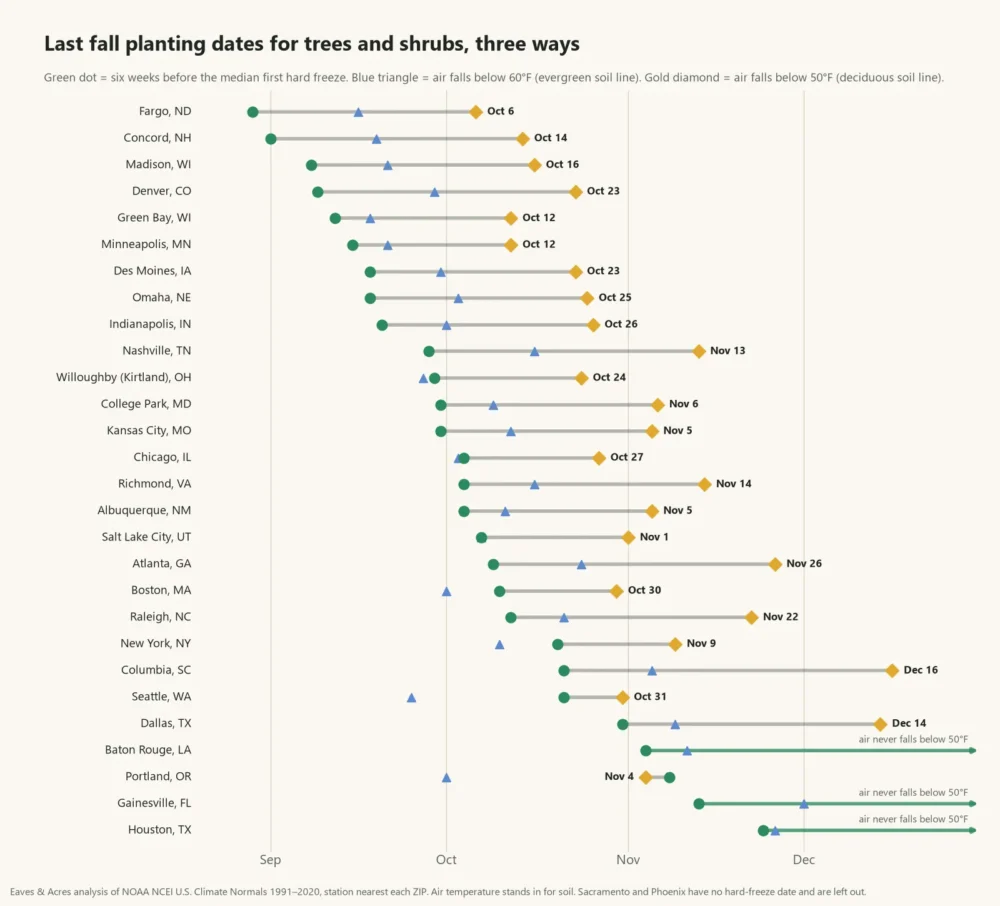
Table 2 counts back six weeks from NOAA’s median first hard freeze (28°F; our frost and freeze guide explains the term). It also shows the day the normal air temperature falls below 50°F and 60°F, the soil lines we test below.
| City (ZIP, zone) | Median first hard freeze (28°F) | Six weeks before it | Air falls below 60°F | Air falls below 50°F |
|---|---|---|---|---|
| Fargo, ND (58102, zone 4a) | Oct 10 | Aug 29 | Sep 16 | Oct 6 |
| Concord, NH (03301, zone 5b) | Oct 13 | Sep 1 | Sep 19 | Oct 14 |
| Madison, WI (53703, zone 5b) | Oct 20 | Sep 8 | Sep 21 | Oct 16 |
| Denver, CO (80202, zone 6a) | Oct 21 | Sep 9 | Sep 29 | Oct 23 |
| Green Bay, WI (54301, zone 5b) | Oct 24 | Sep 12 | Sep 18 | Oct 12 |
| Minneapolis, MN (55401, zone 5a) | Oct 27 | Sep 15 | Sep 21 | Oct 12 |
| Des Moines, IA (50309, zone 5b) | Oct 30 | Sep 18 | Sep 30 | Oct 23 |
| Omaha, NE (68102, zone 6a) | Oct 30 | Sep 18 | Oct 3 | Oct 25 |
| Indianapolis, IN (46204, zone 6b) | Nov 1 | Sep 20 | Oct 1 | Oct 26 |
| Nashville, TN (37201, zone 7b) | Nov 9 | Sep 28 | Oct 16 | Nov 13 |
| Willoughby (Kirtland), OH (44094, zone 6b) | Nov 10 | Sep 29 | Sep 27 | Oct 24 |
| College Park, MD (20742, zone 7b) | Nov 11 | Sep 30 | Oct 9 | Nov 6 |
| Kansas City, MO (64106, zone 6b) | Nov 11 | Sep 30 | Oct 12 | Nov 5 |
| Chicago, IL (60601, zone 6b) | Nov 15 | Oct 4 | Oct 3 | Oct 27 |
| Richmond, VA (23219, zone 7b) | Nov 15 | Oct 4 | Oct 16 | Nov 14 |
| Albuquerque, NM (87102, zone 7b) | Nov 15 | Oct 4 | Oct 11 | Nov 5 |
| Salt Lake City, UT (84101, zone 7b) | Nov 18 | Oct 7 | Oct 7 | Nov 1 |
| Atlanta, GA (30303, zone 8a) | Nov 20 | Oct 9 | Oct 24 | Nov 26 |
| Boston, MA (02108, zone 7a) | Nov 21 | Oct 10 | Oct 1 | Oct 30 |
| Raleigh, NC (27601, zone 8a) | Nov 23 | Oct 12 | Oct 21 | Nov 22 |
| New York, NY (10001, zone 7b) | Dec 1 | Oct 20 | Oct 10 | Nov 9 |
| Columbia, SC (29201, zone 8b) | Dec 2 | Oct 21 | Nov 5 | Dec 16 |
| Seattle, WA (98101, zone 9a) | Dec 2 | Oct 21 | Sep 25 | Oct 31 |
| Dallas, TX (75201, zone 8b) | Dec 12 | Oct 31 | Nov 9 | Dec 14 |
| Baton Rouge, LA (70801, zone 9a) | Dec 16 | Nov 4 | Nov 11 | Stays above |
| Portland, OR (97201, zone 8b) | Dec 20 | Nov 8 | Oct 1 | Nov 4 |
| Gainesville, FL (32601, zone 9a) | Dec 25 | Nov 13 | Dec 1 | Stays above |
| Houston, TX (77002, zone 9b) | Jan 5 | Nov 24 | Nov 26 | Stays above |
| Sacramento, CA (95814, zone 9b) | None | — | Nov 2 | Dec 9 |
| Phoenix, AZ (85001, zone 10a) | None | — | Dec 2 | Stays above |
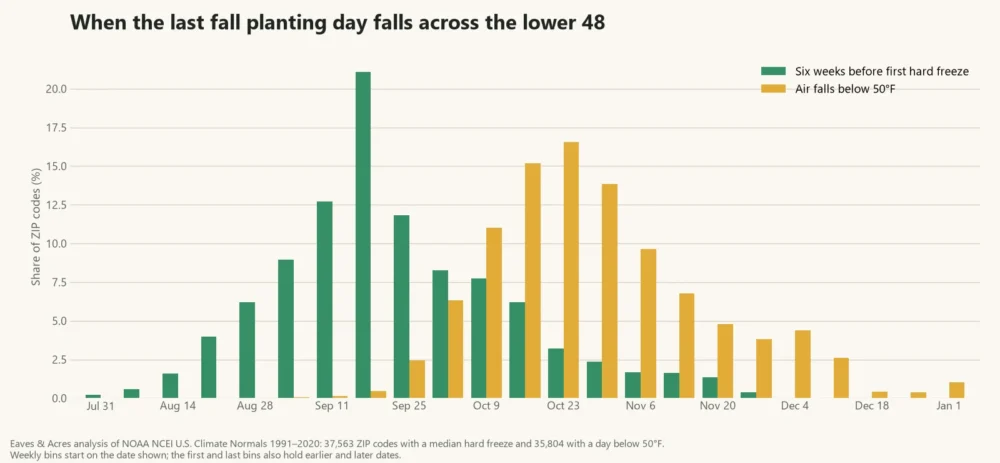
Across the 37,563 lower-48 ZIP codes with a median hard freeze, the six-week date has a median of September 23, and the middle 80% run from September 1 to October 23. It falls before September 1 in 9.6%, in September in 56.5%, in October in 27.5% and in November or later in 6.4%. The other 2,994 (7.4%) have no median hard freeze at all, and Sacramento and Phoenix are among them. The six-week date falls after Columbus Day (October 12) in only 19.2% of those ZIP codes, so UMass’s New England rule of thumb is a late one for most of the country.1
Published last dates against our counts
We took nine last-planting dates from extension services that name one and counted them against three markers for the nearest NOAA station: six weeks before the first hard freeze, six weeks before the day the normal air temperature falls to freezing (our stand-in for the ground freezing), and the day the air falls below 50°F, or 60°F for evergreens. The 50°F line is Missouri Extension’s:13
If your soil is consistently 50℉ or higher, you are good to plant.
Davey Tree, a commercial tree-care company, uses 50°F for deciduous trees and says to avoid planting evergreens when the soil is below 60°F.14 Table 3 shows the result.
| Source and place | Published last date | Six weeks before hard freeze | Six weeks before air averages 32°F | Air falls below soil line | Closest count |
|---|---|---|---|---|---|
| Wisconsin: evergreens in southern Wisconsin (Madison, WI, 53703) | Mid-October | Sep 8 | Oct 18 | Sep 21 (60°F) | ground-freeze count (3 days) |
| Wisconsin: evergreens in northern Wisconsin (Green Bay, WI, 54301) | Early October | Sep 12 | Oct 15 | Sep 18 (60°F) | ground-freeze count (10 days) |
| Iowa State: pine, spruce and other evergreens (Ames, IA, 50010) | Through September | Sep 7 | Oct 17 | Sep 24 (60°F) | soil line (6 days) |
| Iowa State: deciduous trees and shrubs (Ames, IA, 50010) | Early November | Sep 7 | Oct 17 | Oct 17 (50°F) | ground-freeze count and soil line (19 days) |
| UMass: pine and spruce (Amherst, MA, 01002) | End of September | Sep 9 | Oct 28 | Sep 21 (60°F) | soil line (9 days) |
| UMass: Columbus Day weekend rule (Amherst, MA, 01002) | Columbus Day weekend | Sep 9 | Oct 28 | Oct 16 (50°F) | soil line (4 days) |
| UNH: early October deadline (Concord, NH, 03301) | Early October | Sep 1 | Oct 24 | Oct 14 (50°F) | soil line (9 days) |
| Colorado State Forest Service: early fall (Denver, CO, 80202) | October 15 | Sep 9 | Air never averages 32°F | Oct 23 (50°F) | soil line (8 days) |
| Colorado State Forest Service: early fall (Fort Collins, CO, 80521) | October 15 | Sep 5 | Oct 31 | Oct 16 (50°F) | soil line (1 day) |
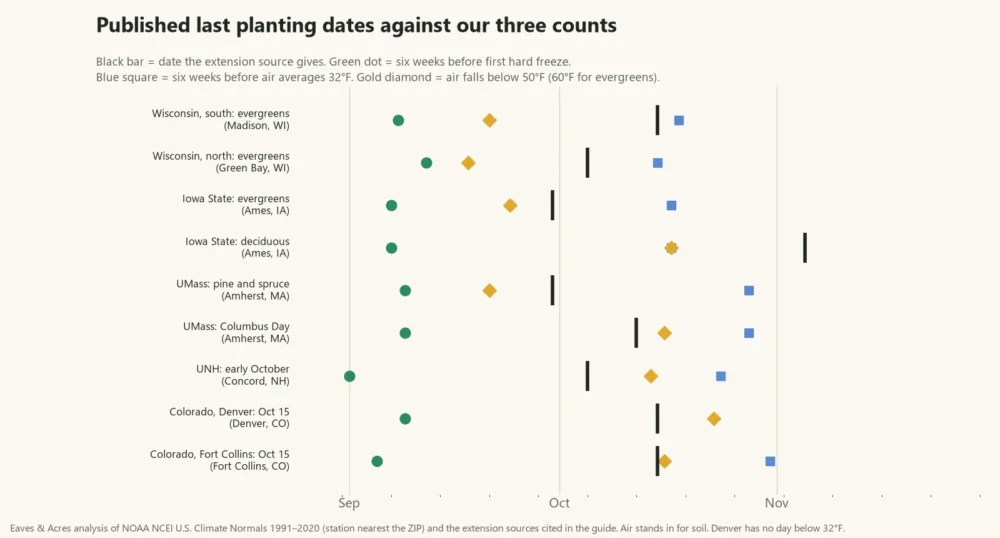
The strict count is early in every case: all nine published dates fall 21 to 59 days after six weeks before the hard freeze, so planting by that date satisfies every source. The count from the ground-freeze stand-in runs from 28 days after a published date to 19 days before it in the eight places where the air average reaches freezing, which makes it too erratic to use. The soil line lands within nine days of six of the nine, and misses Wisconsin’s two evergreen cutoffs by 24 and 17 days and Iowa’s early November by 19. The 60°F evergreen line fits two of the four evergreen dates, Ames and Amherst. Our reading is that the six-week date is the safe date and the 50°F day is the outer limit for deciduous trees where you can water, but a soil thermometer beats both.
Evergreens: earlier in fall, or spring
Evergreens keep their foliage, so they keep losing water all winter while frozen ground blocks the roots from replacing it. Wisconsin’s plant clinic calls the damage winter burn, sets the cutoffs we tested in Table 3, and says summer planting is possible with water:6
Evergreens can be planted in the summer if you provide supplemental water.
The same page says to plant evergreens in early spring before the buds break or in August and September.6 Iowa State calls mid-August through September an excellent time for pine, spruce and other evergreens, and says evergreens planted in late October or November may be too late.7 UMass says pine and spruce do well planted before the end of September but to wait until spring for rhododendron and yew.4 The University of Maryland says broadleaf evergreens are best planted in spring, though mountain laurel, boxwood and hollies can go in early fall with deep watering and mulch.8
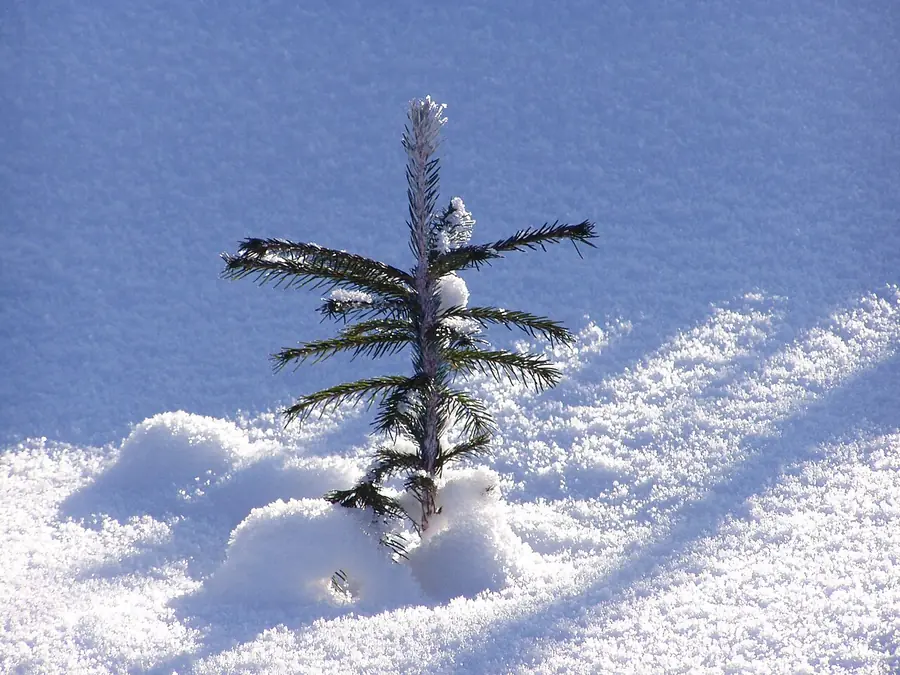

The sources do not all agree. The Southern Group of State Foresters says evergreens should only be planted in late winter or early spring,15 and Holden Arboretum in northeastern Ohio plants evergreens in late summer, describing a white spruce planted after Christmas into a pre-dug, straw-covered site.11 An Ask Extension reply to a Howard County, Maryland, question adds that the later in fall an evergreen goes in, the greater the risk of winter damage, even if it only shows in spring.20 Our counts put the 60°F line on September 18 to 24 in Green Bay, Madison, Ames and Amherst; the median ZIP code reaches it on October 4, and 9.7% reach it before September 15.
Trees that wait for spring
Some species root slowly or have fleshy roots and do poorly when planted in fall. Illinois Extension relays the Morton Arboretum’s list of slow-to-establish trees and a list that suits fall,10 and four other sources name their own. Holden adds a number: dogwood, redbud, beech, sycamore and others need soil of about 56°F or higher to grow new roots, which is why it calls them challenging to dig after early September.11 Table 4 sets the lists side by side, and the disagreements are as useful as the agreement.
| Plant | Spring first, per | Fall is fine, per | Verdict |
|---|---|---|---|
| Magnolia | Purdue, UNH, Maryland, Illinois (Morton), Holden | — | Spring |
| Tuliptree (tulip poplar) | Purdue, UNH, Maryland, Illinois (Morton), Holden | — | Spring |
| Dogwood | Purdue, Maryland, Holden | — | Spring |
| Sweetgum | Purdue, Illinois (Morton), Holden | — | Spring |
| Oaks | Purdue (many oaks), UNH, Holden (balled oaks dug in spring or late summer) | — | Spring |
| Ginkgo, bald-cypress | UNH (ginkgo), Illinois (Morton), Holden | — | Spring |
| Birch, flowering cherry, poplar, willow | Purdue (birch, cherries, poplars), Illinois (willow), Holden | — | Spring |
| Hawthorn | Purdue | UNH, UMass | Sources disagree |
| Red maple and other maples | Purdue (red maple) | Illinois, UNH, UMass (maple) | Sources disagree on red maple |
| Sycamore, redbud | Holden (hard to dig after early September) | Illinois (sycamore), UMass (both) | Sources disagree |
| Crabapple, linden, honey locust | — | Illinois, UNH, UMass | Fall |
| Pine and spruce | — | Illinois, UMass (by end of September), Iowa State (mid-August to September), Holden | Fall, early |
| Rhododendron and yew | UMass | Holden (rhododendron in August and September) | Sources disagree |

Spring: before the buds open
Spring planting works when the ground is workable and the tree has not leafed out. Holden says to plant in late March through April before new shoots emerge in northeastern Ohio, because actively growing shoots leave fewer resources for roots, and that a tree losing many roots in May or early June may wilt and die.11 The Colorado State Forest Service calls March 15 to June 15 another great time to plant, after early fall.12 UNH warns that a rainy spring followed by hot, dry weather can scorch new leaves.5
Illinois reduces the choice to rain: the best time is when regular rainfall arrives, which in the Midwest includes both spring and fall.10 For container and B&B plants, which need only workable soil, the opening date is the thaw. Among the 19,518 ZIP codes where the normal air temperature drops to freezing and recovers, it is the day the air first averages above 32°F again: the median is March 1, and the middle 80% run from January 30 to March 22. Table 5 lists it by city. A late frost can damage new leaves and blossoms but the plant survives; our frost cover guide covers what Iowa State says about protecting them.
Summer: the risky season, and how much to water
The University of Maryland says summer planting, when plants are in full leaf, can be stressful and should be avoided if possible.8 Clemson says shrubs planted from spring through summer need more careful watching of soil moisture in the hot, dry season, because new shrubs have few roots to feed actively growing shoots.17 Arbor Day Foundation notes that fall planting leaves the tree an extra growing season before summer stress.19
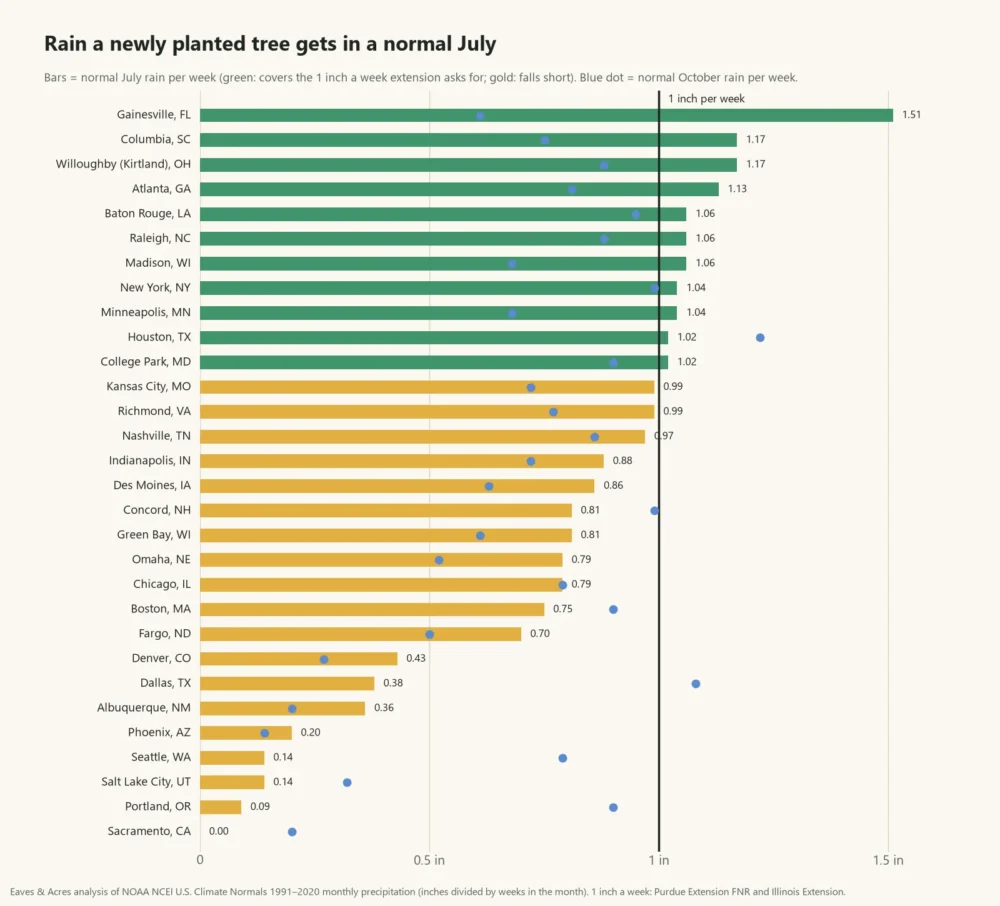
The watering target is the same in every source: about 1 inch of water a week. Purdue says newly planted trees need supplemental water when rainfall falls short of it, and gives 5 gallons a week for every inch of trunk diameter as a starting guide.3 Illinois says to water at least weekly and skip a week that brings an inch of rain, for up to three years.10 Iowa State says to water daily for three or four days, then taper to a thorough watering every 7 to 10 days in dry weather until the ground freezes.7 UNH wants the soil wetted 8 to 10 inches deep once a week,5 and Maryland says to water through the first two years, even in winter, but not when the ground is frozen.8
We compared that inch with NOAA’s normal rainfall, divided into weeks. In a normal July the median ZIP code gets 0.90 inch a week, rain alone is short of an inch in 66.5% of ZIP codes and short of half an inch in 18.7%. October is drier still: the median is 0.75 inch a week, and October is wetter than July in only 30.8% of ZIP codes, so fall planting does not escape watering. Over April to October the median ZIP code has 5 of 7 months below an inch a week, 31.4% have all seven, and only 1.0% have none.
| City (ZIP, zone) | Thaw (air back above 32°F) | July high | July rain, in a week | October rain, in a week | Months under 1 in a week |
|---|---|---|---|---|---|
| Sacramento, CA (95814, zone 9b) | Never averages below 32°F | 94°F | 0.00 | 0.20 | 7 of 7 |
| Portland, OR (97201, zone 8b) | Never averages below 32°F | 80°F | 0.09 | 0.90 | 7 of 7 |
| Salt Lake City, UT (84101, zone 7b) | Never averages below 32°F | 91°F | 0.14 | 0.32 | 7 of 7 |
| Seattle, WA (98101, zone 9a) | Never averages below 32°F | 77°F | 0.14 | 0.79 | 7 of 7 |
| Phoenix, AZ (85001, zone 10a) | Never averages below 32°F | 106°F | 0.20 | 0.14 | 7 of 7 |
| Albuquerque, NM (87102, zone 7b) | Never averages below 32°F | 91°F | 0.36 | 0.20 | 7 of 7 |
| Dallas, TX (75201, zone 8b) | Never averages below 32°F | 97°F | 0.38 | 1.08 | 5 of 7 |
| Denver, CO (80202, zone 6a) | Never averages below 32°F | 91°F | 0.43 | 0.27 | 7 of 7 |
| Fargo, ND (58102, zone 4a) | Mar 25 | 82°F | 0.70 | 0.50 | 6 of 7 |
| Boston, MA (02108, zone 7a) | Feb 16 | 82°F | 0.75 | 0.90 | 7 of 7 |
| Chicago, IL (60601, zone 6b) | Feb 22 | 85°F | 0.79 | 0.79 | 7 of 7 |
| Omaha, NE (68102, zone 6a) | Feb 23 | 88°F | 0.79 | 0.52 | 4 of 7 |
| Green Bay, WI (54301, zone 5b) | Mar 15 | 81°F | 0.81 | 0.61 | 7 of 7 |
| Concord, NH (03301, zone 5b) | Mar 11 | 83°F | 0.81 | 0.99 | 7 of 7 |
| Des Moines, IA (50309, zone 5b) | Feb 27 | 86°F | 0.86 | 0.63 | 5 of 7 |
| Indianapolis, IN (46204, zone 6b) | Feb 20 | 84°F | 0.88 | 0.72 | 4 of 7 |
| Nashville, TN (37201, zone 7b) | Never averages below 32°F | 89°F | 0.97 | 0.86 | 4 of 7 |
| Richmond, VA (23219, zone 7b) | Never averages below 32°F | 90°F | 0.99 | 0.77 | 4 of 7 |
| Kansas City, MO (64106, zone 6b) | Jan 22 | 90°F | 0.99 | 0.72 | 4 of 7 |
| College Park, MD (20742, zone 7b) | Never averages below 32°F | 87°F | 1.02 | 0.90 | 5 of 7 |
| Houston, TX (77002, zone 9b) | Never averages below 32°F | 93°F | 1.02 | 1.22 | 1 of 7 |
| Minneapolis, MN (55401, zone 5a) | Mar 15 | 83°F | 1.04 | 0.68 | 4 of 7 |
| New York, NY (10001, zone 7b) | Never averages below 32°F | 85°F | 1.04 | 0.99 | 3 of 7 |
| Madison, WI (53703, zone 5b) | Mar 10 | 82°F | 1.06 | 0.68 | 4 of 7 |
| Raleigh, NC (27601, zone 8a) | Never averages below 32°F | 91°F | 1.06 | 0.88 | 3 of 7 |
| Baton Rouge, LA (70801, zone 9a) | Never averages below 32°F | 91°F | 1.06 | 0.95 | 1 of 7 |
| Atlanta, GA (30303, zone 8a) | Never averages below 32°F | 90°F | 1.13 | 0.81 | 6 of 7 |
| Willoughby (Kirtland), OH (44094, zone 6b) | Mar 1 | 82°F | 1.17 | 0.88 | 5 of 7 |
| Columbia, SC (29201, zone 8b) | Never averages below 32°F | 96°F | 1.17 | 0.75 | 4 of 7 |
| Gainesville, FL (32601, zone 9a) | Never averages below 32°F | 91°F | 1.51 | 0.61 | 3 of 7 |
Mild winters, dry summers and USDA zones
Where the ground does not freeze, the freeze deadline disappears. In 51.8% of lower-48 ZIP codes the normal air temperature never averages below 32°F, and in 11.7% it never falls below 50°F. Clemson says fall is the best season for shrubs in South Carolina because roots keep growing through winter,17 and says container and B&B trees can go in all year but are best planted in fall.16 UF/IFAS tells Florida gardeners who cannot water regularly to plant at the start of the local rainy season and puts establishment at about 20 to 28 weeks.18 In dry-summer places the calendar is the water: Colorado’s state forest service points to September 1 to October 15,12 and Portland and Seattle get 0.09 and 0.14 inch a week in July.
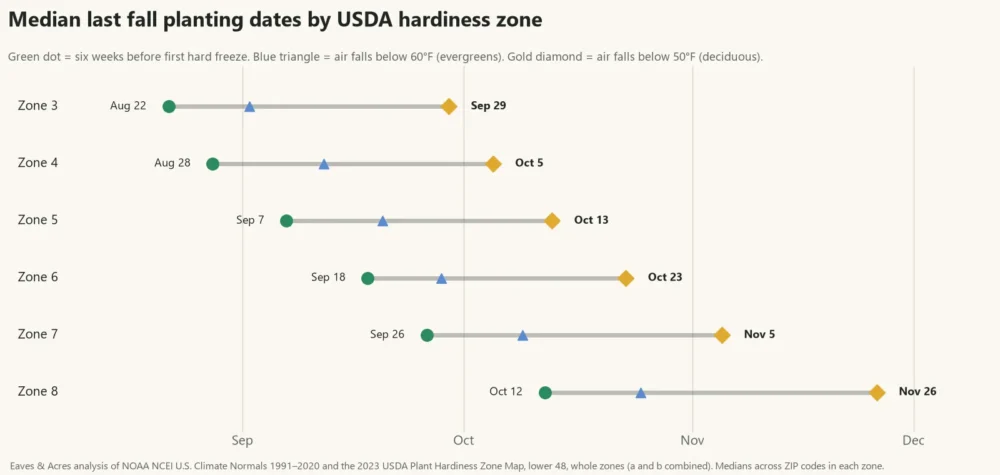
Your hardiness zone tells you what survives, not when to plant;2 our zone and frost date guide draws the line. It still sorts the dates, as Table 6 and the zone chart show.
| Zone | ZIP codes | Six weeks before hard freeze | Air falls below 50°F | ZIPs where air averages 32°F | ZIPs with July rain under 1 in a week |
|---|---|---|---|---|---|
| Zone 3 | 209 | Aug 22 | Sep 29 | 100.0% | 93.8% |
| Zone 4 | 2,039 | Aug 28 | Oct 5 | 100.0% | 86.9% |
| Zone 5 | 5,258 | Sep 7 | Oct 13 | 99.9% | 79.6% |
| Zone 6 | 10,446 | Sep 18 | Oct 23 | 91.8% | 73.6% |
| Zone 7 | 8,695 | Sep 26 | Nov 5 | 23.9% | 56.4% |
| Zone 8 | 6,779 | Oct 12 | Nov 26 | 0.1% | 55.8% |
| Zone 9 | 4,284 | Nov 6 (81% of ZIPs) | Dec 6 (43% of ZIPs) | 0.1% | 62.3% |
After planting: mulch and care
Arbor Day Foundation says to water right after planting, even in cold weather, and to lay a 2- to 3-inch ring of mulch without piling it against the trunk.19 Our mulch timing guide counts when to lay it. Purdue says to keep watering until the ground freezes, even after leaves have dropped, and to wrap thin-barked young trunks in late November and remove the wrap in March.9 Missouri says dry winter soil is a main drawback of fall planting, so water through the winter when the soil is not frozen.13 Perennial divisions use a similar count-back from the freeze, covered in when to divide perennials.
How we calculated these dates
Daily temperatures are NOAA’s monthly normals placed on the 15th of each month and interpolated linearly, for the station nearest each ZIP code.1 The six-week date is NOAA’s median first 28°F freeze minus 42 days; the 50°F and 60°F days are the first days the normal daily mean falls below each line after the warmest day; the thaw is the first day it returns above 32°F. Rain is each month’s normal precipitation divided by the number of weeks in the month. The national pool is 40,557 lower-48 ZIP codes; zones are the 2023 USDA map.2 Soil lags air, the 50°F and 60°F lines are soil rules applied to air, and a single year can run weeks ahead of or behind a normal.
Next steps
Find your median first freeze with the frost date lookup and your zone with the planting zone tool, subtract six weeks, and put a soil thermometer in the ground. Call 811 before you dig, as Arbor Day Foundation advises.19 For pruning timing once the plants are established, see when to prune roses and when to prune hydrangeas.
Frequently asked questions
In most of the North and Midwest, fall from mid-September to the end of October (Missouri Extension) or early spring before the buds open; in mild-winter places, fall through winter. Among lower-48 ZIP codes with a hard freeze, the median reaches six weeks before it on September 23; the median of those that cool below 50°F gets there on October 28.
It can work with steady water, but the University of Maryland says summer planting, when plants are in full leaf, can be stressful and should be avoided if possible. Extension asks for about 1 inch of water a week, and normal July rain is short of that in 66.5% of lower-48 ZIP codes.
Missouri says trees still in leaf are fine to plant if the soil is consistently 50°F or higher, and Arbor Day Foundation says planting is safe until the ground is frozen solid. Evergreens have earlier cutoffs: Wisconsin says not after early October in the north or mid-October in the south.
Purdue names magnolia, dogwood, tuliptree, sweetgum, red maple, birch, hawthorn, poplars, cherries, plum and many oaks as best saved for spring, and UNH names magnolia, tuliptree, oak and ginkgo. Sources disagree on some, such as hawthorn and red maple (Table 4).
In late summer, from mid-August through September, or in early spring before the buds break, per Wisconsin and Iowa State. UMass says pine and spruce by the end of September but to wait until spring for rhododendron and yew; Purdue says broadleaf evergreens are the most prone to winter injury.
Fall for most deciduous shrubs (UMass, UNH) and in South Carolina, where Clemson says fall is the best season for shrubs. UMass says to wait until spring for rhododendron and yew, and UF/IFAS says to plant at the start of the rainy season in Florida if you cannot water regularly.
Aim for about 1 inch of water a week, counting rain. Purdue gives 5 gallons a week for every inch of trunk diameter as a guide, Illinois says at least weekly and to skip a week with an inch of rain, for up to three years, and Iowa State starts with daily watering for three or four days.
Yes where the soil is not frozen: Maryland lists winter among the best times, and Arbor Day Foundation says planting is safe until the ground is frozen solid. In 51.8% of lower-48 ZIP codes the normal air temperature never averages below freezing. Bare-root stock goes in dormant, in late winter or early spring.
Sources
- 1.U.S. Climate Normals 1991–2020. NOAA National Centers for Environmental Information, 2021. Used for: monthly temperature and precipitation normals and median first hard freeze for every ZIP code Back to text
- 2.2023 USDA Plant Hardiness Zone Map. USDA Agricultural Research Service, 2023. Used for: zone by ZIP code Back to text
- 3.Can I Plant Trees in the Fall?, Ben McCallister. Purdue Extension, Forestry and Natural Resources, 2026. Used for: six weeks between planting and the first hard freeze; 1 inch a week and 5 gallons per inch of trunk diameter; broadleaf evergreens and winter injury Back to text
- 4.Fall Planting for Trees & Shrubs. UMass Extension, 2017. Used for: at least six weeks before the ground freezes; Columbus Day weekend; pine and spruce before end of September; wait for spring for rhododendron and yew Back to text
- 5.Is fall a good time to plant trees and shrubs?. UNH Extension, 2019. Used for: six weeks of mild weather; early October deadline; roots grow until soil is below 40°F; species for spring; weekly watering to 8 to 10 inches Back to text
- 6.Winter Burn. University of Wisconsin Extension, Plant Disease Diagnostics Clinic, n.d. Used for: evergreens in early spring or August and September; not after early October in northern or mid-October in southern Wisconsin; summer planting with water Back to text
- 7.Is late summer/early fall a good time to plant trees?, Richard Jauron. Iowa State University Extension and Outreach, 2024. Used for: evergreens mid-August through September; deciduous August through early November; watering schedule Back to text
- 8.Planting a Tree or Shrub. University of Maryland Extension, 2026. Used for: fall, winter and early spring best; summer stressful; broadleaf evergreens; B&B and container any time soil is not frozen; bare-root; watering two years Back to text
- 9.Fall Ideal for Planting Trees, Rosie Lerner. Purdue Consumer Horticulture, 2000. Used for: B&B or container over bare-root; species best saved for spring; 1 inch a week; trunk wrap; mulch Back to text
- 10.When is the Best Time of Year to Plant Trees?, Christopher Enroth. University of Illinois Extension, 2019. Used for: planting when rain is regular; Morton Arboretum lists; weekly watering for up to three years Back to text
- 11.When to Plant a Tree, Ethan Johnson. Holden Forests & Gardens, 2021. Used for: spring before shoots emerge; late summer for evergreens; 56°F for new roots; species hard to dig after early September Back to text
- 12.Fall is ideal time to plant trees. Colorado State Forest Service, 2025. Used for: September 1 to October 15; spring March 15 to June 15 Back to text
- 13.Fall is the Perfect Time to Plant a Yard Tree, Hank Stelzer. University of Missouri Extension, 2019. Used for: mid-September to end of October; soil consistently 50°F or higher; dry winter soil Back to text
- 14.When Is It Too Late to Plant a Tree in Fall?. Davey Tree Expert Company (commercial), 2021. Used for: 50°F for deciduous trees; avoid evergreens when soil is below 60°F Back to text
- 15.Planting Trees. Southern Group of State Foresters, n.d. Used for: evergreens only in late winter or early spring; winter burn Back to text
- 16.Planting Trees Correctly. Clemson Cooperative Extension, Home & Garden Information Center, n.d. Used for: container and B&B any time; best in fall in the Southeast; B&B dug after leaf drop Back to text
- 17.Planting Shrubs Correctly. Clemson Cooperative Extension, Home & Garden Information Center, n.d. Used for: fall best in South Carolina; spring and summer need careful watering; root-washed plants in fall Back to text
- 18.Planting and Establishing Shrubs. UF/IFAS Gardening Solutions, n.d. Used for: plant at the start of the rainy season if you cannot water; establishment 20 to 28 weeks Back to text
- 19.Why It’s Great to Plant Trees in the Fall. Arbor Day Foundation, 2019. Used for: safe until the ground is frozen solid; extra growing season; water and mulch after planting; call 811 Back to text
- 20.Transplanting evergreen shrubs and small trees (question 887058). Ask Extension, Howard County, Maryland expert reply, 2024. Used for: later fall transplanting raises winter damage risk for evergreens Back to text
- 21.Photo: Fall Color 2021 (20210921-FS-Superior-SAR-008), U.S. Forest Service Eastern Region (public domain). Wikimedia Commons, 2021. Used for: hero photo
- 22.Photo: Spruce sapling in snow, Poooow (public domain). Wikimedia Commons, n.d. Used for: evergreen photo
- 23.Photo: Cornus florida, Dogwood, Howard County, Md, USGS Bee Inventory and Monitoring Lab (public domain). Wikimedia Commons, 2018. Used for: dogwood photo
How this guide was made
- Written by the Yard & Garden Desk and reviewed by the Data & Methodology Desk.
- Data: monthly temperature and precipitation normals and median first hard freeze from NOAA NCEI U.S. Climate Normals 1991–2020 for the station nearest each ZIP code, with daily values interpolated from the monthly normals; USDA 2023 Plant Hardiness Zone Map; planting rules and published last-planting dates from Purdue, UMass, UNH, Wisconsin, Iowa State, Maryland, Illinois, Missouri, Clemson, UF/IFAS, Holden Forests & Gardens, the Colorado State Forest Service and the Arbor Day Foundation. Air temperature stands in for soil temperature, and the six-week count and the 50°F and 60°F lines are our tests of published rules, not published dates. See our methodology.
- AI use: AI tools help us research, draft and check this guide. Every figure is checked against the source cited for it, and calculated figures come from our own code, described on the methodology page.
- Spotted an error? Tell us — the form opens with this page’s address filled in.
Change log
- Oct 27, 2026Corrected a date-handling error in our national count: first hard-freeze dates that NOAA lists in January to June (660 mostly Gulf Coast and Florida ZIP codes; they belong to the following winter) were placed in the same calendar year, so their six-week dates fell in the previous fall. Median six-week date September 23 (was 22); middle 80% September 1 to October 23 (was August 30 to October 21); before September 1 in 9.6% (was 11.3%); November or later in 6.4% (was 4.6%); after Columbus Day in 19.2% (was 17.4%); zone 9 November 6 (was October 30). The weekly chart was redrawn.
- Oct 22, 2026Published. Fall planting dates for 30 cities and 40,557 lower-48 ZIP codes from NOAA 1991–2020 normals, tested against nine published last-planting dates from extension services.
Covers lawns, gardens, frost and planting. We write the guides and maintain the tools that tell you when to seed, feed and plant for your ZIP.
Keep reading
When to Plant Pumpkins: Count Back From Halloween, Not Forward From Frost
Sow pumpkins once the soil reaches about 65°F, a median 37 days after the last frost, then count back 90 to 120 days from Halloween or the first frost. Dates for 24 cities.
When to Plant Corn: Match the Date to the Type, Not Just the Frost
Sow standard sweet corn once the soil reaches about 55°F, sugar-enhanced at 60°F and supersweet at 65°F: a median April 25, May 9 and May 25. Dates for 28 spring and 21 fall cities.

When to Cut Back Perennials: Fall, Winter or Spring Dates by City
Cut diseased perennials after several hard frosts and leave healthy stems until spring. Hard-freeze, last-frost and 50°F-night dates for 25 cities and 39,017 ZIP codes from NOAA normals.
Seasonal reminders for your ZIP
Get a short email when it’s time to overseed, start seeds, open the pool or service your furnace — timed to your climate.