

When to Divide Perennials: Fall Dates Counted Back From Your Freeze
Extension services say to finish fall division four to six weeks before the ground freezes but give dates only for one state or region. We counted it for 25 cities and 37,563 ZIP codes and compared what they say about peonies, irises, daylilies and hostas.
- Last reviewed Oct 22, 2026
- 20 cited sources
- 14 min read


Set your ZIP to see dates for your area.
- 1Divide spring- and summer-blooming perennials in fall and fall bloomers in spring. For fall, extension services say to finish 4 to 6 weeks before the ground freezes (New Hampshire says 8).
- 2Counted back from the median first 28°F hard freeze, the 6-week mark is September 23 and the 4-week limit October 7 in the median ZIP code: Minneapolis September 15 to 29, Chicago October 4 to 18, Dallas October 31 to November 14.
- 3The way you count matters: counting from the 32°F frost moves dates 11 days earlier, and the six rule-and-anchor combinations sit 39 days apart (August 29 to October 7).
- 4“Divide in September” fits better than its critics say: a 4-to-6-week window overlaps September in 64.6% of ZIP codes. The 4-week limit falls on October 15 or later in 33.9%.
- 5Peonies go in September and rarely need dividing, bearded irises in August, hostas in spring (fall is possible), and asters, mums and most grasses in spring. Sources disagree on Siberian iris.
Divide perennials that bloom in spring or summer in the fall, and divide fall bloomers in spring. For fall division, extension services say to finish four to six weeks before the ground freezes, and the only dates they give are for one state or region. Counted back from NOAA’s median first hard freeze, the 6-week mark is September 23 and the 4-week limit is October 7 in the median US ZIP code: September 15 to 29 in Minneapolis, October 4 to 18 in Chicago and October 31 to November 14 in Dallas.
We turned the rule into dates for 25 cities and 37,563 ZIP codes with NOAA 1991–2020 normals1 and tested how far the answer moves with the way you count. Spring division needs no calendar: you dig as the new shoots appear. The plants that cause the arguments are peonies, bearded irises, daylilies and hostas, and the extension sources disagree about them more than most guides admit.
The rule: bloom season decides, and the sources mostly agree
Divide a perennial when it is not flowering, so its energy goes to roots and leaves instead of blooms.5,2 From there, Clemson says to divide spring- and summer-blooming plants in the fall and fall bloomers in the spring, and the Chicago Botanic Garden gives the same rule for spring and fall bloomers so you never cut into a plant’s flower cycle.4,12 Asters and chrysanthemums, the classic fall bloomers, wait for spring in the Iowa State, Clemson and Old Farmer’s Almanac lists.3,4,16
The agreement is partial. Oregon State says to divide summer- and fall-blooming perennials in spring,14 where Minnesota and Clemson put summer bloomers in the fall.2,4 Illinois Extension says there is no set rule, that spring is the preferred time, and that the signs on the plant matter more than a date on the calendar.8 The University of New Hampshire adds that a plant can be divided at either end of the season, and that many New Hampshire gardeners divide everything in spring because fall divisions may not root before winter and can heave out of the ground in freeze-and-thaw cycles.7
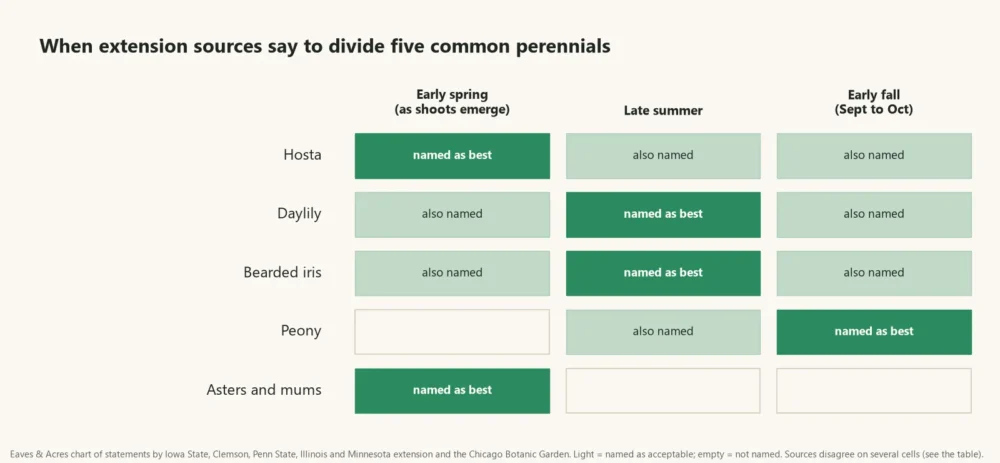
The table below lines up what each source actually says for the plants that cause the most disagreement. Minnesota also publishes a spreadsheet for 125 perennials on its dividing perennials page.2
| Plant | Spring | Summer to fall | Where the sources differ |
|---|---|---|---|
| Hosta | Iowa State: best, as the leaves emerge. Minnesota: before they get too large | Iowa State: any time to late summer. Clemson: early fall. Almanac: easy in fall | Spring preferred by Iowa State and Minnesota; Clemson and the Almanac accept fall |
| Daylily | Iowa State: early spring. Clemson: spring | Iowa State: late summer. Clemson: summer or fall, ideal just after bloom | Both seasons accepted |
| Bearded iris | Clemson’s table: spring | Iowa State: July or August. Penn State: August. Illinois: late summer to very early fall. Clemson’s text: a month after flowering until early fall | Clemson’s table and text differ |
| Siberian iris | — | Minnesota: fall (fleshy roots). Iowa State: early summer, after blooming | Minnesota and Iowa State differ |
| Peony | — | Iowa State: September. Clemson: September or October. Chicago Botanic Garden: fall. Illinois: late summer to very early fall | None names spring |
| Asters and mums | Iowa State, Clemson and the Almanac: spring | — | Agree |
| Ornamental grasses | Iowa State: spring is better than fall. Clemson: spring for most | Almanac: easy in fall. Clemson: many do not tolerate fall division | The Almanac differs |
Fall: turning “four to six weeks before the ground freezes” into dates
Minnesota, Iowa State, Clemson, Penn State and the Piedmont Master Gardeners all give the same fall rule.2,3,4,5,15 Minnesota words it this way:
time it for four to six weeks before the ground freezes
Google’s AI Overview for “when to divide perennials” repeated the 4-to-6-week rule when we checked on October 22, 2026, and no page gives a date for your ZIP code. The problem is the word “freezes.” Our NOAA table has air temperatures only, so it has no date for the ground. We count from the two air-temperature dates it does have: the median first frost, 32°F, and the median first hard freeze, 28°F or colder for an extended time. Penn State’s iris page names an air event instead, and it names the hard one:6
four to six weeks before the first hard freeze or killing frost
So the table counts back from the hard freeze. It shows the 6-week mark, where roots have the most time, and the 4-week limit, the last date the sources allow. Our frost vs. freeze guide explains the terms, and the frost date lookup shows your ZIP code’s 28°F date.
| City (ZIP) | Median first 32°F frost | Median first 28°F hard freeze | 8 weeks before (New Hampshire) | 6 weeks before (earliest in range) | 4 weeks before (last date) |
|---|---|---|---|---|---|
| Durham, NH (03824) | Oct 4 | Oct 19 | Aug 24 | Sep 7 | Sep 21 |
| Denver, CO (80202) | Oct 12 | Oct 21 | Aug 26 | Sep 9 | Sep 23 |
| Minneapolis, MN (55401) | Oct 16 | Oct 27 | Sep 1 | Sep 15 | Sep 29 |
| Des Moines, IA (50309) | Oct 20 | Oct 30 | Sep 4 | Sep 18 | Oct 2 |
| Omaha, NE (68102) | Oct 21 | Oct 30 | Sep 4 | Sep 18 | Oct 2 |
| Milwaukee, WI (53202) | Oct 22 | Nov 1 | Sep 6 | Sep 20 | Oct 4 |
| Columbus, OH (43215) | Oct 24 | Nov 3 | Sep 8 | Sep 22 | Oct 6 |
| State College, PA (16801) | Oct 26 | Nov 5 | Sep 10 | Sep 24 | Oct 8 |
| Detroit, MI (48226) | Oct 31 | Nov 9 | Sep 14 | Sep 28 | Oct 12 |
| Nashville, TN (37201) | Oct 31 | Nov 9 | Sep 14 | Sep 28 | Oct 12 |
| College Park, MD (20742) | Nov 1 | Nov 11 | Sep 16 | Sep 30 | Oct 14 |
| Chicago, IL (60601) | Nov 5 | Nov 15 | Sep 20 | Oct 4 | Oct 18 |
| Richmond, VA (23219) | Nov 4 | Nov 15 | Sep 20 | Oct 4 | Oct 18 |
| St. Louis, MO (63101) | Nov 4 | Nov 15 | Sep 20 | Oct 4 | Oct 18 |
| Salt Lake City, UT (84101) | Nov 8 | Nov 18 | Sep 23 | Oct 7 | Oct 21 |
| Atlanta, GA (30303) | Nov 8 | Nov 20 | Sep 25 | Oct 9 | Oct 23 |
| Boston, MA (02108) | Nov 9 | Nov 21 | Sep 26 | Oct 10 | Oct 24 |
| Greenville, SC (29601) | Nov 7 | Nov 22 | Sep 27 | Oct 11 | Oct 25 |
| Raleigh, NC (27601) | Nov 8 | Nov 23 | Sep 28 | Oct 12 | Oct 26 |
| New York, NY (10001) | Nov 20 | Dec 1 | Oct 6 | Oct 20 | Nov 3 |
| Seattle, WA (98101) | Nov 17 | Dec 2 | Oct 7 | Oct 21 | Nov 4 |
| Dallas, TX (75201) | Nov 29 | Dec 12 | Oct 17 | Oct 31 | Nov 14 |
| Portland, OR (97201) | Dec 1 | Dec 20 | Oct 25 | Nov 8 | Nov 22 |
| Houston, TX (77002) | Dec 25 | Jan 5 | Nov 10 | Nov 24 | Dec 8 |
| Charleston, SC (29401) | Dec 30 | Jan 8 | Nov 13 | Nov 27 | Dec 11 |
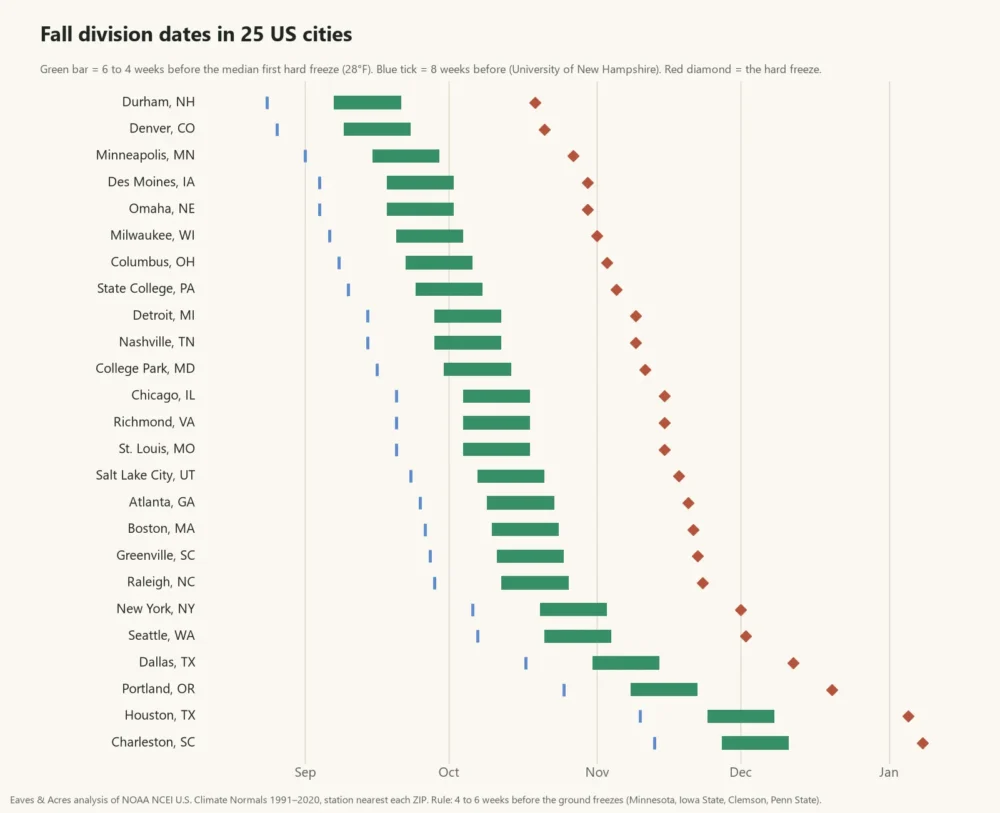
The median ZIP code has its first 32°F frost on October 24 and its first 28°F hard freeze on November 4. Colder places sit at the top of the chart: Denver’s window is September 9 to 23 and Durham, New Hampshire’s is September 7 to 21. Seattle runs October 21 to November 4, Portland, Oregon November 8 to 22, and Charleston, South Carolina November 27 to December 11. A planning table is a median, so one fall in two brings the freeze earlier. NOAA’s 10% date for the first 32°F frost, the early one year in ten, is a median of 14 days before the median date (middle half 13 to 16), so pull your own date forward by about two weeks if you want a safety margin.1
Why the way you count changes the date by weeks
Three choices move the answer: which freeze you count from, how many weeks you allow, and whether you trust the weeks at all. The University of New Hampshire asks for more time than the others:7
aim to do so at least eight weeks before the ground freezes
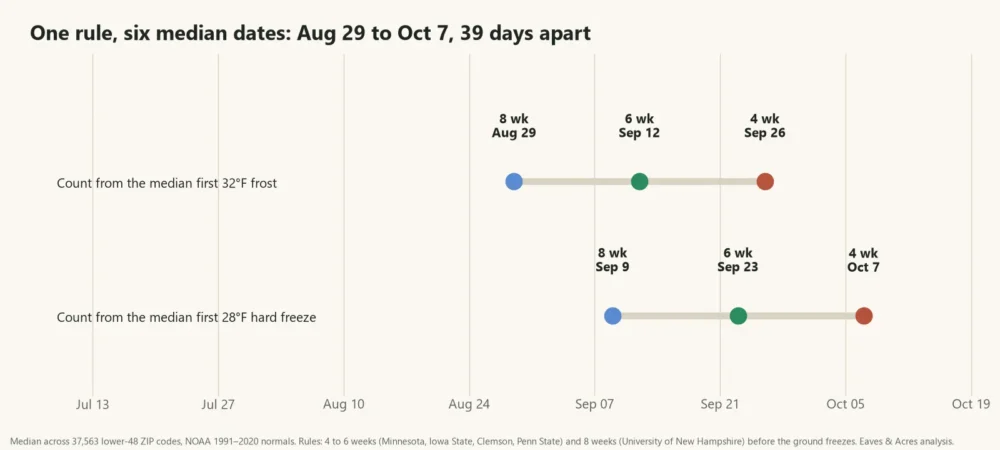
Counting from the 32°F frost instead of the 28°F hard freeze moves every date earlier by a median of 11 days (middle half 10 to 13 days across ZIP codes). That matches the gap in our frost-cover guide. Moving from 4 weeks to 6 weeks costs two more weeks, and 8 weeks costs two more again. The six median dates in the chart below sit 39 days apart.
| Weeks before | Counted from the median first 28°F hard freeze | Share of ZIP codes where that is before Sept 1 | Counted from the median first 32°F frost | Share of ZIP codes where that is before Sept 1 | Who uses it |
|---|---|---|---|---|---|
| 4 weeks | Oct 7 | 1.5% | Sep 26 | 5.9% | Minnesota, Iowa State, Clemson, Penn State, Piedmont Master Gardeners (the last date) |
| 6 weeks | Sep 23 | 9.6% | Sep 12 | 24.4% | The same sources (the early end of 4 to 6) |
| 8 weeks | Sep 9 | 28.2% | Aug 29 | 55.1% | University of New Hampshire |
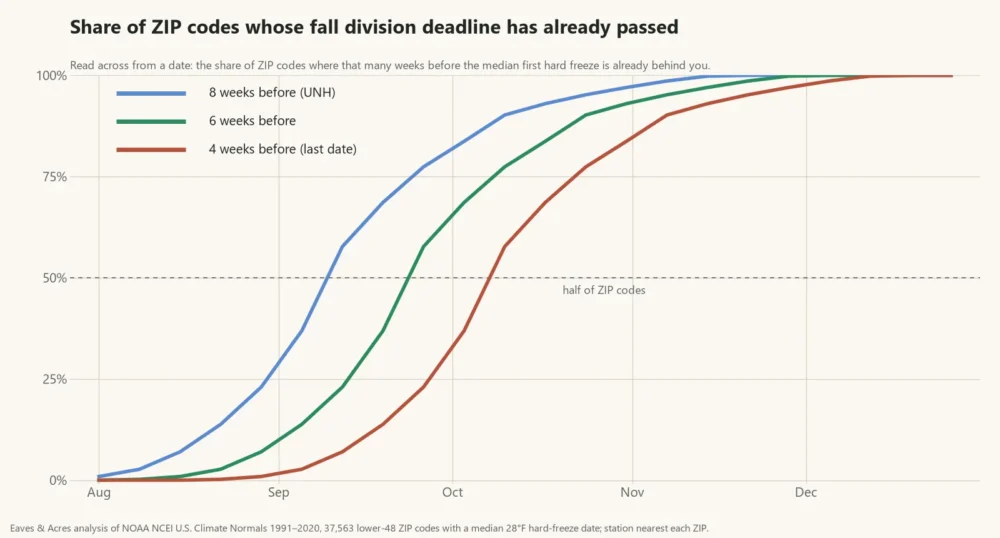
The rule you pick decides whether the deadline has already passed. Counted from the hard freeze, the 4-week limit falls on October 15 or later in 33.9% of ZIP codes, on November 1 or later in 15.5% and on November 15 or later in 6.4%. Under the 8-week rule the date falls before September 1 in 28.2% of ZIP codes, and counted from the frost it does in 55.1%. Read any date on the chart to see how many ZIP codes have passed it.
Is “divide in September” right?
Penn State recommends September where spring is late and short,5 and Iowa State calls mid-August through September a good time to divide some perennials in Iowa.3 As a national rule, September works better than its critics say: a 4-to-6-week window overlaps September in 64.6% of ZIP codes. September 1 is at least 6 weeks before the hard freeze in 90.4% of them. September 30 is still at least 4 weeks ahead in 69.6% and at least 6 weeks ahead in only 35.7%. So early September leaves time almost everywhere, while in the other 30.4% of ZIP codes the 4-week limit passes before the month ends.
How published local calendars compare
Five published statements can be tested against the count. Iowa State’s “mid-August through September” ends within 2 days of our Des Moines limit when we count from the hard freeze (October 2); counted from the frost it would end 8 days earlier.3 Penn State’s September advice sits at the early edge of State College’s window (September 24 to October 8): September 30 is five weeks before the hard freeze. Clemson gives two start dates, early September in the uppermost Piedmont and mid- to late October on the coast, and then the same 4-to-6-week allowance, so its dates are starts, not deadlines, and fall weeks before ours. New Hampshire’s 8-week rule puts Durham at August 24, two weeks earlier than the 6-week mark.4,7
| Place | Published guidance | Our dates | What the comparison shows |
|---|---|---|---|
| Des Moines, IA | Iowa State: mid-August through September; at least 4 to 6 weeks before the ground freezes | Sep 4 / Sep 18 / Oct 2 | Ends 2 days before our 4-week limit; counted from the 32°F frost the limit is Sep 22 |
| State College, PA | Penn State: September where spring is late and short | Sep 10 / Sep 24 / Oct 8 | Sep 30 is 5 weeks before the Nov 5 hard freeze, the early edge of our window |
| Walhalla, SC (uppermost Piedmont) | Clemson: fall division from early September | Sep 14 / Sep 28 / Oct 12 | A start date about 3 to 4 weeks before our 6-week mark |
| Charleston, SC (coast) | Clemson: to mid- to late October on the coast | Nov 13 / Nov 27 / Dec 11 | A start date about 5 to 6 weeks before our 6-week mark |
| Durham, NH | New Hampshire: at least 8 weeks before the ground freezes | Aug 24 / Sep 7 / Sep 21 | Two weeks earlier than our 6-week mark |
Spring: divide as the new shoots appear
For fall bloomers and for anything you want to move before it gets big, spring is the easier season. Minnesota lists the reasons: new growth makes the plant easy to see, small leaves and shoots are damaged less, roots hold stored energy, early-season rain helps, and the plant has the whole growing season to recover.2 Iowa State sets the moment as just as the foliage emerges, in April in Iowa.3 Clemson says the ideal time is as soon as growing tips emerge and warns that spring-divided perennials often bloom a little later than usual, so leave time for roots to settle before hot weather.4

Our NOAA table cannot say when shoots emerge, so we give no spring date; April in Iowa is the only month any source we read states. Do it on a cloudy day, water the soil a day ahead if it is dry, and give each division three to five shoots and a good share of roots.2,4 Iowa State adds that most newly divided perennials do not bloom well until their second growing season.3
Peonies, irises, daylilies and hostas
Peonies
Fall is the answer in every source we read. Iowa State says September is best because the plant has stored food by then and the new divisions have several weeks to settle before winter.11 The Chicago Botanic Garden says fall transplants still bloom the following spring.13 Clemson gives September or October and warns that divisions may wait up to three years to bloom.4 Each division needs three to five buds, called eyes; Iowa State says divisions with fewer than three will probably take several years to flower well.11 Planting depth differs: Iowa State puts the buds 1 to 2 inches below the surface, Clemson no deeper than 1 inch.11,4
Peonies may not need dividing at all. Iowa State says garden peonies can be left undisturbed for 50 or more years, and Minnesota warns that their deep fleshy roots break easily.3,2 The Chicago Botanic Garden says to divide only when a clump overtakes its space or sits in too much shade.13
Bearded irises
Irises are the exception to “not in summer.” Penn State says bearded iris goes dormant in summer, making August the best month, and that dividing after flowering, when the plant is dormant, reduces the chance of bacterial soft rot.5,6 Iowa State says July or August, and Clemson says any time from a month after flowering until early fall.3,4 Illinois puts irises with other fleshy-rooted perennials in late summer to very early fall.8 August 31 is at least 6 weeks before the median hard freeze in 91.5% of ZIP codes, and August 15 in 99.1%, so an August division meets the 4-to-6-week rule nearly everywhere. Every three to five years is the usual interval.6
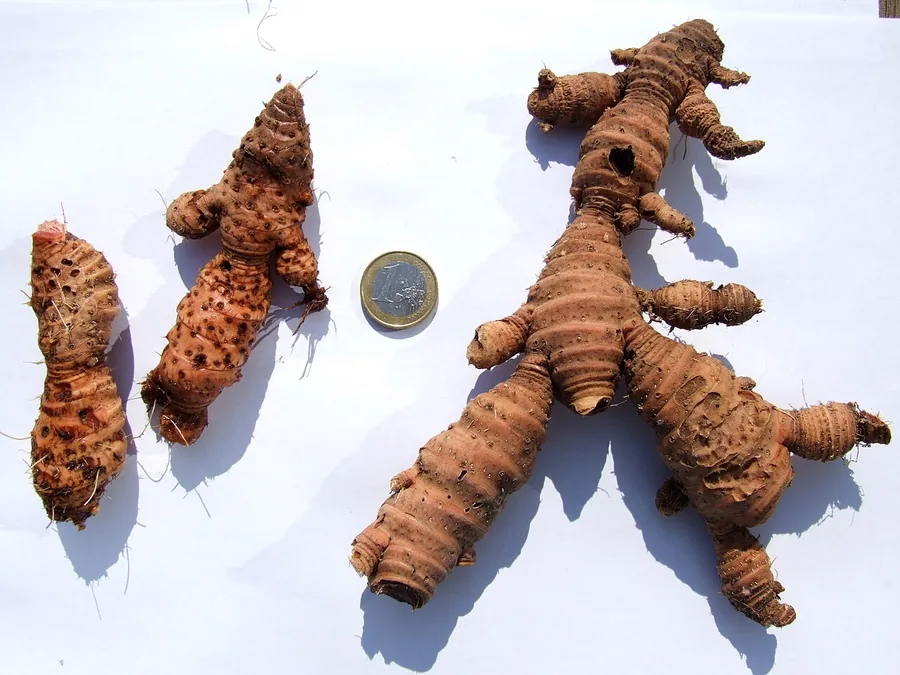

Siberian iris is where the sources split. Minnesota lists it with peonies and Oriental poppy as a fleshy-rooted plant best divided in fall; Iowa State’s table says early summer, right after blooming.2,3 Clemson’s text and table also differ for bearded iris, since its table lists spring.4 For Siberian iris, ask your county extension office which timing it uses.
Daylilies
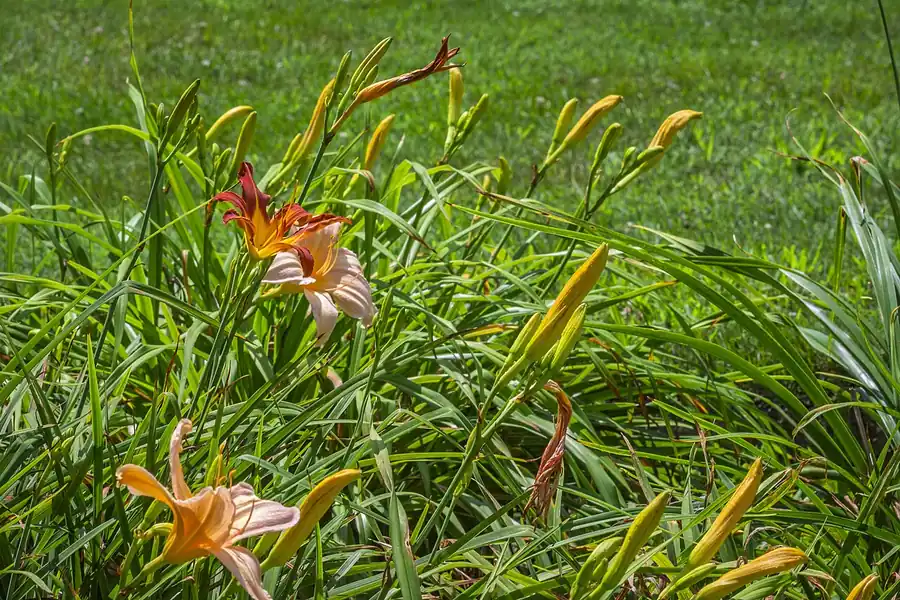
Daylilies take either end of the season. Iowa State says early spring, as new growth starts, or late summer; for a late-summer job it says to cut the foliage back to 6 to 8 inches, and that divided plants usually do not bloom well for 1 or 2 years.10 Clemson says spring, summer or fall, with the ideal time just after bloom, every 3 to 6 years.4 Their dense crowns need a sharp knife or two forks back to back.2,15

Hostas
Iowa State says spring is the best time, digging the whole clump as the pointed leaves emerge, but that hostas can be divided any time from spring to late summer.9 Minnesota says to divide them in spring before they get too large.2 Clemson allows early spring or early fall, and the Old Farmer’s Almanac lists hostas as easy to divide in the fall.4,16 Iowa State’s warning applies to any late division: mulch late-summer divisions with several inches of straw or pine needles in late fall, because repeated freezing and thawing can heave them up and kill them.9 It also says hostas can be left alone for years.3
Signs it is time, and what not to divide
Watch the plant. Minnesota lists smaller blooms, a bald center and stems that need staking; Clemson lists smaller flowers, hollow dead centers and sparse bottom foliage.2,4 Most perennials need dividing every three to five years, though Illinois puts some at 8 to 10 years and Iowa State says vigorous growers such as bee balm and obedient plant need it every 2 to 3 years.4,8,3 Clemson says chrysanthemums and asters can need it every one or two years.4 Penn State’s author states the rule of thumb as every three years but divides only after looking at a plant’s shape and condition.5
Some plants resent it. Minnesota, Iowa State and Penn State list Baptisia, or false indigo, because its long deep roots do not survive being dug.2,3,5 Iowa State and Clemson add butterfly weed, and Penn State adds lavender, Russian sage, lupine, clematis, baby’s breath and columbine.3,4,5 Daffodils and tulips are bulbs, not perennial clumps: our daffodil guide covers when to divide their clumps and the tulip guide when to plant. For shrubs, see when to prune roses and hydrangeas, and when to plant trees and shrubs.
Mild-winter ZIP codes
Where the freeze is rare or late, the count has little to bite on. NOAA gives no median frost date for Phoenix, Los Angeles or Orlando, so there is nothing to count from, and 1,454 contiguous-US ZIP codes have a median 32°F frost but no median 28°F hard freeze (we left them out of the national figures). Houston’s median hard freeze is January 5, which puts the count-back window at November 24 to December 8. Clemson’s fall window for the South Carolina coast starts in mid- to late October,4 weeks before ours for Charleston, so ask your county extension office which of the two applies, and use our zone guide to choose plants rather than to time them.
After dividing: water, mulch and wait
Replant divisions at once, at the depth they grew, and water through the first growing season.3 Minnesota and Clemson say to water the soil a day or two beforehand, and Clemson says to cut stems and foliage back to about 6 inches first.2,4 Late divisions need winter cover. Iowa State advises a 4- to 6-inch layer of straw in November, removed in early April, and the Piedmont Master Gardeners suggest 2 to 3 inches of organic mulch after the first freeze to keep the divisions from heaving.3,15
How we calculated these dates
Dates are the median first 32°F frost and median first 28°F hard freeze in NOAA’s 1991–2020 normals for the station nearest each ZIP code, minus 28, 42 and 56 days (4, 6 and 8 weeks).1 The national figures use the 37,563 contiguous-US ZIP codes with both dates. NOAA has no soil data, so every date is an air-temperature proxy for “before the ground freezes,” the rule extension services state. Spring has no computed date. Individual years vary by weeks.
Next steps
Look up your own dates with our frost date lookup, read what a last frost date means, and browse the rest of our flower and bulb guides.
Frequently asked questions
Divide when the plant is not flowering: spring and summer bloomers in fall, fall bloomers such as asters and mums in spring. Fall division should finish 4 to 6 weeks before the ground freezes (Minnesota, Iowa State, Clemson, Penn State). Spring division is best as the new shoots emerge.
Count 4 weeks back from your first hard freeze. The median US ZIP code reaches that limit on October 7: September 29 in Minneapolis, October 18 in Chicago, November 14 in Dallas. It falls on October 15 or later in 33.9% of ZIP codes and on November 1 or later in 15.5%.
Not everywhere. In 33.9% of ZIP codes the 4-week limit is October 15 or later, but in 32.6% it has passed by October 1. Clemson gives September or October for peonies. If your limit has passed, wait for spring or mulch late divisions well; Iowa State says to cover them in November.
Spring: asters, chrysanthemums, most ornamental grasses, and hostas in Iowa State and Minnesota advice. Late summer to fall: peonies (September) and bearded irises (July or August). Daylilies and hostas can go either way. Siberian iris differs: Minnesota says fall, Iowa State early summer after bloom.
Yes, with a caveat. Iowa State says spring is best but hostas can be divided any time from spring to late summer, and Clemson allows early fall. Mulch late divisions with several inches of straw so freeze-and-thaw cycles do not heave them up.
Baptisia (false indigo) and butterfly weed have deep roots and resent it. Penn State adds lavender and Russian sage, which are shrub-like, and lupine, clematis, baby’s breath and columbine. Peonies rarely need it: Iowa State says they can stay undisturbed for 50 or more years.
Most need it every 3 to 5 years (Clemson, Illinois). Vigorous spreaders such as bee balm need it every 2 to 3 years, asters and mums every 1 to 2, and some plants only every 8 to 10 years. Divide when blooms shrink or the center dies out, not by the calendar.
Sources
- 1.U.S. Climate Normals 1991–2020. NOAA National Centers for Environmental Information, 2021. Used for: median first 32°F frost and first 28°F hard-freeze dates, 1-in-10 first-frost dates and monthly temperature normals for every ZIP code Back to text
- 2.How and when to divide perennials. University of Minnesota Extension, 2026. Used for: divide when not flowering; fall bloomers in spring, spring and summer bloomers in fall; fall division four to six weeks before the ground freezes; peonies, Oriental poppy and Siberian iris in fall; Baptisia and peonies hard to divide Back to text
- 3.How to Divide and Transplant Perennials, Aaron Steil. Iowa State University Extension and Outreach, 2026. Used for: mid-August through September; at least 4 to 6 weeks before the ground freezes; November straw mulch; every 2 to 3 and 3 to 5 years; species table Back to text
- 4.Dividing Perennials. Clemson Cooperative Extension Home & Garden Information Center, 2024. Used for: early September in the uppermost Piedmont to mid- to late October on the coast; four to six weeks before the ground freezes; plant-by-plant table; plants that resent division Back to text
- 5.A Guide to Dividing Perennials. Penn State Extension, 2023. Used for: September where spring is late and short, four to six weeks before the ground freezes; not in summer heat except bearded iris in August; every three years; plants that resent division Back to text
- 6.Dividing Irises. Penn State Extension, 2026. Used for: divide after flowering when dormant to reduce soft rot; roots established four to six weeks before the first hard freeze or killing frost; every three to five years Back to text
- 7.When should I divide my perennials?. University of New Hampshire Extension, 2021. Used for: at least eight weeks before the ground freezes; fall divisions may heave; many New Hampshire gardeners divide in spring Back to text
- 8.Dividing Perennials. University of Illinois Extension, n.d. Used for: no set rule; spring preferred; poppy, peony and iris in late summer to very early fall; every 3 to 5 or 8 to 10 years Back to text
- 9.When is the best time to divide hostas?. Iowa State University Extension and Outreach, 2025. Used for: spring best; any time from spring to late summer; mulch late-summer divisions Back to text
- 10.When can I divide daylilies?. Iowa State University Extension and Outreach, 2025. Used for: early spring or late summer; cut foliage to 6 to 8 inches; slow to bloom for 1 or 2 years Back to text
- 11.Transplanting and Dividing Peonies, Richard Jauron. Iowa State University Extension and Outreach, 2022. Used for: September best; three to five buds per division; planting depth; mulch in mid- to late November Back to text
- 12.Dividing perennials. Chicago Botanic Garden, n.d. Used for: spring bloomers in fall and fall bloomers in spring; most divided in spring Back to text
- 13.Dividing Peonies in Fall. Chicago Botanic Garden, n.d. Used for: fall is best for peonies; three to five eyes; divide when a clump overtakes its space Back to text
- 14.How and when to divide perennials for healthier, more productive plants. Oregon State University Extension Service, 2025. Used for: summer and fall bloomers in spring, spring bloomers after flowering or in fall; never while blooming Back to text
- 15.Guidelines for Dividing Perennials. Piedmont Master Gardeners, n.d. Used for: about four to six weeks before the ground freezes; mulch 2 to 3 inches after the first freeze; two forks for dense crowns Back to text
- 16.When and How to Divide Perennials, Robin Sweetser. The Old Farmer’s Almanac, 2025. Used for: asters and chrysanthemums until spring; hostas, daylilies and ornamental grasses easy to divide in fall Back to text
- 17.Photo: 106. On Edge. Perennial Border Moffatt-Ladd House, InAweofGod’sCreation (CC BY 2.0). Wikimedia Commons, 2005. Used for: hero photo
- 18.Photo: Hosta in a Brastad garden, W.carter (CC0). Wikimedia Commons, 2019. Used for: hosta photo
- 19.Photo: Iris pseudacorus rhizom 2009 09270018, G.-U. Tolkiehn (CC BY 3.0). Wikimedia Commons, 2009. Used for: iris rhizome photo
- 20.Photo: Daylilies, Kellogg Estate Garden, Derby, Ethan Long (CC BY 4.0). Wikimedia Commons, 2025. Used for: daylily photo
How this guide was made
- Written by the Yard & Garden Desk and reviewed by the Data & Methodology Desk.
- Data: median first 32°F frost and first 28°F hard-freeze dates, 1-in-10 first-frost dates and monthly temperature normals from NOAA NCEI U.S. Climate Normals 1991–2020 for the station nearest each ZIP code; division rules and calendars from Minnesota, Iowa State, Clemson, Penn State, New Hampshire, Illinois and Oregon State extension, the Chicago Botanic Garden, the Piedmont Master Gardeners and the Old Farmer’s Almanac. Air temperature stands in for ground temperature. See our methodology.
- AI use: AI tools help us research, draft and check this guide. Every figure is checked against the source cited for it, and calculated figures come from our own code, described on the methodology page.
- Spotted an error? Tell us — the form opens with this page’s address filled in.
Change log
- Oct 22, 2026Published. Fall division dates for 25 cities counted back from NOAA 1991–2020 first hard-freeze and first-frost normals, the rule tested across 37,563 lower-48 ZIP codes, and a plant-by-plant comparison of extension advice.
Covers lawns, gardens, frost and planting. We write the guides and maintain the tools that tell you when to seed, feed and plant for your ZIP.
Keep reading

When to Cut Back Perennials: Fall, Winter or Spring Dates by City
Cut diseased perennials after several hard frosts and leave healthy stems until spring. Hard-freeze, last-frost and 50°F-night dates for 25 cities and 39,017 ZIP codes from NOAA normals.
When to Prune Roses: Late Winter for Most, After Bloom for Some
Prune repeat-blooming roses in late winter as buds swell, and once-bloomers right after flowering. ZIP-code freeze dates, extension windows for eight places and what extension services say about fall pruning.
When to Prune Hydrangeas: Old Wood, New Wood and Local Dates
Prune new-wood hydrangeas in late winter and old-wood types right after bloom. NOAA freeze and frost dates by ZIP and zone, the August 1 cutoff tested, and where extension sources disagree.
Seasonal reminders for your ZIP
Get a short email when it’s time to overseed, start seeds, open the pool or service your furnace — timed to your climate.