

When to Cut Back Perennials: Fall, Winter or Spring Dates by City
Extension services split on cutting back perennials: in fall after hard frosts, in winter to a tall stubble, or in spring before new growth. We turned each rule into dates for 25 cities and 39,017 ZIP codes.
- Last reviewed Oct 22, 2026
- 19 cited sources
- 12 min read

Set your ZIP to see dates for your area.
- 1Cut diseased, pest-ridden or mushy perennials (bee balm and phlox with mildew, hostas, peonies) after several hard frosts. Leave healthy stems, seed heads, grasses and marginally hardy plants such as mums until late winter or spring.
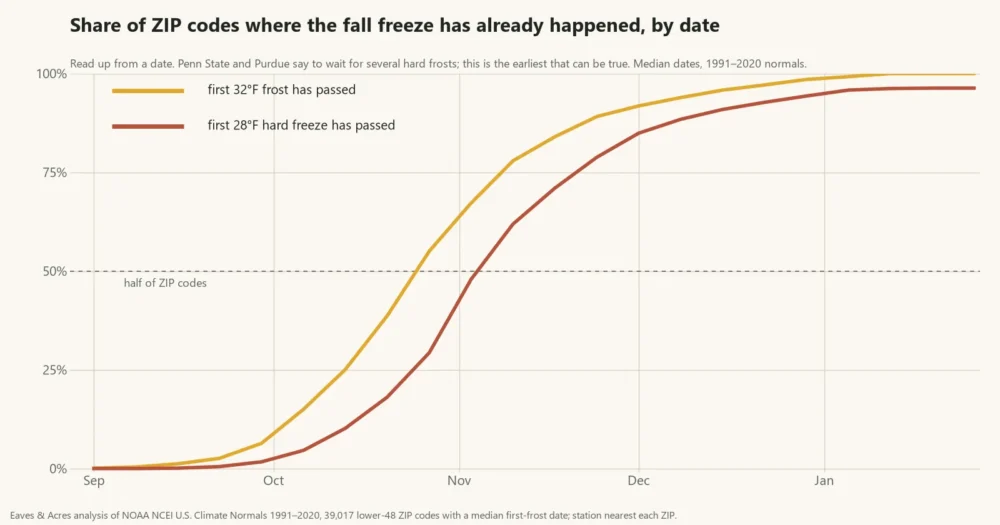
- 2The median US ZIP code has its first 28°F hard freeze on November 4. By October 22 it has passed in only 21.5% of ZIP codes, so October is too early for healthy plants in most places.
- 3NC State says to trim stems to 12 to 24 inches between the first and last frost (a median window of 174 days). Illinois says wait for nights over 50°F, which the median ZIP code reaches on May 13, 25 days after its last frost.
- 4Spring calendars of March and April, such as Minnesota’s, run well ahead of the 50°F-night rule: in 67.8% of ZIP codes that date is May 1 or later.
- 5Height depends on the reason: about 2 inches to mark the plant and tidy it (Penn State, Purdue), 12 to 24 inches to leave nesting stems for bees (NC State, Illinois).
Cut back a perennial after several hard frosts have killed its top growth if it was diseased, pest-ridden or turns to mush, and leave healthy stems and seed heads standing until late winter or spring, before new growth starts. That is what Penn State, Purdue, New Hampshire and Iowa State extension say, and for the median US ZIP code it puts fall cutting no earlier than November 4, the median first 28°F hard freeze, and spring cutting from about April 4, the median last one, until the shoots show.
The sources disagree on two things: whether to cut in fall, winter or spring, and how low to cut. We turned each rule into dates with NOAA 1991–2020 normals1 for 25 cities and about 39,000 ZIP codes, so you can see what “after a hard frost” and “before new growth” mean where you live. Dividing a clump is a different job with its own dates: see when to divide perennials.
Fall, winter or spring? What extension services say
There are three schools of advice. Penn State and Purdue say to cut diseased plants in fall and let most healthy ones stand;2,3 New Hampshire and Iowa State say the same and add that fall clean-up is optional;4,5 and NC State says the best time for stem-nesting bees is a winter trim to a tall stubble.10 Minnesota’s calendar lists November for fall cutting and March and April for spring cutting.13 The table lines them up.
| Source | In fall | In winter or spring | Height left |
|---|---|---|---|
| Penn State Extension | Diseased plants, hostas, plants with browned stalks, after several hard frosts | Leave grasses, seed heads, mums, evergreens; cut grasses before shoots appear | About 2 in |
| Purdue Extension | Diseased plants and iris foliage; otherwise after several hard frosts | Healthy plants and mums stand; butterfly bush and Russian sage before new growth | About 2 in |
| University of New Hampshire | Iris, daylily, hosta, peony, phlox, yarrow and anything diseased | Seed heads, grasses, mums and evergreens, cut before new growth | — |
| Iowa State Extension | Optional after the foliage is killed by a hard freeze; diseased or weedy plants; peonies late Oct to early Nov | Grasses in April; remove mulch about mid-March | 2 to 4 in (grasses) |
| University of Minnesota calendar | November | March and April | — |
| NC State Extension | — | Trim between the first fall frost and the last spring frost, in the first winter | 12 to 24 in |
| University of Illinois Extension | — | Hold off until nights are consistently over 50°F; delay mulch | 12 to 18 in; not under 15 in if early |
| University of Maryland Extension | Only unhealthy stems | Wait until late spring | — |
Iowa State states the shared point plainly: it is not necessary to clear-cut the perennial garden after the first freeze, because leaving the stems protects the crown and feeds wildlife.5 The cost is a little more work in spring, which New Hampshire accepts in exchange for wildlife value, beauty and plant survival.4
Cut in fall: only the plants that need it
Four groups are worth cutting in fall. Plants with disease or insect trouble come first: Penn State names bee balm and garden phlox with powdery mildew and says to destroy the stems, not compost them, and Purdue adds peonies and black-eyed Susans with blackened foliage.2,3 Hostas come next, because their dead leaves hold slug eggs that hatch in spring.2 Plants with browning or blackened foliage and bare stalks, such as peonies, daylilies, brunnera and speedwell, can go too, and so can iris foliage, which Purdue says removes overwintering sites for the iris borer.2,3 The fourth group is weedy seeders, which Iowa State says benefit from late-season deadheading.5
Timing is the other half of the rule. Penn State sets it this way:
wait until several hard frosts have killed back the tops
The reason is that roots pull energy back from dying tops, and Penn State says to give them time to do it. Purdue makes one exception: badly damaged or infested foliage can go at once.3 Iowa State’s peony advice, late October or early November in Iowa, sits on top of the Des Moines median first hard freeze, October 30.7
NOAA’s normals have a date for the first 28°F hard freeze but not for “several”, so the table below shows the earliest date the rule can be met. The median ZIP code has its first 32°F frost on October 25 and its first hard freeze on November 4. By October 22 the median hard freeze has already passed in 21.5% of ZIP codes, by November 1 in 44.8%, by November 15 in 71.4% and by December 1 in 88.2%. So in most of the country October is too early to cut a healthy plant under the Penn State rule.
Leave standing: seed heads, grasses and tender perennials
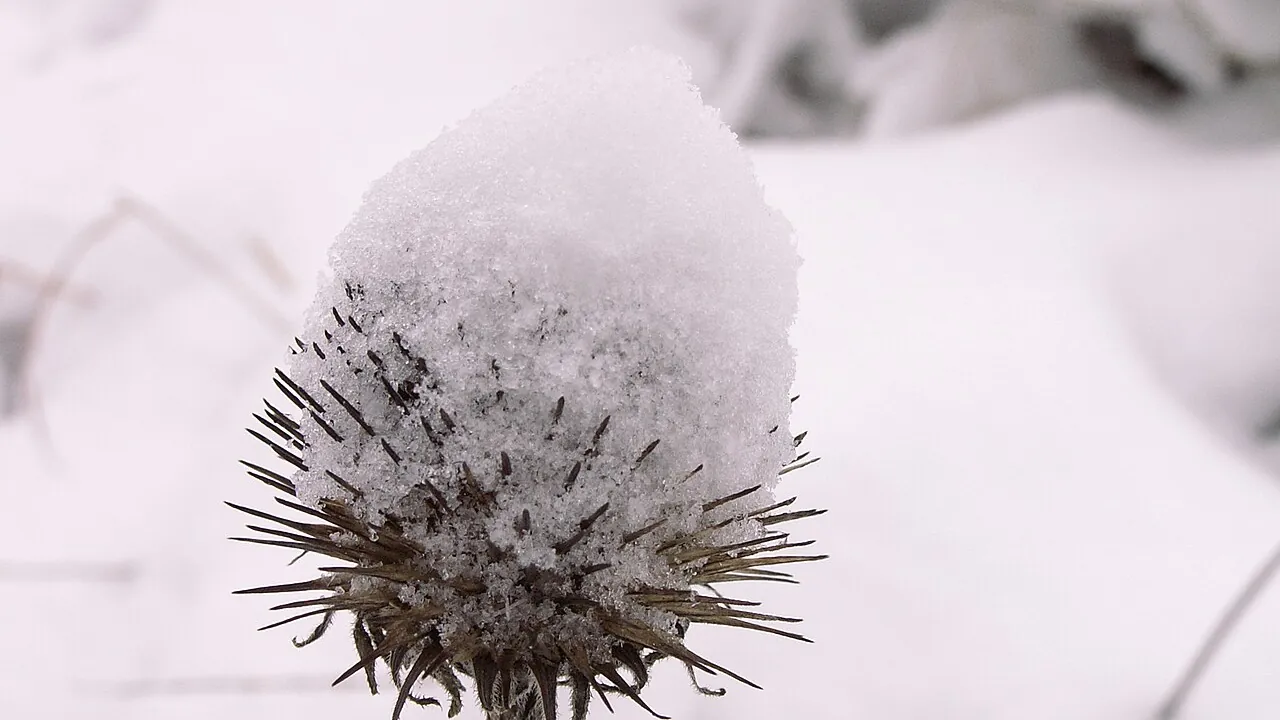
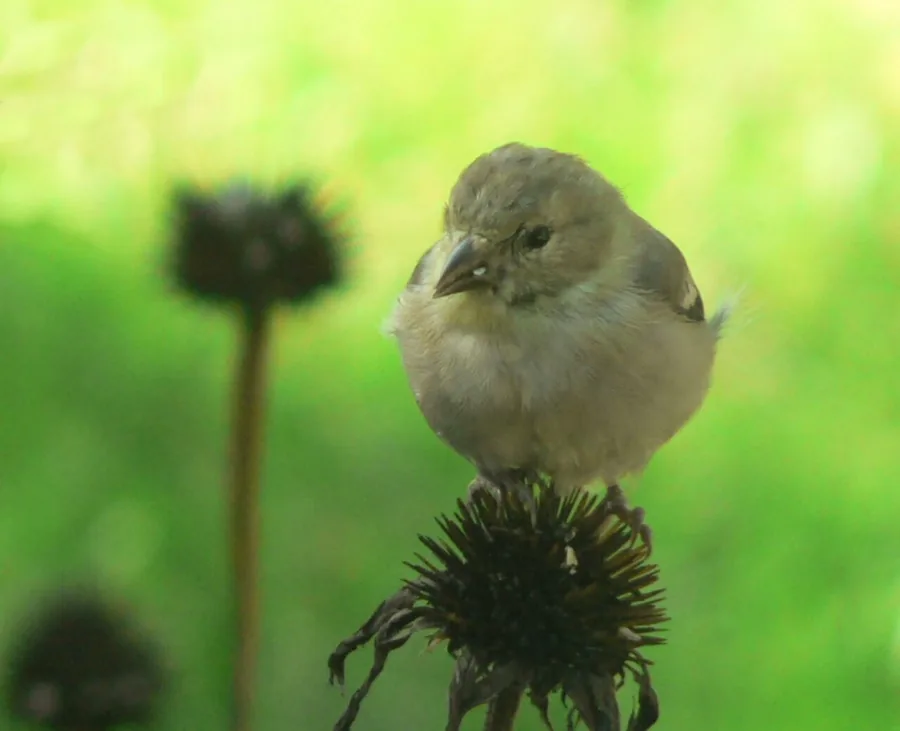
Most healthy perennials can stand until spring, and extension services give four reasons. Seed heads feed birds: Penn State names purple coneflower, black-eyed Susan and oxeye sunflower, and New Hampshire lists coneflower, coreopsis, liatris and switchgrass.2,4 Dead tops collect leaves and snow around the crown, which Iowa State says gives an extra layer of protection and helps shallow-rooted plants that frost-heave.5,6 Structure adds winter interest: ornamental grasses, sedum, Joe Pye weed and the pods of Baptisia and Siberian iris.2 And standing material shelters beneficial insects, so Penn State says not to rake debris from around the plants.2

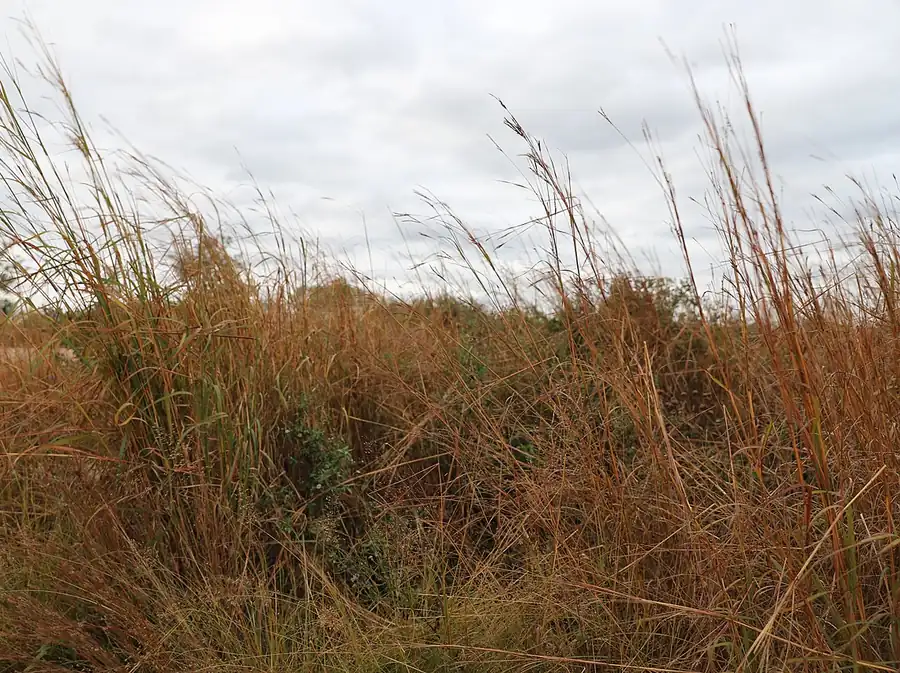
Marginally hardy perennials need the stems most. Purdue says that waiting until early spring to cut garden mums can improve their chance of surviving, and Penn State adds anise hyssop, red-hot poker and Montauk daisy.3,2 Evergreen and semi-evergreen plants such as hellebores, heucheras, hardy geraniums, dianthus and moss phlox are only tidied in spring.2 Ornamental grasses stand until spring and are cut before the new shoots appear; Iowa State says April, to 2 to 4 inches from the ground.2,8 Late emergers such as butterfly weed and rose mallow should keep a stub so you do not dig into them in spring.2

The bee question: trim in winter or wait for warm nights
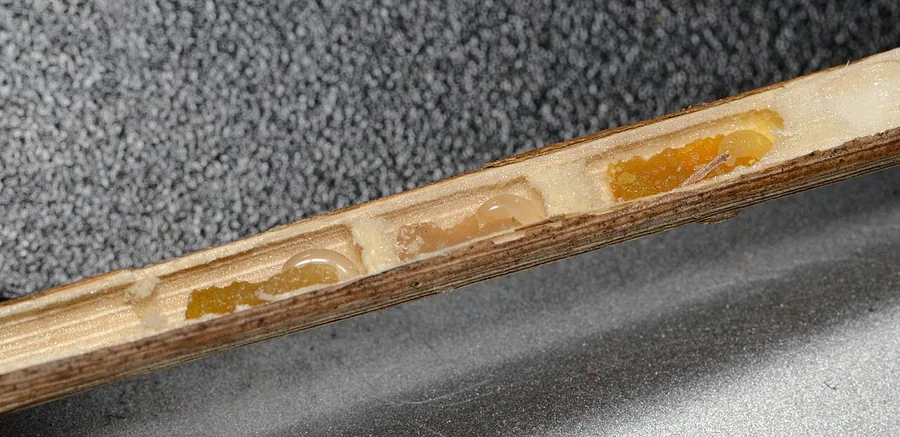
Illinois Extension says 30 percent of native bees nest above ground, and some species overwinter in the pith of stems.12 The two best-sourced answers differ. NC State sampled nearly 3,000 stems from 20 North Carolina gardens and found no nests in stems in their first winter. Its publication says:9,10
trim between the first fall frost and the last spring frost
Its advice is to trim to a 12- to 24-inch stubble in the first winter, leave it alone and let seed heads feed birds for a while.10 Illinois puts the emphasis on the spring side. It also counts butterflies and moths wintering in stems and litter, and says to hold off clearing until nights are consistently over 50°F, to cut no shorter than 15 inches if you must tidy early, and to delay mulch so ground-nesting bees can emerge.11,12 Maryland’s extension says to wait until late spring and remove only unhealthy stems.14

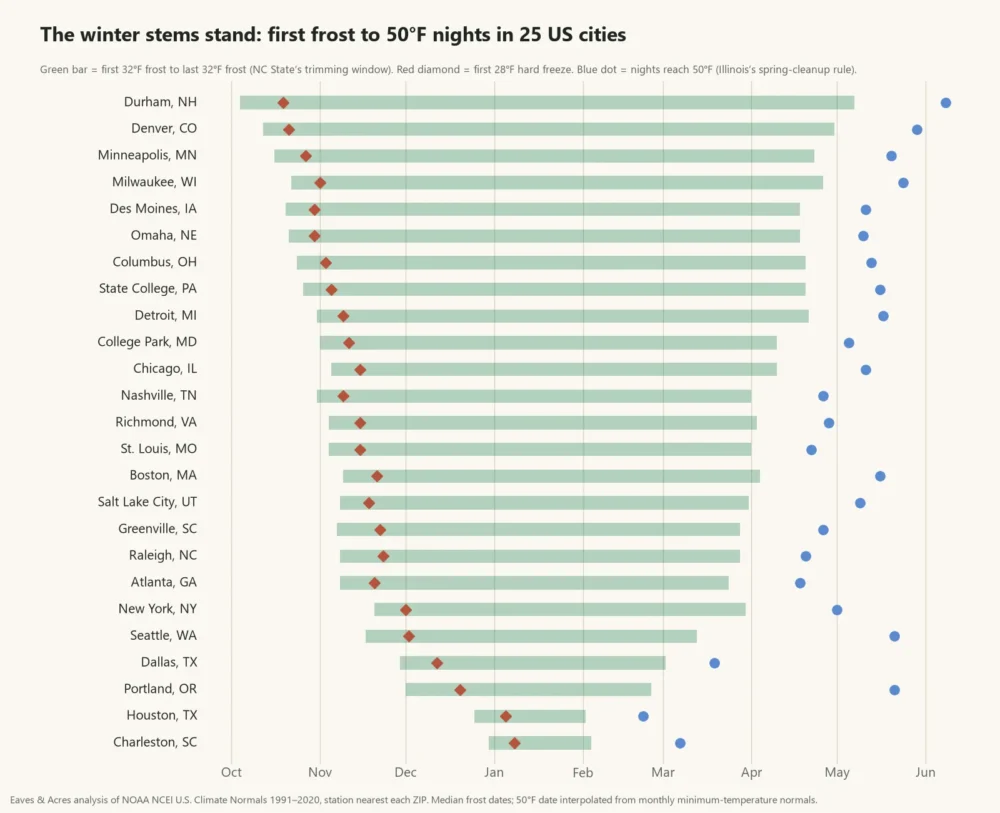
The studies measure different things, so we do not call one right. We can show how much time each rule leaves. NC State’s window, first 32°F frost to last 32°F frost, is a median of 174 days across ZIP codes (middle half 140 to 198) and at least 150 days in 68.1% of them. In Minneapolis it runs 189 days, from October 16 to April 23, and in Chicago 156 days, from November 5 to April 10. Houston has 39 days and Charleston, South Carolina 36, and 8.7% of ZIP codes have under 90.
| City (ZIP) | Median first 32°F frost | Median first 28°F hard freeze | Median last 32°F frost | NC State window: first to last frost (days) |
|---|---|---|---|---|
| Durham, NH (03824) | Oct 4 | Oct 19 | May 7 | 215 |
| Denver, CO (80202) | Oct 12 | Oct 21 | Apr 30 | 200 |
| Minneapolis, MN (55401) | Oct 16 | Oct 27 | Apr 23 | 189 |
| Des Moines, IA (50309) | Oct 20 | Oct 30 | Apr 18 | 180 |
| Omaha, NE (68102) | Oct 21 | Oct 30 | Apr 18 | 179 |
| Milwaukee, WI (53202) | Oct 22 | Nov 1 | Apr 26 | 186 |
| Columbus, OH (43215) | Oct 24 | Nov 3 | Apr 20 | 178 |
| State College, PA (16801) | Oct 26 | Nov 5 | Apr 20 | 176 |
| Detroit, MI (48226) | Oct 31 | Nov 9 | Apr 21 | 172 |
| Nashville, TN (37201) | Oct 31 | Nov 9 | Apr 1 | 152 |
| College Park, MD (20742) | Nov 1 | Nov 11 | Apr 10 | 160 |
| Chicago, IL (60601) | Nov 5 | Nov 15 | Apr 10 | 156 |
| Richmond, VA (23219) | Nov 4 | Nov 15 | Apr 3 | 150 |
| St. Louis, MO (63101) | Nov 4 | Nov 15 | Apr 1 | 148 |
| Salt Lake City, UT (84101) | Nov 8 | Nov 18 | Mar 31 | 143 |
| Atlanta, GA (30303) | Nov 8 | Nov 20 | Mar 24 | 136 |
| Boston, MA (02108) | Nov 9 | Nov 21 | Apr 4 | 146 |
| Greenville, SC (29601) | Nov 7 | Nov 22 | Mar 28 | 141 |
| Raleigh, NC (27601) | Nov 8 | Nov 23 | Mar 28 | 140 |
| New York, NY (10001) | Nov 20 | Dec 1 | Mar 30 | 130 |
| Seattle, WA (98101) | Nov 17 | Dec 2 | Mar 13 | 116 |
| Dallas, TX (75201) | Nov 29 | Dec 12 | Mar 2 | 93 |
| Portland, OR (97201) | Dec 1 | Dec 20 | Feb 25 | 86 |
| Houston, TX (77002) | Dec 25 | Jan 5 | Feb 2 | 39 |
| Charleston, SC (29401) | Dec 30 | Jan 8 | Feb 4 | 36 |
Spring: before new growth, and what that means in dates
New Hampshire says old stalks can be cut in spring before new growth begins, Penn State says the same for grasses, and Minnesota’s calendar says March and April.4,2,13 Illinois gives a temperature instead:11
hold off until temperatures are consistently over 50 degrees overnight
We computed that rule from NOAA’s monthly lows. The normal night first reaches 50°F in the median ZIP code on May 13, which is a median of 25 days after the last 32°F frost (middle half 22 to 30) and after the median last frost in 99.6% of ZIP codes. “Consistently” would be later still. That is a long wait: in 67.8% of ZIP codes the 50°F date is May 1 or later and in 18.8% June 1 or later, and the median last hard freeze is April 4, so a March-and-April calendar is much earlier than Illinois’s rule in most places.
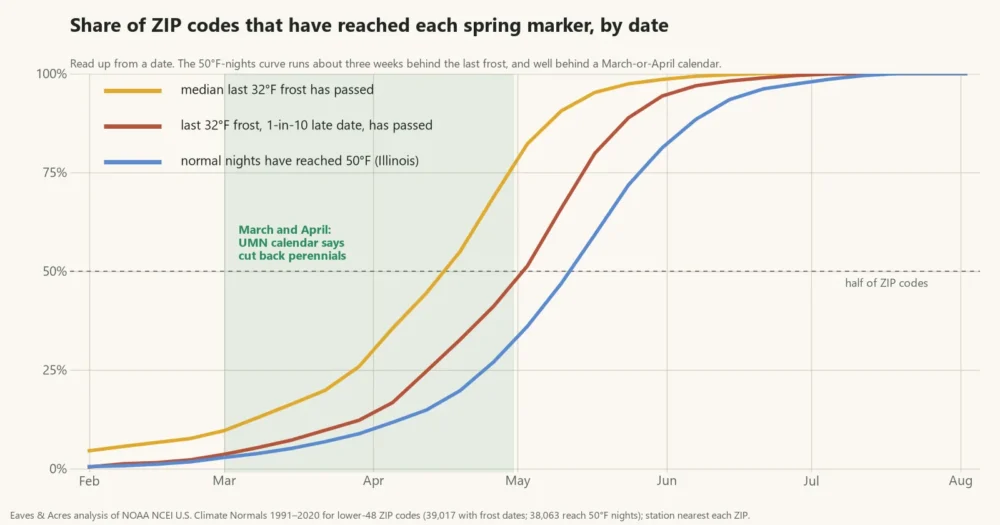
Minneapolis shows the gap: the last 28°F freeze is April 14, the last 32°F frost April 23 and the 50°F date May 20. Chicago’s are April 1, April 10 and May 11. In Seattle the 50°F date is May 21, 69 days after the March 13 last frost, and in Portland, Oregon it is 85 days. Dallas, where lows reach 50°F on March 19, is the opposite case. We read the late date, the 1-in-10 date for the last 32°F frost, as a margin: it falls May 3 for the median ZIP code, and 50°F nights come after it in 88.9%.
| City (ZIP) | Median last 28°F hard freeze | Median last 32°F frost | Late 32°F frost (1-in-10 date) | Normal nights reach 50°F | Days from last frost to 50°F |
|---|---|---|---|---|---|
| Houston, TX (77002) | Jan 23 | Feb 2 | Mar 5 | Feb 22 | 20 |
| Charleston, SC (29401) | Jan 24 | Feb 4 | Mar 4 | Mar 7 | 31 |
| Dallas, TX (75201) | Feb 18 | Mar 2 | Mar 19 | Mar 19 | 17 |
| Atlanta, GA (30303) | Mar 9 | Mar 24 | Apr 10 | Apr 18 | 25 |
| Raleigh, NC (27601) | Mar 14 | Mar 28 | Apr 12 | Apr 20 | 23 |
| St. Louis, MO (63101) | Mar 22 | Apr 1 | Apr 18 | Apr 22 | 21 |
| Nashville, TN (37201) | Mar 20 | Apr 1 | Apr 16 | Apr 26 | 25 |
| Greenville, SC (29601) | Mar 16 | Mar 28 | Apr 12 | Apr 26 | 29 |
| Richmond, VA (23219) | Mar 22 | Apr 3 | Apr 18 | Apr 28 | 25 |
| New York, NY (10001) | Mar 19 | Mar 30 | Apr 9 | May 1 | 32 |
| College Park, MD (20742) | Mar 29 | Apr 10 | May 1 | May 5 | 25 |
| Salt Lake City, UT (84101) | Mar 8 | Mar 31 | Apr 19 | May 9 | 39 |
| Omaha, NE (68102) | Apr 8 | Apr 18 | Apr 30 | May 10 | 22 |
| Chicago, IL (60601) | Apr 1 | Apr 10 | Apr 25 | May 11 | 31 |
| Des Moines, IA (50309) | Apr 8 | Apr 18 | May 2 | May 11 | 23 |
| Columbus, OH (43215) | Apr 8 | Apr 20 | May 7 | May 13 | 23 |
| Boston, MA (02108) | Mar 28 | Apr 4 | Apr 17 | May 16 | 42 |
| State College, PA (16801) | Apr 8 | Apr 20 | May 6 | May 16 | 26 |
| Detroit, MI (48226) | Apr 8 | Apr 21 | May 6 | May 17 | 26 |
| Minneapolis, MN (55401) | Apr 14 | Apr 23 | May 7 | May 20 | 27 |
| Seattle, WA (98101) | Feb 18 | Mar 13 | Apr 1 | May 21 | 69 |
| Portland, OR (97201) | Jan 31 | Feb 25 | Mar 21 | May 21 | 85 |
| Milwaukee, WI (53202) | Apr 14 | Apr 26 | May 12 | May 24 | 28 |
| Denver, CO (80202) | Apr 18 | Apr 30 | May 13 | May 29 | 29 |
| Durham, NH (03824) | Apr 24 | May 7 | May 19 | Jun 8 | 32 |
A practical order follows. Cut grasses and sub-shrubs when the sources say, tidy stems to a tall stubble as the ground thaws if you want order, and clear the rest when nights warm. For a plant already damaged by frost, wait: our frost-cover guide quotes UF/IFAS on not pruning until new growth shows. Purdue says butterfly bush, bluebeard and Russian sage are cut to a few inches above the ground in the dormant season, best before new growth begins.15 That is a spring job; for true shrubs see when to prune roses and when to prune hydrangeas.
How far to cut
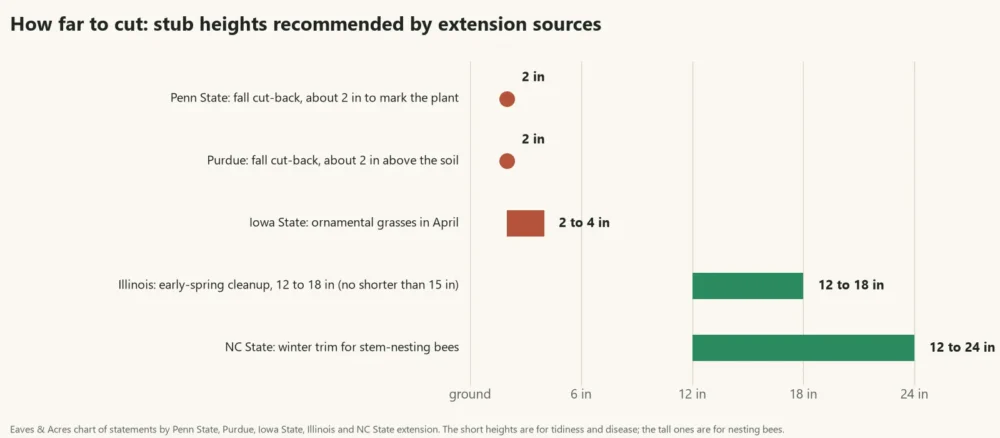
The height depends on the reason. Penn State and Purdue say to leave about 2 inches so you can find the plant, and Iowa State says 2 to 4 inches for grasses.2,3,8 NC State recommends 12 to 24 inches in winter for bees and Illinois 12 to 18 inches in early spring, never below 15 if you cut early.10,12,11 If you cut stems earlier in the season, NC State says do not cut them again in winter, because bees can move into cut stems.10 Whichever height you choose, loosely stack what you remove: Illinois says dense piles can trap insects, and its 2022 piece says to chop trimmed stems into large chunks and spread them in the garden instead of composting them.11,12
Plant by plant
This table collects what the sources say for the plants that cause the most questions. “Either” means a source accepts both seasons.
| Plant | What the sources say | Source |
|---|---|---|
| Bee balm, garden phlox | Cut in fall if mildew or other disease; destroy the stems, do not compost | Penn State, Purdue, New Hampshire |
| Peony | Cut near ground level after a hard freeze, late October or early November in Iowa; disease is the strongest reason | Iowa State, Penn State, Purdue |
| Hosta | Cut and clear the leaves as soon as frost takes them; they harbor slug eggs | Penn State |
| Daylily, iris | Either: fall when foliage browns; iris foliage removed in fall cuts iris borer sites | Penn State, Purdue, New Hampshire |
| Coneflower, black-eyed Susan | Leave standing for finches; NC State would trim to 12 to 24 in in winter | Penn State, New Hampshire, NC State |
| Ornamental grasses | Leave until spring; cut before shoots appear, in April in Iowa, to 2 to 4 in | Penn State, Iowa State |
| Garden mums, anise hyssop, red-hot poker | Leave until spring; the stems insulate the crown | Purdue, Penn State, New Hampshire |
| Hellebore, heuchera, hardy geranium, dianthus | No cut-back needed; tidy in spring | Penn State, New Hampshire |
| Sedum, Joe Pye weed, Baptisia, Siberian iris | Leave the seed heads for winter interest | Penn State |
| Butterfly weed, rose mallow, balloon flower | If cut, leave about 2 in to mark late-emerging plants | Penn State |
| Yarrow, Shasta daisy, globe thistle | Cut the flower stalks and leave the new basal leaves | Penn State |
| Butterfly bush, bluebeard, Russian sage | Cut to a few inches in the dormant season, best before new growth | Purdue |
Mild-winter ZIP codes
None of the sources we read gives cut-back timing for places without a regular freeze, and the frost-based rules do not apply there. NOAA gives no median frost date for Orlando, Phoenix or Los Angeles, and 1,549 lower-48 ZIP codes have none; 1,454 more have a first frost but no median hard freeze. Where a plant does not die back, trim it when it looks tired and ask your county extension office. Our frost vs. freeze guide explains the terms and the frost date lookup gives the dates for your ZIP code.
How we calculated these dates
Frost and freeze dates are medians from NOAA’s 1991–2020 normals for the station nearest each ZIP code: the first and last 32°F frost, the first and last 28°F hard freeze and the 1-in-10 late spring frost.1 The 50°F date is the first spring day the daily minimum reaches 50°F, with monthly normals placed mid-month and interpolated, the same method as our other guides. National figures use 39,017 lower-48 ZIP codes with a median first frost (37,563 with a median hard freeze; 38,063 that reach 50°F nights). Individual years vary by weeks, and “several hard frosts” cannot be computed from the normals.
Next steps
Read what a last frost date means, see our leaf-raking guide for the lawn side of fall clean-up, and browse the other flower and bulb guides.
Frequently asked questions
For healthy plants, late winter or spring before new growth starts, or a winter trim to a tall stubble if you want to help bees. Cut diseased or mushy plants in fall, after several hard frosts. Penn State, Purdue, New Hampshire and Iowa State agree on this split.
Usually yes for healthy plants. Penn State says to wait until several hard frosts have killed the tops, and the median ZIP code does not reach its first 28°F hard freeze until November 4. By October 22 it has passed in only 21.5% of ZIP codes. Badly diseased foliage can go at once, says Purdue.
Penn State and Purdue say to leave coneflower and black-eyed Susan seed heads for birds, ornamental grasses, sedum, Baptisia, marginally hardy mums, anise hyssop and red-hot poker, and evergreen hellebores, heucheras, hardy geraniums and dianthus.
Ornamental grasses (April in Iowa, to 2 to 4 inches), garden mums and other marginally hardy plants, and sub-shrubs such as butterfly bush, bluebeard and Russian sage, which Purdue says to cut to a few inches before new growth begins.
Mostly little. Iowa State says clear-cutting is not necessary, and the stems protect the crown and feed wildlife; New Hampshire says it only adds some work in spring. The exception is diseased plants: Purdue says leaving them can carry problems into next season.
About 2 inches above the soil to mark the plant (Penn State, Purdue), 2 to 4 inches for grasses (Iowa State), or 12 to 24 inches in winter if you want stems for nesting bees (NC State). Illinois says no shorter than 15 inches if you clean up early in spring.
Minnesota’s calendar says March and April and Iowa State says April for grasses. Illinois says wait until nights are consistently over 50°F, which the median ZIP code reaches on May 13. Check the table for your city, and wait longer if you want to protect overwintering insects.
Sources
- 1.U.S. Climate Normals 1991–2020. NOAA National Centers for Environmental Information, 2021. Used for: median first and last 32°F frost, first and last 28°F hard-freeze dates, 1-in-10 late spring frost dates and monthly minimum-temperature normals for every ZIP code Back to text
- 2.Cutting Down Perennials in the Fall, Nancy Knauss and Pamela T. Hubbard. Penn State Extension, 2026. Used for: wait until several hard frosts have killed the tops; diseased plants, hostas and browned stalks in fall; seed heads, grasses, mums and evergreens stand; about two inches left Back to text
- 3.Cut Back Perennials Now or Later?, Rosie Lerner. Purdue Extension, 2006. Used for: healthy plants can stand; diseased plants in fall; mums survive better if cut in early spring; iris foliage; about two inches above the soil Back to text
- 4.Should perennials be cut back in fall?. University of New Hampshire Extension, 2019. Used for: seed heads for birds; winter interest; marginally hardy plants; perennials to cut in fall; old stalks cut in spring before new growth Back to text
- 5.How should I prepare my perennial beds for winter?. Iowa State University Extension and Outreach, 2022. Used for: cutting back in fall after a hard freeze is optional; leaving stems protects crowns and helps pollinators; diseased or weedy plants are removed Back to text
- 6.Fall Garden Tasks. Iowa State University Extension and Outreach, n.d. Used for: no need to clear-cut the perennial garden; mulch after the ground freezes and remove it about mid-March Back to text
- 7.When can I cut back peony foliage?. Iowa State University Extension and Outreach, 2024. Used for: after a hard freeze destroys the foliage; late October or early November in Iowa; cut near ground level Back to text
- 8.When should I cut back my ornamental grasses?. Iowa State University Extension and Outreach, 2025. Used for: April in Iowa, to 2 to 4 inches above the ground Back to text
- 9.Winter Is a Great Time to Tidy Up Perennial Stems for Pollinator Habitat, Elsa Youngsteadt. NC State Extension, 2025. Used for: study of nearly 3,000 stems from 20 gardens: stems are not occupied in their first winter Back to text
- 10.Garden Cleanup for Pollinators: Trim Perennial Stems in Their First Winter. NC State Extension, 2025. Used for: trim between the first fall frost and the last spring frost; 12 to 24 inch stubble; do not re-cut stems trimmed earlier Back to text
- 11.Spring Garden Cleanup, Ryan Pankau. University of Illinois Extension, 2021. Used for: hold off until temperatures are consistently over 50 degrees overnight; cut no shorter than 15 inches if cleaning early; delay mulch; stack loosely Back to text
- 12.Delay spring garden cleanup, encourage native insects, Kelly Allsup. University of Illinois Extension, 2022. Used for: 30 percent of native bees nest above ground; cut stems to 12 to 18 inches; chop and spread cuttings rather than composting Back to text
- 13.Upper Midwest home garden care schedule. University of Minnesota Extension, n.d. Used for: cut back perennials in March and April and in November Back to text
- 14.How to Protect Pollinators in the Fall, Annette Cormany. University of Maryland Extension, 2024. Used for: do not cut perennials until late spring; remove only unhealthy stems; leave leaves until mid-spring Back to text
- 15.Spring Forward in the Garden, Rosie Lerner. Purdue Extension, 2004. Used for: butterfly bush, bluebeard and Russian sage cut to a few inches in the dormant season, best before new growth Back to text
- 16.Photo: Snow on Purple Coneflower, Cbaile19 (CC0). Wikimedia Commons, 2015. Used for: hero photo
- 17.Photo: Goldfinch on Coneflower, Patty O’Hearn Kickham (CC BY 2.0). Wikimedia Commons, 2006. Used for: goldfinch photo
- 18.Photo: Ceratina nest in fennel 1, Gideon Pisanty (CC BY 3.0). Wikimedia Commons, n.d. Used for: bee nest photo
- 19.Photo: Fall Colors 2019 (20191016-FS-Midewin-WMS-001), U.S. Forest Service (public domain). Wikimedia Commons, 2019. Used for: prairie grasses photo
How this guide was made
- Written by the Yard & Garden Desk and reviewed by the Data & Methodology Desk.
- Data: median first and last 32°F frost, first and last 28°F hard-freeze dates, 1-in-10 late spring frost dates and monthly minimum-temperature normals from NOAA NCEI U.S. Climate Normals 1991–2020 for the station nearest each ZIP code; cut-back rules from Penn State, Purdue, New Hampshire, Iowa State, Minnesota, NC State, Illinois and Maryland extension. The 50°F-night date interpolates monthly normals; air temperature only. See our methodology.
- AI use: AI tools help us research, draft and check this guide. Every figure is checked against the source cited for it, and calculated figures come from our own code, described on the methodology page.
- Spotted an error? Tell us — the form opens with this page’s address filled in.
Change log
- Oct 22, 2026Published. Fall, winter and spring cut-back markers for 25 cities counted from NOAA 1991–2020 first and last frost, hard-freeze and 50°F-night normals, tested across 39,017 lower-48 ZIP codes, with a source-by-source and plant-by-plant comparison of extension advice.
Covers lawns, gardens, frost and planting. We write the guides and maintain the tools that tell you when to seed, feed and plant for your ZIP.
Keep reading
When to Divide Perennials: Fall Dates Counted Back From Your Freeze
Divide spring and summer bloomers in fall, 4 to 6 weeks before the ground freezes, and fall bloomers in spring. Dates for 25 cities and 37,563 ZIP codes from NOAA normals.
When to Prune Roses: Late Winter for Most, After Bloom for Some
Prune repeat-blooming roses in late winter as buds swell, and once-bloomers right after flowering. ZIP-code freeze dates, extension windows for eight places and what extension services say about fall pruning.
When to Prune Hydrangeas: Old Wood, New Wood and Local Dates
Prune new-wood hydrangeas in late winter and old-wood types right after bloom. NOAA freeze and frost dates by ZIP and zone, the August 1 cutoff tested, and where extension sources disagree.
Seasonal reminders for your ZIP
Get a short email when it’s time to overseed, start seeds, open the pool or service your furnace — timed to your climate.