When to Mulch Garden Beds: After the Soil Warms, After the Freeze
Mulch too early in spring and the soil stays cold; mulch too early in fall and plants keep growing. We turned extension rules into dates for 22 cities and tested them against NOAA normals for 37,563 ZIP codes.
- Last reviewed Oct 22, 2026
- 21 cited sources
- 13 min read

Set your ZIP to see dates for your area.
- 1Mulch in spring once the soil has warmed and plants are up, and in fall after the first hard freeze: Iowa State, the Old Farmer’s Almanac and the Morton Arboretum all warn that mulching too early backfires.
- 2Spring: the median ZIP code’s last frost is April 18, and its air mean reaches 65°F, our vegetable-bed marker, on May 25. In Chicago those dates are April 10 and May 26.
- 3Fall: the median first 28°F hard freeze is November 4, and Thanksgiving comes before it in 16.8% of ZIP codes. Chicago’s winter mulch window runs November 15 to December 14.
- 4Mulch 2 to 4 inches deep (3 to 4 in winter) and keep it off trunks: Iowa State says no more than 4 inches at a trunk, and a deeper pile is a “volcano”.
Mulch garden beds twice a year: in spring, once the soil has warmed and plants are up, and in fall, after the first hard freeze rather than before it. Extension sources agree on that shape and publish almost no dates, so we turned their conditions into dates for 22 cities with NOAA normals. In Chicago, flower beds can be mulched from the April 10 median last frost, vegetable beds from about May 26, and winter mulch goes on between the November 15 hard freeze and December 14, when the normal daily air temperature falls below 32°F.
Timing matters because mulch insulates in both directions. Iowa State warns that mulch put down too early in spring can slow plant emergence, and the Old Farmer’s Almanac warns that fall mulch laid too early keeps the soil warm so plants keep growing.2,3 We tested those rules against NOAA 1991–2020 normals1 for 37,563 lower-48 ZIP codes. Everything uses air temperature as a stand-in for soil temperature, because our NOAA data has no soil readings.
Spring: after the soil warms, not when the snow melts
The Brooklyn Botanic Garden says you would ideally mulch in spring after the soil has warmed and before weeds have emerged, though you can mulch any time of year.15 The warning is about starting too early. Iowa State says that in early spring you should wait until the ground warms and perennials emerge, because a layer put down too early:2
can further insulate the ground and slow plant emergence
The Morton Arboretum says spring mulch should wait until the soil begins to warm and excess moisture has drained away, since mulch on cold, wet soil keeps it cold and wet.4 Illinois Extension says to add perennial-bed mulch as soils start to warm,7 and the Almanac says to take winter mulch off once the danger of a hard frost is past.3 None of them gives a temperature for flower beds, so Table 1 gives the nearest frost markers and air-temperature dates for strawberry straw and vegetable beds.
| City (ZIP) | Last 28°F freeze: take winter mulch off | Air mean reaches 40°F: strawberry straw | Last 32°F frost: flower and shrub beds | Air mean reaches 65°F: vegetable beds | Air mean reaches 75°F: Utah State rule |
|---|---|---|---|---|---|
| Minneapolis, MN (55401) | Apr 14 | Apr 3 | Apr 23 | Jun 4 | Never |
| Madison, WI (53703) | Apr 20 | Mar 30 | May 1 | Jun 7 | Never |
| Chicago, IL (60601) | Apr 1 | Mar 17 | Apr 10 | May 26 | Jul 7 |
| Springfield, IL (62701) | Apr 5 | Mar 11 | Apr 15 | May 21 | Jul 8 |
| West Lafayette, IN (47907) | Apr 13 | Mar 15 | Apr 26 | May 27 | Never |
| Des Moines, IA (50309) | Apr 8 | Mar 17 | Apr 18 | May 24 | Jul 8 |
| Columbus, OH (43215) | Apr 8 | Mar 13 | Apr 20 | May 23 | Never |
| Boston, MA (02108) | Mar 28 | Mar 21 | Apr 4 | Jun 6 | Never |
| Concord, NH (03301) | Apr 27 | Apr 2 | May 8 | Jun 13 | Never |
| New York, NY (10001) | Mar 19 | Mar 4 | Mar 30 | May 22 | Jul 2 |
| St. Louis, MO (63101) | Mar 22 | Feb 23 | Apr 1 | May 7 | Jun 10 |
| Denver, CO (80202) | Apr 18 | Mar 3 | Apr 30 | May 31 | Jul 7 |
| Salt Lake City, UT (84101) | Mar 8 | Feb 20 | Mar 31 | May 25 | Jun 27 |
| Spokane, WA (99201) | Apr 6 | Mar 15 | Apr 26 | Jun 25 | Never |
| Portland, OR (97201) | Jan 31 | 40°F or higher all winter | Feb 25 | Jun 25 | Never |
| Seattle, WA (98101) | Feb 18 | 40°F or higher all winter | Mar 13 | Jun 30 | Never |
| Nashville, TN (37201) | Mar 20 | Feb 2 | Apr 1 | May 5 | Jun 14 |
| Raleigh, NC (27601) | Mar 14 | 40°F or higher all winter | Mar 28 | May 1 | Jun 9 |
| Atlanta, GA (30303) | Mar 9 | 40°F or higher all winter | Mar 24 | Apr 28 | Jun 7 |
| Dallas, TX (75201) | Feb 18 | 40°F or higher all winter | Mar 2 | Apr 7 | May 14 |
| Houston, TX (77002) | Jan 23 | 40°F or higher all winter | Feb 2 | Mar 23 | May 6 |
| Richmond, VA (23219) | Mar 22 | Feb 4 | Apr 3 | May 9 | Jun 15 |
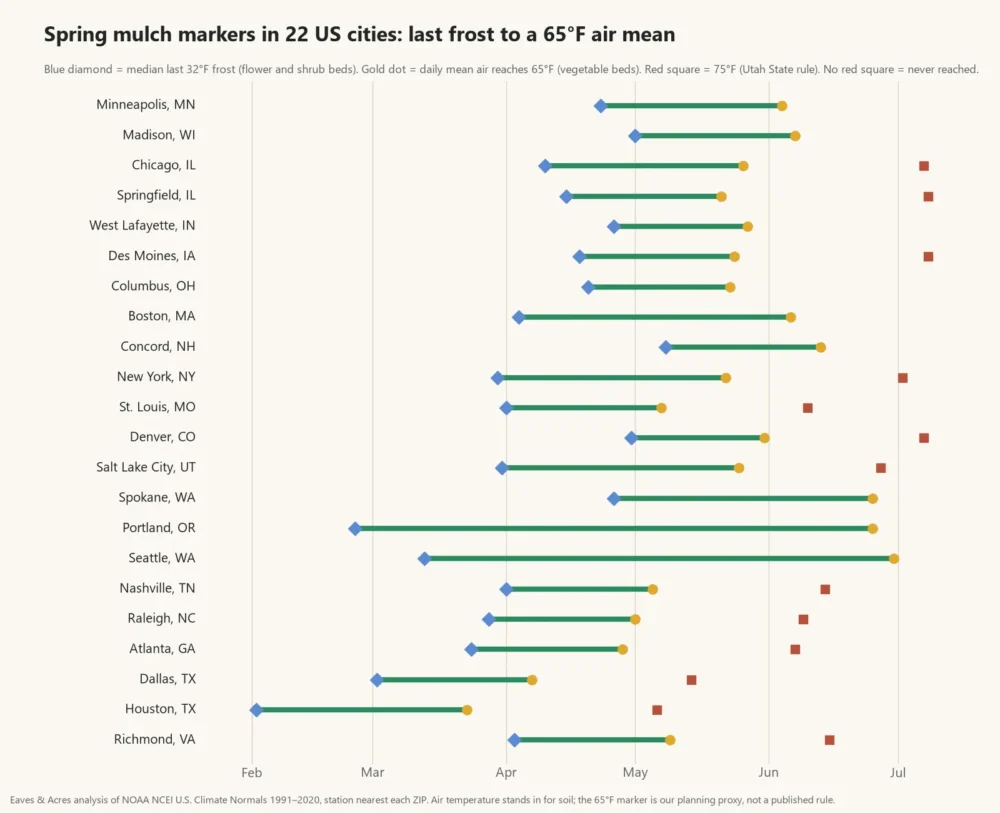
The markers are far apart. The median ZIP code’s last 28°F freeze is April 4 and its last 32°F frost April 18, while its normal air mean first reaches 40°F on March 17. In 75.4% of ZIP codes the air mean has already reached 40°F before the median last frost, by a median 37 days, so warming soil is rarely the limit for flower and shrub beds; frost is. We use the last 32°F frost as the start for beds, our reading of Iowa State’s “perennials emerge” test. Mulch also blocks seedlings, so leave soil bare where you want plants to self-seed.15 For sowing outdoors in winter, see our winter sowing guide.
Vegetable beds: weeks after planting
Vegetables wait longer than flower beds, because organic mulch keeps the soil cool. Utah State is the only source we found with a number, and it is steep: no organic mulch around cucumbers until soils are warmer than 75°F.12 The other sources give dates. UW–Madison Extension says mid- to late June in Wisconsin, and mid-May on sandy soil, which warms faster;6 Washington State says about June 1 in the Inland Northwest and not to mulch seedlings with organic mulch until they are 6 inches tall;13 Oregon State says mid-June on the coast.14 UW–Madison adds that transplants should get about 1 inch of mulch while young, rising to 3 inches as they grow.6
Applied to air temperature, 75°F is reached in only 52.2% of ZIP codes. Minneapolis, Madison, Boston and Seattle never get there, and Chicago does on July 7, so as an air rule it cannot be used in 47.8% of the country. As a planning marker we use a 65°F air mean instead: the median ZIP code reaches it on May 25, 36 days after its last frost, and 97.4% of ZIP codes reach it. Table 3 sets that marker against the published calendars; a soil thermometer settles it for your bed.
Fall and winter: after the freeze, before the deep cold
The Almanac’s rule is to wait for several freezes, often around Thanksgiving, when the ground is cold and hard, then apply 3 to 4 inches; mulched early, plants keep growing and new growth may not harden off.3 Iowa State agrees that late-season mulch goes on after plants go dormant but not too early, because it can delay dormancy and raise the risk of cold damage.2 Morton explains why one frost is not enough:4
One frost alone does not indicate a cooling of the soil.
Penn State gives a soil number for strawberries, 40°F or less before straw goes on,9 and Illinois and UNH say after the ground freezes.7,11 Table 2 gives three markers: the median first 28°F hard freeze as the earliest date, and the days the normal daily mean air temperature falls below 40°F and below 32°F.
| City (ZIP) | First 28°F hard freeze: earliest date | Air mean falls below 40°F: soil cold | Air mean falls below 32°F: ground freezing |
|---|---|---|---|
| Minneapolis, MN (55401) | Oct 27 | Nov 2 | Nov 19 |
| Madison, WI (53703) | Oct 20 | Nov 9 | Nov 29 |
| Chicago, IL (60601) | Nov 15 | Nov 21 | Dec 14 |
| Springfield, IL (62701) | Nov 1 | Nov 23 | Dec 18 |
| West Lafayette, IN (47907) | Oct 28 | Nov 19 | Dec 13 |
| Des Moines, IA (50309) | Oct 30 | Nov 14 | Dec 4 |
| Columbus, OH (43215) | Nov 3 | Nov 24 | Dec 27 |
| Boston, MA (02108) | Nov 21 | Dec 1 | Jan 4 |
| Concord, NH (03301) | Oct 13 | Nov 11 | Dec 5 |
| New York, NY (10001) | Dec 1 | Dec 12 | Stays above 32°F |
| St. Louis, MO (63101) | Nov 15 | Dec 8 | Stays above 32°F |
| Denver, CO (80202) | Oct 21 | Nov 22 | Stays above 32°F |
| Salt Lake City, UT (84101) | Nov 18 | Nov 28 | Stays above 32°F |
| Spokane, WA (99201) | Oct 23 | Nov 6 | Dec 3 |
| Portland, OR (97201) | Dec 20 | Stays above 40°F | Stays above 32°F |
| Seattle, WA (98101) | Dec 2 | Stays above 40°F | Stays above 32°F |
| Nashville, TN (37201) | Nov 9 | Dec 28 | Stays above 32°F |
| Raleigh, NC (27601) | Nov 23 | Stays above 40°F | Stays above 32°F |
| Atlanta, GA (30303) | Nov 20 | Stays above 40°F | Stays above 32°F |
| Dallas, TX (75201) | Dec 12 | Stays above 40°F | Stays above 32°F |
| Houston, TX (77002) | Jan 5 | Stays above 40°F | Stays above 32°F |
| Richmond, VA (23219) | Nov 15 | Dec 31 | Stays above 32°F |
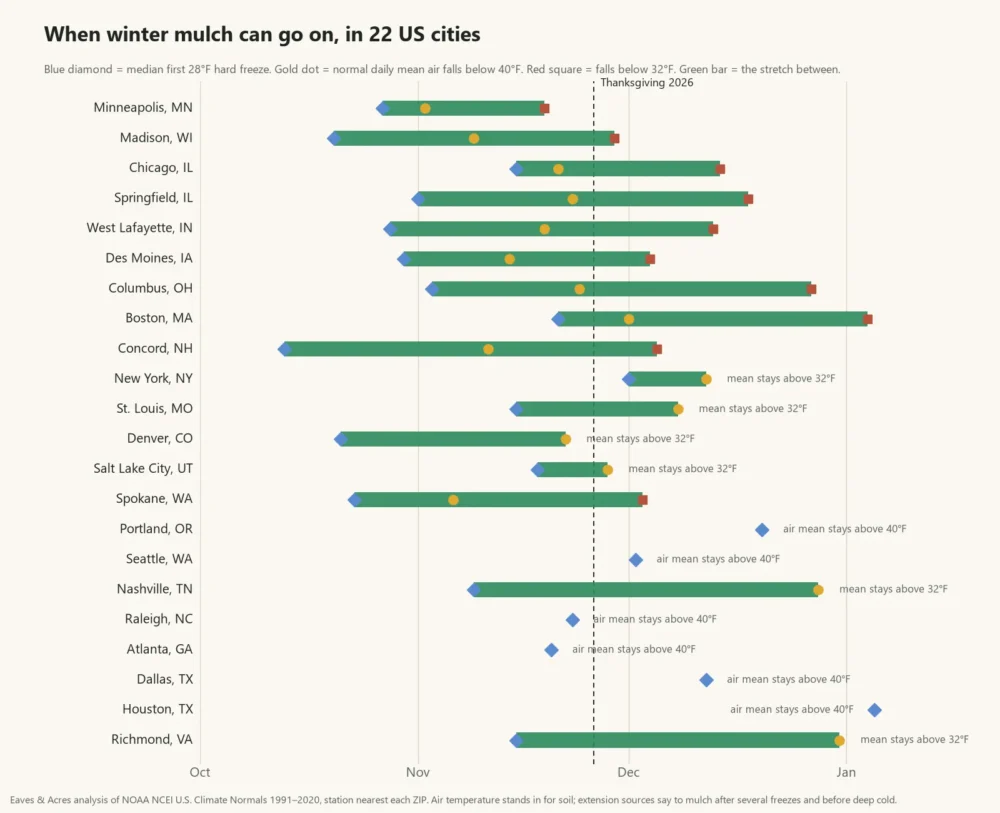
Thanksgiving, the Almanac’s and UW–Madison’s yardstick,3,6 works in some places and not others. Thanksgiving 2026 falls on November 26. It comes before the median first hard freeze in 16.8% of ZIP codes (New York’s is December 1, Dallas’s December 12 and Portland’s December 20), so mulching then breaks the “several freezes” rule. In 46.4% it falls after the air mean has dropped below 40°F, and in the other 36.8% the hard freeze has come but the air mean is still 40°F or higher.
Across ZIP codes the median first hard freeze is November 4. In the 75.6% where the air mean ever falls below 40°F, that happens a median 23 days later, around November 21. In the other 24.4%, including Atlanta, Dallas and Seattle, the mean never gets that low. Nor does it fall below 32°F in 48.0%, though nights freeze there, so “the ground has frozen” is not a date in St. Louis, Denver or New York. There, wait for the hard freeze and a run of cold nights.
Which beds need winter mulch
Strawberries are the clearest case. Illinois says to apply straw after several frosts but before the temperature drops below 20°F, generally mid-November to mid-December in Illinois, 3 to 4 inches deep.8 Purdue says late November or early December, when plants are dormant, and warns that mulching too early may rot crowns.10 Penn State adds that soil at 40°F or less at 4 inches has matched flattened leaves in its plots, a sign the plants are ready.9 UNH says after the ground freezes, usually mid to late November, 3 to 6 inches.11 Planting dates are in our strawberry guide, and fall-planted garlic is mulched too: see when to plant garlic.
Perennials and shrubs mostly do not. The Almanac says to mulch perennials after the first hard freeze that follows cutting them down, leaving some stems for native insects; see when to cut back perennials.3 Illinois says most perennials need no extra winter mulch in well-prepared, well-drained soil, but plants transplanted or set out late in autumn do, with 3 to 4 inches of loose mulch such as straw or evergreen boughs applied after the soil is frozen, to prevent frost heaving.7 That includes fall divisions: see when to divide perennials. The Almanac says grafted plants such as hybrid tea roses benefit from heavy mulching,3 and Purdue says to mound soil over a rose’s graft union after several killing frosts, since plants covered too early may be smothered.10 Trees planted this fall are covered in when to plant fruit trees. For a single cold night, use covers rather than mulch: when to cover plants for frost.

How deep: 2 to 4 inches, and never a volcano
For beds, the sources cluster on 2 to 3 inches: Mississippi State Extension, the Brooklyn Botanic Garden and the Almanac,5,15,3 with Iowa State at 2 to 4, coarser mulches like wood chips toward the top and finer ones like grass clippings toward the bottom.2 The Morton Arboretum gives 3 to 4 inches under trees and shrubs but only a couple in perennial beds,4 and Illinois says the total depth in a perennial bed should not exceed 2 inches.7 Winter layers are thicker, as the chart shows.
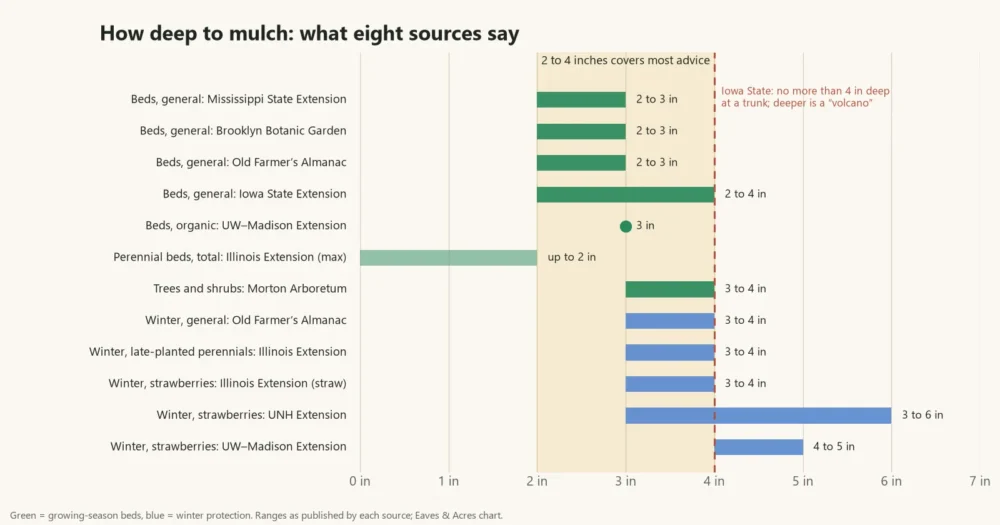
Deeper is not better. Iowa State says an excessively deep layer can cause waterlogging, low soil oxygen, shallow rooting and overly warm soil in winter.2 Mississippi State Extension’s Southern Gardening column notes that depth creeps up as gardeners top up for looks, which can delay warming in spring and slow soil cooling in fall.5
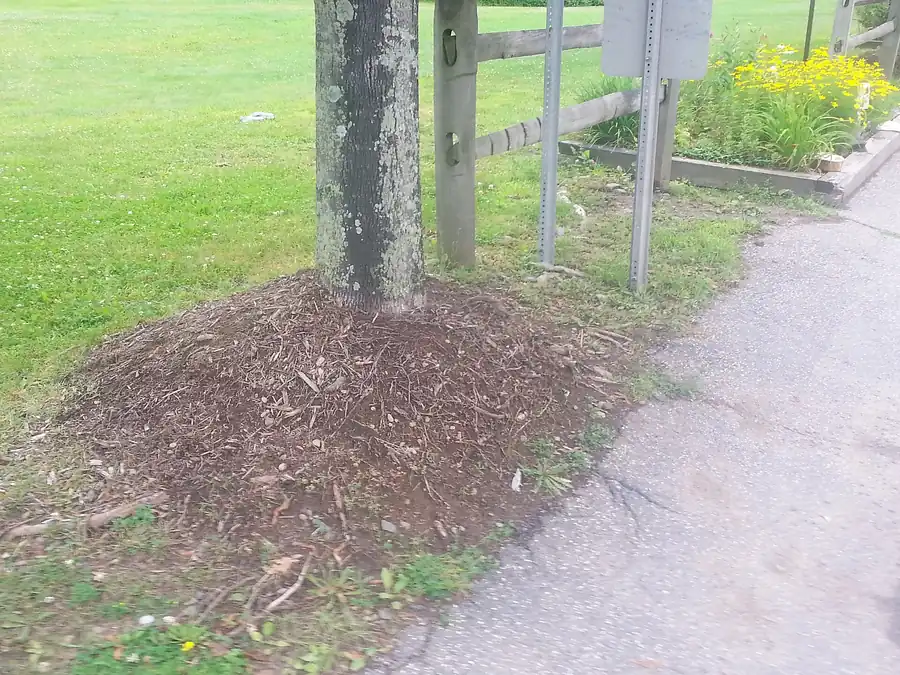
The worst depth error is against the trunk. Iowa State defines a mulch “volcano” as mulch piled more than 2 to 4 inches against a trunk, which keeps the trunk constantly moist and favors cankers and root rots; it says to keep mulch no more than 4 inches deep and feather it away from woody plants.2 The Almanac says to keep it 6 to 12 inches from the base of woody plants.3 Mississippi State’s rule is short:5
spread mulch horizontally and not pile it vertically against the trunk

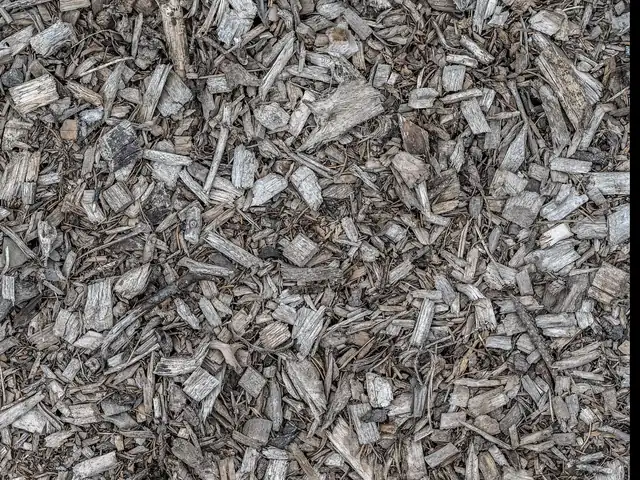
Wood chips, straw or leaves
Iowa State says wood chips are best used in landscape plantings, such as around trees, shrubs and roses and in perennial beds.2 The Brooklyn Botanic Garden and the Almanac both note that fresh wood chips can tie up soil nitrogen as they break down.15,3 Straw is the vegetable and strawberry mulch: Iowa State calls it excellent for the vegetable garden and ideal for overwintering perennials, roses and tender plants, but says to keep it away from trees and shrubs, where it can shelter mice, and to use straw free of seeds.2 UW–Madison says straw or hay goes on deeper, 4 to 6 inches, because it packs down.6

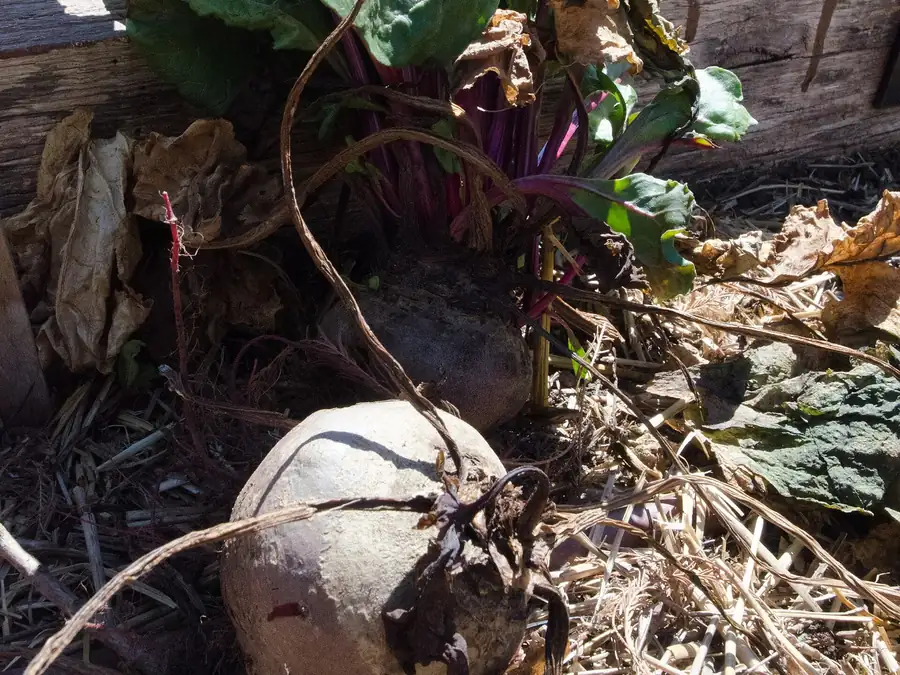
Leaves are where sources disagree. Iowa State says to shred or compost them first and that they are great for vegetable gardens and perennials, but a poor winter mulch for strawberries and herbaceous perennials because they mat down and smother plants.2 University of Maine Extension says leaves protect plants, protect soil from erosion and keep the frost in the ground so plants do not heave, and that chopping is not needed unless they are matted oak leaves.16 Shred them when in doubt and keep them off crowns. For leaves on the lawn, see should you rake leaves.
Taking winter mulch off in spring
The Almanac says to remove winter mulch when the danger of a hard frost is past, so the ground can warm and new growth is not held back.3 UW–Madison says to uncover strawberries when the leaves show a yellowish tinge, and roses and other perennials when new growth begins.6 Illinois says to pull back part of the strawberry straw once the soil has stayed at 40°F for at least three or four days, and to use it again over the plants on cold spring nights to protect flowers from frost.8
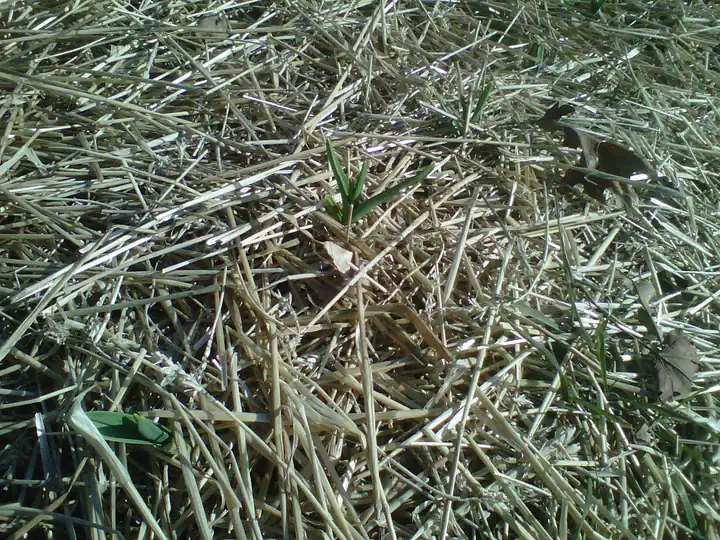

How published calendars compare with ours
We converted nine published statements to dates and put our markers beside them in Table 3. In fall, three of four strawberry and perennial windows start within 8 days of our 40°F date, not at the first hard freeze. In spring the vegetable-bed calendars land on air means from about 55°F to 70°F, so no single temperature fits Wisconsin, Washington and the Oregon coast.
| Place and use | Source | What it says | Our markers | Comparison |
|---|---|---|---|---|
| Spring Madison, WI vegetable beds | UW–Madison Extension | Mid- to late June (read as June 15–30); mid-May on sandy soil | Air mean 65°F Jun 7; 70°F Jul 2; 75°F never | Opens 8 days after our 65°F date and sits between our 65°F and 70°F dates |
| Walla Walla, WA vegetable beds | Washington State Extension, Inland Northwest | About June 1; seedlings 6 inches tall first | Air mean 60°F May 14; 65°F Jun 6 | Between our 60°F and 65°F dates; 5 days before 65°F |
| Astoria and Newport, OR vegetable beds | Oregon State Extension, coastal guide | Mid-June (read as June 15) | Astoria 55°F May 28, 60°F Jul 10; Newport 55°F Jun 15, never 60°F | Matches Newport’s 55°F date; neither city reaches 65°F |
| Salt Lake City, UT vegetable beds | Utah State Extension (cucumbers) | Organic mulch only when soils are warmer than 75°F | Air mean 75°F Jun 27 | Reachable here; not in Madison, Minneapolis or Boston |
| Springfield, IL strawberry straw off | Illinois Extension | Part of the straw off after soil stays at 40°F for 3–4 days | Air mean 40°F Mar 11; last frost Apr 15 | 35 days before the last frost; keep straw to cover flowers on cold nights |
| Fall Madison, WI perennials | UW–Madison Extension | After several freezes, usually about Thanksgiving (Nov 26, 2026) | Hard freeze Oct 20; 40°F Nov 9; 32°F Nov 29 | Thanksgiving is 17 days after our 40°F date and 3 days before 32°F |
| Springfield, IL strawberries | Illinois Extension | After several frosts, before 20°F: mid-Nov to mid-Dec (read as Nov 15–Dec 15) | Hard freeze Nov 1; 40°F Nov 23; 32°F Dec 18 | Opens 8 days before our 40°F date; ends 3 days before 32°F |
| West Lafayette, IN strawberries | Purdue Extension (2001) | Late Nov or early Dec, plants dormant (read as Nov 21–Dec 10) | Hard freeze Oct 28; 40°F Nov 19; 32°F Dec 13 | Opens 2 days after our 40°F date; ends 3 days before 32°F |
| Concord, NH strawberries | UNH Extension | After the ground freezes, mid to late Nov (read as Nov 15–30) | Hard freeze Oct 13; 40°F Nov 11; 32°F Dec 5 | Opens 4 days after our 40°F date; ends 5 days before 32°F |
How we calculated these dates
Daily temperatures are NOAA’s monthly normals placed on the 15th of each month and interpolated linearly, for the station nearest each ZIP code.1 Last and first frost are the median 32°F dates and the hard freeze is the median 28°F date. “Air mean” is the normal daily mean temperature, and the fall dates look ahead into the next January. We did not test soil. Nights freeze in places where the daily mean never reaches 32°F, and individual years vary by weeks. Our file has no frost dates for 1,549 of the 40,567 lower-48 ZIP codes, mostly in the frost-free South and Southwest, so we give no dates there; ask your county extension office.
Next steps
Look up your own frost dates with our frost date lookup, read what a last frost date means, and see how a frost differs from a freeze.
Frequently asked questions
Spring and fall. The median ZIP code’s last frost is April 18, vegetable beds follow on about May 25, and its first hard freeze is November 4, so winter mulch goes on in mid to late November. In Chicago: April 10 for flower beds, May 26 for vegetables, November 15 to December 14 for winter.
Not until the ground is frozen hard. The Brooklyn Botanic Garden says you can mulch any time of year, though fall mulch suppresses weeds less well. For strawberries, Illinois says to put straw on before the temperature drops below 20°F and Purdue says late November or early December.
Illinois says new perennial beds are mulched right after planting, about 2 inches deep. For vegetables, wait for warm soil and young plants: Washington State says not to mulch seedlings with organic mulch until they are 6 inches tall, and UW–Madison says about 1 inch for young transplants.
Piling it against trunks in a “volcano”. Iowa State says to keep mulch no more than 4 inches deep and feather it away from woody plants, and the Almanac says to keep it 6 to 12 inches from the base. Mulching too early in spring or fall is the other common error.
Yes, but count the total depth. Mississippi State Extension says depth creeps up as gardeners top up, which can delay spring warming. Illinois says total depth in a perennial bed should not exceed 2 inches, and Iowa State says 2 to 4 inches for beds.
The Almanac says when the danger of a hard frost is past. Illinois says to pull back part of strawberry straw once the soil has stayed at 40°F for three or four days. By air, the median ZIP code reaches 40°F on March 17, 37 days before its last frost, so keep the straw nearby.
Sources
- 1.U.S. Climate Normals 1991–2020. NOAA National Centers for Environmental Information, 2021. Used for: median last- and first-frost dates, median first and last 28°F hard-freeze dates and monthly temperature normals for every ZIP code Back to text
- 2.Using Mulch in the Garden, Aaron Steil. Iowa State University Extension and Outreach, 2026. Used for: when to apply, depth of 2 to 4 inches, volcanoes, wood chips, straw and leaves Back to text
- 3.How to Mulch Your Garden: Types of Mulch, Robin Sweetser. The Old Farmer’s Almanac, 2025. Used for: spring and fall timing, several freezes, 3 to 4 inches in winter, 6 to 12 inches from woody plants Back to text
- 4.How to Mulch Trees and Shrubs. The Morton Arboretum, 2026. Used for: when to mulch in spring and fall, one frost is not enough, depth and volcano mulching Back to text
- 5.Use mulch for beauty and weed, temperature control. Mississippi State University Extension Service, 2022. Used for: 2 to 3 inches, depth creep, spread mulch horizontally Back to text
- 6.Mulches for Home Gardens and Plantings. University of Wisconsin–Madison Extension, Horticulture, n.d. Used for: vegetable beds mid to late June, perennials after several freezes, straw 4 to 6 inches, removing winter mulch Back to text
- 7.Planting and Care (flowers). University of Illinois Extension, n.d. Used for: mulch as soils warm, 2 inches total, winter mulch for late-planted perennials after the soil is frozen Back to text
- 8.Growing Strawberries. University of Illinois Extension, n.d. Used for: straw after several frosts and before 20°F, 3 to 4 inches, remove part when soil stays at 40°F Back to text
- 9.Strawberry Plants and Winter – Ready or Not?. Penn State Extension, n.d. Used for: soil at 40°F or less before straw goes on Back to text
- 10.Autumn Garden Calendar (HO-93), B. Rosie Lerner. Purdue University Cooperative Extension Service, 2001. Used for: strawberry mulch in late November or early December, too early rots crowns, roses after several killing frosts Back to text
- 11.How do I prepare my backyard fruits for winter?. University of New Hampshire Extension, 2020. Used for: strawberry mulch after the ground freezes, 3 to 6 inches Back to text
- 12.Cucumbers in the Garden. Utah State University Extension, n.d. Used for: no organic mulch until soils are warmer than 75°F Back to text
- 13.Inland Northwest Vegetable Gardening. Washington State University Extension, Walla Walla County, n.d. Used for: no mulch in vegetable beds until about June 1; seedlings 6 inches tall Back to text
- 14.Growing Vegetables in the Pacific Northwest Coastal Region (EM 9695). Oregon State University Extension Service, n.d. Used for: wait until mid-June before applying mulch on the coast Back to text
- 15.Ask a Gardener: What Is Mulch, and When Should I Use It?. Brooklyn Botanic Garden, 2023. Used for: spring after the soil warms, any time of year, mulch inhibits seed germination Back to text
- 16.Can I use leaves for mulch in the gardens over winter?. University of Maine Cooperative Extension, 2020. Used for: leaves protect plants and keep frost in the ground Back to text
- 17.Photo: During the lockdown I laid out a new garden bed, Ron Frazier (CC BY 2.0). Wikimedia Commons, 2020. Used for: hero photo
- 18.Photo: Volcano mulching, NY State IPM Program at Cornell University (CC BY 2.0). Wikimedia Commons, 2015. Used for: mulch volcano photo
- 19.Photo: Wood chip mulch, Quebec City, Wilfredor (CC0). Wikimedia Commons, 2023. Used for: wood chip photo
- 20.Photo: The garlic is up, Dwight Sipler (CC BY 2.0). Wikimedia Commons, 2011. Used for: garlic in straw photo
- 21.Photo: 2016 People’s Garden Planting (20160405-AMS-SLS-0268), USDA (public domain). Wikimedia Commons, 2016. Used for: beets in straw photo


How this guide was made
- Written by the Yard & Garden Desk and reviewed by the Data & Methodology Desk.
- Data: median last- and first-frost dates, median first and last 28°F hard-freeze dates and monthly temperature normals from NOAA NCEI U.S. Climate Normals 1991–2020 for the station nearest each ZIP code, with daily values interpolated from the monthly normals; mulch timing, depth and material rules from Iowa State, Illinois, Penn State, Purdue, UNH, UW–Madison, Washington State, Oregon State, Utah State, Mississippi State and Maine extension, the Morton Arboretum, the Old Farmer’s Almanac and the Brooklyn Botanic Garden. Air temperature stands in for soil temperature. See our methodology.
- AI use: AI tools help us research, draft and check this guide. Every figure is checked against the source cited for it, and calculated figures come from our own code, described on the methodology page.
- Spotted an error? Tell us — the form opens with this page’s address filled in.
Change log
- Oct 22, 2026Published. Spring and winter mulch markers for 22 cities from NOAA 1991–2020 normals, tested against nine published calendars and across 37,563 lower-48 ZIP codes, with depth and material rules from extension sources.
Covers lawns, gardens, frost and planting. We write the guides and maintain the tools that tell you when to seed, feed and plant for your ZIP.
Keep reading
When to Plant Pumpkins: Count Back From Halloween, Not Forward From Frost
Sow pumpkins once the soil reaches about 65°F, a median 37 days after the last frost, then count back 90 to 120 days from Halloween or the first frost. Dates for 24 cities.
When to Plant Corn: Match the Date to the Type, Not Just the Frost
Sow standard sweet corn once the soil reaches about 55°F, sugar-enhanced at 60°F and supersweet at 65°F: a median April 25, May 9 and May 25. Dates for 28 spring and 21 fall cities.
When to Plant Trees and Shrubs: Fall Dates Counted From Your Freeze
Finish fall planting about six weeks before your first hard freeze, plant evergreens earlier or wait for spring, and avoid midsummer. Dates for 30 cities and 40,557 ZIP codes.
Seasonal reminders for your ZIP
Get a short email when it’s time to overseed, start seeds, open the pool or service your furnace — timed to your climate.