
How Many Gallons in a Pool? Chart by Size and Shape
55 sizes in gallons and liters from one formula, checked against Intex and Latham specs and seven published charts whose answers for one pool differ by up to 58%.
- Last reviewed Oct 27, 2026
- 16 cited sources
- 9 min read
- 1Gallons = surface area × average water depth × 7.4805; liters = gallons × 3.7854.
- 2An 18 ft round pool with 4 ft of water holds 7,614 gallons; a 16 × 32 ft in-ground pool averaging 5 ft holds 19,150.
- 3Published capacities for one 18 ft round pool run from 5,455 to 8,602 gallons: cities print a full pool, Intex prints 70–90% of one.
- 4Using the wall height for the water depth overstates volume by 12–14%; measure the water.
- 5Fiberglass shells with steps and ledges hold 50–84% of the length × width × depth box.
An 18 ft round above-ground pool with 4 ft of water holds about 7,614 gallons (28,820 liters), and a 16 × 32 ft in-ground pool averaging 5 ft deep holds about 19,150. Pool volume is surface area × average water depth × 7.4805 gallons per cubic foot, and the tables below apply that one formula to 55 standard sizes.1
The gallons printed for the same pool vary by up to 58%, so we also checked the formula against Intex, Latham and seven published size charts.
Pool gallons by size and shape
Every figure is area × depth × 7.4805, rounded to the whole gallon (liters to the nearest 10). Use your water depth, not your wall height: the water stands below the top of the wall, and Intex’s 52 in frame pool works out to about 44 in. Each table gives gallons per inch (or foot) so you can scale to your own depth.
Round above-ground pools
Retail charts list 48, 52 and 54 in walls, and the Intex frame pools we read have 30, 42, 48 and 52 in walls.3,4,10 For a small pool with 24–30 in of water, multiply the per-inch figure by your inches.
| Diameter | Per inch of water | 42 in (3.5 ft) | 48 in (4 ft) | 52 in (4.33 ft) | 54 in (4.5 ft) |
|---|---|---|---|---|---|
| 8 ft | 31 120 L | 1,316 4,980 L | 1,504 5,690 L | 1,629 6,170 L | 1,692 6,410 L |
| 10 ft | 49 190 L | 2,056 7,780 L | 2,350 8,900 L | 2,546 9,640 L | 2,644 10,010 L |
| 12 ft | 71 270 L | 2,961 11,210 L | 3,384 12,810 L | 3,666 13,880 L | 3,807 14,410 L |
| 13 ft | 83 310 L | 3,475 13,150 L | 3,972 15,030 L | 4,303 16,290 L | 4,468 16,910 L |
| 14 ft | 96 360 L | 4,030 15,260 L | 4,606 17,440 L | 4,990 18,890 L | 5,182 19,620 L |
| 15 ft | 110 420 L | 4,627 17,510 L | 5,288 20,020 L | 5,728 21,680 L | 5,949 22,520 L |
| 16 ft | 125 470 L | 5,264 19,930 L | 6,016 22,770 L | 6,518 24,670 L | 6,768 25,620 L |
| 18 ft | 159 600 L | 6,662 25,220 L | 7,614 28,820 L | 8,249 31,220 L | 8,566 32,430 L |
| 20 ft | 196 740 L | 8,225 31,140 L | 9,400 35,580 L | 10,184 38,550 L | 10,575 40,030 L |
| 21 ft | 216 820 L | 9,068 34,330 L | 10,364 39,230 L | 11,227 42,500 L | 11,659 44,140 L |
| 24 ft | 282 1,070 L | 11,844 44,840 L | 13,536 51,240 L | 14,664 55,510 L | 15,228 57,650 L |
| 26 ft | 331 1,250 L | 13,901 52,620 L | 15,887 60,140 L | 17,210 65,150 L | 17,872 67,650 L |
| 27 ft | 357 1,350 L | 14,991 56,750 L | 17,132 64,850 L | 18,560 70,260 L | 19,274 72,960 L |
| 28 ft | 384 1,450 L | 16,122 61,030 L | 18,425 69,740 L | 19,960 75,560 L | 20,728 78,460 L |
| 30 ft | 441 1,670 L | 18,507 70,060 L | 21,151 80,060 L | 22,913 86,740 L | 23,795 90,070 L |
| 32 ft | 501 1,900 L | 21,057 79,710 L | 24,065 91,100 L | 26,070 98,690 L | 27,073 102,480 L |
| 33 ft | 533 2,020 L | 22,393 84,770 L | 25,592 96,880 L | 27,725 104,950 L | 28,791 108,990 L |
Oval above-ground pools
Our oval rows assume straight sides and half-round ends, the shape the calculator uses. An ellipse of the same length and width holds 11–12% less, so a chart that treats an oval as an ellipse reads low.2
| Length × width | Per inch of water | 42 in (3.5 ft) | 48 in (4 ft) | 52 in (4.33 ft) | 54 in (4.5 ft) |
|---|---|---|---|---|---|
| 15 × 10 ft | 80 300 L | 3,365 12,740 L | 3,846 14,560 L | 4,167 15,770 L | 4,327 16,380 L |
| 18 × 11 ft | 107 410 L | 4,504 17,050 L | 5,148 19,490 L | 5,577 21,110 L | 5,791 21,920 L |
| 25 × 11 ft | 155 590 L | 6,520 24,680 L | 7,452 28,210 L | 8,073 30,560 L | 8,383 31,730 L |
| 30 × 11 ft | 190 720 L | 7,960 30,130 L | 9,097 34,440 L | 9,855 37,310 L | 10,234 38,740 L |
| 18 × 12 ft | 115 440 L | 4,846 18,340 L | 5,538 20,970 L | 6,000 22,710 L | 6,231 23,590 L |
| 24 × 12 ft | 160 610 L | 6,731 25,480 L | 7,693 29,120 L | 8,334 31,550 L | 8,654 32,760 L |
| 25 × 15 ft | 204 770 L | 8,554 32,380 L | 9,776 37,010 L | 10,591 40,090 L | 10,998 41,630 L |
| 27 × 15 ft | 222 840 L | 9,339 35,350 L | 10,674 40,400 L | 11,563 43,770 L | 12,008 45,450 L |
| 30 × 15 ft | 250 950 L | 10,518 39,810 L | 12,020 45,500 L | 13,022 49,290 L | 13,523 51,190 L |
| 32 × 16 ft | 285 1,080 L | 11,967 45,300 L | 13,676 51,770 L | 14,816 56,080 L | 15,386 58,240 L |
| 33 × 18 ft | 327 1,240 L | 13,732 51,980 L | 15,693 59,410 L | 17,001 64,360 L | 17,655 66,830 L |
| 38 × 18 ft | 383 1,450 L | 16,088 60,900 L | 18,386 69,600 L | 19,918 75,400 L | 20,684 78,300 L |
| 40 × 18 ft | 405 1,530 L | 17,030 64,470 L | 19,463 73,680 L | 21,085 79,820 L | 21,896 82,890 L |
| 20 × 10 ft | 111 420 L | 4,674 17,690 L | 5,342 20,220 L | 5,787 21,910 L | 6,010 22,750 L |
| 38 × 21 ft | 438 1,660 L | 18,415 69,710 L | 21,046 79,670 L | 22,800 86,310 L | 23,677 89,630 L |
| 41 × 21 ft | 478 1,810 L | 20,065 75,950 L | 22,931 86,800 L | 24,842 94,040 L | 25,797 97,650 L |
In-ground rectangles and ovals
In-ground pools slope, so charts use an average depth. The City of Oregon City’s pool water estimator states its basis:
assumes a depth of 7′ at the deep end and 3′ at the shallow end
That is a 5 ft average, and the city’s rectangles and ovals land within 0.6% of the formula at 5 ft (24 × 12 rectangle: 10,800 printed, 10,772 computed).6
| Size | Per foot of depth | 4 ft average depth | 5 ft average depth | 6 ft average depth |
|---|---|---|---|---|
| 10 × 20 ft rectangle | 1,496 5,660 L | 5,984 22,650 L | 7,481 28,320 L | 8,977 33,980 L |
| 12 × 20 ft rectangle | 1,795 6,800 L | 7,181 27,180 L | 8,977 33,980 L | 10,772 40,780 L |
| 12 × 24 ft rectangle | 2,154 8,160 L | 8,618 32,620 L | 10,772 40,780 L | 12,926 48,930 L |
| 14 × 28 ft rectangle | 2,932 11,100 L | 11,729 44,400 L | 14,662 55,500 L | 17,594 66,600 L |
| 15 × 30 ft rectangle | 3,366 12,740 L | 13,465 50,970 L | 16,831 63,710 L | 20,197 76,460 L |
| 16 × 24 ft rectangle | 2,873 10,870 L | 11,490 43,490 L | 14,363 54,370 L | 17,235 65,240 L |
| 16 × 32 ft rectangle | 3,830 14,500 L | 15,320 57,990 L | 19,150 72,490 L | 22,980 86,990 L |
| 16 × 36 ft rectangle | 4,309 16,310 L | 17,235 65,240 L | 21,544 81,550 L | 25,853 97,860 L |
| 17 × 35 ft rectangle | 4,451 16,850 L | 17,804 67,390 L | 22,255 84,240 L | 26,705 101,090 L |
| 18 × 36 ft rectangle | 4,847 18,350 L | 19,390 73,400 L | 24,237 91,750 L | 29,084 110,100 L |
| 18 × 40 ft rectangle | 5,386 20,390 L | 21,544 81,550 L | 26,930 101,940 L | 32,316 122,330 L |
| 19 × 37 ft rectangle | 5,259 19,910 L | 21,035 79,630 L | 26,294 99,530 L | 31,553 119,440 L |
| 19 × 38 ft rectangle | 5,401 20,440 L | 21,604 81,780 L | 27,005 102,220 L | 32,406 122,670 L |
| 19 × 43 ft rectangle | 6,112 23,130 L | 24,446 92,540 L | 30,558 115,670 L | 36,670 138,810 L |
| 20 × 40 ft rectangle | 5,984 22,650 L | 23,938 90,610 L | 29,922 113,270 L | 35,906 135,920 L |
| 22 × 44 ft rectangle | 7,241 27,410 L | 28,965 109,640 L | 36,206 137,050 L | 43,447 164,460 L |
| 25 × 45 ft rectangle | 8,416 31,860 L | 33,662 127,430 L | 42,078 159,280 L | 50,494 191,140 L |
| 25 × 50 ft rectangle | 9,351 35,400 L | 37,403 141,580 L | 46,753 176,980 L | 56,104 212,380 L |
| 30 × 50 ft rectangle | 11,221 42,480 L | 44,883 169,900 L | 56,104 212,380 L | 67,325 254,850 L |
| 16 × 32 ft oval | 3,419 12,940 L | 13,676 51,770 L | 17,095 64,710 L | 20,514 77,660 L |
| 18 × 36 ft oval | 4,327 16,380 L | 17,309 65,520 L | 21,636 81,900 L | 25,963 98,280 L |
| 20 × 40 ft oval | 5,342 20,220 L | 21,369 80,890 L | 26,711 101,110 L | 32,054 121,340 L |
The formulas, with worked examples
One US gallon is defined as 231 cubic inches, so a cubic foot holds 7.4805 gallons and a liter is 0.2642 gallon.1 The area depends on shape: round π × (diameter ÷ 2)²; rectangle length × width; straight-sided oval (length − width) × width + π × (width ÷ 2)². Average depth is (shallow + deep) ÷ 2 for a floor that slopes at one steady angle. Hayward’s AquaRite manual rounds the same math to multipliers of 7.5 (rectangle), 5.9 (round, diameter × diameter) and 6.7 (oval, length × width).2 For custom shapes, our pool volume calculator applies the same formulas.
A 24 ft round pool with 4 ft of water
- Scenario
- Diameter 24 ft, water depth 4 ft.
- Math
- Area = 3.1416 × 12² = 452.4 sq ft. 452.4 × 4 ft × 7.4805 = 13,536 gallons. Liters = 13,536 × 3.7854.
- Answer
- About 13,536 gallons (51,240 liters), or 282 gallons per inch of water.
A 16 × 32 ft in-ground pool, 3.5 ft to 8 ft
- Scenario
- One steady slope from the shallow end to the deep end.
- Math
- Average depth = (3.5 + 8) ÷ 2 = 5.75 ft. 512 sq ft × 5.75 × 7.4805 = 22,023 gallons.
- Answer
- About 22,023 gallons (83,360 liters).
Why the published numbers disagree
Look up an 18 ft round pool and you find 13 printed capacities from 5,455 to 8,602 gallons. Three patterns show up in the sources.3,4,5,6,7,8,9,10,12
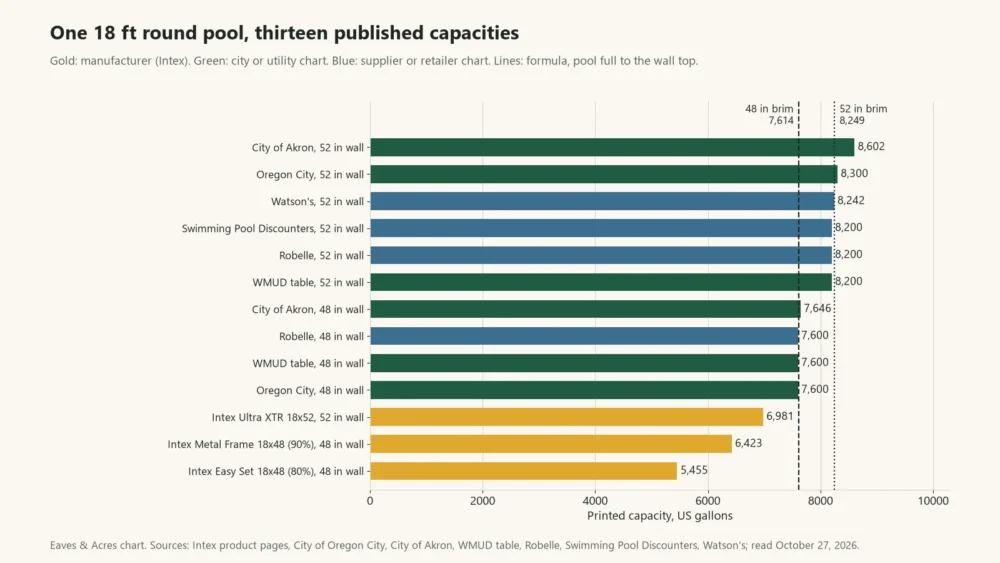
The wall is used as the water depth. Oregon City prints 7,600 (48 in) and 8,300 (52 in) and Watson’s prints 8,242 (52 in), all within 1% of a pool filled to the wall top, which the formula puts at 7,614 and 8,249.6,12 The label and the math disagree. One retailer’s chart carries a footnote:
Assumes water depth is 6 inches less than wall height
Yet its 18 ft round at a 48 in wall, 7,646 gallons, equals 18 × 18 × 4 ft × 5.9, a 4 ft depth, while its 18 × 33 oval under the same label matches 3.5 ft. City of Akron’s chart carries the same numbers under the same headings.7,11 Makers print less than a full pool. Intex’s 18 × 52 in frame pool prints 6,981 gallons, 85% of the 8,249 the same wall holds when full, which implies about 44 in of water.3

What manufacturers print
Across the 17 Intex product pages we read, printed capacity is 81–85% of the full-wall volume for its round frame pools, 86–87% for the two rectangles, 70–72% for Easy Set inflatables and 90% for the one oval. Intex prints “(80%)” or “(90%)” beside most figures without saying what the percentage means.3,4,5 If you only know a frame pool’s box capacity, 0.85 × the wall-height volume is a fair starting point for Intex; other brands may differ.

Ovals disagree even more: Table 4 lists 9 printed capacities for an 18 × 33 ft oval, from 12,267 to 18,900 gallons.6,7,8,9,10
| Source | Wall label | Printed gallons | Full to the wall top (formula) | Printed as % of full |
|---|---|---|---|---|
| City of Akron | 48 in | 12,267 | 15,693 | 78% |
| City of Oregon City | 48 in | 14,000 | 15,693 | 89% |
| WMUD table | 48 in | 14,000 | 15,693 | 89% |
| Robelle (pool-care products) | 48 in | 17,400 | 15,693 | 111% |
| City of Akron | 52 in | 14,019 | 17,001 | 82% |
| Swimming Pool Discounters (retailer) | 52 in | 14,020 | 17,001 | 82% |
| WMUD table | 52 in | 15,100 | 17,001 | 89% |
| City of Oregon City | 52 in | 15,200 | 17,001 | 89% |
| Robelle (pool-care products) | 52 in | 18,900 | 17,001 | 111% |
How far off can you be?
Royal Swimming Pools says a volume estimate should be
typically within 5 to 10 percent of the actual volume
Table 5 shows which mistakes break that rule. The biggest are depth and shape, not arithmetic.14
| Mistake or assumption | Size of the error | How we got it |
|---|---|---|
| Wall height used as the water depth (water 6 in lower) | Overstates by 14% on a 48 in wall, 13% on 52 in, 12.5% on 54 in | wall ÷ (wall − 6 in) |
| Depth off by 3 in | ±6.2% at 4 ft of water, ±5.0% at a 5 ft average | 3 in ÷ depth |
| Length and width each 3 in too long | +1.9% on a 20 × 40 ft rectangle; +2.8% on an 18 ft round pool | area ratio |
| Rounded multipliers | 5.9 is 0.4% high for round pools; 7.5 is 0.3% high for rectangles | exact: π/4 × 7.4805 = 5.875; 7.4805 |
| Oval treated as an ellipse | 11–12% low on a straight-sided oval (12 × 24 to 21 × 41 ft) | π/4 × L × W vs (L − W) × W + π(W/2)² |
| Hayward’s 6.7 oval multiplier | +0.3% to +1.4% against the straight-sided formula | L × W × 6.7 vs the same oval at 7.4805 |
| Averaging the ends of a floor that is flat, then drops | +32% in our illustration: 22,023 gallons by the average of the ends, 16,637 if the 16 × 32 ft floor stays 3.5 ft for 20 ft and then slopes to 8 ft | illustration, not measured data |
| Fiberglass shell, steps and ledges | Printed gallons are 50–84% of the length × width × depth box (Table 6) | Latham product pages |
| A maker’s printed capacity read as a full pool | Intex prints 70–90% of a full pool (Intex chart above) | printed gallons ÷ formula at the wall height |
Steps, ledges and fiberglass shells
Latham prints approximate gallons for its fiberglass pools. Against outer length × outer width × the average of its printed depth range, seven models hold 50–84% of the box volume. We attribute that to sloped walls, rounded corners, steps and ledges; Latham does not publish its method.13 Kidney and Grecian shapes get the same warning: Oregon City’s kidney figures are 71–83% and its Grecian figures 90–94% of a rectangle of the same length and width at 5 ft, and it says the shapes “vary.”6
| Latham model | Outer size | Printed depth | Printed gallons | Box: length × width × average depth | Printed as % of box |
|---|---|---|---|---|---|
| Lake Shore | 16 ft × 33 ft | 3 ft 7 in to 5 ft 5 in | 15,000 | 17,774 | 84% |
| Olympia 16 | 16 ft × 35 ft | 3 ft 6 in to 6 ft 6 in | 15,250 | 20,945 | 73% |
| Axiom 16 | 16 ft × 35 ft | 4 ft 6 in to 6 ft 6 in | 11,600 | 23,040 | 50% |
| Astoria 16 | 15 ft 10 in × 40 ft | 3 ft 6 in to 7 ft | 15,600 | 24,873 | 63% |
| Cayman 16 | 15 ft 10 in × 38 ft | 3 ft 6 in to 6 ft 8 in | 14,500 | 22,879 | 63% |
| Astoria 14 | 14 ft × 35 ft | 3 ft 6 in to 6 ft 6 in | 10,700 | 18,327 | 58% |
| Cayman 14 Deluxe | 13 ft 10 in × 32 ft | 3 ft 6 in to 6 ft | 9,300 | 15,729 | 59% |
Before you dose or fill
Volume drives pump run time (how long to run a pool pump), salt (pool salt calculator), and the water a backwash sends to waste, which our backwash guide converts using gallons per inch.
Frequently asked questions
With 4 ft (48 in) of water it holds about 7,614 gallons, and 8,249 with 52 in; each inch is 159 gallons. Intex prints 6,981 for its 18 ft × 52 in frame pool, and published charts run from 5,455 to 8,602.
In-ground, 15,320 gallons at a 4 ft average depth, 19,150 at 5 ft and 22,980 at 6 ft (Table 3). A 16 × 32 ft above-ground oval with 48 in of water holds 13,676.
About 10,000: a 20 ft round pool with 52 in of water (10,184). About 20,000: a 28 ft round with 52 in (19,960), or a 16 × 32 ft in-ground pool averaging 5.2 ft.
An 18 × 33 ft straight-sided oval with 4 ft of water holds 15,693 gallons. Treating it as an ellipse gives 13,959, about 11% low.
Multiply gallons by 3.7854. An 18 ft round pool with 48 in of water is 28,820 liters, or 28.8 cubic meters.
Makers print less than a full pool: Intex’s figures are 70–90% of the wall-height volume, and it does not say what its “(80%)” or “(90%)” refers to.
Royal Swimming Pools says within 5 to 10 percent. Wall height for water depth (12–14% high) or an ellipse for an oval (11–12% low) breaks that.
Sources
- 1.NIST Handbook 44 (2026), Appendix C: General Tables of Units of Measurement. National Institute of Standards and Technology, 2026. Used for: 1 gallon = 231 cubic inches; 1 liter = 0.264 172 1 gallon Back to text
- 2.AquaRite Electronic Chlorine Generator Owner’s Manual (092538 Rev D), page 4. Hayward Pool Products, 2019. Used for: volume multipliers 7.5 (rectangular), 5.9 (round), 6.7 (oval) Back to text
- 3.Ultra XTR Frame 18ft x 52in Round Above Ground Pool with Sand Filter Pump (product page). Intex, read 2026-10-27. Used for: Approximate set-up size 18ft X 52in; Water Capacity 6,981 gallons Back to text
- 4.Intex Ultra XTR, Metal Frame and Prism Frame pool product pages (16 pages, e.g. Prism Frame 15ft x 48in). Intex, read 2026-10-27. Used for: printed water capacity and set-up size per model (Table in chart 3); wall heights 30, 42, 48, 52 in Back to text
- 5.Intex Easy Set inflatable pool product pages (e.g. 15ft x 48in). Intex, read 2026-10-27. Used for: printed water capacity (80%) and water depth for Easy Set pools Back to text
- 6.Swimming Pool Water Estimator. City of Oregon City, Oregon, n.d. Used for: above-ground gallons at 48 and 52 in walls; in-ground chart assuming 3 ft shallow and 7 ft deep end; kidney and Grecian sizes Back to text
- 7.How to calculate the gallons in a swimming pool. City of Akron, Ohio, n.d. Used for: above-ground gallons at 48 and 52 in; multipliers 5.9 and 7.5 Back to text
- 8.How Much Does My Pool Hold? (table). WMUD (wmud.myruralwater.com), n.d. Used for: above-ground gallons at 48 and 52 in walls; in-ground gallons Back to text
- 9.Water Capacity for Common Pool Sizes. Robelle Industries (pool-care products), n.d. Used for: gallons by average depth for round, oval and rectangular pools Back to text
- 10.Gallons of Water per Pool Size Chart. Swimming Pool Discounters, read 2026-10-27. Used for: gallons at 52 and 54 in deep Back to text
- 11.Pool Water Volume Calculator In Gallons with Size Charts. Backyard City Pools, read 2026-10-27. Used for: gallons at 48 and 52 in wall with its footnote on water depth Back to text
- 12.How Many Gallons Are In My Above Ground Pool?. Watson’s, read 2026-10-27. Used for: 18 ft round: 8,242 gallons at 52 in, 8,565 at 54 in Back to text
- 13.Olympia 16 Model 16' x 35' Pool (and Lake Shore, Axiom 16, Astoria 14 and 16, Cayman 14 Deluxe and 16). Latham Pool Products, read 2026-10-27. Used for: outer dimensions, depth range and gallons approx. for seven fiberglass models Back to text
- 14.Pool Gallon Calculator, FAQ. Royal Swimming Pools, read 2026-10-27. Used for: estimate should be within 5 to 10 percent; steps and benches change true volume Back to text
- 15.Une piscine privée dans l'Ain (vue aérienne) (photo). Benoît Prieur, Wikimedia Commons, CC0, n.d. Used for: hero photo, cropped
- 16.Une piscine privée dans l'Ain (photo). Benoît Prieur, Wikimedia Commons, CC0, n.d. Used for: in-ground pool corner with steps


How this guide was made
- Written by the Pool Desk and reviewed by the Data & Methodology Desk.
- Data: gallons = surface area (sq ft) × water depth (ft) × 7.4805 (231 cubic inches per US gallon, NIST); liters = gallons × 3.7854. Round: π × (d ÷ 2)²; rectangle: length × width; straight-sided oval: (length − width) × width + π × (width ÷ 2)². Published capacities were read from the sources listed on October 27, 2026; the percent-of-full, implied-depth and error figures are our arithmetic from them. Table 5’s floor-profile row is an illustration, not measured data. See our methodology.
- AI use: AI tools help us research, draft and check this guide. Every figure is checked against the source cited for it, and calculated figures come from our own code, described on the methodology page.
- Spotted an error? Tell us — the form opens with this page’s address filled in.
Change log
- Oct 27, 2026Published. 55 pool sizes computed from one formula in gallons and liters; checked against 17 Intex product pages, seven Latham fiberglass models, City of Oregon City, City of Akron, WMUD, Robelle, Swimming Pool Discounters, Backyard City Pools and Watson’s charts; error table and implied water depths.
Covers pool and hot tub water chemistry, opening and closing. We maintain the dosing calculators and check every rate against product chemistry and public health guidance.
Keep reading

What Is Cyanuric Acid for Pools? What Labels and CDC Say
Cyanuric acid (stabilizer) shields pool chlorine from sunlight but holds it in a slower form. Labels set 20–60 ppm, CDC’s model code caps public pools at 90 ppm.
How to Raise Pool Alkalinity: What the Labels and Chemistry Say
Add sodium bicarbonate with the pump running at your label’s rate: 1.5 lb per 10,000 gallons per 10 ppm on two labels, 1.4 lb in CDC’s model code Annex.

How Long to Wait to Swim After Shocking a Pool: What Nine Labels Say
Swim again when a test shows free chlorine at or below your shock label’s limit, 4 ppm on the seven chlorine shock labels we read, with pH back in range.
Seasonal reminders for your ZIP
Get a short email when it’s time to overseed, start seeds, open the pool or service your furnace — timed to your climate.