

How Often to Backwash a Pool Filter: Eight Manuals Compared
We read eight sand, DE and cartridge filter manuals, CDC’s pool code and three cities’ rules, and estimated the water one backwash sends to waste.
- Last reviewed Oct 14, 2026
- 18 cited sources
- 7 min read

- 1Backwash sand and DE filters when the gauge reads about 8–10 psi above its clean reading (Hayward, Pentair), not on a timed schedule.
- 2Cartridge filters are never backwashed: hose the cartridges at 7–12 psi above clean, depending on the brand.
- 3Backwash until the water runs clear (about 2 minutes for Hayward, 3–5 for Pentair), then rinse 20 seconds to 1 minute.
- 4One backwash of a mid-size sand filter sends roughly 116–256 gallons to waste by our estimate.
- 5DE dust contains crystalline silica: wear an approved dust mask and safety glasses, and follow local disposal rules.
Backwash a sand or DE pool filter when its pressure gauge reads about 8 to 10 psi above its clean reading, not on a calendar schedule. That is what the Hayward and Pentair manuals we read say. Cartridge filters are never backwashed; you take the cartridges out and hose them off at a similar rise.1,2,7,11
The guides in the search results give a calendar answer instead, anywhere from weekly to every six weeks, and trigger pressures from 1 to 10 psi. So we put eight owner’s manuals side by side and worked out how much water one backwash sends to waste.
What eight filter manuals say, side by side
Every manual uses one signal: note the gauge reading when the filter is clean, and clean it once the reading climbs by a set amount.
| Filter (manual) | Clean it when | Backwash, then rinse | After that |
|---|---|---|---|
| Hayward ProSeries sand IS210TS Rev A, 2024 | Gauge 8–10 psi above the initial clean pressure1 | Until the sight glass is clear, about 2 minutes or less; rinse ½–1 minute1 | No sand replacement interval given |
| Pentair Triton sand P/N 154901 Rev L, 2025 | Flow 30% lower, if you have a flow meter; otherwise 10 psi above the reading just after a backwash2 | About 3–5 minutes or until clean; rinse about 30 seconds2 | Still 4–6 psi high: chemically clean the sand bed |
| Intex Krystal Clear sand 341PO, 2025 | Gauge needle in the yellow zone; check it weekly3 | Until the waste water runs clear; rinse about 1 minute3 | Product page: replace the sand every 5 years4 |
| Hayward Pro-Grid DE ISDE2423EF Rev E, 2024 | Gauge 8–10 psi above the pre-coat pressure5 | About 2 minutes or until clean; rinse 20 seconds (six-position valve)5 | Add fresh DE: 3.0–9.0 lb by model |
| Pentair FNS Plus DE 2025 guide | About 10 psi above the starting pressure, or a significant drop in flow6 | Until the waste line runs clear; no minutes given6 | Recoat with 3.6–6 lb of DE |
| Hayward SwimClear cartridge ISC2030 Rev C | 7–10 psi above the starting pressure7 | No backwash: hose inside and out, brush the pleats, no pressure washer7 | Replace when a cleaned set starts over 6 psi above new |
| Pentair Clean & Clear Plus cartridge P/N 179262 Rev A, 2025 | About 10 psi above the starting pressure8 | No backwashing needed (product page)10 | Older manual: average cartridge life 3 years9 |
| Jandy CL/CV cartridge H0291800 Rev J | Needle at the “dirty” arrow, 10–12 psi above start; check weekly11 | Not backwashed: hose each pleat; degreaser for oils11 | Replace if holed, torn or worn |

Why pressure beats a weekly schedule
Pentair’s Triton sand filter guide is blunt about the calendar:
Backwashing too frequently can lead to poor filtration.
The same guide says weather, heavy rain, dust or pollen and water temperature change how often a filter needs it, so a fixed “every three days” is wrong.2 CDC’s Model Aquatic Health Code takes the same approach for public pools: backwash at the pressure rise the filter maker recommends, or sooner if the system can no longer reach its design flow.12
Two exceptions in the manuals: a new pool or very dirty water may need frequent backwashing at first, and Pentair says to backwash a new sand filter after about 48 hours.1,2,5
If you have a variable-speed pump
Pentair’s DE and cartridge guides warn that the starting pressure depends on pump speed, so they ask you to record the pump RPM next to it.6,8 Read the gauge at that same speed each time. Our guide to how long to run a pool pump explains why low speeds also mean lower flow.
How long to backwash and rinse
Run the backwash until the water in the sight glass or waste hose runs clear. The manuals’ time estimates range from about 2 minutes (Hayward sand and DE) to 3–5 minutes (Pentair Triton). Then, on a multiport valve, rinse for 20 seconds to 1 minute; Hayward says this sends the last dirty water to waste instead of back to the pool. A two-position slide valve has no rinse setting; Pentair skips that step.1,2,5


How much water one backwash sends to waste
No manual we read prints gallons per backwash, so we estimated them. For sand filters, CDC’s code sets a minimum backwash rate for public pools of 15 gallons per minute per square foot of filter bed.12 We multiplied that by each filter’s area from its manual and by the manual’s minutes. For DE filters we used Hayward’s design flow.1,2,5
A Hayward ProSeries S244T sand filter
- Scenario
- 3.1 sq ft of filter area (Hayward’s table), backwashed about 2 minutes and rinsed ½ to 1 minute.
- Math
- 3.1 × 15 gpm = 46.5 gpm. 46.5 × 2.5 to 3 minutes = 116 to 140 gallons. A 16 × 32 ft pool loses about 319 gallons per inch of depth.
- Answer
- About 116–140 gallons, roughly 0.4 inch of water level, before you top the pool back up.
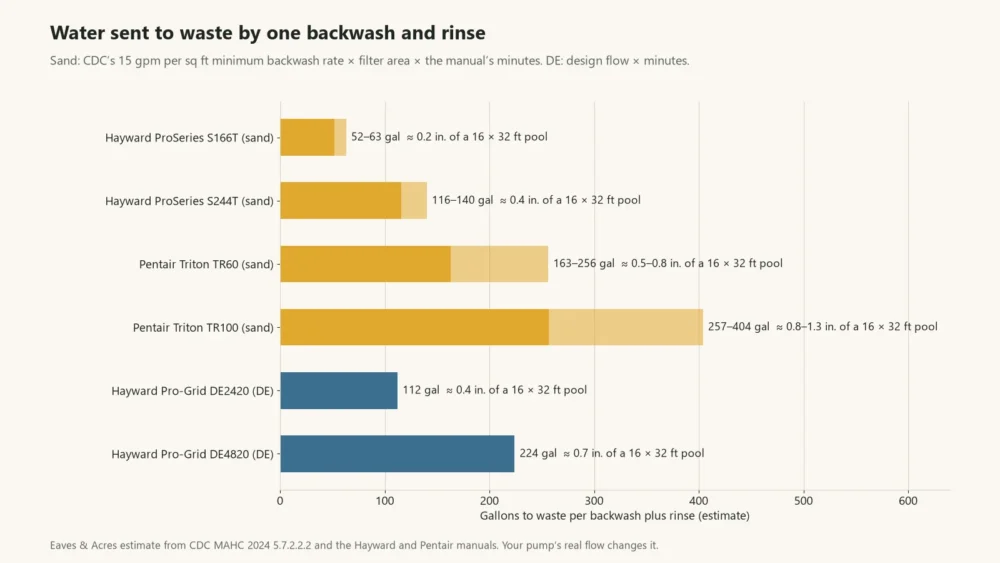
A 3–5 minute Triton backwash on a TR60 comes to about 163–256 gallons, and the large TR100 up to about 404. A small Intex unit moves at most 1,050 gallons an hour, or 17.5 gallons a minute.3 Your pump’s real flow will differ, so treat these as orders of magnitude. Backwash water also takes chemicals with it: on a salt pool, salt is lost when water leaves by backwashing, and stabilizer is diluted, so retest against the ideal pool chemical levels after topping up. Our pool volume calculator gives your gallons per inch.
Sand, DE and cartridge: what changes

Sand. Backwash, rinse, back to filter. If the pressure right after a backwash is 4–6 psi above where it started, Pentair says to chemically clean the sand bed with the proper cleaner from a pool chemical supplier, mixed as its label directs.2
DE. Backwashing flushes the old powder out with the dirt, so the filter needs a fresh coat of DE afterward, added through the skimmer as the manual directs.5,6 Pentair says never to run its DE filter longer than 3 minutes without DE.6 If pressure stays high after several backwashes, the grids need cleaning by hand, which means opening the filter: follow its disassembly steps exactly.6
Cartridge. Jandy says it plainly:
CL and CV (Cartridge) Filters are not subject to backwashing.
Hayward warns that a pressure washer can damage the cartridge, and Jandy says suntan oil, body oils, algae and calcium may need a soak in a degreaser and then a descaler, used as their labels direct.7,11
Handling DE powder safely
The safety data sheet for Dicalite’s flux-calcined DE, whose grades include one named SWIMPOOL, lists up to 70% cristobalite, a crystalline silica that is hazardous by inhalation. It warns the powder “may cause cancer through prolonged or repeated exposure.”13 Pentair’s guide sets the rule for pool owners:
To avoid breathing dust, wear an NIOSH/MSHA approved dust mask, as well as safety glasses
The data sheet says to avoid making dust, to wet spilled powder before sweeping or vacuum it up, and to dispose of it under federal, state and local rules.13
Where backwash water and spent DE can go
That depends on your city. Pentair tells owners to check local codes for backwash, separation tanks and DE disposal.6 Three examples show how far apart the rules are:
| Rule maker | What it says |
|---|---|
| San Diego, CA | Filter backwash may not enter the storm drain. Clean filters over a lawn or planter, collect materials on filter cloth and throw it away; backwash to the sewer must be pH 7–8 through a legal connection.14 |
| Tacoma, WA | Backwash and pool-filter DE cannot go onto the ground, the street, the stormwater system, water bodies or septic systems.15 |
| Chandler, AZ | Backwash may stay on your own landscape or go to the sanitary sewer cleanout; pipes hard-plumbed to the street are prohibited.16 |
| CDC MAHC 2024 (public pools) | Backwash goes to a sanitary sewer; DE filters need a separation tank before discharge.12 |
San Diego’s pool and spa storm water rules show what to look for in your own city’s.14 If you don’t know where your waste line drains, or how to reach your sewer cleanout, ask your city or a pool professional before your next backwash.
Before the next backwash
Record the clean pressure (and pump speed) in the blanks your manual provides, check the gauge weekly as Intex and Jandy ask, and clean at your manual’s number.3,11 Closing for winter? Our guide to when to close your pool explains why water left in a filter can freeze. Treating algae? Start with how much shock to add.
Frequently asked questions
Yes. Pentair’s sand filter guide says backwashing too frequently can lead to poor filtration and tells owners not to backwash on a timed basis.
Watch the gauge. Hayward says 8–10 psi above the clean pressure; Pentair says 10 psi, or 30% less flow on a flow meter. Intex marks a yellow zone.
Stop when the water runs clear. The manuals estimate about 2 minutes (Hayward) to 3–5 minutes (Pentair Triton).
On a multiport valve, yes: Hayward, Pentair and Intex give 20 seconds to 1 minute. A two-position slide valve has no rinse setting.
No. Jandy says its cartridge filters are not subject to backwashing, and Pentair says its Clean & Clear Plus needs none. You remove and hose the cartridges.
Yes. Hayward and Pentair both say to add a fresh charge of DE after backwashing.
Intex says every 5 years for its sand filter pumps. The Hayward and Pentair sand manuals we read give no interval.
Sources
- 1.ProSeries High-Rate Sand Filters Owner’s Manual (IS210TS Rev A). Hayward Industries, 2024. Used for: 8–10 psi trigger; backwash about 2 minutes or less; rinse 1/2–1 minute; filter areas; stop pump before switching valve Back to text
- 2.Triton Side Mount Sand Filter Installation and User’s Guide (P/N 154901 Rev L). Pentair, 2025. Used for: 30% flow drop or 10 psi; not on a timed basis; backwash 3–5 minutes; rinse 30 seconds; chemical cleaning at 4–6 psi; new pool 48 hours; filter areas Back to text
- 3.Krystal Clear Sand Filter Pump Owner’s Manual, model SF90110-2 (341PO). Intex, 2025. Used for: yellow gauge zone; check weekly; backwash until clear; rinse about one minute; maximum flow 1,050 gallons per hour Back to text
- 4.Krystal Clear Sand Filter Pump SX1500 (product page). Intex, read 2026-10-14. Used for: replacement of sand every 5 years Back to text
- 5.Pro-Grid Vertical DE Filter Series Owner’s Manual (ISDE2423EF Rev E). Hayward Industries, 2024. Used for: 8–10 psi above pre-coat; backwash about two minutes; rinse 20 seconds; fresh DE 3.0–9.0 lb; design flow 48–144 gpm Back to text
- 6.FNS Plus Vertical Grid D.E. Filter Installation and User’s Guide. Pentair, 2025. Used for: about 10 psi or significant flow loss; VS pump RPM; dust mask and safety glasses; DE 3.6–6 lb; local codes for DE disposal; trapped-air warning; 3-minute limit without DE Back to text
- 7.SwimClear Cartridge Filter Owner’s Manual (ISC2030 Rev C). Hayward Pool Products, 2011. Used for: 7–10 psi; replace when over 6 psi above new after cleaning; hose and brush, no pressure washing Back to text
- 8.Clean and Clear Plus Cartridge Filter Installation and User’s Guide (P/N 179262 Rev A). Pentair, 2025. Used for: about 10 psi above starting pressure; VS pump RPM Back to text
- 9.Clean & Clear Plus Cartridge Filters Owner’s Manual (P/N 178558 Rev M), retailer-hosted copy. Pentair, 2012. Used for: average cartridge life of 3 years Back to text
- 10.Clean & Clear Plus Cartridge Filter (product page). Pentair, read 2026-10-14. Used for: no need for backwashing; clean at 10 psi above starting pressure Back to text
- 11.Cartridge Pool Filters Installation and Operation Manual, Models CL and CV (H0291800 Rev J). Jandy (Fluidra), n.d. Used for: not subject to backwashing; 10–12 psi; check weekly; hose each pleat; degreaser and descaler Back to text
- 12.Model Aquatic Health Code, 5th Edition (2024 MAHC Code), 4.11.6 and 5.7.2. Centers for Disease Control and Prevention, 2024. Used for: backwash at the maker’s pressure rise; at least 15 gpm per sq ft backwash rate; backwash to sanitary sewer; separation tank for DE Back to text
- 13.Safety Data Sheet: Flux-Calcined Diatomaceous Earth (Dicalite, incl. SWIMPOOL). Dicalite, via Orenda Technologies, 2014. Used for: up to 70% cristobalite; may cause cancer through prolonged or repeated exposure; avoid dust; wet before sweeping; dispose per regulations Back to text
- 14.Pools, Spas & Fountains: Storm Water Regulations. City of San Diego, 2016. Used for: backwash not to storm drain; clean filters over lawn; filter cloth; pH 7–8 to sewer Back to text
- 15.BMP S160: Swimming Pools, Spas, Hot Tubs, and Fountains (Stormwater Management Manual). City of Tacoma, read 2026-10-14. Used for: backwash and DE not to ground, street, stormwater, water bodies or septic Back to text
- 16.Pool Drainage. City of Chandler, Arizona, read 2026-10-14. Used for: backwash on own landscape or sewer cleanout; hard-plumbed street discharge prohibited Back to text
- 17.Pool (photo). Evan Delshaw, Wikimedia Commons, CC BY 2.0, n.d. Used for: hero photo, cropped
- 18.Rapid sand filter EPA (illustration, from EPA/625/4-89/023). US Environmental Protection Agency, Wikimedia Commons, public domain, 1989. Used for: sand filter cutaway
How this guide was made
- Written by the Pool Desk and reviewed by the Data & Methodology Desk.
- Data: trigger pressures, minutes and DE amounts are copied from each manual (read 2026-10-14). Water per backwash is our estimate: for sand filters, CDC MAHC 2024 5.7.2.2.2’s minimum backwash rate of 15 gpm per sq ft × the manual’s filter area × the manual’s backwash and rinse minutes (e.g. Hayward S244T: 3.1 sq ft × 15 = 46.5 gpm → 116–140 gallons); for DE filters, Hayward’s design flow × minutes. Rinse is assumed to run at the backwash flow. Your pump’s real flow changes the result. See our methodology.
- AI use: AI tools help us research, draft and check this guide. Every figure is checked against the source cited for it, and calculated figures come from our own code, described on the methodology page.
- Spotted an error? Tell us — the form opens with this page’s address filled in.
Change log
- Oct 14, 2026Published. Eight Hayward, Pentair, Intex and Jandy filter manuals read 2026-10-14 and compared; CDC MAHC 2024; Dicalite DE safety data sheet; San Diego, Tacoma and Chandler backwash rules; water-per-backwash estimate.
Covers pool and hot tub water chemistry, opening and closing. We maintain the dosing calculators and check every rate against product chemistry and public health guidance.
Keep reading
How Many Gallons in a Pool? Chart by Size and Shape
An 18 ft round pool with 4 ft of water holds 7,614 gallons. Chart of 55 round, oval and in-ground sizes in gallons and liters, checked against Intex, Latham and city charts.

What Is Cyanuric Acid for Pools? What Labels and CDC Say
Cyanuric acid (stabilizer) shields pool chlorine from sunlight but holds it in a slower form. Labels set 20–60 ppm, CDC’s model code caps public pools at 90 ppm.
How to Raise Pool Alkalinity: What the Labels and Chemistry Say
Add sodium bicarbonate with the pump running at your label’s rate: 1.5 lb per 10,000 gallons per 10 ppm on two labels, 1.4 lb in CDC’s model code Annex.
Seasonal reminders for your ZIP
Get a short email when it’s time to overseed, start seeds, open the pool or service your furnace — timed to your climate.