

What Is Cyanuric Acid for Pools? What Labels and CDC Say
We put the stabilizer statements on product labels, maker pages, salt-cell manuals and CDC’s model code side by side, with the chlorine each rule asks for and what tablets add between tests in 19 cities.
- Last reviewed Oct 26, 2026
- 24 cited sources
- 8 min read


- 1Cyanuric acid (stabilizer) shields chlorine from sunlight but holds it in a slower form; CDC asks for at least 2 ppm chlorine in stabilized pools.
- 2Labels and makers set targets from 20 to 60 ppm; CDC’s model code caps public pools at 90 ppm, Montana at 50, and PHTA cites the APSP 100 ppm maximum.
- 3No trichlor or dichlor label we read prints a maximum, though each ppm of chlorine adds 0.6 ppm (trichlor) or 0.9 ppm (dichlor) stabilizer.
- 4CDC’s code lets a public pool be closed when stabilizer exceeds 45 times its free chlorine; at 90 ppm that equals the 2 ppm floor.
- 5Stabilizer leaves only with water; HTH, PHTA and Montana name a partial drain and refill as the fix.
Cyanuric acid (CYA), sold as pool stabilizer or conditioner, shields chlorine in outdoor pools from sunlight, but it also holds chlorine in a slower form, so the more you have, the more chlorine you need. Without it, Pentair says the sun destroys 90% of unstabilized chlorine within two hours.11 CDC’s model code caps public pools at 90 ppm.2
Below are the stabilizer levels printed by the labels, makers and agencies we read, side by side, with the chlorine each rule asks for and what tablets add between tests in 19 cities.
What cyanuric acid does in pool water
CDC’s model code Annex says CYA combines with chlorine to form chlorinated isocyanurates, the family of trichlor tablets and dichlor shock, and reversibly binds chlorine, lowering the hypochlorous acid (HOCl) that does the killing.3 Montana’s health department calls it a weak bond.15 EPA’s review of these products says they form hypochlorous acid in water and the cyanuric acid remains.20 PHTA, the pool industry’s trade association, says stabilized chlorine lasts 3–4 times longer outdoors.13
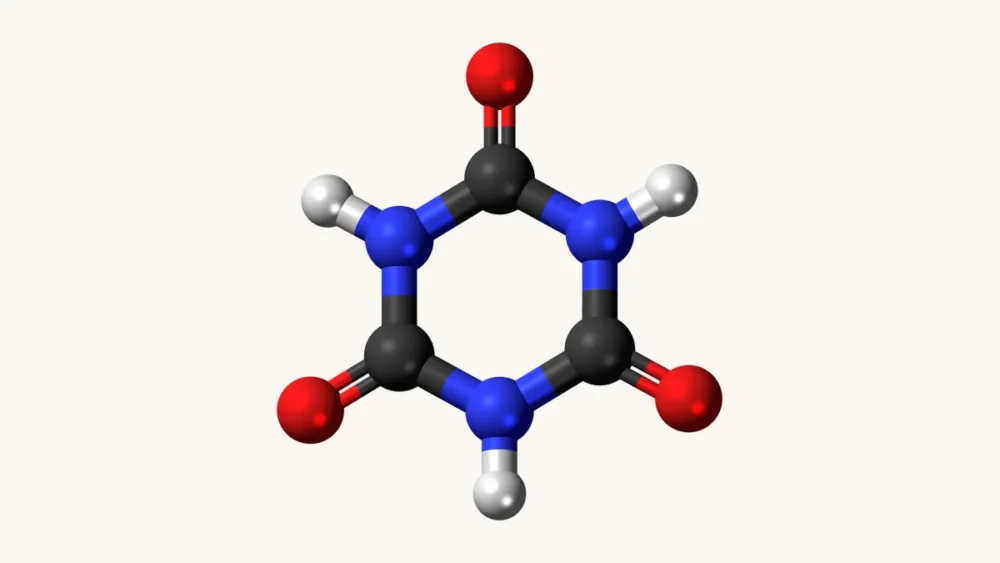

Stabilizer is not a sanitizer: the Annex says CYA is not a disinfectant and is not registered by the EPA.3 CDC says germ kill times are longer with cyanuric acid, and asks for at least 2 ppm free chlorine, not 1, in any stabilized pool.1
How much stabilizer: what labels, makers and CDC say
Table 1 lists every stabilizer level printed on the product labels and maker documents we read. Most put the floor near 30 ppm; they agree on little else.
| Source | Target or minimum | Upper limit printed | Test or retest |
|---|---|---|---|
| HTH Chlorine Stabilizer, label directions | Ideal 20–25 ppm5 | Above 90 ppm: replace water | Twice a season; retest after 48 hours |
| HTH Chlorine Stabilizer, product page | 30–50 ppm; 60–80 ppm for salt pools | Above 100 ppm reduces chlorine; drain partly | Retest after 24–48 hours |
| Leslie’s Instant Pool Water Conditioner (liquid) | Minimum 30 ppm6 | None | Not stated |
| Clorox Pool&Spa Chlorine Stabilizer | At least 30 ppm7 | None | Weekly |
| Trichlor tablet label (RWP, EPA Reg. 67262-17) | 40–50 ppm before use8 | None | Not stated |
| Granular trichlor label (Clearon, EPA Reg. 69470-28) | Minimum of 40–60 ppm9 | None | Not stated |
| Dichlor shock label (T-0072, EPA Reg. 67262-46) | Minimum of 30 ppm10 | None | 2–3 times per season |
| Pentair IntelliChlor salt cell guide | 30–50 ppm11 | None | Not stated |
| Hayward AquaRite salt cell manual | Raise to 40 ppm12 | None | Whenever you check salt |
| Natural Chemistry CYA Removal Kit (reducer) | Ideal 30–50 ppm17 | Treats up to 150 ppm | Test after 7–10 days |
Agencies set the ceilings, and they differ: 50 ppm in Montana, 90 in CDC’s model code, 100 in the APSP maximum PHTA cites.
| Source | What it says | Testing |
|---|---|---|
| CDC home-pool page | At least 2 ppm chlorine with stabilizer; no cyanuric acid in hot tubs1 | Chlorine and pH at least twice a day |
| CDC MAHC 2024 Code (public pools) | At or below 90 ppm; closed at 300 ppm until remediated; correction or closure if CYA exceeds 45 times chlorine2 | Monthly; weekly with stabilized chlorine; 24 hours after adding |
| PHTA trichlor fact sheet | Usually 30–50 ppm; partial drain above the APSP maximum of 10013 | Not stated |
| Montana DPHHS (public pools) | Never above 50 ppm, ideally under 15; none indoors15 | Weekly in one line, monthly in its summary |
| San Bernardino County EHS | Above 50 ppm can substantially decrease chlorine’s effectiveness16 | Not stated |
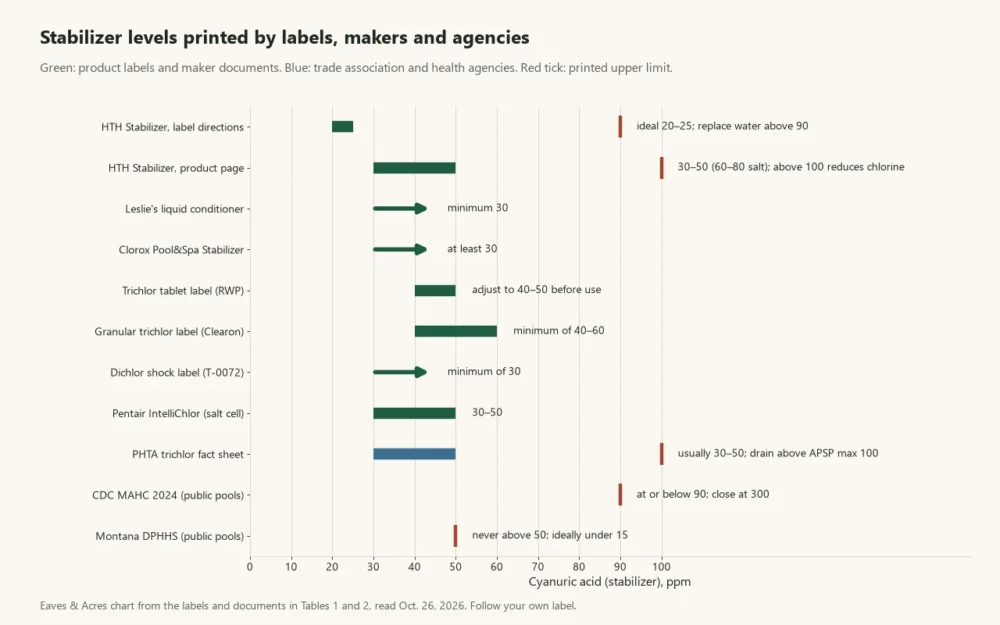
- No sanitizer label we read prints a maximum. The trichlor and dichlor labels give only floors, though each dose adds stabilizer.8,9,10
- HTH disagrees with itself. Its printed directions say 20–25 ppm is ideal; the same product page sells 30–50.5
- Salt pools split. HTH’s page says 60–80 ppm; Pentair, which makes the salt cell, says 30–50.5,11 Hayward’s manual raises stabilizer to 40.12
For the other targets, see ideal pool chemical levels.
Chlorine and stabilizer: why the ratio matters
The Annex says chlorine should rise in proportion to stabilizer:3
A maximum CYA:DPD-FC ratio equates to a minimum HOCl concentration.
CDC’s code turns that into a hard limit: a public pool whose stabilizer is more than 45 times its free chlorine can be ordered closed.2 Table 3 compares that line with CDC’s flat 2 ppm floor and the chart Trouble Free Pool, a pool-owner forum, uses.19
| Stabilizer | CDC minimum | MAHC 45:1 closure line | Trouble Free Pool minimum | HOCl at 2 ppm (MAHC Annex) |
|---|---|---|---|---|
| 0 ppm | 1 ppm | — | — | 0.49 ppm at 1 ppm |
| 30 ppm | 2 ppm | 0.67 ppm | 2 ppm | 0.027 ppm |
| 50 ppm | 2 ppm | 1.11 ppm | 4 ppm | 0.016 ppm |
| 70 ppm | 2 ppm | 1.56 ppm | 5 ppm | 0.011 ppm |
| 90 ppm | 2 ppm | 2.00 ppm | 7 ppm | 0.0087 ppm |
| 100 ppm | 2 ppm | 2.22 ppm | 8 ppm | — |
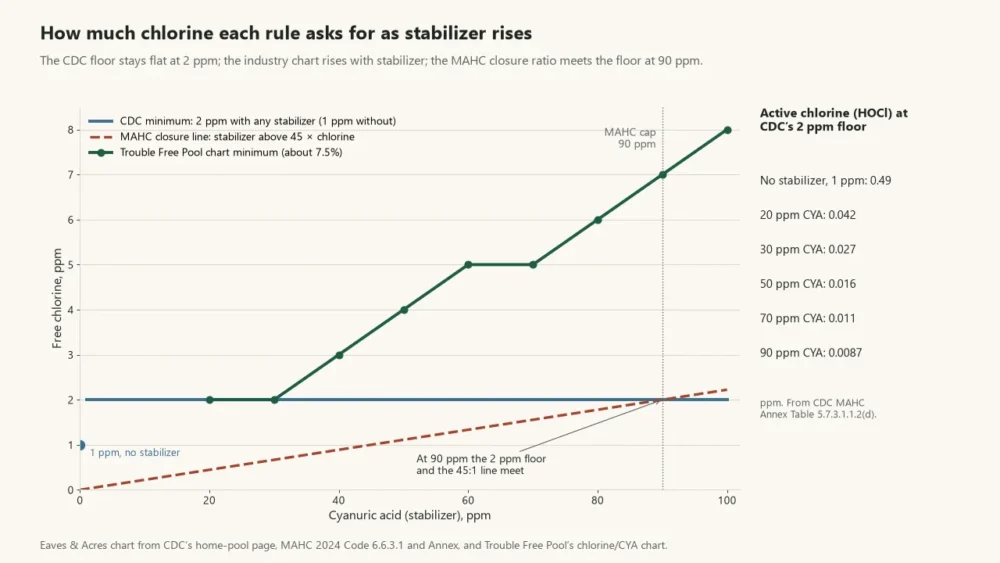
Up to 90 ppm, CDC’s 2 ppm floor is the stricter rule; at 90 ppm, the cap, the floor and the 45:1 line meet. Even at the floor, 90 ppm leaves about 56 times less HOCl than 1 ppm with no stabilizer.3 For shock levels by stabilizer, see how much shock to add to a pool.
Is “chlorine lock” real?
Not as a lock. Trouble Free Pool says pool stores often call high-stabilizer trouble chlorine lock; HTH says it means a pool needs much more chlorine.19,5 CDC’s code explains why the test looks fine: a DPD free chlorine reading includes chlorine bound to cyanurate.2 The bond is reversible, so the fixes are more chlorine for your stabilizer level, or less stabilizer.
Where pool stabilizer comes from
- Stabilizer itself. HTH’s label says 1 pound per 10,000 gallons raises it 10 ppm; at its 98.5% purity, the molar math gives 11.8 ppm, so 1 pound lands about 18% high.5,21 Leslie’s liquid adds 1 ppm per 4 ounces per 10,000 gallons.6
- Trichlor tablets. PHTA says each ppm of chlorine adds 0.6 ppm of cyanuric acid.13 At the RWP label’s weekly chart, 9–14 ounces for 15,000 gallons, that is 2.5–3.8 ppm a week.8,21
- Dichlor shock. By PubChem molecular weights, 0.9 ppm per ppm of chlorine.21
CDC’s code calls liquid chlorine and cal-hypo unstabilized, and PHTA says a salt cell adds no stabilizer.2,14
Unlike chlorine, cyanuric acid is never used up and accumulates in the pool water.

It leaves only with water. Hayward says salt is lost to splashing, backwashing or draining after rain, not evaporation, and that salt and stabilizer usually drop together.12 Our saltwater vs. chlorine pool guide totals a season of tablets by city, and how often to backwash a pool filter covers what each backwash sends to waste.
How to test stabilizer and read the result
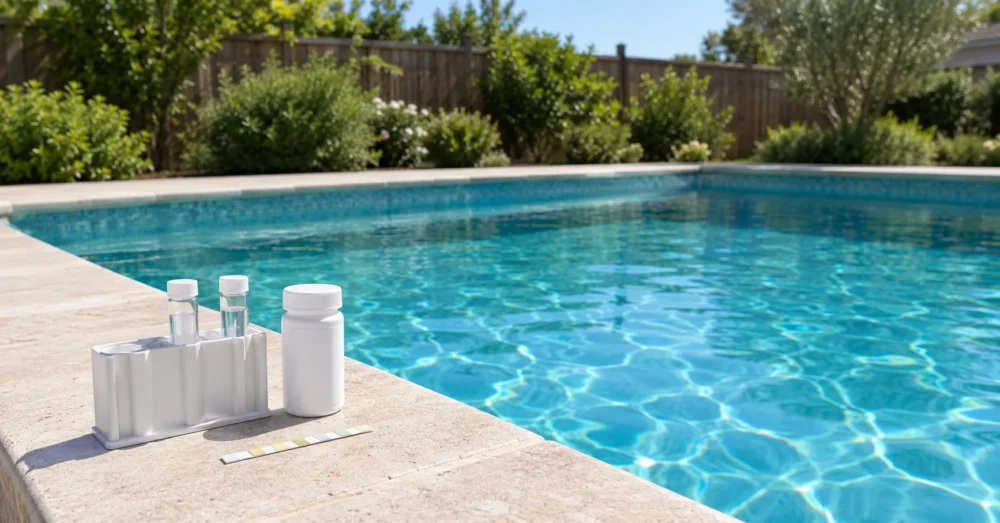
Home kits use a turbidity test. In Taylor’s kit you mix pool water with its cyanuric acid reagent, pour the cloudy sample into a tube until a black dot on the bottom just disappears, and read the level off the tube.18 The Annex says 100 ppm is the highest this test reads without diluting the sample; that is why CDC set its cap at 90.3 Follow your kit’s own directions.
Retest 24 hours after adding stabilizer (CDC’s code) or 48 (HTH’s label).2,5 Stabilizer also counts toward total alkalinity; Pentair subtracts one-third of the reading from the alkalinity test.11
How often to test, by climate
Labels say to test stabilizer 2–3 times per season (dichlor) or at least twice (HTH); CDC’s code says monthly, and weekly when stabilized chlorine is the main sanitizer.10,5,2 We counted each city’s swim season as the days its normal daily mean air temperature is 65°F or higher in NOAA’s 1991–2020 normals.22
| City | Swim season | Weeks | Weeks between 3 tests | Tablets could add between tests |
|---|---|---|---|---|
| Seattle, WA | Jul 1–Sep 2 | 9 | 3 | 7–12 ppm |
| Minneapolis, MN | Jun 5–Sep 7 | 14 | 4.7 | 12–18 ppm |
| Boston, MA | Jun 7–Sep 17 | 15 | 5 | 12–19 ppm |
| Denver, CO | Jun 1–Sep 18 | 16 | 5.3 | 13–20 ppm |
| Chicago, IL | May 27–Sep 21 | 17 | 5.7 | 14–22 ppm |
| Columbus, OH | May 24–Sep 19 | 17 | 5.7 | 14–22 ppm |
| New York, NY | May 23–Sep 27 | 18 | 6 | 15–23 ppm |
| Philadelphia, PA | May 13–Oct 2 | 20 | 6.7 | 16–26 ppm |
| Kansas City, MO | May 11–Sep 29 | 20 | 6.7 | 16–26 ppm |
| Nashville, TN | May 6–Oct 3 | 22 | 7.3 | 18–28 ppm |
| Charlotte, NC | May 1–Oct 7 | 23 | 7.7 | 19–29 ppm |
| Atlanta, GA | Apr 29–Oct 10 | 24 | 8 | 20–31 ppm |
| Los Angeles, CA | May 5–Nov 6 | 27 | 9 | 22–35 ppm |
| Dallas, TX | Apr 8–Oct 27 | 29 | 9.7 | 24–37 ppm |
| Las Vegas, NV | Apr 5–Oct 29 | 30 | 10 | 25–38 ppm |
| Houston, TX | Mar 24–Nov 7 | 33 | 11 | 27–42 ppm |
| Phoenix, AZ | Mar 11–Nov 16 | 36 | 12 | 30–46 ppm |
| Tampa, FL | Feb 18–Dec 15 | 43 | 14.3 | 35–55 ppm |
| Miami, FL | All year | 52 | 17.3 | 43–67 ppm |
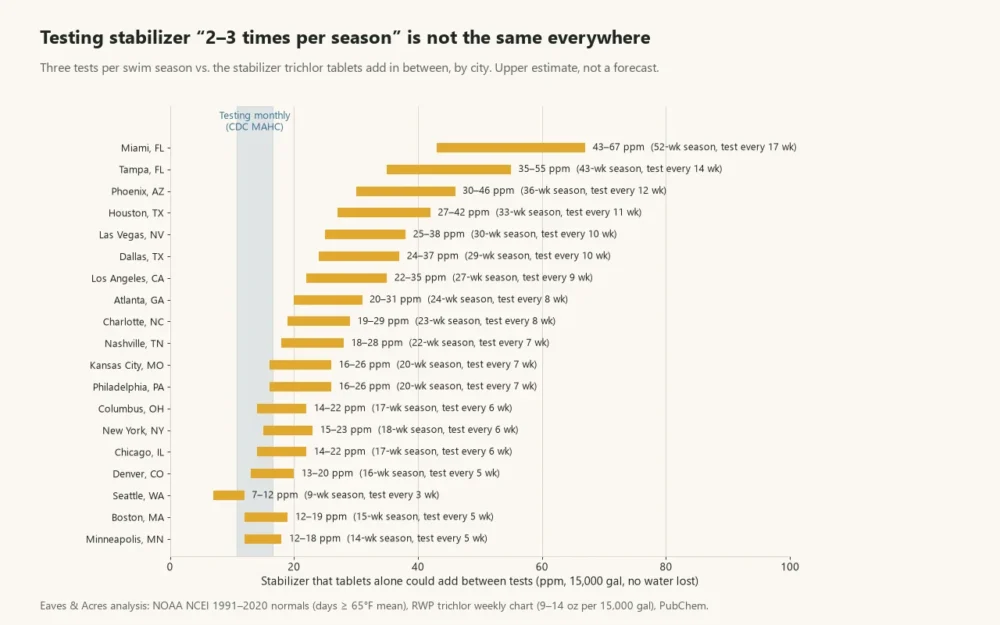
In the median of 40,906 ZIP codes, a 17-week season puts 5.7 weeks between three tests, time for tablets to add 14–22 ppm. In 73% of ZIP codes, three tests a season means testing less often than monthly. In Phoenix, Tampa and Miami, CDC’s monthly schedule means 8–12 tests a season instead of three. Splash-out, backwash and rain lower these figures, so test instead of predicting.12
When stabilizer is too high
At high concentrations (>50 ppm), cyanuric acid can substantially decrease the effectiveness of chlorine.
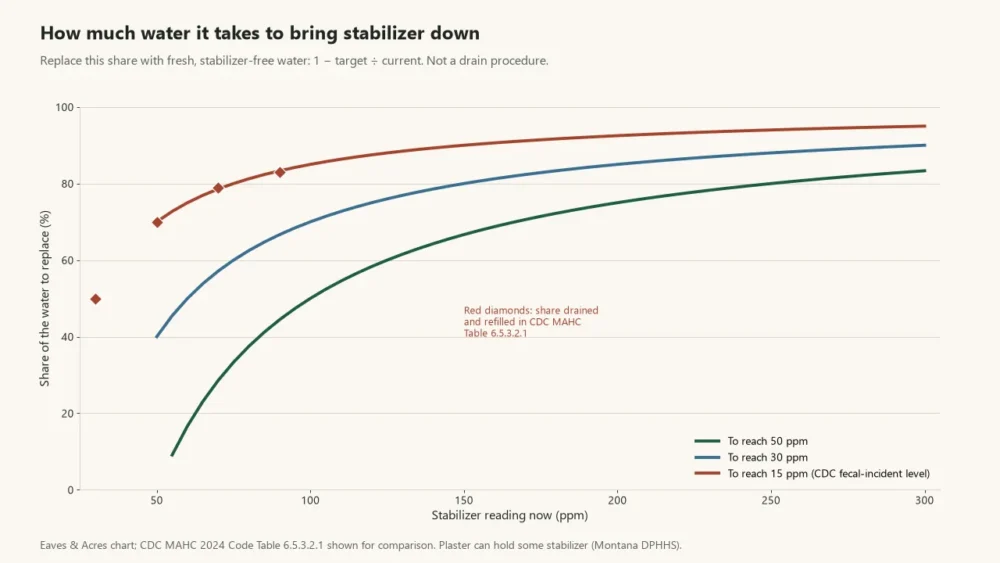
Every agency, trade group and stabilizer maker we read names the same fix: fresh water. HTH’s label says to replace water above 90 ppm; PHTA recommends a partial drain and refill above 100; Montana says to partially drain and add fresh water.5,13,15 After a diarrhea incident, CDC’s MAHC Annex has public pools partly drain to 15 ppm or less; other methods count only if tests confirm it.3
The share of water to replace is 1 − target ÷ current: from 100 ppm to 50, half; from 150 to 50, two-thirds. That matches CDC’s code table (50% from 30 ppm to 15, 83% from 90).2 Montana warns that some stabilizer clings to the pool, plumbing and filter, so a refill can test higher than expected.15 Ask your pool’s builder or a pool professional how much water your pool can lose at once; this page gives no drain procedure.
Reducer products exist: Natural Chemistry’s CYA Removal Kit, now listed as discontinued, claimed to work in 7–10 days without draining.17 Meanwhile, switching to unstabilized chlorine stops adding more.2
Salt pools, hot tubs and indoor pools
Salt pools: PHTA says chlorine from a salt cell is unstabilized, so cyanuric acid may be needed; levels differ by maker (Table 1).14 Check salt with our pool salt calculator. Hot tubs: CDC recommends no cyanuric acid or stabilized chlorine, and its code bars both from new spas; see hot tub chemical levels.1,2 Indoor pools: the Annex says CDC does not recommend CYA indoors, and Pentair’s manual says not to use it.3,11
When to call a pool professional
CDC’s poster says to ask for help with any task you are not trained for.4 Call one before a large drain or if stabilizer reads above 100 ppm. HTH’s stabilizer causes eye irritation: if in eyes, rinse with water for 15–20 minutes and call a poison control center or doctor.5 Get your gallons from our pool volume calculator, and see our methodology for how we check sources.
Frequently asked questions
No. Baking soda is sodium bicarbonate, which CDC’s model code lists for pH adjustment; it raises alkalinity. Cyanuric acid, C3H3N3O3 in PubChem, stabilizes chlorine. Never mix pool chemicals.
When a test reads below your label’s floor, often 30 ppm. The RWP trichlor label says to bring stabilizer to 40–50 ppm before you start tablets. CDC advises none in hot tubs.
Dichlor shock does, about 0.9 ppm per ppm of chlorine by PubChem molecular weights. Liquid chlorine and cal-hypo add none; CDC’s model code calls them unstabilized.
Only the rain that leaves the pool. Hayward says salt is lost when water is drained because of rain, not by evaporation, and that salt and stabilizer usually drop together.
PHTA calls it a very stable molecule that does not readily degrade in pools, and Montana says it is never used up. We found no sunlight breakdown rate, so test it instead of assuming it fades.
The main risk is slower chlorine. CDC’s Annex calls 90 ppm protective on toxicity and says pools should close above 300 ppm; a public pool can be closed when stabilizer exceeds 45 times its chlorine.
Sources
- 1.Home Pool and Hot Tub Water Treatment and Testing. Centers for Disease Control and Prevention, 2024. Used for: at least 2 ppm chlorine with cyanuric acid; none in hot tubs; kill times only without cyanuric acid; testing twice a day Back to text
- 2.Model Aquatic Health Code, 5th Edition (2024 MAHC Code), 5.7.3.1.1.2, 5.7.3.1.3, 5.7.3.4.2, 5.7.5.7, 6.1.2.1.1, 6.5.3.2.1, 6.6.3.1. Centers for Disease Control and Prevention, 2024. Used for: 90 ppm cap; closed at 300 ppm; 45:1 CYA:chlorine closure; DPD-FC includes cyanurate-bound chlorine; testing schedule; no CYA in new spas; unstabilized vs stabilized products; drain table Back to text
- 3.Model Aquatic Health Code Annex, 5th Edition (2024 MAHC Annex), 5.7.3.1.1.2 and 5.7.3.1.3. Centers for Disease Control and Prevention, 2024. Used for: how CYA binds chlorine; not an EPA-registered disinfectant; HOCl tables; why 90 not 100 ppm (test range); indoor pools; toxicity; 15 ppm for fecal response Back to text
- 4.Use Pool Chemicals Safely (poster CS317109-B). Centers for Disease Control and Prevention, n.d. Used for: goggles and gloves; read the label before each use; one container at a time; never mix pool chemicals; ask for help if untrained Back to text
- 5.HTH Pool Care Chlorine Stabilizer (product page, directions, ingredients, safety). HTH Pools (Innovative Water Care), read 2026-10-26. Used for: 98.5% cyanuric acid; 1 lb per 10,000 gal = 10 ppm; ideal 20–25 ppm; replace water above 90 ppm; 30–50 / 60–80 ppm; above 100 ppm; retest 48 h; eye irritation first aid Back to text
- 6.Instant Pool Water Conditioner directions. Leslie’s, read 2026-10-26. Used for: 1 gallon per 10,000 gal raises stabilizer 32 ppm; 4 oz = 1 ppm; recommended minimum 30 ppm Back to text
- 7.Clorox Pool&Spa Chlorine Stabilizer. Clorox Pool&Spa (Recreational Water Products), read 2026-10-26. Used for: test weekly; stabilizer at least 30 ppm Back to text
- 8.RWP Master Trichloro label, 99% trichloro-s-triazinetrione (EPA Reg. No. 67262-17). Recreational Water Products / U.S. EPA, 2024. Used for: adjust stabilizer to 40–50 ppm; weekly dosage chart 9–14 oz per 15,000 gal; no stabilizer maximum Back to text
- 9.Clearon Granular Trichlor label (EPA Reg. No. 69470-28). Clearon Corp. / U.S. EPA, 2016. Used for: stabilizer minimum of 40–60 ppm; no maximum Back to text
- 10.T-0072 dichlor shock label, sold as Clorox Pool&Spa Shock XtraBlue (EPA Reg. No. 67262-46). Recreational Water Products / U.S. EPA, 2025. Used for: stabilizer minimum of 30 ppm, tested 2–3 times per season; no maximum Back to text
- 11.IntelliChlor Salt Chlorine Generator Installation and User’s Guide (P/N 520589 Rev R). Pentair, 2023. Used for: 90% of unstabilized chlorine destroyed by sun within two hours; 30–50 ppm; not in indoor pools; subtract 1/3 of CYA from alkalinity Back to text
- 12.AquaRite Electronic Chlorine Generator Owner’s Manual (092538 Rev D). Hayward Pool Products, 2019. Used for: raise stabilizer to 40 ppm; salt and stabilizer decline together; salt lost by splashing, backwashing, draining after rain, not evaporation Back to text
- 13.Trichlor: The dependable pool performer. PHTA Recreational Water Quality Committee, ICC Building Safety Journal, 2020. Used for: 0.6 ppm cyanuric acid per ppm chlorine; usually 30–50 ppm; 3–4 times longer; very stable; APSP maximum 100 ppm, partial drain and refill Back to text
- 14.Fact Sheet: Electrolytic Chlorine Generators. Pool & Hot Tub Alliance (PHTA), 2021. Used for: no stabilizer added by the cell; cyanuric acid may be required Back to text
- 15.Fact Sheet on Cyanuric Acid and Stabilized Chlorine Products. Montana Department of Public Health and Human Services, n.d. Used for: weak bond; never used up; maximum 50 ppm, ideally under 15; no indoor use; partial drain; clings to the pool and plumbing Back to text
- 16.What is cyanuric acid?. San Bernardino County Environmental Health Services, 2022. Used for: above 50 ppm can substantially decrease chlorine effectiveness Back to text
- 17.CYA Removal Kit. Natural Chemistry (NC Brands), read 2026-10-26. Used for: discontinued; up to 25,000 gal at 150 ppm or less; 7–10 days; ideal 30–50 ppm Back to text
- 18.Taylor 2000 Series Test Kits instructions (copy hosted by Pool Supply Unlimited). Taylor Technologies, 2020. Used for: cyanuric acid turbidity test: 7 mL sample, R-0013 to 14 mL, black dot disappears Back to text
- 19.CYA Chlorine Relationship (chlorine/CYA chart). Trouble Free Pool, n.d. Used for: minimum free chlorine about 7.5% of CYA; chart values; “chlorine lock” is a pool-store term Back to text
- 20.R.E.D. Facts: Chlorinated Isocyanurates (EPA-738-F-92-010). U.S. Environmental Protection Agency, 1992. Used for: chlorinated isocyanurates form hypochlorous acid in water; cyanuric acid remains Back to text
- 21.PubChem compound records: cyanuric acid (CID 7956), trichloroisocyanuric acid (CID 6909), sodium dichloroisocyanurate dihydrate (CID 23667638). National Library of Medicine (NIH), read 2026-10-26. Used for: molecular weights 129.07, 232.41, 255.97 for the molar-mass checks Back to text
- 22.U.S. Climate Normals 1991–2020 (monthly mean temperature), nearest station. NOAA National Centers for Environmental Information, 2021. Used for: swim season (days at or above 65°F mean) for 19 cities and 40,906 ZIP codes Back to text
- 23.Blue study (sunlight on swimming pool water), photo. Thad Zajdowicz, Wikimedia Commons, CC BY 2.0, 2014. Used for: hero photo, cropped
- 24.Cyanuric acid (trione) 3D ball model. Jynto, Wikimedia Commons, CC0, 2011. Used for: molecule image, padded
How this guide was made
- Written by the Pool Desk and reviewed by the Data & Methodology Desk.
- Data: levels copied from each label, maker page and agency document, read 2026-10-26. Molar-mass checks: PubChem weights; 1 lb of 98.5% cyanuric acid in 10,000 gallons = 11.8 ppm; trichlor 0.61 and dichlor 0.91 ppm stabilizer per ppm available chlorine. Test spacing: swim season = days with a NOAA 1991–2020 normal daily mean of 65°F or more (nearest station), divided by three tests; tablet stabilizer from the RWP trichlor weekly chart (9–14 oz per 15,000 gallons = 2.5–3.8 ppm a week), no water lost; an upper estimate, not a dose. Dilution share = 1 − target ÷ current reading. See our methodology.
- AI use: AI tools help us research, draft and check this guide. Every figure is checked against the source cited for it, and calculated figures come from our own code, described on the methodology page.
- Spotted an error? Tell us — the form opens with this page’s address filled in.
Change log
- Oct 26, 2026Published. Stabilizer statements on the HTH, Leslie’s, Clorox and Natural Chemistry product pages, three EPA-accepted trichlor and dichlor labels, Pentair and Hayward salt-cell manuals, CDC’s home-pool page, MAHC 2024 Code and Annex, PHTA, Montana DPHHS and San Bernardino County read 2026-10-26; molar-mass checks and NOAA test-spacing table computed the same day.
Covers pool and hot tub water chemistry, opening and closing. We maintain the dosing calculators and check every rate against product chemistry and public health guidance.
Keep reading
How to Raise Pool Alkalinity: What the Labels and Chemistry Say
Add sodium bicarbonate with the pump running at your label’s rate: 1.5 lb per 10,000 gallons per 10 ppm on two labels, 1.4 lb in CDC’s model code Annex.

How Long to Wait to Swim After Shocking a Pool: What Nine Labels Say
Swim again when a test shows free chlorine at or below your shock label’s limit, 4 ppm on the seven chlorine shock labels we read, with pH back in range.
How Often to Backwash a Pool Filter: Eight Manuals Compared
Backwash sand and DE filters at the pressure rise your manual gives, about 8–10 psi, not by the calendar. Cartridge filters are hosed, not backwashed.
Seasonal reminders for your ZIP
Get a short email when it’s time to overseed, start seeds, open the pool or service your furnace — timed to your climate.