

How Long to Wait to Swim After Shocking a Pool: What Nine Labels Say
We read nine pool chemical labels, CDC’s home-pool advice and model code, and two state pool codes, then worked out why no label can give you a number of hours.
- Last reviewed Oct 22, 2026
- 21 cited sources
- 7 min read

- 1Swim when a test shows free chlorine at or below your label’s limit (4 ppm on all seven chlorine shock labels we read) and pH in range.
- 2Label clocks are minimums: non-chlorine shock 15 minutes; dichlor 15 minutes, then 1–4 ppm; liquid and cal-hypo print no hours.
- 3From 2 ppm, one liquid or cal-hypo label dose leaves 7–12 ppm, so the wait depends on start level and dose.
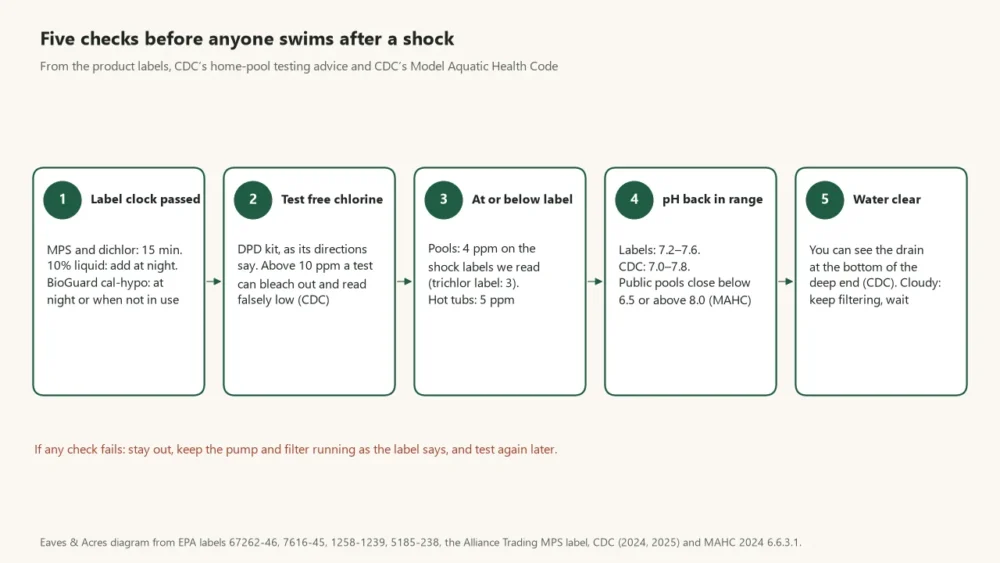
- 4Above 10 ppm a DPD test can bleach out and read falsely low (CDC): don’t trust a zero right after shocking.
- 5Public-pool codes allow 10 ppm, but CDC’s model code says re-entry follows the label; spa directions allow 5 ppm.
Swim again after shocking a pool when a test shows free chlorine at or below the limit printed on your shock’s label, with pH back in range. On all seven chlorine pool shock labels we read, that limit is 4 ppm.1,3,5,7 The clock alone never decides it.
The waits the labels print are short and conditional: 15 minutes for non-chlorine shock, 15 minutes and then 1–4 ppm for dichlor, and no hours at all for liquid chlorine or cal-hypo. The 10% liquid label says to add it at night and check in the morning.8,7,1
What nine shock labels say about getting back in
Each chlorine shock is registered with EPA, and its label says it is a violation of federal law to use the product in a manner inconsistent with its labeling.5 So the label’s re-entry line is the answer for your product. We read the current version of nine labels, found through EPA’s pesticide label database: seven chlorine shocks, one non-chlorine shock and one trichlor sanitizer.20
| Product (label) | When swimmers may get back in | Time printed |
|---|---|---|
| 10% liquid chlorine, KIK EPA Reg. No. 7616-45, 2024 | “DO NOT enter pool until residual is less than 4.0 ppm.”1 | Add at night; check in the morning |
| 12.5% liquid chlorine, Surchlor EPA Reg. No. 9359-2, 2017 | “Do not reenter pool with a chlorine residual above 4 ppm”2 | None |
| HTH Granular 73 (cal-hypo) EPA Reg. No. 1258-1239, 2025 | “Re-entry into treated pools is prohibited above 4 ppm”3 | Opening: 30 minutes to disperse, then test |
| HTH Dry Chlorinator Granular, 68% cal-hypo EPA Reg. No. 1258-427, 2025 | Re-entry prohibited above 4 ppm4 | Opening: 30 minutes to disperse, then test |
| BioGuard Burn Out (cal-hypo) EPA Reg. No. 5185-238, 2021 | “Do not enter the pool until the free chlorine residual has dropped to 4.0 ppm or less”5 | Shock at night or when not in use; opening: at least 4 hours, preferably overnight |
| HTH Shock Advanced (cal-hypo) EPA Reg. No. 1258-1343, 2021 | Enter at 1–4 ppm; prohibited above 4 ppm6 | None |
| Dichlor (T-0072, sold as Clorox Pool & Spa Shock XtraBlue) EPA Reg. No. 67262-46, 2025 | “Wait at least 15 minutes after product application before entering pool.” Then 1–4 ppm7 | 15 minutes; algae dose: 24 hours of filtering |
| Non-chlorine shock (MPS), Alliance Trading REV052024 | “Swimming or bathing may be resumed in 15 minutes.”8 | Add only when no bathers are present |
| Clearon Granular Trichlor (sanitizer) EPA Reg. No. 69470-28, 2016 | Re-entry prohibited “above levels of 3 ppm of chlorine”9 | None |

Google’s AI answer, when we checked, gave dichlor 12 to 24 hours and cal-hypo 24 to 48. The dichlor label prints 15 minutes, and no cal-hypo label we read prints hours. What every chlorine label shares is a number to test for:
it is necessary to test the chlorine (or bromine) residual.
Why no label can give you a number of hours
How long the wait lasts depends on where your chlorine started and how much the dose added. We took each label’s shock dose and added it to 2 ppm, CDC’s minimum for pools that use stabilizer (cyanuric acid), before any of it is used up.10
| Product | One label dose adds | Reading right after | Must drop before swimming |
|---|---|---|---|
| 10% or 12.5% liquid chlorine | 5–10 ppm (label) | 7–12 ppm | 3–8 ppm |
| HTH 73% or 68% cal-hypo | 5–10 ppm (label) | 7–12 ppm | 3–8 ppm |
| BioGuard Burn Out, 1 lb per 10,000 gal | 7.8 ppm (our math) | 9.8 ppm | 5.8 ppm |
| HTH Shock Advanced, 1 lb per 13,500 gal | 5.0 ppm (our math) | 7.0 ppm | 3.0 ppm |
| Dichlor, 1 lb per 12,000 gal | 4.0 ppm (our math) | 6.0 ppm | 2.0 ppm |
| Non-chlorine shock (MPS) | None | 2 ppm | None |
“Our math” uses the labels’ available chlorine: ppm = pounds × available chlorine × 1,000,000 ÷ (gallons × 8.34). It gives 8.75 ppm for one pound of 73% cal-hypo in 10,000 gallons, the figure on HTH’s own chart.3 The MPS label calls its product nonhalogenated, with no chlorine or bromine.8

So the dichlor label’s 15 minutes only works out when chlorine starts near zero, because its dose adds 4.0 ppm by itself; from 2 ppm, the same bag leaves 6 ppm.7 And a high-end liquid or cal-hypo dose on top of 2 ppm reaches 12 ppm, past the point where a test kit can mislead you. For doses by pool size, see how much shock to add to a pool; the pool volume calculator gives your gallons.
How fast chlorine falls after that varies. CDC lists sunlight and swimmers’ sweat, dirt, pee and poop as things that lower it.10 The only rate we found is for chlorine without stabilizer: Pentair says the sun’s UV destroys 90% of it within two hours, which is why labels say to shock at night.19 We found no figure for a stabilized pool, so we give no hours estimate.
Test before anyone gets in, and watch for a false low
CDC advises home pool owners to test chlorine and pH at least twice a day, and more often with many swimmers, using a DPD test kit for the most accurate result; test strips are less accurate.10 Right after a shock, CDC warns, a sample above 10 ppm can
partially or totally bleach out, resulting in a false low or 0 ppm chlorine result
So a zero reading soon after shocking is a reason to doubt the test, not to swim. Follow your kit maker’s directions for high readings; CDC’s code Annex mentions more reagent, a smaller sample or dilution with distilled water.10,12
pH and clear water are part of the answer
None of the shock labels we read makes pH a written re-entry condition, but the liquid chlorine and HTH labels ask you to keep pH at 7.2–7.6, and BioGuard says to adjust it to 7.2–7.4 before shocking.1,3,5 CDC recommends 7.0–7.8 for home pools, and its Model Aquatic Health Code lets inspectors close a public pool below 6.5 or above 8.0.10,11 Test pH in the same sample; if it is high, see how to lower pool pH, and the full set of targets is in ideal pool chemical levels.
Then look. CDC tells swimmers to make sure they can see the drain at the bottom of the deep end; the model code lists a bottom that is not visible as a reason to close a public pool.16,11 After an algae dose, the dichlor label calls for 24 hours of pump and filter time and no entry until chlorine is 1–4 ppm.7 Our guide to how long to run a pool pump covers filter hours.
Why public pools can reopen at 10 ppm
State codes for public pools set a ceiling of 10 ppm. California allows 1–10 ppm free chlorine in public pools; Florida lets a pool reopen after breakpoint chlorination once free chlorine drops to 10 mg/L or less, and keeps it closed for at least an hour after chemicals are added by hand.14,13 CDC’s model code treats more than 10 ppm with bathers present as an imminent health hazard, but also says chlorine must not exceed the limit on the product label.11 Its Annex explains:
EPA has not approved any POOL product use above 4 ppm (mg/L) DPD-FC
The Annex says 10 ppm was chosen so operators can still measure chlorine, reports no data showing health risks at or well above 4 ppm, and says bather re-entry should follow the label.12 At home, the label’s number is the one that applies to you.

Hot tubs, salt pools and fouled water
Hot tubs
Spa directions on four of the labels set 5 ppm. The three HTH labels prohibit re-entry above 5 ppm, and the dichlor label says to stay out until chlorine is 5 ppm or less, or bromine 8 ppm or less.3,4,6,7 CDC’s floor for hot tubs is 3 ppm; more in hot tub chemical levels.10
Salt pools
A salt pool is chlorinated too, so the same test applies; Pentair’s guide prints no swim wait after its 24-hour Boost mode.19 See saltwater vs chlorine pools.
After a poop accident
CDC’s guidance for pool staff closes the pool, holds chlorine at a set level for a set time, and lets swimmers back only after disinfection is complete and chlorine and pH are within the range the state or local regulator allows.15 Diarrhea calls for far higher chlorine for hours; follow CDC’s steps or ask your health department.
Keep the label after you shock: its EPA registration number finds the full directions in EPA’s database.20
Frequently asked questions
Only if a test then shows free chlorine at or below your label’s limit, 4 ppm on the shock labels we read. No chlorine shock label we read promises a number of hours.
The labels prohibit it above 4 ppm “due to risk of bodily harm.” CDC estimates 13,508 emergency visits for pool chemical injuries in 2015–2017, some when chemicals were added just before someone got in.
The potassium monopersulfate label we read says swimming may resume in 15 minutes, and to add it only when no bathers are present. It contains no chlorine.
Not by the pool labels: every chlorine shock label we read prohibits re-entry above 4 ppm, and a trichlor label sets 3 ppm. Spa directions allow 5 ppm in hot tubs.
Several labels say so: the 10% liquid label says add it at night and check in the morning, and BioGuard says at night or when the pool is not in use. Pentair says sunlight destroys 90% of unstabilized chlorine within two hours.
The same rule applies: test, and swim when free chlorine is at or below the limit on the shock you used. Pentair’s salt cell guide gives no swim wait after its 24-hour Boost mode.
Sources
- 1.Chlorinating Liquid label, 10% sodium hypochlorite (EPA Reg. No. 7616-45). KIK Pool Additives / U.S. EPA, 2024. Used for: do not enter until residual is less than 4.0 ppm; shock 64–128 fl oz per 10,000 gal for 5–10 ppm; add at night, check in the morning; pH 7.2–7.6 Back to text
- 2.Surchlor 12.5% sodium hypochlorite label (EPA Reg. No. 9359-2). Surpass Chemical Company / U.S. EPA, 2017. Used for: do not reenter above 4 ppm; superchlorinate 52–104 oz per 10,000 gal for 5–10 ppm Back to text
- 3.HTH Granular 73 label, 73% calcium hypochlorite (EPA Reg. No. 1258-1239). Innovative Water Care / U.S. EPA, 2025. Used for: re-entry prohibited above 4 ppm (spas 5 ppm); shock 9–18 oz per 10,000 gal for 5–10 ppm; dose chart; opening: 30 minutes to disperse; pH 7.2–7.6 Back to text
- 4.HTH Dry Chlorinator Granular label, 68% calcium hypochlorite (EPA Reg. No. 1258-427). Innovative Water Care / U.S. EPA, 2025. Used for: re-entry prohibited above 4 ppm (spas 5 ppm); shock 10–20 oz per 10,000 gal for 5–10 ppm; opening: 30 minutes to disperse Back to text
- 5.BioGuard Master Calcium Hypochlorite label, sold as BioGuard Burn Out (EPA Reg. No. 5185-238). Bio-Lab / U.S. EPA, 2021. Used for: 65% available chlorine; test to know how long to wait; enter at 4.0 ppm or less; shock at night or when not in use; opening at least 4 hours, preferably overnight; pH 7.2–7.4 before shocking; federal-law labeling statement Back to text
- 6.HTH Pool Care Shock Advanced label (AW52), 56% available chlorine (EPA Reg. No. 1258-1343). Innovative Water Care / U.S. EPA, 2021. Used for: 1 lb per 13,500 gal; enter at 1–4 ppm, prohibited above 4 ppm; spas 5 ppm Back to text
- 7.T-0072 dichlor shock label, sold as Clorox Pool & Spa Shock XtraBlue (EPA Reg. No. 67262-46). Recreational Water Products / U.S. EPA, 2025. Used for: 40% available chlorine; 1 lb per 12,000 gal; wait at least 15 minutes, enter at 1–4 ppm; algae dose 24 h filtering, no entry until 1–4 ppm; spas 5 ppm chlorine or 8 ppm bromine Back to text
- 8.Non-Chlorine Shock oxidizing treatment label (REV052024). Alliance Trading, Inc., 2024. Used for: 42.8% potassium peroxymonosulfate; nonhalogenated, not a sanitizer; add when no bathers are present; swimming may resume in 15 minutes Back to text
- 9.Clearon Granular Trichlor label (EPA Reg. No. 69470-28). Clearon Corp. / U.S. EPA, 2016. Used for: reentry prohibited above 3 ppm; shock with an appropriate shock product Back to text
- 10.Home Pool and Hot Tub Water Treatment and Testing. Centers for Disease Control and Prevention, 2024. Used for: pH 7.0–7.8; at least 1 ppm chlorine, 2 ppm with stabilizer, 3 ppm in hot tubs; what lowers chlorine; test twice a day; DPD kits; bleach-out above 10 ppm Back to text
- 11.Model Aquatic Health Code, 5th Edition (2024 MAHC Code), 5.7.3.1.1.5 and 6.6.3.1. Centers for Disease Control and Prevention, 2024. Used for: maximum chlorine set by the product label; imminent health hazards: above 10 ppm with bathers, pH below 6.5 or above 8.0, bottom not visible Back to text
- 12.Model Aquatic Health Code Annex, 5th Edition (2024 MAHC Annex). Centers for Disease Control and Prevention, 2024. Used for: EPA has approved no pool product above 4 ppm with bathers; 10 ppm chosen for measurability; re-entry per label; DPD bleach-out and remedies Back to text
- 13.Fla. Admin. Code R. 64E-9.004, Pool Operation and Maintenance. Florida Department of Health (via Cornell LII), 2023. Used for: public pools 1–10 mg/L free chlorine; closed at least 1 hour after manual chemical addition; reopen after breakpoint chlorination at 10.0 mg/L or less Back to text
- 14.Cal. Code Regs. tit. 22, § 65529, Disinfectant residuals. California Department of Public Health (via Cornell LII), 2017. Used for: public pools 1.0–10.0 ppm free chlorine (2.0–10.0 with CYA); DPD test kits Back to text
- 15.Fecal Incident Response Recommendations for Aquatic Staff. Centers for Disease Control and Prevention, 2018. Used for: close the venue; disinfect; swimmers back only when chlorine and pH are within the regulator’s operating range Back to text
- 16.Preventing Swimming-related Illnesses. Centers for Disease Control and Prevention, 2025. Used for: see the drain at the bottom of the deep end before you get in Back to text
- 17.Use Pool Chemicals Safely (poster CS317109-B). Centers for Disease Control and Prevention, n.d. Used for: read the label before each use; goggles and gloves; never mix chlorine with acid or different chlorine products Back to text
- 18.Pool Chemical Injuries in Public and Residential Settings — United States, 2008–2017, and New York, 2018 (MMWR 68(19):433–438). Centers for Disease Control and Prevention, 2019. Used for: 13,508 ED visits 2015–2017; injuries when chemicals were added just before the patient entered the water
- 19.IntelliChlor Salt Chlorine Generator Installation and User’s Guide (P/N 520589 Rev R). Pentair, 2023. Used for: 90% of unstabilized chlorine destroyed by UV within two hours; Boost mode 100% for 24 hours of pump time Back to text
- 20.Pesticide Labels and the Pesticide Product Label System (PPLS). U.S. Environmental Protection Agency, 2026. Used for: label search by EPA registration number and brand name; current label versions and alternate brand names Back to text
- 21.Swimming pool at night (photo). oatsy40, Wikimedia Commons, CC BY 2.0, 2017. Used for: hero photo, cropped
How this guide was made
- Written by the Pool Desk and reviewed by the Data & Methodology Desk.
- Data: label doses and re-entry statements copied from each product label, current versions in EPA’s label system, read 2026-10-22. Where a label gives a dose in pounds, ppm = pounds × available chlorine × 1,000,000 ÷ (gallons × 8.34), which matches HTH’s chart (8.75 ppm per pound of 73% in 10,000 gallons). Table 2 adds that dose to 2 ppm before anything uses it up; it is an upper bound, not a time estimate, and no dose here is ours. See our methodology.
- AI use: AI tools help us research, draft and check this guide. Every figure is checked against the source cited for it, and calculated figures come from our own code, described on the methodology page.
- Spotted an error? Tell us — the form opens with this page’s address filled in.
Change log
- Oct 22, 2026Published. Re-entry statements of nine current pool chemical labels (seven EPA-registered chlorine shocks, one non-chlorine shock, one trichlor sanitizer) read 2026-10-22; CDC home-pool testing page, MAHC 2024 Code and Annex, CDC fecal incident guidance, Florida 64E-9.004 and California 22 CCR 65529; start-plus-dose table from the label doses.
Covers pool and hot tub water chemistry, opening and closing. We maintain the dosing calculators and check every rate against product chemistry and public health guidance.
Keep reading

What Is Cyanuric Acid for Pools? What Labels and CDC Say
Cyanuric acid (stabilizer) shields pool chlorine from sunlight but holds it in a slower form. Labels set 20–60 ppm, CDC’s model code caps public pools at 90 ppm.
How to Raise Pool Alkalinity: What the Labels and Chemistry Say
Add sodium bicarbonate with the pump running at your label’s rate: 1.5 lb per 10,000 gallons per 10 ppm on two labels, 1.4 lb in CDC’s model code Annex.
How Often to Backwash a Pool Filter: Eight Manuals Compared
Backwash sand and DE filters at the pressure rise your manual gives, about 8–10 psi, not by the calendar. Cartridge filters are hosed, not backwashed.
Seasonal reminders for your ZIP
Get a short email when it’s time to overseed, start seeds, open the pool or service your furnace — timed to your climate.