

How Long to Run a Pool Pump: Hours by Pool Size and Pump Type
We took the measured flow and watts of 1,644 approved pool filter pumps from California’s database, DOE’s test points and NOAA monthly normals, and priced one turnover a day in 21 US cities.
- Last reviewed Oct 13, 2026
- 18 cited sources
- 11 min read

- 1One turnover a day, one pass of all the water through the filter, is the floor Hayward’s manual and DOE’s working group share. Hours = gallons ÷ (gpm × 60).
- 2For 15,000 gallons, the median in-ground variable-speed pump on low takes 8.0 hours and 0.97 kWh; a typical small single-speed pump takes 3.7 hours and 3.9 kWh.
- 3One turnover a day through the warm months costs $9 (Seattle) to $60 (Sacramento) a year with variable speed and $35 to $239 with single speed at 2026 state prices.
- 4DOE’s freeze-protection defaults are 40°F or lower, 1 hour and half speed, and Pentair warns not to depend on the feature.
- 5Test flows come from DOE’s fixed system, not your plumbing: read your own pump’s curve.
Run the pump long enough to move all of your pool’s water through the filter at least once a day. That one pass is a turnover, and the hours it takes are your pool’s gallons divided by the pump’s flow in gallons per minute, divided by 60. For a 15,000-gallon pool, a typical in-ground variable-speed pump on its low setting needs about 8.0 hours; a typical single-speed pump needs about 3.7, and uses about 4.0 times the electricity to do it.
Most guides stop at “8 to 12 hours.” We started from the flow and input watts that 1,644 approved pool filter pumps recorded at the Department of Energy’s test points in California’s database, then priced one turnover a day through the warm months in 21 cities.
Start with one turnover a day
Published guidance agrees on the unit, not on a single number of hours. Hayward’s salt-system manual tells owners how to set the timer in terms of water, not hours:
all of the water in the pool passes through the filter each day.
The same manual lists a filter time that is too short, “8 hours for average size pools, more for large pools,” among the reasons a salt cell makes too little chlorine.13 The federal rulemaking record says the same about homes. When DOE wrote the pool pump rule, working-group members told it:
the pool industry recommends one turnover per day for residential applications.
Public pools are held to more: the CDC’s model code, Arizona and Utah set turnover times of 6 to 8 hours and, in the CDC’s code, 24-hour operation.9,10,11 Those rules cover pools open to the public, not homes. Table 1 compares them.
| Source | What it says | Covers |
|---|---|---|
| Hayward AquaRite manual (2019) | Set the timer so all the pool water passes through the filter each day; filter time of “8 hours for average size pools, more for large pools.”13 | Home pools |
| DOE rulemaking record (2017) | Working-group members: one turnover per day for homes. DOE assumed 12 hours per turnover for variable-speed pumps on home pools.4 | Home pools |
| DOE pool pump timer rule | Pumps built into a pool kit ship with a timer that stops them after no more than 10 hours.1,2 All 103 integral pumps in the database list 10 hours (three list 9.98).6 | Integral cartridge and sand-filter pumps |
| ICC code notes on ANSI/APSP/ICC-15 (2021) | Pipe sizing for the 6-hour turnover flow, or 36 gpm, whichever is greater. This is equipment design, not run time.12 | New home pools |
| CDC Model Aquatic Health Code (2024) | Maximum turnover of 6 hours for most pools; operate 24 hours a day at the designed flow.9 | Public pools (model code) |
| Arizona Administrative Code R18-5-223 | Turnover at least once every 8 hours.10 | Public and semipublic pools |
| Utah Administrative Code R392-302-19 | Minimum turnover rate of six hours.11 | Public pools |
No home-pool rule sets hours of pumping per day. One turnover is the shared floor; more is a judgment about heat, swimmers and water clarity.
Work out your own pump hours
First get your gallons. Our pool volume calculator handles rectangles, rounds and ovals. Then find your pump’s flow: the performance curve in its manual shows gallons per minute at the resistance of your filter, heater and plumbing, and a dirty filter lowers it. Hours for one turnover = gallons ÷ (gpm × 60).
A 22,000-gallon in-ground pool
- Scenario
- The 16 × 32 ft pool from our volume calculator, 22,023 gallons, with the median in-ground variable-speed pump on its low test setting (31.3 gpm, 124 W).
- Math
- 22,023 ÷ (31.3 × 60) = 11.7 hours. 11.7 h × 124 W = 1.4 kWh, times 18.19¢ (US average, January–July 2026).
- Answer
- About 11.7 hours and $0.26 of electricity for one turnover. Faster speeds finish sooner but cost more per gallon.
DOE’s analysis of home variable-speed pumps assumed a similar 12 hours per turnover, a figure its working group supplied.4 Table 2 shows how pool size and flow change the hours.
| Pool volume | 31.1 gpm | 50 gpm | 67 gpm | 83 gpm |
|---|---|---|---|---|
| 8,000 gal | 4.3 h | 2.7 h | 2.0 h | 1.6 h |
| 12,000 gal | 6.4 h | 4.0 h | 3.0 h | 2.4 h |
| 15,000 gal | 8.0 h | 5.0 h | 3.7 h | 3.0 h |
| 20,000 gal | 10.7 h | 6.7 h | 5.0 h | 4.0 h |
| 25,000 gal | 13.4 h | 8.3 h | 6.2 h | 5.0 h |
| 30,000 gal | 16.1 h | 10.0 h | 7.5 h | 6.0 h |

The 67 gpm and 83 gpm columns are test flows, measured by DOE’s method on a fixed system curve (head = 0.0082 × flow²).3 Your pool can differ from that system, so treat them as the short end of the range. DOE chose its low-speed test flows, 31.1 gpm for larger pumps and 24.7 gpm for smaller ones, because they represent the flow needed to filter large and small pools.5
What certified pumps use per turnover
Pumps made since July 19, 2021 must meet a minimum weighted energy factor under 10 CFR 431.465, measured by a standard test, and California lists each model’s measured flow and input power.2,3 We read all 1,790 approved listings in the Energy Commission’s database on October 13, 2026. They include 1,644 filter pumps (many are the same pump sold under several brands). Every one of the 428 in-ground-size self-priming pumps (0.711 to 2.5 hydraulic horsepower) is multi- or variable-speed: none is single- or two-speed.6 That follows from the federal minimum: at 1 hydraulic horsepower the weighted energy factor must be at least 6.6 (−2.30 × ln(hhp) + 6.59), against a median of 3.8 for the single-speed filter pumps in the database.2,6
Energy per turnover is the pump’s watts divided by its flow, scaled to your gallons. Table 3 does it for each class at a 15,000-gallon pool.
| Pump class (listings) | Test flow · input power | One turnover of 15,000 gal |
|---|---|---|
| In-ground size, variable or multi-speed 428 listings | 31.3 gpm · 124 W low-speed test point | 8.0 h · 1.0 kWh $0.18 at 18.19¢ |
| Smaller self-priming, variable or multi-speed 213 listings | 25.7 gpm · 96 W low-speed test point | 9.7 h · 0.9 kWh $0.16 at 18.19¢ |
| Above-ground type, variable or multi-speed 73 listings | 25.4 gpm · 86 W low-speed test point | 9.8 h · 0.8 kWh $0.15 at 18.19¢ |
| Smaller self-priming, two-speed 76 listings | 30.8 gpm · 298 W low-speed test point | 8.1 h · 2.5 kWh $0.46 at 18.19¢ |
| Smaller self-priming, single-speed 229 listings | 67.1 gpm · 1,066 W maximum speed | 3.7 h · 3.9 kWh $0.71 at 18.19¢ |
| Above-ground type, single-speed 398 listings | 60.4 gpm · 913 W maximum speed | 4.1 h · 3.8 kWh $0.69 at 18.19¢ |
| In-ground size, variable or multi-speed 428 listings | 83.0 gpm · 1,659 W maximum speed | 3.0 h · 5.0 kWh $0.92 at 18.19¢ |
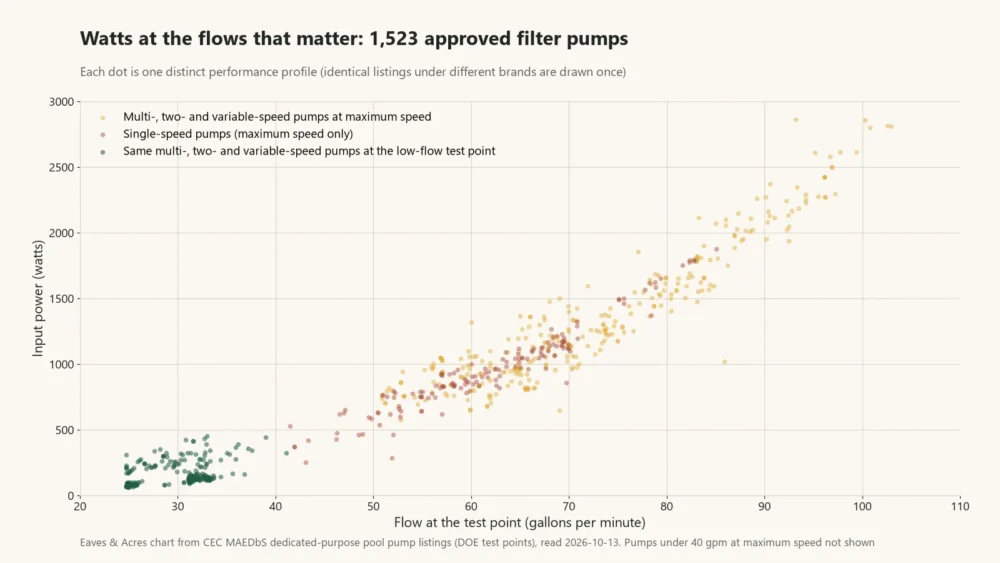
The in-ground variable-speed pump draws 124 W at 31.3 gpm and 1,659 W at 83 gpm on its highest setting: 7% of the power for 38% of the flow. Per gallon moved, its low setting uses about 5.2 times less electricity than its top speed. Search results say variable-speed pumps use “up to 80–90%” less electricity; the certified medians say 81% less energy per gallon at the low setting. The extra hours the low setting needs are why you plan hours from flow, and the total still falls.
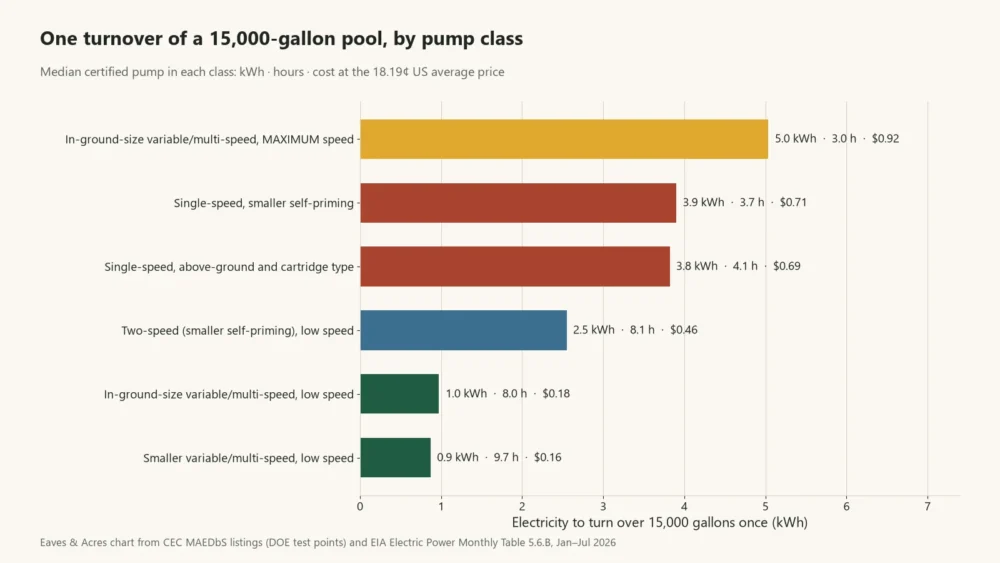
Single-speed pumps are still sold in smaller sizes, mostly for above-ground pools.6 A 67 gpm single-speed pump turns a 15,000-gallon pool over in about 3.7 hours, so “8 hours” is more than two turnovers. A pump made before 2021 is not in this data; use its own manual.

What a season of pumping costs by city
Multiply kWh by your price. We priced one turnover a day for the months when NOAA’s normal mean air temperature is 65°F or higher, the figure our closing guide uses for water, applied here to air.8 Prices are each state’s 2026 residential average from the Energy Information Administration, the same source as our hot tub running cost guide.7 Sacramento’s 33.3¢ power makes a six-month season cost more than Phoenix’s nine.
| City (months at 65°F or more · price per kWh) | Yearly cost: variable-speed / single-speed | Months with normal lows at 40°F or below |
|---|---|---|
| Denver, CO 4 warm months (DOE 4) · 16.7¢ | $20 / $80 119 / 476 kWh | 7 mo 5 at 32°F or below |
| Fargo, ND 3 warm months (DOE 4) · 12.4¢ | $11 / $44 90 / 359 kWh | 7 mo 6 at 32°F or below |
| Madison, WI 3 warm months (DOE 4) · 19.0¢ | $17 / $68 90 / 359 kWh | 7 mo 5 at 32°F or below |
| Detroit, MI 4 warm months (DOE 4) · 21.5¢ | $26 / $102 119 / 476 kWh | 6 mo 4 at 32°F or below |
| Minneapolis, MN 3 warm months (DOE 4) · 16.2¢ | $15 / $58 90 / 359 kWh | 6 mo 5 at 32°F or below |
| Boston, MA 4 warm months (DOE 4) · 30.1¢ | $36 / $143 119 / 476 kWh | 5 mo 4 at 32°F or below |
| Chicago, IL 4 warm months (DOE 4) · 19.2¢ | $23 / $91 119 / 476 kWh | 5 mo 4 at 32°F or below |
| Columbus, OH 4 warm months (DOE 4) · 18.7¢ | $22 / $89 119 / 476 kWh | 5 mo 4 at 32°F or below |
| Kansas City, MO 5 warm months (DOE 4) · 14.0¢ | $21 / $83 149 / 597 kWh | 5 mo 3 at 32°F or below |
| Louisville, KY 5 warm months (DOE 12) · 14.3¢ | $21 / $85 149 / 597 kWh | 5 mo 3 at 32°F or below |
| Nashville, TN 5 warm months (DOE 12) · 13.9¢ | $21 / $83 149 / 597 kWh | 5 mo 3 at 32°F or below |
| Omaha, NE 4 warm months (DOE 4) · 12.9¢ | $15 / $61 119 / 476 kWh | 5 mo 5 at 32°F or below |
| Salt Lake City, UT 4 warm months (DOE 4) · 13.2¢ | $16 / $63 119 / 476 kWh | 5 mo 3 at 32°F or below |
| Seattle, WA 2 warm months (DOE 3) · 14.4¢ | $9 / $35 60 / 242 kWh | 5 mo 0 at 32°F or below |
| New York, NY 4 warm months (DOE 4) · 29.4¢ | $35 / $140 119 / 476 kWh | 4 mo 2 at 32°F or below |
| Atlanta, GA 5 warm months (DOE 7) · 15.4¢ | $23 / $92 149 / 597 kWh | 3 mo 0 at 32°F or below |
| Portland, OR 3 warm months (DOE 3) · 15.4¢ | $14 / $55 90 / 359 kWh | 3 mo 0 at 32°F or below |
| Dallas, TX 7 warm months (DOE 12) · 16.1¢ | $33 / $134 209 / 835 kWh | 2 mo 0 at 32°F or below |
| Miami, FL 12 warm months (DOE 12) · 15.3¢ | $54 / $218 356 / 1,424 kWh | 0 mo 0 at 32°F or below |
| Phoenix, AZ 9 warm months (DOE 12) · 15.4¢ | $41 / $166 268 / 1,073 kWh | 0 mo 0 at 32°F or below |
| Sacramento, CA 6 warm months (DOE 12) · 33.2¢ | $60 / $239 179 / 718 kWh | 0 mo 0 at 32°F or below |

Each extra turnover adds the same cost again.
Adjust for season, heat and freezing
DOE’s analysis assumed pumps run through a fixed number of months by state: 4 in most of the Northeast and Midwest, 3 in Washington and Oregon, and 12 in states from Tennessee and Kentucky to Texas, Arizona and California.4 It also put average daily operating hours at 10 for a standard-size self-priming pump, in season only.4 The two answers differ most in Nashville, Louisville, Dallas and Sacramento, which have 5 to 7 warm months by NOAA but sit in states DOE modeled year-round.

Heat and heavy use call for more turnovers. The popular “1 hour per 10°F of air temperature” rule appears in search results and Google’s AI answer, but we found no test, code or manual behind it, so we do not use it. Use turnovers instead: add a second pass in a heat wave or after a crowd, and watch the water.
Cold is the other end. A pump shipped with freeze protection controls must ship with them disabled or with defaults of no more than 40°F, no more than 1 hour of run time before the temperature is rechecked, and no more than half of top speed, DOE says.2 In the database, 174 of the 196 listings with freeze controls ship with them disabled, and the 22 enabled ones default to 37–39°F and 30 or 60 minutes.6 Pentair’s IntelliFlo pump defaults to 40°F and 1,000 rpm, and its guide warns:
Do not depend on the anti freeze feature for freeze protection of the pool.
That feature protects the pump; it reads the temperature at the pump and does not sense the water.14 In NOAA normals, the average overnight low is 40°F or below for 5 to 7 months in Chicago, Denver, Madison and Fargo, and for none in Miami, Phoenix or Sacramento (Table 4). If you keep a pool open through freezing nights, follow your manuals’ freeze steps, and if you close it, see when to close your pool.

After shocking, adding salt or clearing algae
Labels set the hours here. The dichlor shock label we read says to operate the pump and filter continuously for 4 to 8 hours after adding product, and for 24 hours after treating a heavy algae area.15 Our shock dosing guide has the doses, and the pool salt calculator covers salt. Salt cells make chlorine only while the pump runs, so the hours you choose also set how much chlorine you get; see saltwater vs. chlorine pools. For target levels, use our ideal pool chemical levels, and for the season’s start and end, when to open your pool.
What these numbers leave out
The test flows are DOE’s fixed system, not your plumbing; real flow can be lower, which lengthens the hours. Heaters, cleaners, booster pumps, salt cells and lights are not counted, variable-speed owners choose their own speeds, and time-of-use rates change what an hour costs. We found no standard or manual that ties pump hours to the time of day. Our methodology page explains the method.
Frequently asked questions
Long enough to turn all the water over at least once: Hayward’s manual and DOE’s working group both point to one turnover a day. Hours = gallons ÷ (gpm × 60); add passes for heat, heavy use or algae.
About 8.0 hours with the median in-ground variable-speed pump on its low test setting (31.3 gpm), or about 3.7 hours with a typical single-speed pump (67 gpm test flow). Your own flow decides it.
Public pools do under the CDC’s model code; no home-pool rule requires it. At the US average price it is about $0.54 a day for the median variable-speed pump on low and $4.65 for a typical small single-speed pump.
At 18.19¢ per kWh, about $1.55 a day for a typical small single-speed pump (1,066 W) and $0.18 for the median in-ground variable-speed pump on its low setting (124 W).
Follow the label. The dichlor shock label we read says 4 to 8 hours of continuous pump and filter time after adding product, and 24 hours after an algae treatment.
Not at all if the pool is closed. If you keep it open, follow your manuals: DOE’s freeze-protection defaults are 40°F or lower, 1 hour and half speed, and Pentair warns not to depend on its anti-freeze feature to protect the pool.
We found no standard or manual that ties run time to time of day. Cost can differ under time-of-use rates, so check your utility plan.
Sources
- 1.10 CFR 431.462, Definitions (subpart Y, pumps): pool pump timer, variable-speed and two-speed dedicated-purpose pool pumps. U.S. Department of Energy (eCFR), read 2026-10-13. Used for: pool pump timer definition (10 hours); speed-configuration definitions Back to text
- 2.10 CFR 431.465, Energy conservation standards and their compliance dates (dedicated-purpose pool pumps). U.S. Department of Energy (eCFR), read 2026-10-13. Used for: minimum weighted energy factor formulas (effective 2021-07-19); timer requirement; freeze-protection defaults Back to text
- 3.10 CFR part 431, subpart Y, appendix B: uniform test method for dedicated-purpose pool pumps. U.S. Department of Energy (eCFR), read 2026-10-13. Used for: test points (head = 0.0082 × flow²; low flow 31.1 and 24.7 gpm; 80/20 weights) Back to text
- 4.Energy Conservation Standards for Dedicated-Purpose Pool Pumps, direct final rule (docket EERE-2015-BT-STD-0008, doc. 2016-31666). U.S. Department of Energy, Federal Register, 2017. Used for: one turnover per day for homes; 12 hours per turnover assumption; operating hours; pool-use months by state (Table IV-27) Back to text
- 5.Test Procedure for Dedicated-Purpose Pool Pumps, final rule (docket EERE-2016-BT-TP-0002, doc. 2017-15464). U.S. Department of Energy, Federal Register, 2017. Used for: why the low-speed test flows are 24.7 and 31.1 gpm Back to text
- 6.Modernized Appliance Efficiency Database System (MAEDbS), Pool Products > Dedicated-Purpose Pool Pumps, approved listings. California Energy Commission, read 2026-10-13 (Search > Advanced Search). Used for: 1,790 listings: flow and input watts at the DOE test points, weighted energy factor, freeze-protection defaults, timer limits Back to text
- 7.Electric Power Monthly, Table 5.6.B: Average Price of Electricity to Ultimate Customers by End-Use Sector, by State, Year-to-Date through July 2026. U.S. Energy Information Administration, 2026. Used for: residential prices by state and US average (18.19¢) Back to text
- 8.U.S. Climate Normals 1991–2020. NOAA National Centers for Environmental Information, 2021. Used for: monthly mean and minimum air temperatures for 21 cities (station nearest each ZIP code) Back to text
- 9.Model Aquatic Health Code, 5th Edition (2024 MAHC Code), sections 4.7.1.10 and 5.7.1.9. Centers for Disease Control and Prevention, 2024. Used for: maximum turnover times for public pools; 24-hour operation Back to text
- 10.Ariz. Admin. Code R18-5-223, Water Circulation System. Arizona Department of Environmental Quality (via Cornell LII), n.d. Used for: public and semipublic pool turnover at least every 8 hours Back to text
- 11.Utah Admin. Code R392-302-19, Circulation Systems (Table 1). Utah Department of Health (via Cornell LII), n.d. Used for: minimum turnover rate of six hours for swimming pools Back to text
- 12.CodeNotes: Velocity Limits in the 2021 International Swimming Pool and Spa Code. International Code Council, 2024. Used for: ANSI/APSP/ICC-15 pipe sizing for the 6-hour turnover flow or 36 gpm Back to text
- 13.AquaRite Electronic Chlorine Generator Owner’s Manual (092538 Rev D). Hayward Pool Products, 2019. Used for: filter timer set so all pool water passes through the filter each day; 8 hours for average pools Back to text
- 14.IntelliFlo Variable Speed Pump Installation and User’s Guide (P/N 354604 Rev. D). Pentair, 2016. Used for: anti-freeze defaults (40°F, 1,000 rpm) and warning that it protects the pump, not the pool Back to text
- 15.T-0072 dichlor shock label, sold as Clorox Pool&Spa Shock XtraBlue+ (EPA Reg. No. 67262-46). Recreational Water Products / U.S. EPA, 2025. Used for: run pump and filter 4 to 8 hours after addition; 24 hours after algae treatment Back to text
- 16.Backyardpool.jpg (photo). Vic Brincat, Wikimedia Commons, CC BY 2.0, n.d. Used for: hero photo, cropped
- 17.Above Ground swimming pool - 4420.jpg (photo). Chris Grazioli, Wikimedia Commons, CC BY 2.0, n.d. Used for: photo, resized
- 18.Above ground pool.jpg (photo). Jonathan Hogue, Wikimedia Commons, public domain, n.d. Used for: photo, resized
How this guide was made
- Written by the Pool Desk and reviewed by the Data & Methodology Desk.
- Data: flow and input power at DOE test points for the 1,644 approved filter pumps among 1,790 dedicated-purpose pool pump listings in the California Energy Commission’s MAEDbS database, read 2026-10-13 (1,523 used: maximum-speed flow of at least 40 gpm; low-speed listings under 20 W excluded), medians weighted by listing; turnover hours = gallons ÷ (gpm × 60) and energy = gallons × watts ÷ (gpm × 60 × 1,000), for a 15,000-gallon reference pool; season = months with NOAA NCEI 1991–2020 normal mean air temperature of 65°F or more (station nearest each ZIP code); electricity from EIA Electric Power Monthly Table 5.6.B (residential, January–July 2026). Excludes extra turnovers, heaters, cleaners, booster pumps, salt cells and time-of-use rates. See our methodology.
- AI use: AI tools help us research, draft and check this guide. Every figure is checked against the source cited for it, and calculated figures come from our own code, described on the methodology page.
- Spotted an error? Tell us — the form opens with this page’s address filled in.
Change log
- Oct 13, 2026Published. Pump hours, energy per turnover and season cost from the flow and input watts of the approved dedicated-purpose pool pump listings in the CEC’s MAEDbS database (read 2026-10-13), DOE’s test points and rulemaking record, NOAA 1991–2020 normals for 21 cities and EIA residential prices (January–July 2026).
Covers pool and hot tub water chemistry, opening and closing. We maintain the dosing calculators and check every rate against product chemistry and public health guidance.
Keep reading
How Many Gallons in a Pool? Chart by Size and Shape
An 18 ft round pool with 4 ft of water holds 7,614 gallons. Chart of 55 round, oval and in-ground sizes in gallons and liters, checked against Intex, Latham and city charts.

What Is Cyanuric Acid for Pools? What Labels and CDC Say
Cyanuric acid (stabilizer) shields pool chlorine from sunlight but holds it in a slower form. Labels set 20–60 ppm, CDC’s model code caps public pools at 90 ppm.
How to Raise Pool Alkalinity: What the Labels and Chemistry Say
Add sodium bicarbonate with the pump running at your label’s rate: 1.5 lb per 10,000 gallons per 10 ppm on two labels, 1.4 lb in CDC’s model code Annex.
Seasonal reminders for your ZIP
Get a short email when it’s time to overseed, start seeds, open the pool or service your furnace — timed to your climate.