

How to Raise Pool Alkalinity: What the Labels and Chemistry Say
We read three alkalinity increaser labels, a soda ash label, CDC’s model code and two health-department tables, then checked the rates by molar mass and modeled how far each product moves pH.
- Last reviewed Oct 23, 2026
- 18 cited sources
- 8 min read

- 1Add sodium bicarbonate (baking soda or alkalinity increaser) with the pump running: 1.5 lb per 10,000 gallons per 10 ppm on two labels; CDC’s Annex says 1.4 lb.
- 2The chemistry says 1.40 lb, so labels run about 7% high; a 15,000-gallon pool needs about 2.25 lb per 10 ppm.
- 3Limits differ: Leslie’s allows 10 lb per 10,000 gallons at once; Indiana’s health department says about 50 ppm at a time.
- 4In our model 10 ppm from baking soda takes pH 7.2 to about 7.3; the same from soda ash, to about 7.8.
- 5Retest after 4 to 24 hours, as your label says, and subtract one-third of the stabilizer reading (CDC Annex).
To raise pool alkalinity, add sodium bicarbonate (baking soda, sold as alkalinity increaser or Alkalinity Up) with the pump running, at the rate on your label, then retest after the wait the label gives. The two pool labels we read that print a rate both say 1.5 pounds per 10,000 gallons raises total alkalinity about 10 ppm, and both say to retest after 4 hours.5,6 CDC’s model code Annex gives 1.4 pounds.3
The labels agree on the amount, within 7% of the chemistry. They differ on when to add it, how much at once and how long to wait, and few guides say how far each product moves pH, so we worked that out.
Test alkalinity and pH, then correct the reading
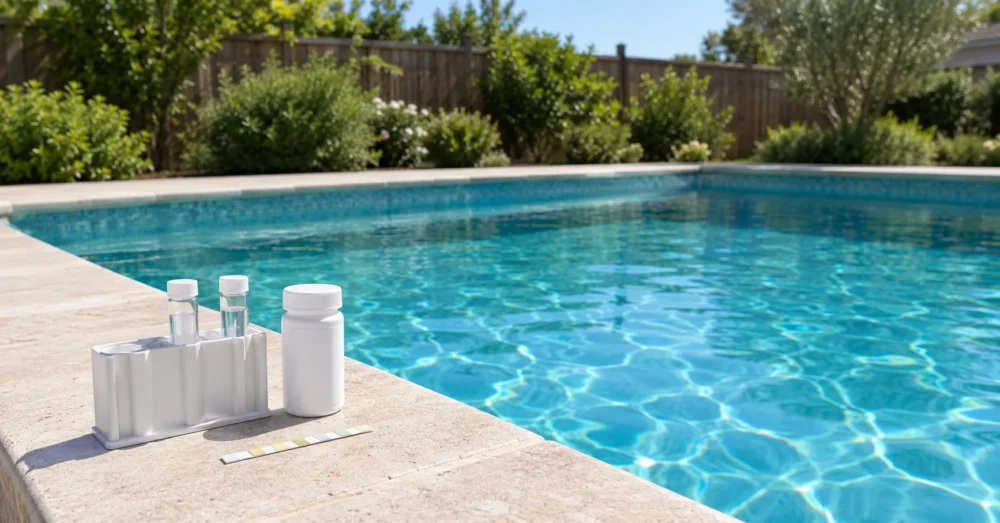
Test total alkalinity and pH together. CDC tells home pool owners to test pH at least twice a day, and its model code has public pools test alkalinity weekly.1,2 Leslie’s wants 80–100 ppm with liquid chlorine or calcium hypochlorite and 100–120 ppm with dichlor, trichlor or bromine tablets.6 HASA’s normal reading is 80–120 ppm.5 Arm & Hammer puts the ideal at 110–150 ppm.10 Our ideal pool chemical levels page compares all the ranges.
Stabilizer counts toward the alkalinity test. In its alkalinity section, CDC’s MAHC Annex says to subtract one-third of the cyanuric acid reading; its water-balance section says 30%.3 At 50 ppm stabilizer, that takes 15–17 ppm off the reading. The Annex also warns that high chlorine can bleach some alkalinity reagents and give false readings.3 Then get your gallons from our pool volume calculator.
Which products raise alkalinity
CDC’s 2024 Model Aquatic Health Code lists sodium bicarbonate and soda ash (sodium carbonate) among approved pH adjusters, and the Annex names bicarbonate for raising alkalinity.2,3 On the shelf:
- Alkalinity increaser. HASA Alkalinity Up and HTH Alkalinity Up both list 100% sodium bicarbonate; Leslie’s says it contains sodium bicarbonate.5,7,6
- Baking soda. HTH says it is the same active ingredient as most commercial alkalinity increasers, and Arm & Hammer gives the same 1.5-pound rule.8,10
- Soda ash. Sold as pH increaser; HTH pH Up is 99% sodium carbonate.9 It raises alkalinity too, but moves pH much more.
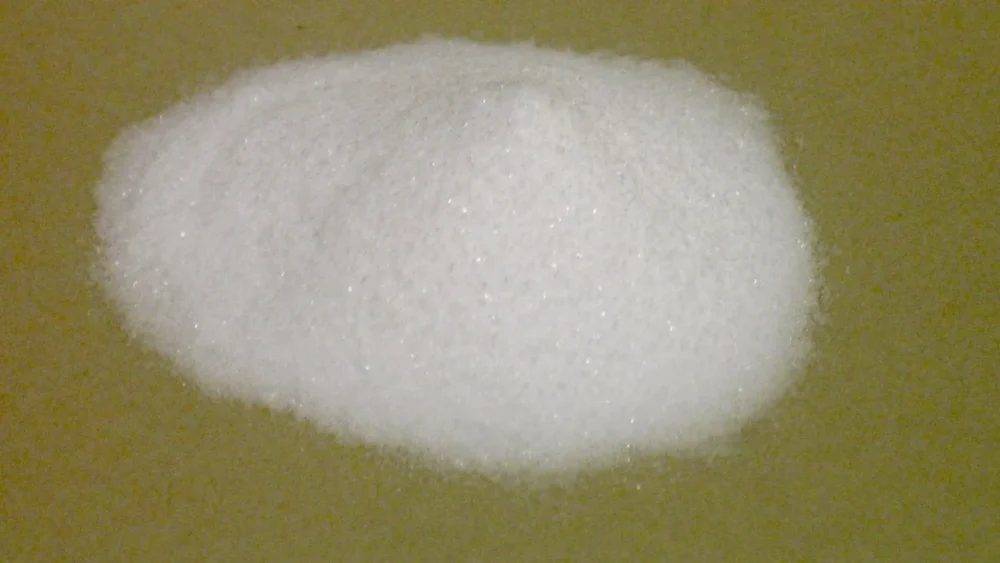

Indiana’s Department of Health says to use soda ash when both pH and alkalinity are low until pH reaches the proper level, then baking soda for the rest of the alkalinity. Leslie’s label sets the line at pH 6.8 or lower, or alkalinity below 50 ppm.11,6
How much: what the labels and health departments say
Table 1 puts every printed rate we found side by side, scaled by simple proportion to a 15,000-gallon pool. Indiana’s guide gives that same proportional formula for label doses.11
| Source | Per 10,000 gal | At 15,000 gal | Most at one time | Retest |
|---|---|---|---|---|
| HASA Alkalinity Up label sheet | 1.5 lb5 | 2.25 lb | Not stated | After 4 hours |
| Leslie’s Alkalinity Up label | 1½ lb6 | 2.25 lb | 10 lb per 10,000 gal | Wait 4 hours |
| HTH Alkalinity Up page | Not printed; “dosage varies”7 | — | Not stated | After 6–8 hours of circulation |
| Arm & Hammer baking soda guide | 1.5 lb10 | 2.25 lb | Not stated; new users start with ½–¾ | 6–24 hours |
| Portsmouth (Va.) Health Dept. table | 24 oz (1.5 lb)12 | 2.25 lb | Not stated | Not stated |
| Indiana Dept. of Health table | 1.4 lb11 | 2.1 lb | About 50 ppm | 24 hours if far off |
| CDC MAHC 2024 Annex | 1.4 lb (635.0 g)3 | 2.1 lb | Not stated | Not stated |
| Molar-mass check (ours) | 1.40 lb (635.4 g)14 | 2.1 lb | — | — |
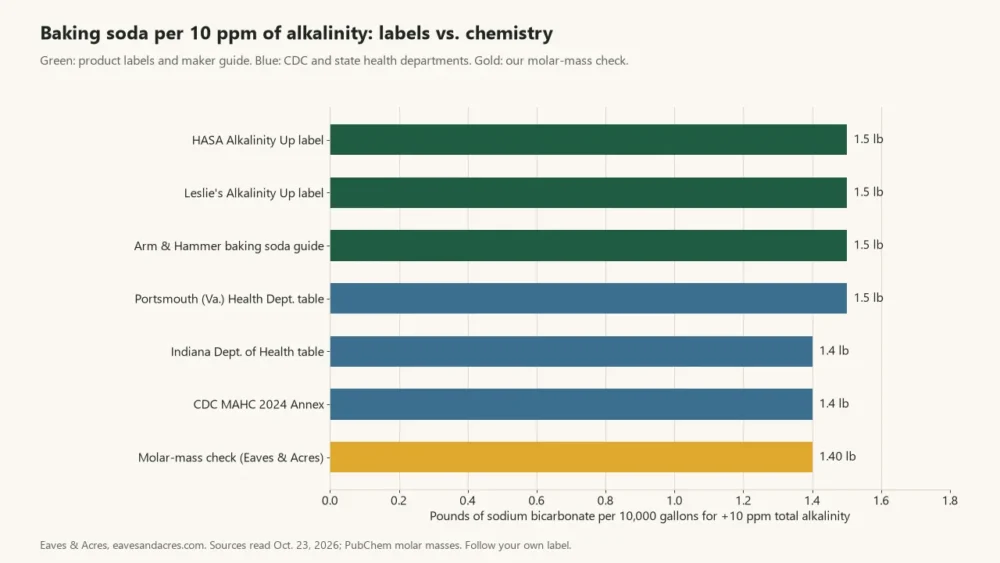
The molar-mass check reproduces the Annex’s 635.0 grams within half a gram, so the 1.5-pound label rate is about 7% more than the chemistry needs.14,3 For bigger corrections, multiply: at the 1.5-pound rate, a 15,000-gallon pool needs about 2.25 pounds per 10 ppm, or 6.75 pounds to go from 50 to 80 ppm. The limits differ. Leslie’s allows 10 pounds per 10,000 gallons at one time, about 67 ppm at its own rate, while Indiana says:6,11
Do not attempt to raise it more than about 50 ppm at one time.
Step by step, as the labels direct
Wait, retest, then adjust pH
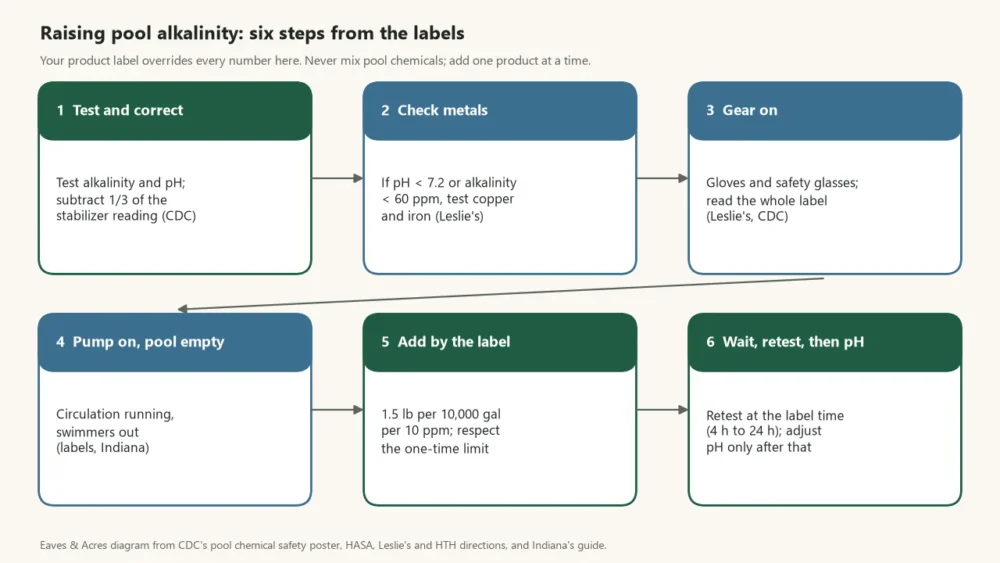
Wait the label’s time (Table 1) and retest before adding more. Leslie’s says to adjust alkalinity first, then pH.6
Raising alkalinity without raising pH
Baking soda raises pH a little; soda ash raises it a lot. Indiana and Portsmouth both say bicarbonate lifts pH too, and HTH tells hot tub owners the same.11,12,8 None says how much, so we modeled it with standard carbonic acid constants, no stabilizer, for the moment after mixing.15
| Alkalinity added | Baking soda | Soda ash | Soda ash, 50 ppm stabilizer |
|---|---|---|---|
| +10 ppm | 7.28 | 7.78 | 7.52 |
| +20 ppm | 7.34 | 8.95 | 8.14 |
| +30 ppm | 7.40 | 9.36 | 9.10 |

With baking soda, pH rises by roughly the logarithm of the alkalinity ratio: doubling alkalinity from 50 to 100 ppm adds about 0.3. Soda ash reacts with the water’s dissolved carbon dioxide, and once that runs out pH climbs fast. Per 10 ppm it takes less weight: 14 ounces per 10,000 gallons in Indiana’s table, against 1.4 pounds of bicarbonate.11 That is why the labels save soda ash for low pH.
Remember that raising the alkalinity level will also increase the pH.
Over the following days pH tends to drift up anyway. The Annex says alkalinity is itself a source of rising pH as carbon dioxide leaves the water.3 One robot-cleaner brand’s guide says aeration brings pH back down after baking soda, the opposite of the Annex. If pH ends up high, see how to lower pool pH.
Why pool alkalinity keeps dropping
- Acid additions. Portsmouth’s guide says muriatic acid and sodium bisulfate lower alkalinity along with pH.12
- Acidic chlorine products. The Annex calls trichlor, dichlor and potassium monopersulfate net acidic; with low alkalinity, pH can drop fast and cause etching and corrosion.3 Doses are in how much shock to add to a pool.
- Rain that leaves the pool. HTH says rain dilutes pool chemicals.8 Water that overflows, or that you pump out to get the level back down, carries alkalinity with it.
pH changes rapidly when chemicals or impurities enter the water.
Rain hurts mostly by dilution, not acidity. EPA says normal rain has a pH of about 5.6 and acid rain usually 4.2–4.4.13 Even at 4.2, an inch of rain in a pool averaging 5 feet deep uses up about 0.05 ppm of alkalinity. Diluting the same pool at 100 ppm, that inch removes about 1.6 ppm once the extra water leaves. Table 3 applies that to each city’s wettest swim-season month in NOAA’s 1991–2020 normals.16
| City | Wettest month | Normal rain | Alkalinity after |
|---|---|---|---|
| Miami, FL | Sep | 8.4 in | 88 ppm |
| Houston, TX | Jun | 7.9 in | 88 ppm |
| New Orleans, LA | Jul | 7.3 in | 89 ppm |
| Madison, WI | Jun | 5.7 in | 91 ppm |
| Kansas City, MO | Jun | 5.3 in | 92 ppm |
| Nashville, TN | May | 5.3 in | 92 ppm |
| Atlanta, GA | Jul | 5.0 in | 92 ppm |
| Minneapolis, MN | Jun | 4.8 in | 93 ppm |
| Columbus, OH | May | 4.8 in | 93 ppm |
| Louisville, KY | May | 4.8 in | 93 ppm |
| Omaha, NE | May | 4.7 in | 93 ppm |
| New York, NY | Jul | 4.6 in | 93 ppm |
| Dallas, TX | May | 4.6 in | 93 ppm |
| Fargo, ND | Jun | 4.3 in | 93 ppm |
| Charlotte, NC | Aug | 4.3 in | 93 ppm |
| Chicago, IL | May | 4.1 in | 94 ppm |
| Boston, MA | Jun | 3.9 in | 94 ppm |
| Detroit, MI | May | 3.5 in | 95 ppm |
| Denver, CO | May | 2.6 in | 96 ppm |
| Portland, OR | May | 2.6 in | 96 ppm |
| Salt Lake City, UT | May | 2.1 in | 97 ppm |
| Seattle, WA | May | 2.0 in | 97 ppm |
| Phoenix, AZ | Jul | 0.9 in | 99 ppm |
| Sacramento, CA | May | 0.9 in | 99 ppm |

Across 40,906 ZIP codes with monthly rain normals, 37.7% get 5 inches or more in their wettest May–September month and 5.7% get 7 or more. A guide claiming one heavy storm cuts alkalinity 10–20 ppm would need 6.7–15 inches of overflow at 100 ppm. Along the Gulf and in Florida, test after big storms. The loss happens only when diluted water leaves the pool.
How long to wait, and when you can swim

Retest times run from 4 hours (HASA, Leslie’s) to 6–8 hours (HTH), 6–24 hours (Arm & Hammer) and 24 hours for a large correction (Indiana).5,6,7,10,11 HTH’s own hot tub FAQ says 1–3 hours for spas, which follow their manuals (hot tub chemical levels).8
No label we read prints a swim wait. Portsmouth says the pool should stay closed until chemicals are completely dissolved or dispersed.12 Shocking the same day? HTH says never to add multiple chemicals at once, and CDC says never to mix pool chemicals.8,4 Pump hours are in how long to run a pool pump.
Where the labels disagree
- HTH’s directions say to add its product below 60 ppm; its FAQ on the same page says below 80.7
- HTH’s pH Up text gives one pound per 10,000 gallons at pH 6.8–7.2 and half as much for the same range; its table lists 8–12 ounces.9
- Leslie’s one-time limit (about 67 ppm) is higher than Indiana’s 50 ppm.6,11
- Targets run from 80–100 ppm (Leslie’s, liquid chlorine) to 110–150 ppm (Arm & Hammer); public pools may run 60–180 ppm under CDC’s model code.6,10,2
Follow your label over any guide, and ask the maker when a label contradicts itself. Salt pools still need balanced alkalinity, HTH says (saltwater vs. chlorine pools).7
When to call a pool professional
CDC’s poster says to ask for help with any task you are not trained for.4 Call a professional or the maker if alkalinity keeps falling after label doses, metals show up or stains appear. Leslie’s first aid says to flush eyes with cool water for 15 minutes and get medical attention if irritation persists; HTH’s pH Up warns of moderate to severe eye irritation.6,9 Our methodology explains how we check sources.
Frequently asked questions
The ones we read are sodium bicarbonate: HASA and HTH list 100%, and HTH says baking soda is the same active ingredient as most alkalinity increasers. Arm & Hammer gives the same 1.5-pound rate.
Use sodium bicarbonate, not soda ash, in label-sized steps. In our model, 30 ppm from baking soda takes pH 7.2 to about 7.4; the same from soda ash goes past 9.
Not the products CDC’s Annex names: it calls trichlor, dichlor and potassium monopersulfate net acidic, able to drop pH fast when alkalinity is low.
HTH says never to add multiple chemicals at once, and its pH Up page says to wait at least 4–6 hours between additions. CDC says never to mix pool chemicals.
HASA and Leslie’s say to retest after 4 hours, HTH after 6–8 hours of circulation, and Indiana after 24 hours when alkalinity was far off.
No label we read gives a swim wait. Portsmouth’s health department keeps a pool closed until chemicals are completely dissolved or dispersed.
Indiana’s guide says to use soda ash until pH is right, then baking soda for the rest of the alkalinity. Add one product at a time.
Sources
- 1.Home Pool and Hot Tub Water Treatment and Testing. Centers for Disease Control and Prevention, 2024. Used for: pH 7.0–7.8; test chlorine and pH at least twice a day; follow the test maker’s directions Back to text
- 2.Model Aquatic Health Code, 5th Edition (2024 MAHC Code), 5.7.3.4.2, 5.7.4.4.1A, 5.7.5.5. Centers for Disease Control and Prevention, 2024. Used for: sodium bicarbonate and soda ash approved for pH adjustment; public-pool alkalinity 60–180 ppm; alkalinity tested weekly Back to text
- 3.Model Aquatic Health Code Annex, 5th Edition (2024 MAHC Annex), 5.7.4.4.1 and LSI section. Centers for Disease Control and Prevention, 2024. Used for: alkalinity buffers pH and is a source of rising pH; too-low effects; 1.4 lb bicarbonate per 10,000 gal per 10 ppm; CYA correction one-third (and 30% for LSI); high chlorine bleaches alkalinity reagents; net acidic chlorine products Back to text
- 4.Use Pool Chemicals Safely (poster CS317109-B). Centers for Disease Control and Prevention, n.d. Used for: goggles and gloves; read the label before each use; ventilation; measure carefully; one container at a time; never mix pool chemicals; pre-dissolve only if the label says; ask for help if untrained Back to text
- 5.HASA Alkalinity Up product sheet (P-11). HASA, Inc., read 2026-10-23. Used for: 100% sodium bicarbonate; 1.5 lb per 10,000 gal for about 10 ppm with the pump running; retest after 4 hours; normal 80–120 ppm; soda ash for pH Back to text
- 6.Leslie’s Alkalinity Up label, LPM 14068 (Rev. 01/15). Leslie’s Poolmart, Inc., 2015. Used for: contains sodium bicarbonate; 1½ lb per 10,000 gal per 10 ppm; no more than 10 lb per 10,000 gal at one time; wait 4 hours; ranges by sanitizer; metals test; soda ash first when very low; precautions and first aid Back to text
- 7.HTH Pool Care Alkalinity Up (product page and directions). HTH Pools (Innovative Water Care), read 2026-10-23. Used for: 100% sodium bicarbonate; add below 60 ppm (directions) vs below 80 ppm (FAQ); broadcast with the pump running; retest after 6–8 hours; dosage varies; saltwater pools Back to text
- 8.Pool and Hot Tub FAQ. HTH Pools (Innovative Water Care), read 2026-10-23. Used for: baking soda same active ingredient; one chemical at a time; balancing order; rain dilutes chemicals; bicarbonate can raise pH slightly; hot tub retest 1–3 hours Back to text
- 9.HTH Pool Care pH Up (product page, dosage table, safety). HTH Pools (Innovative Water Care), read 2026-10-23. Used for: 99% sodium carbonate; text vs table doses; retest 4–6 h vs 12–24 h; wait 4–6 hours between additions; eye irritation warning Back to text
- 10.How to Use Baking Soda for Pool Maintenance. Arm & Hammer (Church & Dwight), read 2026-10-23. Used for: 1.5 lb per 10,000 gal raises alkalinity about 10 ppm; ideal 110–150 ppm; start with one-half to three-fourths; wide arcs; windy day; retest 6–24 hours Back to text
- 11.Adjusting Chemical Levels in a Swimming Pool. Indiana Department of Health, n.d. Used for: proportional label-dose formula; bicarbonate 1.4 lb and soda ash 14 oz per 10 ppm per 10,000 gal; no more than about 50 ppm at once; retest after 24 hours; metals test at 50 ppm or below; soda ash first when both low; swimmers out Back to text
- 12.Pool Operation and Maintenance Guide (Portsmouth Health Department). Virginia Department of Health, Portsmouth Health Dept., 2018. Used for: raising alkalinity also raises pH; 24 oz bicarbonate per 10 ppm per 10,000 gal; acid lowers alkalinity and pH; closed until chemicals dissolve or disperse Back to text
- 13.What is Acid Rain?. U.S. Environmental Protection Agency, read 2026-10-23. Used for: normal rain pH about 5.6; acid rain usually 4.2–4.4 Back to text
- 14.PubChem compound records: Sodium Bicarbonate (CID 516892), Sodium Carbonate (CID 10340), Calcium Carbonate (CID 10112). National Library of Medicine (NIH), read 2026-10-23. Used for: molecular weights 84.007, 105.988, 100.09 for the molar-mass check Back to text
- 15.CEE 680 Lecture 7: Acids and Bases (table of pKa values). David Reckhow, University of Massachusetts Amherst, 2020. Used for: carbonic acid pKa 6.35 and 10.33; water 14.00, used in the pH model Back to text
- 16.U.S. Climate Normals 1991–2020 (monthly precipitation), nearest station. NOAA National Centers for Environmental Information, 2021. Used for: wettest May–September month for 24 cities and 40,906 ZIP codes Back to text
- 17.Pool (backyard pool with safety fence), photo. Evan Delshaw, Wikimedia Commons, CC BY 2.0, 2015. Used for: hero photo, cropped
- 18.Sodium bicarbonate, photo. Thavox, Wikimedia Commons, public domain, n.d. Used for: photo of sodium bicarbonate powder, cropped
How this guide was made
- Written by the Pool Desk and reviewed by the Data & Methodology Desk.
- Data: label rates copied from each product’s directions, read 2026-10-23, and scaled by proportion to 15,000 gallons. Molar-mass check: 10 ppm as calcium carbonate in 10,000 gallons = 7.564 equivalents = 635.4 g sodium bicarbonate (CDC Annex 635.0 g) or 14.1 oz soda ash (Indiana 14 oz). pH model: closed carbonate system, pKa 6.35 and 10.33, no stabilizer unless stated, the moment after mixing; an estimate, not a dose. Rain: NOAA 1991–2020 monthly normals, nearest station; alkalinity after = 100 × 60 ÷ (60 + inches), a pool averaging 5 feet deep, dilution only. See our methodology.
- AI use: AI tools help us research, draft and check this guide. Every figure is checked against the source cited for it, and calculated figures come from our own code, described on the methodology page.
- Spotted an error? Tell us — the form opens with this page’s address filled in.
Change log
- Oct 23, 2026Published. Directions of three alkalinity increasers (HASA, Leslie’s, HTH) and HTH pH Up, Arm & Hammer’s pool guide, CDC’s home-pool page, MAHC 2024 Code and Annex, Indiana and Portsmouth (Va.) health-department tables and EPA read 2026-10-23; molar-mass check, pH model and NOAA rain-dilution table computed the same day.
Covers pool and hot tub water chemistry, opening and closing. We maintain the dosing calculators and check every rate against product chemistry and public health guidance.
Keep reading

What Is Cyanuric Acid for Pools? What Labels and CDC Say
Cyanuric acid (stabilizer) shields pool chlorine from sunlight but holds it in a slower form. Labels set 20–60 ppm, CDC’s model code caps public pools at 90 ppm.

How Long to Wait to Swim After Shocking a Pool: What Nine Labels Say
Swim again when a test shows free chlorine at or below your shock label’s limit, 4 ppm on the seven chlorine shock labels we read, with pH back in range.
How Often to Backwash a Pool Filter: Eight Manuals Compared
Backwash sand and DE filters at the pressure rise your manual gives, about 8–10 psi, not by the calendar. Cartridge filters are hosed, not backwashed.
Seasonal reminders for your ZIP
Get a short email when it’s time to overseed, start seeds, open the pool or service your furnace — timed to your climate.