

How to Lower Pool pH: What the Labels Say, Side by Side
We read four pH decreasers’ directions, CDC’s pool code and safety posters, and put the doses side by side for one 15,000-gallon pool.
- Last reviewed Oct 14, 2026
- 21 cited sources
- 9 min read

- 1Lower pH with muriatic or dry acid, dosed from your product’s label for your gallons, pump running. CDC’s range is 7.0–7.8.
- 2For 15,000 gallons at pH 8.0–8.4, three dry-acid labels give 24, 30 and 44.8 ounces; never exceed your label’s limit.
- 3Retest when your label says: the four we read range from 1 hour of pumping to 48 hours.
- 4Goggles and gloves, one product at a time, never mix acid with chlorine, and add chemical to water, never water to chemical (CDC).
- 5High alkalinity keeps pushing pH back up, and lowering it takes far more acid.
To lower pool pH, add a pH decreaser, either muriatic (hydrochloric) acid or dry acid (sodium bisulfate), in the amount your product’s label gives for your gallons and your reading, with the pump running, then retest when the label says to. CDC recommends keeping pool pH between 7.0 and 7.8, and says chlorine kills germs less well as pH rises, especially above 8.0.1
The hard part is the amount. Three dry-acid dose charts, scaled to the same 15,000-gallon pool, call for 24, 30 and 44.8 ounces at a reading of 8.0 to 8.4. So we give no dose of our own; we show what the labels say and where they disagree.
Test pH and alkalinity before you add anything
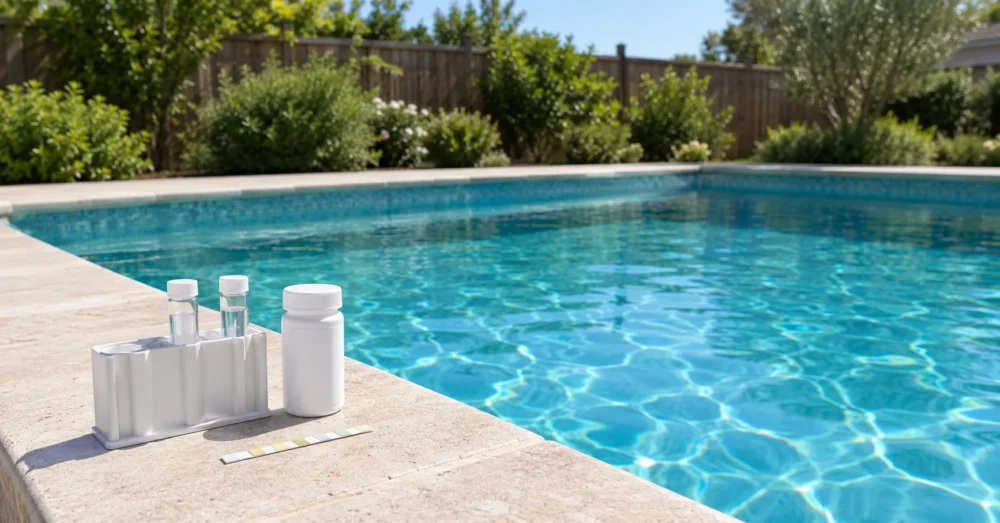
CDC tells home pool owners to test chlorine and pH at least twice a day, and more often when many people swim.1 Test total alkalinity too: HTH says to adjust it first to help prevent pH drift, and Alliance Trading’s label wants 80–125 ppm in plaster pools and 125–150 ppm in vinyl and fiberglass ones.10,11 Stabilizer skews that test; CDC’s model code Annex corrects for it by subtracting one-third of the cyanuric acid reading from the measured alkalinity.3
Then get your gallons: our pool volume calculator handles rectangles, rounds, ovals and sloped floors. The target numbers are in ideal pool chemical levels; this page is about bringing a high reading down.
Which products lower pH
CDC’s 2024 Model Aquatic Health Code names approved pH adjusters for public pools: muriatic (hydrochloric) acid, sodium bisulfate, carbon dioxide and sulfuric acid lower pH; sodium bicarbonate and soda ash raise it.2 On a store shelf you will mostly find two:
- Muriatic acid. HASA’s is 31.45% hydrochloric acid, sold to lower pH and alkalinity; its safety data sheet lists it as Category 1 for skin corrosion and serious eye damage, with the signal word DANGER.8,9
- Dry acid (sodium bisulfate). Granules, 92–93.2% sodium bisulfate in the products we read.10,11 Alliance Trading’s label calls it safer to handle than liquid acids yet warns that it causes severe burns and forms a weak sulfuric acid solution with water.11
- Carbon dioxide. Approved, but fed by dedicated equipment, not poured.2
Baking soda is not a pH decreaser. Arm & Hammer, which sells it, tells pool owners to add it to increase water pH, and the Annex uses it to raise alkalinity.19,3 No label or code we read lists vinegar or other household products for it.
How much: what the labels say for a 15,000-gallon pool
Table 1 copies each product’s dose chart and scales it, by simple proportion, to a 15,000-gallon reference pool. For your own pool, use your label’s figure for your gallons.
| Product (active ingredient) | As printed | At 15,000 gallons | Most per addition |
|---|---|---|---|
| HTH pH Down sodium bisulfate 92% | 15,000 gal: 24 oz at pH 8.0–8.4; 36 oz above 8.410 | 24 oz · 36 oz | Not stated |
| Alliance Trading pH Down sodium bisulfate 93.2% | Per 10,000 gal: 3/4 lb at 7.7–8.0; 1-1/4 lb at 8.1–8.4; 1-1/2 lb above 8.411 | 18 oz · 30 oz · 36 oz | 1.5 lb per 10,000 gal (36 oz) |
| Pool Solutions PH Minus sodium bisulfate | 15,000 gal: 1.4 lb at 7.6–7.8; 1.9 lb at 7.8–8.0; 2.8 lb at 8.0–8.4; 3.7 lb above 8.412 | 22.4 oz · 30.4 oz · 44.8 oz · 59.2 oz | 20 oz per 10,000 gal (30 oz) |
| HASA Muriatic Acid hydrochloric acid 31.45% | 1 quart per 20,000 gal per 24 hours, repeated at 24-hour intervals8 | 24 fl oz per day | 1 quart per 20,000 gal per 24 h |

No chart states the alkalinity it assumes, though the Annex says higher alkalinity makes water resist pH correction.3 Some cap one addition below their own dose: PH Minus lists 44.8 ounces for 8.0–8.4 but allows 30 at a time, then a retest 4–6 hours later.12 HASA allows one quart per 20,000 gallons in 24 hours.8 There is no faster safe route than the label’s limit.
Do not overdose. When in doubt use less muriatic acid.
Don’t swap liquid and dry acid ounce for ounce: by molar mass, one fluid ounce of 31.45% muriatic acid carries about as much acid as 1.34 ounces by weight of 93.2% dry acid.20,9 Use the chart for the product in your hand.
Step by step, as the labels direct
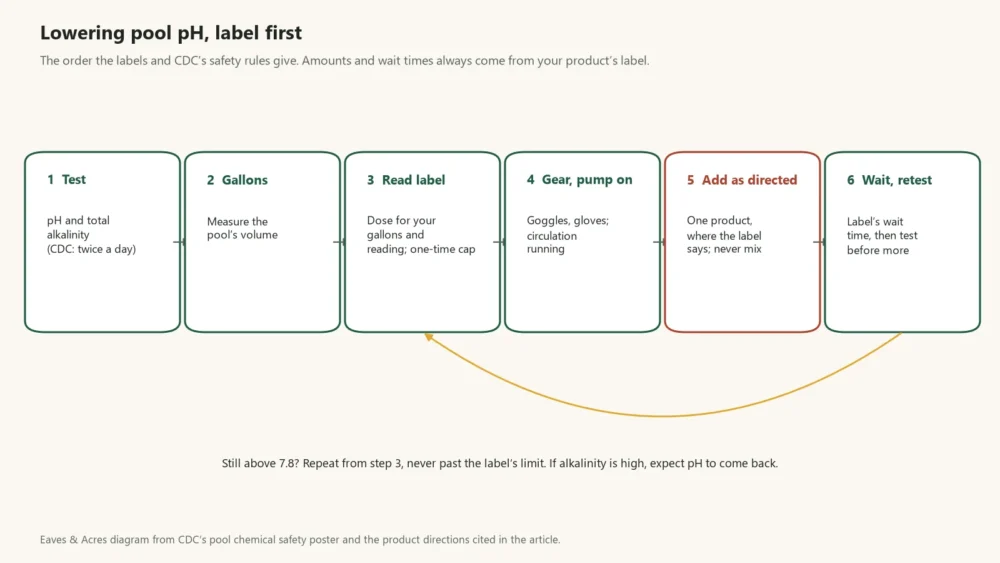
Put on the gear the label names
CDC’s poster says to wear safety goggles and gloves, work in a well-ventilated area, measure carefully and open one container at a time.4 HASA’s safety data sheet adds old clothing and rubber gloves for muriatic acid.9 CDC’s injury review found people were often hurt when chemicals were not secured away from children or were added just before someone got in the water.6
Add it exactly where and how the label says
HTH: broadcast evenly over the deepest part of the pool, never pre-dissolved in a plastic bucket.10 Alliance Trading: broadcast into the deep end, not near metal fittings, and brush away undissolved lumps.11 HASA: at the deep end, at least one foot from the wall, poured slowly over as large an area as possible.8 Pre-dissolve only if your label says to; then add the chemical to the water, never the water to the chemical.4
Wait, then retest before adding more
Wait as long as your label says (Table 2) and retest before adding more; Alliance Trading says not to let pH drop below 7.2.11
NEVER add water to the pool chemical because a violent (potentially explosive) reaction can occur.
Where the labels and guides disagree
Popular guides say to dilute acid in a bucket and pour it near a return jet. HTH says never to pre-dissolve its pH Down, and HASA’s label never mentions diluting, while a HASA blog post recommends 10 parts water to 1 part acid.10,8,18 One chemical supplier’s guide says to pour acid in front of a return jet, then says never to add it near return jets. Wait times run from 30 minutes to 48 hours, and HTH’s own page gives both 48 hours and 4–6 hours.10
| Product | Circulation and retest | Other timing on the label |
|---|---|---|
| HASA Muriatic Acid | Pump and filter running while adding and at least 1 hour after8 | Repeat at 24-hour intervals as needed |
| Alliance Trading pH Down | Recirculate 2 hours, then retest11 | Repeat treatment as necessary |
| Pool Solutions PH Minus | Retest 4–6 hours after a capped addition12 | Full directions on the container |
| HTH pH Down | Directions: wait at least 48 hours before retesting. FAQ: retest after 4–6 hours of circulation10 | Wait 4–6 hours after a shock treatment before adding, and vice versa |
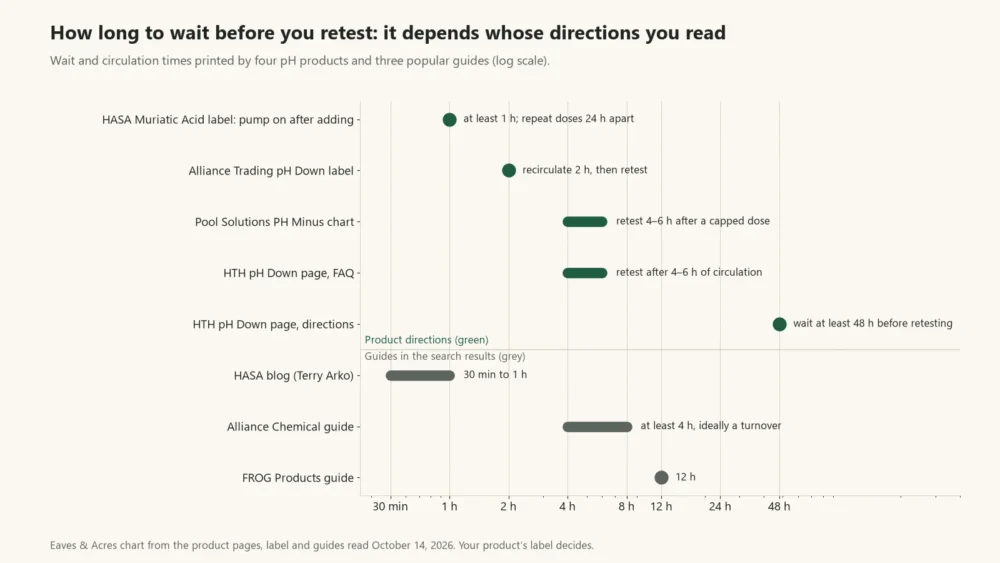
When a guide and your label disagree, the label wins; when a label contradicts itself, ask the maker.
Why pool pH keeps rising
A high reading usually has a cause that brings it back:
- Aeration. The Annex ties rising pH to carbon dioxide leaving the water, and HASA names waterfalls, spillways, spa jets and heavy splashing.3,18
- High total alkalinity. When alkalinity is too high, the Annex says, pH becomes difficult to adjust and high pH often follows.3
- Salt chlorine generators. The Annex’s salt-cell equation yields chlorine, hydrogen gas and sodium hydroxide; PHTA notes high pH at the cathode plates, and HTH lists saltwater systems as a cause.3,15,10
- Liquid chlorine and calcium hypochlorite. HASA says both carry hydroxides that temporarily raise pH.18
- Fill water and new plaster. HTH lists high-pH fill water; Alliance Trading’s label says newly plastered pools may need frequent treatments for the first few weeks.10,11
Some sanitizers and oxidizers work the other way. The Annex calls trichlor, dichlor and potassium monopersulfate net acidic, and PHTA says pH and alkalinity may drift down in trichlor-treated water.3,16 Shock doses are in how much shock to add to a pool.

a source of rising pH itself from the outgassing of carbon dioxide.
When pH and alkalinity are both high
Acid lowers both. HTH says its pH Down lowers alkalinity too, and warns against taking alkalinity below 80 ppm.10 The MAHC Annex says to add acid, then retest and adjust pH: 1.6 pounds of dry acid or 1.3 quarts of muriatic acid per 10,000 gallons for each 10 ppm.3 We checked both by molar mass, on a basis that reproduces the Annex’s own baking-soda figure within 0.5 gram.20

The PH Minus chart matches the chemistry within 1%; the Annex’s dry-acid figure is about 26% lower and its muriatic figure about 62% higher, perhaps a concentration it does not state. Either way, cutting alkalinity takes far more acid than a pH touch-up: HASA’s daily 24 fl oz in 15,000 gallons removes only about 6 ppm.8,20 If pH overshoots low, HASA says aeration can raise it without raising alkalinity.18
Saltwater pools
Pentair’s IntelliChlor guide says to use muriatic acid to lower pH. Pentair and Hayward discourage dry acid in arid regions, where heavy evaporation and little fresh water let its by-products build up and damage the cell.13,14 Salt levels: our pool salt calculator; cells vs. tablets: saltwater vs. chlorine pools. Hot tubs follow their own manual (hot tub chemical levels).
Storage, spills and exposure
CDC’s storage poster says to separate acid and chlorine, lock chemicals up, keep them cool, dry and out of direct sun in their original containers, and store liquids low.5 The 10% liquid chlorine label we read warns that mixing it with acids releases chlorine gas and says not to store it near acid.17 HASA says not to mix muriatic acid with chlorine-type bleaches or other household chemicals.9
NIOSH lists an OSHA ceiling of 5 ppm for hydrogen chloride vapor and 50 ppm as immediately dangerous to life or health; the solution burns eyes and skin.7 If acid gets in the eyes, the HASA and HTH first aid is to rinse with water for 15–20 minutes and call a poison control center or doctor; if someone is not breathing, call 911.9,10
CDC estimates pool chemicals caused 13,508 emergency department visits in 2015–2017: at least 56.3% at a residence, about two-thirds between Memorial Day weekend and Labor Day, and roughly 90% of poisonings from breathing fumes (CDC MMWR, 2019).6

When to call a pool professional
CDC’s poster says to ask for help with any task you are not trained for, and Pentair says to adjust pH according to your pool professional’s recommendations.4,13 Call a professional, or the product’s maker, if:
- pH keeps climbing back after you follow the label;
- your labels conflict and you can’t tell which applies;
- a salt cell needs acid cleaning (PHTA says too much acid cleaning damages the cell, so follow your cell manual);15
- acid has spilled or leaked, or anyone has breathed fumes or been splashed: follow the label’s first aid first.9
For unlabeled containers, CDC says to contact your local or state hazardous materials agency.5 Once pH is back in range, recheck chlorine, and see how long to run a pool pump. Our methodology explains how we check sources.
Frequently asked questions
Yes. CDC’s pool range tops out at 7.8, and CDC says chlorine kills germs less well as pH rises, especially above 8.0. Each dry-acid label we read gives a dose for readings of 8.0 to 8.4.
We found no label or code that does it without an acid or carbon dioxide, which needs dedicated feed equipment. Aeration raises pH rather than lowering it.
No. Arm & Hammer says baking soda raises pool pH, and CDC’s model code Annex uses it to raise alkalinity.
Use your label. The four we read say at least 1 hour of pumping (HASA), 2 hours (Alliance Trading), 4–6 hours (PH Minus) and 48 hours (HTH’s directions). Alliance Trading says to add its product when the pool is not in use.
It depends on the product. CDC’s model code Annex calls trichlor, dichlor and potassium monopersulfate net acidic, while HASA says liquid chlorine and cal hypo temporarily raise pH. HTH says to wait 4–6 hours between a shock and its pH Down.
A salt cell makes sodium hydroxide, according to CDC’s model code Annex, and PHTA notes high pH at the cell’s plates. Pentair says to lower pH with muriatic acid, and Pentair and Hayward discourage dry acid in arid regions.
Sources
- 1.Home Pool and Hot Tub Water Treatment and Testing. Centers for Disease Control and Prevention, 2024. Used for: pH 7.0–7.8; chlorine weaker as pH rises, especially above 8.0; test chlorine and pH at least twice a day Back to text
- 2.Model Aquatic Health Code, 5th Edition (2024 MAHC Code), 5.7.3.4. Centers for Disease Control and Prevention, 2024. Used for: public-pool pH 7.0–7.8; approved pH adjusters; NSF/ANSI 50 or 60 certification Back to text
- 3.Model Aquatic Health Code Annex, 5th Edition (2024 MAHC Annex), 5.7.3.4 and 5.7.4.4.1. Centers for Disease Control and Prevention, 2024. Used for: alkalinity as a source of rising pH (CO2 outgassing); high alkalinity makes pH hard to adjust; acid per 10 ppm alkalinity; baking soda per 10 ppm; CYA correction; salt-cell equation; net acidic chlorine products Back to text
- 4.Use Pool Chemicals Safely (poster CS317109-B). Centers for Disease Control and Prevention, n.d. Used for: goggles and gloves; read label before each use; never mix chlorine with acid; pre-dissolve only if the label says, chemical to water; ask for help if untrained Back to text
- 5.Store Pool Chemicals Safely (poster CS317109-A). Centers for Disease Control and Prevention, n.d. Used for: separate acid and chlorine; lock up; cool, dry, ventilated, out of sun; original containers; liquids low; hazardous materials agency for unlabeled containers Back to text
- 6.Pool Chemical Injuries in Public and Residential Settings — United States, 2008–2017, and New York, 2018 (MMWR 68(19):433–438). Centers for Disease Control and Prevention, 2019. Used for: 13,508 ED visits 2015–2017; 56.3% at a residence; 64.5% in summer; 36.4% under 18; inhalation in about 90% of poisonings; how injuries happened Back to text
- 7.NIOSH Pocket Guide to Chemical Hazards: Hydrogen chloride. National Institute for Occupational Safety and Health, 2019. Used for: OSHA PEL ceiling 5 ppm; IDLH 50 ppm; symptoms; eye and skin first aid Back to text
- 8.HASA Muriatic Acid product sheet (P-2). HASA, Inc., read 2026-10-14. Used for: 31.45% HCl; 1 quart per 20,000 gal per 24 hours; deep end, one foot from wall; pump at least 1 hour; pH 7.2–7.6; “do not overdose” Back to text
- 9.HASA Muriatic Acid Safety Data Sheet (SDS No. 110). HASA, Inc., 2026. Used for: Category 1 skin corrosion and eye damage; goggles, old clothing, rubber gloves; do not mix with chlorine bleaches; first aid; specific gravity 1.16 Back to text
- 10.HTH Pool Care pH Down (product directions, dosage table, FAQ). HTH Pools (Innovative Water Care), read 2026-10-14. Used for: 92% sodium bisulfate; dose table by gallons; broadcast over deepest part, never pre-dissolve; 48 h / 4–6 h retest; wait 4–6 h after shock; alkalinity first; causes of high pH; first aid Back to text
- 11.pH DOWN label (REV052024). Alliance Trading, Inc., 2024. Used for: 93.2% sodium bisulfate; usage chart per 10,000 gal; 1.5 lb maximum at one time; deep end when not in use; 2 h recirculation; alkalinity ranges; new plaster; not below 7.2 Back to text
- 12.Pool and Spa Water pH Decreaser (Pool Solutions PH Minus), P32012DE. InyoPools, read 2026-10-14. Used for: dry-acid charts for pH and alkalinity by gallons; 20 oz per 10,000 gal at one time; retest 4–6 h Back to text
- 13.IntelliChlor Salt Chlorine Generator Installation and User’s Guide (P/N 520589 Rev R). Pentair, 2023. Used for: use muriatic acid to lower pH; no dry acid in arid areas; adjust per your pool professional Back to text
- 14.AquaRite Electronic Chlorine Generator Owner’s Manual (092538 Rev D). Hayward Pool Products, 2019. Used for: dry acid discouraged in arid regions; by-products damage the cell Back to text
- 15.Fact Sheet: Electrolytic Chlorine Generators. Pool & Hot Tub Alliance (PHTA) Recreational Water Quality Committee, 2021. Used for: high pH at the cathode plates; excessive acid cleaning damages the cell Back to text
- 16.Trichlor: The dependable pool performer. PHTA Recreational Water Quality Committee, ICC Building Safety Journal, 2020. Used for: pH and alkalinity may drift down with trichlor Back to text
- 17.Chlorinating Liquid label, 10% sodium hypochlorite (EPA Reg. No. 7616-45). KIK Pool Additives / U.S. EPA, 2024. Used for: mixing with acids releases chlorine gas; do not store near acid Back to text
- 18.How to Lower the pH in Pool Water Safely (Terry Arko). HASA, Inc., 2026. Used for: aeration, liquid chlorine, cal hypo and salt cells raise pH; dilution 10:1; aeration raises low pH without raising alkalinity Back to text
- 19.How to Achieve a Balanced Pool Water pH & Why it Matters. ARM & HAMMER (Church & Dwight), n.d. Used for: baking soda raises pool pH Back to text
- 20.PubChem: hydrogen chloride (CID 313), sodium bisulfate (CID 516919), calcium carbonate (CID 10112), sodium bicarbonate (CID 516892). National Library of Medicine, PubChem, 2026. Used for: molar masses for the alkalinity check and the liquid-to-dry acid equivalence Back to text
- 21.Water flowing steadily into a vibrant blue swimming pool during a sunny day (photo). Shixart1985, Wikimedia Commons, CC BY 2.0, n.d. Used for: hero photo, cropped
How this guide was made
- Written by the Pool Desk and reviewed by the Data & Methodology Desk.
- Data: doses copied from each product’s printed chart (read 2026-10-14) and scaled in proportion to a 15,000-gallon reference pool; no dose is ours. Alkalinity check: 10 ppm as calcium carbonate in 10,000 gallons = 7.564 equivalents of acid, using PubChem molar masses, 31.45% HCl at specific gravity 1.16 (HASA SDS) and 93.2% sodium bisulfate; the same basis gives 635.5 g of baking soda against the Annex’s 635.0 g. It is a cross-check of published figures, not a dose. See our methodology.
- AI use: AI tools help us research, draft and check this guide. Every figure is checked against the source cited for it, and calculated figures come from our own code, described on the methodology page.
- Spotted an error? Tell us — the form opens with this page’s address filled in.
Change log
- Oct 14, 2026Published. Directions and dose charts of four pH decreasers (HTH, Alliance Trading, Pool Solutions, HASA) read 2026-10-14 and scaled to a 15,000-gallon pool; CDC MAHC 2024 Code and Annex, CDC safety posters, MMWR 2019, NIOSH; molar-mass check of the Annex alkalinity figures.
Covers pool and hot tub water chemistry, opening and closing. We maintain the dosing calculators and check every rate against product chemistry and public health guidance.
Keep reading

What Is Cyanuric Acid for Pools? What Labels and CDC Say
Cyanuric acid (stabilizer) shields pool chlorine from sunlight but holds it in a slower form. Labels set 20–60 ppm, CDC’s model code caps public pools at 90 ppm.
How to Raise Pool Alkalinity: What the Labels and Chemistry Say
Add sodium bicarbonate with the pump running at your label’s rate: 1.5 lb per 10,000 gallons per 10 ppm on two labels, 1.4 lb in CDC’s model code Annex.

How Long to Wait to Swim After Shocking a Pool: What Nine Labels Say
Swim again when a test shows free chlorine at or below your shock label’s limit, 4 ppm on the seven chlorine shock labels we read, with pH back in range.
Seasonal reminders for your ZIP
Get a short email when it’s time to overseed, start seeds, open the pool or service your furnace — timed to your climate.