How Often to Water New Grass Seed: Schedule by Stage and Weather
Ten extension services agree on the stages and differ on the numbers. Here is where they overlap, and how much rain and heat NOAA’s normals give your first three weeks in 33,915 ZIP codes.
- Last reviewed Oct 26, 2026
- 20 cited sources
- 13 min read

Set your ZIP to see dates for your area.
- 1Start at two light waterings a day, enough to keep the top inch or so moist; that count is inside every extension range that gives one. Go up to four in hot, windy or sunny weather.
- 2Cut back by the seedlings, not the calendar: every other day, then every third day at 1 to 2 inches tall (Kansas State), and about weekly after two or three mowings (Iowa State, NC State). In mixed seed, wait for the bluegrass.
- 3Amounts differ: ¼ inch a session (Maryland) against ⅛ to ¼ inch a day (Tennessee, Georgia). Use the can test: if 30 minutes puts ½ inch in the cans, ¼ inch takes 15 minutes.
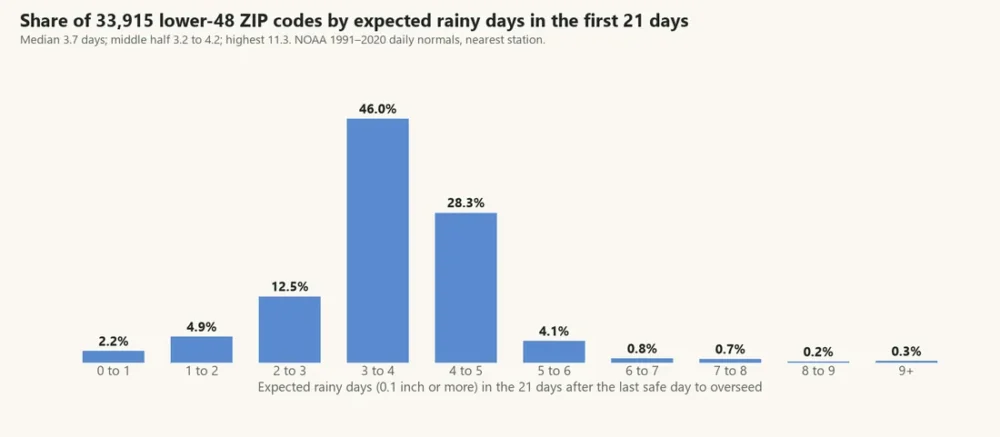
- 4Rain trims the schedule; it does not replace it. NOAA normals for 33,915 ZIP codes expect 0.1 inch of rain or more on a median of 3.7 of the first 21 days after the last safe fall sowing day.
- 5A Sept. 1 sowing meets a normal high above 82°F in 39.8% of the ZIP codes where it is still inside the window: Chicago averages 78°F after Sept. 1 and 66°F after Oct. 1.
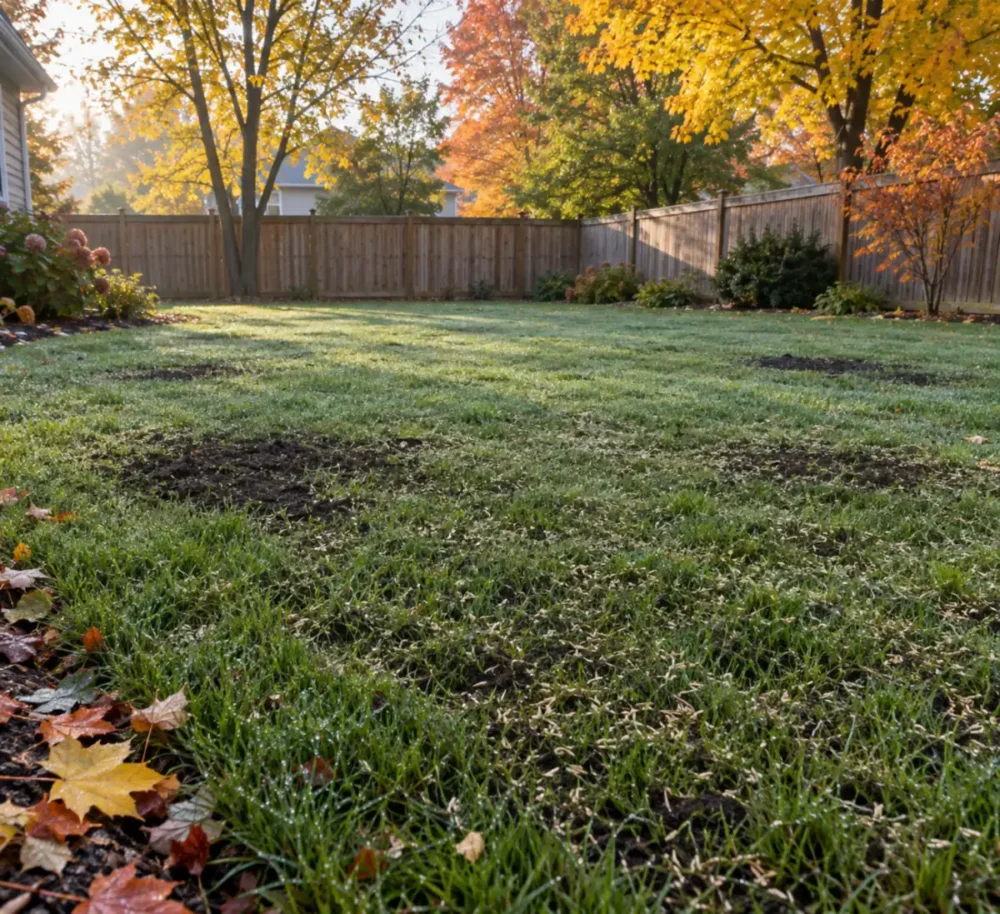
Water new grass seed lightly, about twice a day, just enough to keep the top inch or so of soil moist, until the seedlings are about 2 inches tall. Then water less often and more deeply. Two waterings a day is the one count inside every extension range we found that gives a count, and heat, wind and sun are the reasons to go higher.1,3,5
The pages we compared leave out how often the weather you will really get calls for the high end. NOAA’s daily normals for 33,915 ZIP codes expect rain of 0.1 inch or more on only 3.2 to 4.2 of the first 21 days after the last safe fall sowing day, and on 11.3 days at most.2 That is about one rainy day a week: rain can excuse a day’s sessions now and then, but it never replaces the schedule. A Labor Day sowing, meanwhile, meets an average normal high above 82°F in 39.8% of the ZIP codes where Sept. 1 is still inside the window (Table 4).
Google’s AI Overview for this query, checked on October 26, 2026, gives 2 to 4 times a day in weeks 1 and 2, 1 to 2 times a day in weeks 3 and 4, and 2 to 3 times a week from week 5. The extension pages tie the change to the seedlings, not the week, and several end at once a week.
The schedule: water by stage, not by calendar week
Ten extension sources agree on three stages and differ on the timing between them. Table 1 summarizes them and Table 2 lists each source’s own numbers.
| Stage | Starts when | How often | Sources |
|---|---|---|---|
| 1. Seed down to seedlings rooting in | Right after seeding, once the seedbed is wet | About 2 light waterings a day; up to 4 in hot, windy or sunny weather; for 2 to 3 weeks (up to 30 days in California’s guide) | Iowa State, Purdue, Clemson, NC State, Colorado State, UC IPM |
| 2. Cutting back | Seedlings about 1 to 2 inches tall, and the slowest grass in a mix is up | Every other day, then every third day; ¼ inch each time, then ½ inch (Kansas State) | Kansas State, Colorado State, UC IPM, Tennessee, Iowa State |
| 3. Established | After 2 or 3 mowings | About once a week, deep: 6 to 8 inches (NC State) or 1 inch every 5 to 7 days (Kansas State) | Iowa State, NC State, Kansas State, UC IPM, Purdue |

Stage 1 runs until the seedlings are up and rooting, usually two to four weeks. Iowa State says two light applications a day will usually do unless it is hot and windy, and for the extreme case:
up to four light waterings per day may be necessary
Iowa State continues this for three weeks after seeding.1 Purdue says two to four times daily depending on the weather,3 Clemson two or three times a day for two to three weeks,5 and NC State two or three times a day for 7 to 21 days.6 Kansas State is the low outlier at once or twice a day or more.10 Two a day sits inside all six ranges, which is why it is our starting point. Purdue’s turf specialist agrees: keep the upper inch moist for the first two or three weeks.13 Our guide to how long grass seed takes to grow gives the days for each grass.
Mixed seed is the trap. Kentucky bluegrass takes 7 to 14 days longer to germinate than other cool-season grasses, NC State says, and it warns:
do not make the mistake of decreasing water as soon as the first seedlings appear
Maryland likewise says to wait for the slowest-growing species in the mix before cutting back.8
Stage 2 begins when the seedlings are about 1 to 2 inches tall (Iowa State) or 2 inches (Purdue); Maryland ties it to seedlings tall enough to mow.1,3,8 Kansas State gives the most specific schedule we found: once germination is complete and the seedlings are 1 inch tall, water every other day with ¼ inch each time; in the second week after complete germination, every third day with ½ inch; after that, 1 inch every 5 to 7 days.10
Stage 3 starts after two or three mowings. Iowa State says a thorough watering once a week should be adequate by then,1 and NC State says to water 6 to 8 inches deep about once a week after the third mowing.6 Illinois names newly seeded lawns as the exception to its infrequent-watering advice.14 The AI Overview’s “2 to 3 times a week” from week 5 is more frequent than Iowa State or NC State. Our guide to how much to water an established lawn covers this stage, and how high to mow covers the first cuts.
How much water each time, and how to measure it
The amounts do not match. Maryland says to apply about ¼ inch in each session, and that seedlings may need several sessions a day for several weeks.8 Tennessee and Georgia describe daily irrigation of ⅛ to ¼ inch, which Tennessee puts at 75 to 150 gallons per 1,000 square feet, and Tennessee then moves to ½ inch every two to three days.9,4 Two ¼-inch sessions a day make ½ inch, twice Georgia’s upper figure. The depth to keep moist differs too, from the top ¼ inch (Colorado State) to the top 1.5 inches (NC State).7,6
| Source | Times a day at the start | Amount or depth kept moist | Cutting back |
|---|---|---|---|
| Iowa State (2026) | 2 usually; up to 4 if hot and windy; 3 weeks | Top 1 inch moist | Seedlings 1 to 2 inches: less often, deeper; weekly after 2 or 3 mowings |
| Purdue (AY-3-W, 2006) | 2 to 4, depending on the weather | Top 0.5 to 1 inch | Seedlings 2 inches: less often, deeper; deep and infrequent after 2 or 3 mowings |
| NC State (2022) | 2 to 3 for 7 to 21 days | Top 1.5 inches | After the third mowing: 6 to 8 inches about weekly |
| Clemson (HGIC 1203, 2024) | 2 to 3 for 2 to 3 weeks | Small amounts; water to a depth of 2 to 3 inches in the soil | Less often, larger volume as roots develop |
| University of California IPM (2017) | Several, up to 30 days; more in hot periods | Top 1 to 2 inches, not soaked | Every other day, then deep 1 to 2 times a week |
| Colorado State (PlantTalk) | 2, more often in hot weather | Top ¼ inch | Every 2 days, then every 3 days |
| Maryland (2026) | Several, for several weeks | ¼ inch per session; top inch moist | When seedlings are mowable; work up to about 1 inch per session; wait for the slowest grass |
| Georgia (UGA B1533-2) | Daily, 2 to 3 weeks | ⅛ to ¼ inch a day; top 1 to 2 inches moist | Less often, deeper, as roots develop |
| Tennessee (W160-B, 2007) | Daily, several weeks | ⅛ to ¼ inch (75 to 150 gallons per 1,000 sq ft) | ½ inch (about 300 gallons) every 2 to 3 days |
| Kansas State (MF2802, 2008) | 1 to 2 or more | Surface kept moist | At 1 inch tall: ¼ inch every other day; then ½ inch every third day; then 1 inch every 5 to 7 days |
With sources that far apart, measure the soil rather than the clock. Clemson’s test is how it feels:
moist, but not excessively wet, similar to a wrung-out sponge
California’s lawn guide suggests probing with a screwdriver to see how deep the moisture goes,11 and Kansas State says to measure what your sprinkler delivers in straight-sided cans.10 Run time depends on the sprinkler, so LawnStarter’s 5 to 10 minutes a session15 and Nature’s Seed’s 10 to 15 minutes16 can both be right for different sprinklers. Here is the can arithmetic:
Minutes for a quarter-inch watering
- Scenario
- You set cans on the lawn, run the sprinkler for 30 minutes and find ½ inch of water in them.
- Math
- ½ inch in 30 minutes means ¼ inch takes half the time: 30 ÷ 2 = 15 minutes. For ⅛ inch, 7.5 minutes.
- Answer
- Run 15 minutes per session for ¼ inch. Re-measure if you change sprinklers or water pressure.

What pushes the count up or down
Every extension source that mentions weather says to add waterings in heat, wind and sun, and none of the extension pages we read sets a lower count for cool weather. Table 3 lists the adjustments. Seed companies are more specific: Nature’s Seed says you may need 4 to 5 short waterings a day above 85°F and 1 to 2 a day in cool weather above 55°F,16 and Grass Pad says at least three a day when it is sunny, 90 degrees and windy.17 Those are company figures, not extension advice.
| Condition | What the sources say | Source |
|---|---|---|
| Hot, windy or sunny | Up to four light waterings a day; sometimes several a day in sun and wind; even more in hot periods; several light waterings on hot, breezy, low-humidity days | Iowa State, UC IPM, Colorado State, Maryland |
| Sandy soil | Dries out faster than clay | Maryland |
| Straw mulch | A light mulch slows drying between waterings; it will not fully make up for dry conditions; too much shades seedlings | Kansas State, Maryland, Purdue |
| Rain | Keep the seedbed moist with frequent, light irrigation unless rainfall occurs; no source gives an amount that lets you skip | Kansas State |
| Cool weather | No lower count in the extension pages we read; seed company Nature’s Seed says 1 to 2 a day above 55°F | Nature’s Seed (company) |
| No irrigation | Expect poorer germination, rooting and establishment; postpone planting during a drought | Maryland |
Straw is the adjustment you control. Kansas State says a light mulch of clean straw slows drying between waterings, and you should be able to see soil through it.10 Iowa State leaves about half the soil visible, roughly one bale per 1,000 square feet,12 and Purdue warns that many people apply too much, which shades seedlings.3
Your first three weeks of weather, city by city
The extension pages say “hot and windy” without saying how often you will meet it. NOAA’s daily normals can answer for temperature and rain.2 For each city we took two sowing dates: the last safe day to overseed from our overseeding guide (45 days before the median 28°F freeze), and Sept. 1 where that is still inside the window. For the 21 days after each, we averaged the normal highs and added the daily chances of 0.1 inch of rain or more; the sources keep the light routine going for two to three weeks. The temperature yardstick is Tennessee’s: air temperatures of about 59 to 82°F favor rapid germination of cool-season seed,9 so above 82°F the “hot” advice applies.
| City (ZIP) | Last safe day to overseed | Sown Sept. 1 high / rainy days | Sown on the last safe day high / rainy days |
|---|---|---|---|
| Fargo, ND (58102) | Aug 26 | past the cut-off | 76.1 / 3.3 |
| Madison, WI (53703) | Sep 5 | 75.5 / 4.2 | 74.2 / 4.2 |
| Denver, CO (80202) | Sep 6 | 83.6 / 2.3 | 81.6 / 2.3 |
| Spokane, WA (99201) | Sep 8 | 75.5 / 1.2 | 72.7 / 1.4 |
| Boise, ID (83702) | Sep 9 | 77.9 / 1.1 | 74.7 / 1.3 |
| Minneapolis, MN (55401) | Sep 12 | 73.7 / 4.2 | 69.0 / 4.2 |
| Albany, NY (12207) | Sep 13 | 76.2 / 4.3 | 71.5 / 4.4 |
| Des Moines, IA (50309) | Sep 15 | 78.5 / 3.7 | 73.5 / 3.5 |
| Omaha, NE (68102) | Sep 15 | 80.7 / 3.5 | 75.7 / 3.4 |
| Milwaukee, WI (53202) | Sep 17 | 78.5 / 4.2 | 71.4 / 4.2 |
| Indianapolis, IN (46204) | Sep 17 | 78.4 / 3.4 | 72.7 / 3.7 |
| Columbus, OH (43215) | Sep 19 | 79.6 / 4.4 | 73.3 / 4.6 |
| Pittsburgh, PA (15222) | Sep 21 | 79.7 / 4.1 | 71.9 / 4.2 |
| Detroit, MI (48201) | Sep 25 | 76.0 / 4.2 | 66.3 / 4.0 |
| Kansas City, MO (64105) | Sep 27 | 82.0 / 4.0 | 72.2 / 3.5 |
| Chicago, IL (60601) | Oct 1 | 77.9 / 4.0 | 65.8 / 4.0 |
| St. Louis, MO (63101) | Oct 1 | 82.7 / 3.3 | 71.4 / 3.5 |
| Salt Lake City, UT (84101) | Oct 4 | 81.6 / 1.8 | 66.8 / 2.5 |
| Louisville, KY (40202) | Oct 6 | 83.1 / 3.4 | 70.4 / 3.6 |
| Washington, DC (20001) | Oct 6 | 83.4 / 4.2 | 69.9 / 3.8 |
| Boston, MA (02108) | Oct 7 | 74.7 / 3.9 | 61.7 / 4.2 |
| Philadelphia, PA (19103) | Oct 15 | 82.0 / 4.2 | 64.5 / 4.2 |
| New York, NY (10001) | Oct 17 | 77.9 / 4.0 | 60.6 / 3.9 |
| Seattle, WA (98101) | Oct 18 | 73.1 / 2.4 | 57.4 / 6.6 |

Rain is scarce: about 4 expected rainy days for Chicago, Detroit, Boston and Philadelphia, 3.5 for Des Moines and Kansas City, and only Seattle, at 6.6, gets rain on about one day in three. It is scarcest in the interior West: Boise 1.3, Spokane 1.4, Denver 2.3, Salt Lake City 2.5. A Labor Day sowing is much hotter than one on the last safe day: Chicago’s normal high averages 78°F after Sept. 1 and 66°F after Oct. 1, Kansas City’s 82°F and 72°F after Sept. 27. Late dates bring cool weather, with average highs of 57°F in Seattle, 61°F in New York and 62°F in Boston, and the sources give no lower count for it, so check the soil before cutting back.

Across 33,915 lower-48 ZIP codes with a fall window, the expected rainy days in the 21 days after the last safe day have a median of 3.7 (middle half 3.2 to 4.2, highest 11.3 days). The median average high is 73.8°F, and 95.9% of ZIP codes sit inside Tennessee’s 59 to 82°F range.
Kansas State says to irrigate frequently and lightly “unless rainfall occurs,”10 and none of the sources says how much rain lets you skip a session. Skip one only after a rain that wets the top inch.
Warm-season seed, sown in June
Georgia says to seed warm-season grass when soil 4 inches down is consistently 65°F and rising, listing May to June for common Bermuda, centipede and zoysia,4 and Kansas State calls June preferred.10 Table 5 shows the first three weeks of June in ten southern and plains cities.
| City (ZIP) | Average normal high (°F) | Hottest day’s normal high (°F) | Expected rainy days (0.1 inch or more) |
|---|---|---|---|
| Raleigh, NC (27601) | 86.3 | 88 | 4.7 |
| Oklahoma City, OK (73102) | 86.5 | 89 | 4.5 |
| Atlanta, GA (30303) | 86.5 | 88 | 4.6 |
| Nashville, TN (37201) | 86.8 | 89 | 4.9 |
| Birmingham, AL (35203) | 87.4 | 89 | 5.5 |
| Orlando, FL (32801) | 90.5 | 91 | 7.5 |
| Houston, TX (77002) | 90.9 | 92 | 4.2 |
| Dallas, TX (75201) | 92.0 | 94 | 3.8 |
| Austin, TX (78701) | 92.7 | 94 | 3.6 |
| Phoenix, AZ (85001) | 103.3 | 106 | 0.2 |
In Raleigh, Nashville, Oklahoma City, Atlanta and Birmingham the normal high averages 86 to 87°F with 4.5 to 5.5 expected rainy days. Dallas and Austin average 92 to 93°F with 3.6 to 3.8, Houston 91°F, and Orlando gets the most rain, 7.5 days. Tennessee says warm-season seed germinates well at 68 to 95°F, so nine of the ten sit inside it, toward the top; Phoenix, at 103°F with 0.2 rainy days, is outside anything the sources describe.9 Our cool- vs warm-season guide shows which grass you have, and our spring seeding guide covers cool-season seed sown in spring.

When to water: the evening question
The sources split on night watering. Maryland and California say to avoid evening watering because wet leaves invite disease.8,11 Kansas State says late evening is acceptable for newly seeded bluegrass or tall fescue in the fall, because it keeps the seedbed moist overnight, and that in the cooler weather of early to mid-fall night watering is less likely to contribute to disease.10 Both can be right, because the seasons differ: add an evening session only in cool fall weather.
Too wet and too dry
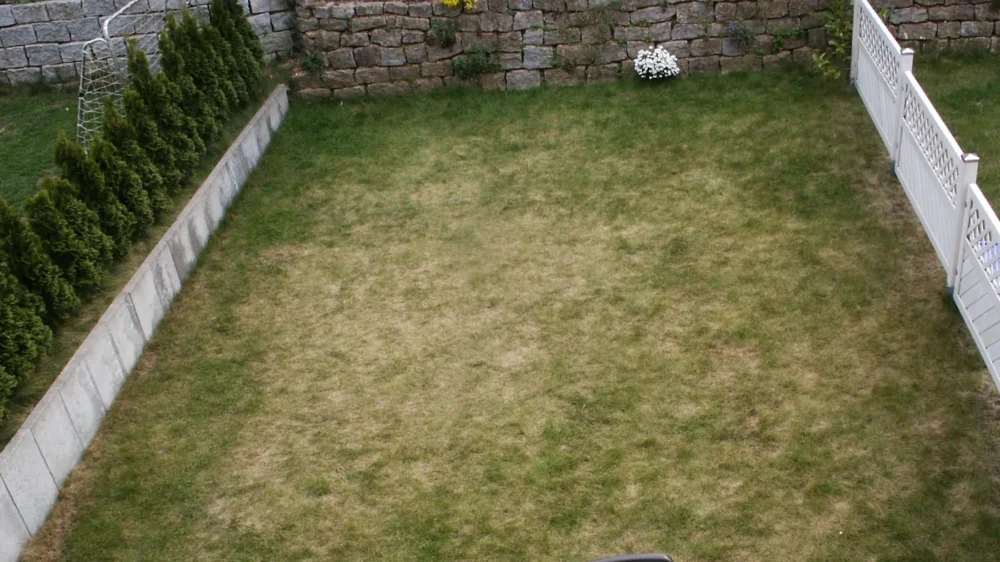
Too dry is the bigger risk. Iowa State says seedlings are very susceptible to desiccation,1 California says seedlings are likely to die if the soil dries out during germination, and Colorado State says seedlings that start to germinate and then dry can be killed before they emerge.11,7 Too wet is the other mistake: California says too much water will cause seeds to rot, and Iowa State and Purdue say to avoid saturating the soil and runoff.11,1,3 Pooling, as in the photo below, is the sign to shorten each session and add one.


Some places restrict outdoor watering. UGA says Georgia’s Water Stewardship Act of 2010 permits irrigation of newly installed plants, seeds or turf during a 30-day establishment period.4 Other states and utilities differ, so check local rules before you seed.
How we calculated the weather numbers
The data are NOAA’s 1991–2020 daily normals: the normal high and the probability that a day has 0.1 inch of rain or more, for the station nearest each ZIP code.2 The 21-day high is the mean of 21 daily normals from the sowing date, and the expected rainy days are the sum of the 21 probabilities. St. Louis and Nashville use airport stations because their nearby stations have no daily normals; ZIP codes whose station has none are left out of the national figures (33,915 of 36,903 with a window are included). A real week can be hotter, windier or wetter than normal, and 0.1 inch is our yardstick, not a published rule.
 Related guideWhen to Overseed Your Lawn: The Last Safe Day Where You Live
Next steps
Pick your start date in the overseeding guide, set the sprinkler with the can test, start at two light waterings a day and add one when the top inch dries between sessions. Look up your frost dates with our frost date lookup, and see the lawn seeding guides for the rest.
Frequently asked questions
Yes. California says too much water will cause seeds to rot, and Iowa State and Purdue say to avoid saturating the soil and runoff. Clemson’s test is soil moist but not excessively wet, like a wrung-out sponge. If water pools, shorten each session and add one.
No extension source we read gives a number of days it can skip. California says seedlings are likely to die if the soil dries out during germination. The company Eartheasy says ungerminated seed may tolerate a day in cool, mild weather.
Iowa State says three weeks after seeding, NC State 7 to 21 days, Clemson and Georgia two to three weeks, and California up to 30 days. Cut back when seedlings are about 1 to 2 inches tall (Iowa State) or 2 inches (Purdue), and in mixed seed wait until the bluegrass is up.
Iowa State says up to four light waterings a day may be necessary, and California says even more in hot periods. The company Nature’s Seed says 4 to 5 short waterings above 85°F. Check the top inch of soil between sessions rather than the clock.
Use the same stages. In the 33,915 ZIP codes we analyzed, the 21 days after the last safe sowing day have a median average high of 73.8°F and about 3.7 rainy days, so most sessions are still yours to supply.
A little. Kansas State says a light straw mulch slows drying between waterings, and Clemson says less irrigation is needed with mulch. Maryland says it will not fully make up for dry conditions.
Purdue says after the lawn has been mowed two or three times, and Iowa State says a thorough watering once a week should then be adequate. NC State says 6 to 8 inches deep about once a week after the third mowing.
The sources split. Maryland and California say to avoid evening watering because wet leaves invite disease; Kansas State says late evening is acceptable in the fall for new bluegrass or tall fescue.
Sources
- 1.How should I water a newly seeded lawn?. Iowa State University Extension and Outreach, 2026. Used for: two light waterings a day, up to four; three weeks; 1 to 2 inches tall; weekly after two or three mowings Back to text
- 2.U.S. Climate Normals 1991–2020, daily normals. NOAA National Centers for Environmental Information, 2021. Used for: daily normal highs and probability of 0.1 inch of rain or more, station nearest each ZIP code Back to text
- 3.Establishing Turfgrass Areas (AY-3-W). Purdue University Extension, 2006. Used for: two to four times daily depending on the weather; top 0.5 to 1.0 inch; seedlings 2 inches; mulch Back to text
- 4.Lawns in Georgia: Establishment (B1533-2). University of Georgia Extension, 2021. Used for: daily watering of about ⅛ to ¼ inch for 2 to 3 weeks; 65°F soil and May to June warm-season seeding; 30-day irrigation allowance under the Georgia Water Stewardship Act Back to text
- 5.Lawn Establishment (HGIC 1203). Clemson Cooperative Extension, Home & Garden Information Center, 2024. Used for: two or three times a day for two to three weeks; wrung-out sponge; less irrigation with mulch Back to text
- 6.Lawns, Chapter 9 in the North Carolina Extension Gardener Handbook. NC State Extension, 2022. Used for: top 1.5 inches; two or three times a day for 7 to 21 days; bluegrass 7 to 14 days longer; weekly after the third mowing Back to text
- 7.2131 Watering, Seed Germination, and Drying Winds. Colorado State University Extension (PlantTalk Colorado), n.d. Used for: top quarter inch; twice daily, more in hot weather; every second then every third day; dried seedlings die Back to text
- 8.Starting a New Lawn. University of Maryland Extension, 2026. Used for: quarter inch per session; several times a day; windy dry days; sandy soil; evening; weaning to about 1 inch; slowest grass Back to text
- 9.Turfgrass Establishment: Seeding (W160-B). University of Tennessee Extension, 2007. Used for: 1/8 to 1/4 inch (75 to 150 gallons per 1,000 sq ft) daily; 1/2 inch every two to three days; air temperatures 59 to 82°F and 68 to 95°F Back to text
- 10.Watering New Lawns (MF-2802). Kansas State University Research and Extension, 2008. Used for: once or twice a day or more; every other day at 1 inch tall; every third day; 1 inch every 5 to 7 days; straw; late-evening watering in fall; June for warm-season grasses; cans Back to text
- 11.Healthy Lawns: Irrigating new lawns. University of California Statewide IPM Program, 2017. Used for: top 1 to 2 inches; several light waterings for up to 30 days; seeds rot if too wet; screwdriver probe; evening Back to text
- 12.Seeding a New Lawn. Iowa State University Extension and Outreach, 2026. Used for: straw leaving about half the soil visible; top 1 inch; several times a day in sunny, windy conditions Back to text
- 13.Watering Newly Seeded Areas, Aaron Patton. Purdue University Turfgrass Science, 2014. Used for: upper 1 inch kept moist with frequent irrigation for the first two or three weeks Back to text
- 14.Watering Your Lawn. University of Illinois Extension, 2025. Used for: newly seeded lawns are the exception to infrequent, thorough watering Back to text
- 15.How Often to Water Grass Seed. LawnStarter, 2026. Used for: company figure: 2 to 4 times daily for 5 to 10 minutes Back to text
- 16.How Often Should You Water New Grass Seed. Nature’s Seed, 2025. Used for: company figures: 10 to 15 minutes three times a day in week one; 4 to 5 times above 85°F; 1 to 2 times above 55°F Back to text
- 17.How Much to Water New Grass Seed. Grass Pad, 2025. Used for: company figure: at least three times a day when sunny, 90 degrees and windy Back to text
- 18.How Often to Water New Grass Seed: Schedule. Eartheasy, 2026. Used for: company statement on skipping a day in cool, mild weather
- 19.Photo: Endless Summer, Michael Pardo (CC0). Wikimedia Commons, 2015. Used for: hero photo
- 20.Photo: grass-lawn-park-sprinkler, www.Pixel.la Free Stock Photos (CC0). Wikimedia Commons, 2013. Used for: tripod sprinkler photo
How this guide was made
- Written by the Yard & Garden Desk and reviewed by the Data & Methodology Desk.
- Data: normal daily highs and the daily probability of 0.1 inch of rain or more from NOAA NCEI U.S. Climate Normals 1991–2020 (daily normals) for the station nearest each ZIP code; sowing dates are the last safe day to overseed (45 days before the median 28°F freeze) and Sept. 1 for cool-season seed, and June 1 for warm-season seed; watering counts and amounts as published by Iowa State, Purdue, NC State, Clemson, Colorado State, Maryland, Georgia, Tennessee, Kansas State and the University of California. Air temperature and rain only; wind, sun, soil and mulch are not in the data. See our methodology.
- AI use: AI tools help us research, draft and check this guide. Every figure is checked against the source cited for it, and calculated figures come from our own code, described on the methodology page.
- Spotted an error? Tell us — the form opens with this page’s address filled in.
Change log
- Oct 26, 2026Drafted. Stage-by-stage watering schedule from ten extension sources, their amounts side by side, and NOAA 1991–2020 daily normals (normal highs and expected rainy days in the 21 days after sowing) for 24 fall and 10 June sowing cities and the national ZIP-code spread.
Covers lawns, gardens, frost and planting. We write the guides and maintain the tools that tell you when to seed, feed and plant for your ZIP.
Keep reading

When to Plant Zoysia: Seed, Plugs and Sprigs by City
Plant zoysia plugs and sprigs from 65°F soil to early July and seed about 11 days later. Dates for 28 cities, tested against seven extension calendars.

When to Lay Sod: Best Dates by Grass Type and City
Lay cool-season sod in early fall and warm-season sod from 55°F soil to one month before the first frost. Dates for 25 cities, checked against extension guides.
When to Dethatch Your Lawn: Dates by Grass Type and City
Dethatch only when thatch is thicker than half an inch: cool-season lawns in late summer to early fall, warm-season lawns from green-up through early summer. Dates for 22 cities from NOAA normals, checked against extension calendars.
Seasonal reminders for your ZIP
Get a short email when it’s time to overseed, start seeds, open the pool or service your furnace — timed to your climate.