How High to Mow Your Lawn: Heights by Grass Type and Season
Ten universities publish mowing heights for eight grasses, and they mostly agree. Where they do not, and when heat should change your setting, our NOAA analysis of 40,567 ZIP codes gives the dates.
- Last reviewed Oct 23, 2026
- 24 cited sources
- 14 min read

Set your ZIP to see dates for your area.
- 1Heights every compared source allows: tall fescue 3 inches, Kentucky bluegrass and perennial ryegrass 2.5, common Bermuda 1 to 2, centipede 1.5 to 2, buffalograss 2 to 3, standard St. Augustine 3.5 to 4. Zoysia sources disagree (0.75 to 3).
- 2Never remove more than a third of the blade at once: mow a 3-inch lawn before it reaches 4.5 inches (Ohio State, Minnesota). Fix an overgrown lawn in steps.
- 3Cool-season lawns get a little taller in heat: Minnesota says an inch in mid-summer, Iowa State half an inch. Purdue warns against raising a dry, unwatered lawn in drought.
- 4The heat-stress line is a normal high of 85°F (Kansas State, Minnesota). It is reached in 60.2% of ZIP codes, at a median from Jun 12 to Sep 3: Kansas City Jun 13 to Aug 28, Philadelphia Jun 16 to Aug 24, Dallas May 16 to Sep 29.
- 5Warm-season grass is not stressed until about 100°F (Kansas State), which the normal high reaches in only 1.6% of ZIP codes, so heat rarely calls for raising it.
Mow at the height that suits your grass, and never take off more than a third of the blade in one pass. Every extension source we compared allows 3 inches for tall fescue, 2.5 inches for Kentucky bluegrass and perennial ryegrass, 1 to 2 inches for common Bermuda, 1.5 to 2 for centipede, 2 to 3 for buffalograss and 3.5 to 4 for standard St. Augustine. Zoysia is the exception: its sources run from under 1 inch to 3.
Height can also change with the season. Cool-season lawns do better a little taller in heat, and Kansas State and the University of Minnesota both put the heat-stress line at 85°F.17,16 In 60.2% of lower-48 ZIP codes the normal daily high reaches 85°F, at a median from June 12 to September 3. We turned that rule into dates for 25 cities (Table 5), which none of the pages we read does. Google’s AI Overview for this query, checked on October 23, 2026, said to cut cool-season grass 2.5 to 4 inches and keep it at 3.5 to 4 inches in hot summers, citing Illinois Extension. The Illinois page gives 2½ to 3 inches for most lawns and does not say 3.5 to 4 inches for hot summers,2 so we went to the sources.
Mowing height by grass type: what ten universities publish
The ranges below are copied as published from Illinois, Kansas State, Ohio State, Purdue, Clemson, Florida (IFAS), NC State, Iowa State, Utah State and Nebraska.2,3,4,5,7,8,13,14,19,20 The last column is our own addition: the heights that fall inside every range listed in that row. Where a row has no such height, the sources genuinely disagree.
| Grass | Published range, in inches (source) | Inside every range |
|---|---|---|
| Tall fescue | Illinois: 2.5–3.5 Kansas State: 2–3 Ohio State: 2.5–4 Purdue: 3–4 Clemson (winter 2–3, summer 3–3.5): 2–3.5 NC State: 2.5–3.5 | 3 |
| Kentucky bluegrass | Illinois: 2–3 Kansas State: 2–3 Ohio State: 2–4 Purdue: 2.5–3.5 Iowa State (spring and fall 2.5–3, summer 3–3.5): 2.5–3.5 NC State (mountains, planted alone): 1.5–2.5 | 2.5 (2.5–3 without NC State’s mountain figure) |
| Perennial ryegrass | Illinois: 2–3 Kansas State: 2–3 Ohio State: 2–4 Purdue: 2.5–3.5 NC State (mixed with bluegrass): 1.5–2.5 | 2.5 |
| Bermudagrass (common) | Illinois: 1–2 Ohio State: 1–2 Clemson: 1–2 Florida (low to moderate management): 1–2 NC State (rotary mower): 1–2 | 1–2 |
| Zoysiagrass | Illinois: 1–3 Kansas State: 1–1.5 Ohio State: 1–2.5 Clemson: 1–2 Florida (medium to coarse, rotary): 1.75–2.5 NC State: 0.75–2 | None: the ranges do not overlap |
| St. Augustinegrass | Clemson: 2.5–4 Florida (standard cultivars): 3.5–4 NC State: 3–4 | 3.5–4 |
| Centipedegrass | Clemson: 1.5–2 Florida: 1.5–2.5 NC State: 1–2 | 1.5–2 |
| Buffalograss | Illinois: 1.5–3 Utah State: 2–4 Nebraska: 2–4 | 2–3 |
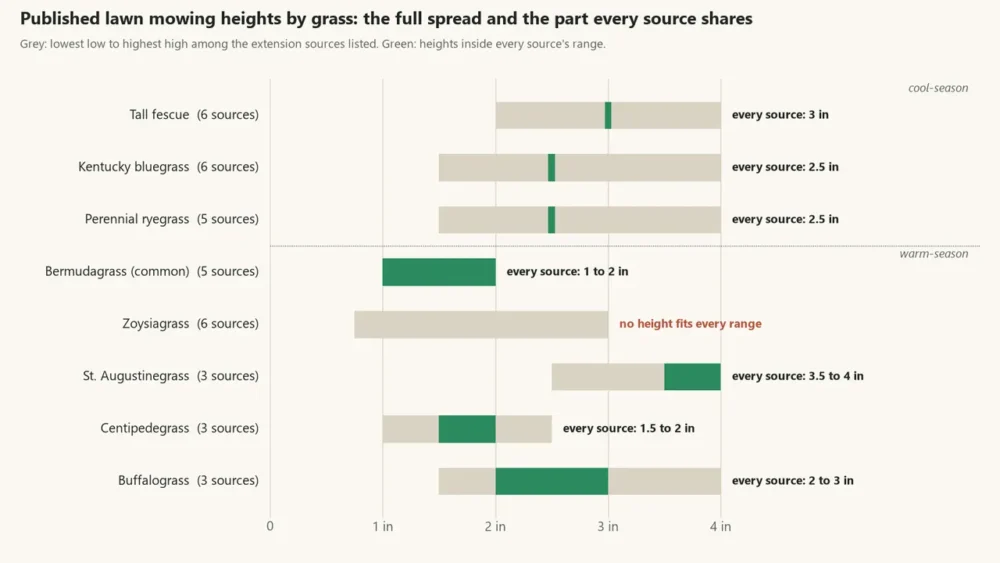
Three things stand out. Cool-season grasses overlap in a narrow band: tall fescue lands on exactly 3 inches, Kentucky bluegrass and perennial ryegrass on 2.5. Leave out NC State’s figure for bluegrass planted alone in the North Carolina mountains and bluegrass widens to 2.5 to 3 inches.13 Common Bermuda is the tightest warm-season grass, with five sources at 1 to 2 inches. Zoysia is the loosest, because the answer depends on the cultivar: Florida says medium- to coarse-textured types go at 1.75 to 2.5 inches with a rotary mower and fine-textured types below 1 inch,10 while Kansas State says 1 to 1.5.3


Cultivar matters for two more grasses. Florida says standard St. Augustine cultivars should be mowed at 3.5 to 4 inches and dwarf cultivars at 2.5,8 and Clemson lists hybrid Bermuda at 0.5 to 1.5 inches against 1 to 2 for common Bermuda.7 If you do not know your cultivar, use the common-type row. The same sources agree on the direction of any error: when in doubt, go to the higher end, which is what Florida’s home-lawn guide says in so many words:
Mow at the highest recommended height for your grass species.
Not sure which row is yours? Cool-season grasses (tall fescue, bluegrass, ryegrass) and warm-season grasses (Bermuda, zoysia, St. Augustine, centipede, buffalograss) grow in different parts of the country, and the transition zone between them can hold either. Our guide to cool-season vs. warm-season grass shows how to tell them apart. Mixed lawns follow the tallest grass in the mix, which is why NC State says to mow bluegrass at 2.5 inches or higher when it is mixed with tall fescue.13
The one-third rule and how to fix an overgrown lawn
Whatever height you pick, the rule that goes with it is the same in every source: remove no more than one third of the blade in one mowing. That fixes how often you mow, because the grass has to grow back to 1.5 times your height before you cut. Ohio State’s example is a 3-inch lawn, which should be mowed before the blades pass 4.5 inches,4 and Minnesota gives the same numbers.15 Kansas State explains the cost of breaking the rule: removing more than a third may stop root growth while the leaves regrow.3
| Height you keep | Mow before it reaches | Most you remove |
|---|---|---|
| 1 in | 1.5 in | 0.5 in |
| 1.5 in | 2.25 in | 0.75 in |
| 2 in | 3 in | 1 in |
| 2.5 in | 3.75 in | 1.25 in |
| 3 in | 4.5 in | 1.5 in |
| 3.5 in | 5.25 in | 1.75 in |
| 4 in | 6 in | 2 in |
Illinois adds that clippings of a lawn mowed on this schedule fall back into the grass, contain 75 to 80% water and do not cause thatch, and that it is never advisable to mow when the grass is wet.2 In spring, expect to mow more than once a week.2
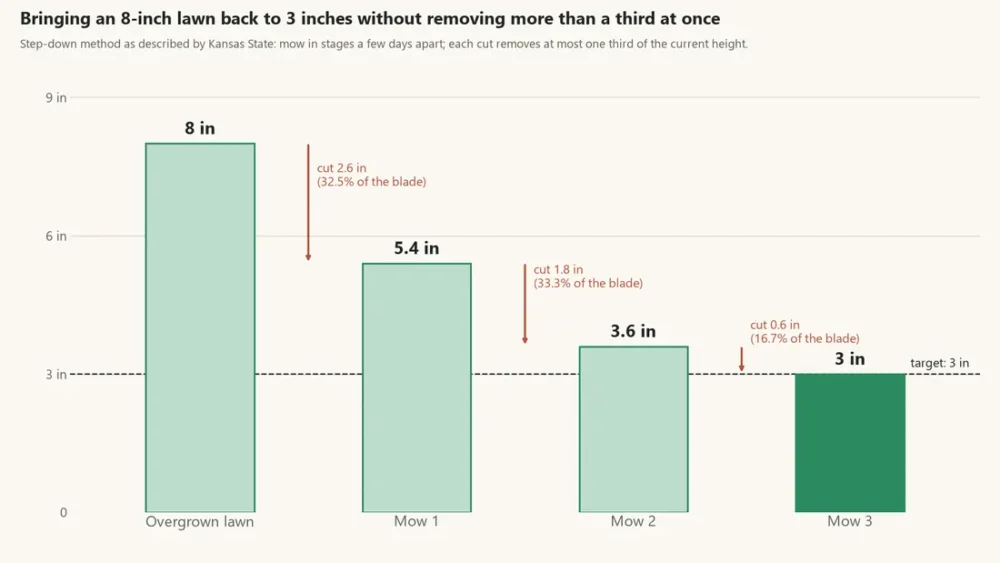
If you miss a few weeks, do not drop the deck to the target in one pass. Kansas State’s example is a 6-inch lawn with a 2-inch target: the first mowing should be at 4 inches, and several days later you cut again, reducing the height by the same rule until the lawn is where you want it.3 Applied to an 8-inch lawn with a 3-inch target, that takes three mowings:
An 8-inch lawn, a 3-inch target
- Scenario
- Each cut may remove at most one third of the current height (Kansas State, Ohio State, Minnesota).
- Math
- 8 in × ⅔ = 5.33, so set the deck at 5.4 in (rounding up keeps the cut under a third). Then 5.4 × ⅔ = 3.6 in. Then 3.6 × ⅔ = 2.4, which is below the target, so stop at 3 in.
- Answer
- Mow 1 at 5.4 in (32.5% of the blade), mow 2 at 3.6 in (33.3%), mow 3 at 3 in (16.7%), a few days apart.
Why not just cut it short?
A shorter cut means fewer mowings, which is why people do it, but the extension sources count the costs. Kansas State says turf cut too short usually has a shallow root system, lacks density, and often needs pesticides to hold off the weeds and pests that invade stressed lawns, and that tall turf is not the answer either, because it can look wide-bladed, thin and clumpy.3 Ohio State says research shows taller mowing heights significantly reduce weed density, through shade and competition with seedlings.4 Florida adds that repeatedly mowing low raises the chance of scalping when a mowing is missed.8 Illinois sums up the trade: lawns mowed higher tend to have deeper roots and fewer weeds, and mowing too close invites weed growth.2
Purdue’s optimum-height table defines the target. It is the height where a species grows the thickest turf with the fewest inputs; mowing far below it creates a weak turf that needs more fertilizer, water and pesticide.5 Our guide to when to fertilize your lawn covers the feeding side, and dethatching and aeration fix problems that low mowing can worsen.
Should the height change with the seasons?
Here the sources disagree, and the disagreement is the useful part. Most say to go higher in summer heat; one says to pick a height and keep it; and Oklahoma State tells Bermuda growers to do the opposite of everyone else. Table 3 sets out nine statements.
| Source | What it says | Direction |
|---|---|---|
| Iowa State | Kentucky bluegrass: 3 to 3.5 in summer; 2.5 to 3 in spring and fall | Higher in summer |
| Oklahoma State | Kentucky bluegrass and tall fescue: 2.5 to 3 in summer, 2 to 2.5 from fall to spring. Bermuda: 0.5 to 0.75 in summer, 1 to 1.25 from fall to spring, if mowing is needed | Cool-season higher in summer; Bermuda lower |
| Clemson | Tall fescue: winter 2 to 3, summer 3 to 3.5. Fine fescue: winter 1.5 to 2.5, summer 2.5 to 3 | Higher in summer |
| Minnesota | Increase the height by an inch in mid-summer; keep 3 inches or higher | Higher in summer |
| Kansas State | Mow at the lower heights when turf is healthy; raise within the range during warm-hot periods or stress | Higher in heat or stress |
| Ohio State | Higher mowing in summer promotes cooler soil and moisture preservation; consider raising further in shade | Higher in summer |
| Nebraska | Raise during hot, dry periods; lower gradually as the growing season ends | Higher in summer, lower in fall |
| Purdue (Reicher) | Mow as high as can be tolerated and keep that height season-long; do not raise on dry, unirrigated turf in drought | One height all year |
| Illinois | For most home lawns the easiest strategy is to set the height and leave it; first and last mowing may be slightly shorter | One height all year |
The Minnesota and Purdue positions bracket the question. Minnesota’s advice for its Kentucky bluegrass, ryegrass and fescue lawns is specific:
Increase the mowing height by an inch during mid-summer
Purdue’s Zac Reicher pushes back on the simple version of that advice. Grass roots on cool-season lawns grow mostly in April to May and October to November, he wrote, so raising the deck in a drought does not deepen roots that are not growing, and a dry, unirrigated lawn then has more leaf to feed. His summary:6
mow the turf areas as high as can be tolerated for your given situation
Put together, the sources support this reading: choose a height in the upper half of your grass’s range and leave it alone through spring and fall, then add some height in the heat if the lawn is irrigated or the weather is not dry. Kansas State says the same thing from the other side: mow at the lower heights when the turf is healthy and growing, and raise the setting within the range during warm-hot periods or when the turf is stressed by drought, disease, shade, insects or traffic.3 How much to add is a judgment. Minnesota says an inch; Iowa State’s bluegrass numbers move from 2.5 to 3 inches in spring and fall to 3 to 3.5 inches in summer, half an inch;14 Kansas State’s 2026 newsletter says even half an inch helps.17
When to raise the deck where you live
“Summer” is not a date. Kansas State says cool-season grasses thrive at air temperatures of 65 to 75°F and enter heat stress once air temperatures consistently exceed 85°F,17 and Minnesota’s turf program says high-temperature stress tends to start as daytime air temperatures rise over 85°F, adding that mowing in that heat should be delayed.16 Those are daily highs, and NOAA publishes normal highs for the station nearest every ZIP code.1 We counted the days on which the normal high is 85°F or more, and also marked the day it first reaches 80°F as a warning that the line is coming. The 80°F mark is our addition, not a published threshold.
| Source | Grass group | What it says |
|---|---|---|
| Kansas State (Braun, 2026) | Cool-season: tall fescue, Kentucky bluegrass, perennial ryegrass | Thrive at 65 to 75°F; heat stress once air temperatures consistently exceed 85°F |
| Minnesota Turfgrass Science (2026) | Cool-season lawn species | Heat stress tends to start as daytime air temperatures rise over 85°F and soil temperatures exceed 75°F; delay mowing when daytime air is over 85°F |
| Kansas State (Braun, 2026) | Warm-season: buffalograss, zoysiagrass, Bermudagrass | Optimum growth at 80 to 95°F; generally no stress until temperatures reach 100°F |
Kansas City shows how this looks over a year: the normal high first reaches 85°F on June 13, stays there for 77 days and drops back below it on August 28.

Across 40,567 lower-48 ZIP codes, the normal high reaches 80°F in 90.1% and 85°F in 60.2%. Where it reaches 85°F, the first day comes at a median of June 12 and the last at September 3, a median of 84 days (middle half 52 to 123 days), and the 80°F mark arrives a median of 22 days before the 85°F day (middle half 19 to 27 days). That is your lead time. Another 39.8% of ZIP codes never reach 85°F in the normals, though individual hot spells still do, so take the date as a planning guide and the thermometer as the final word.
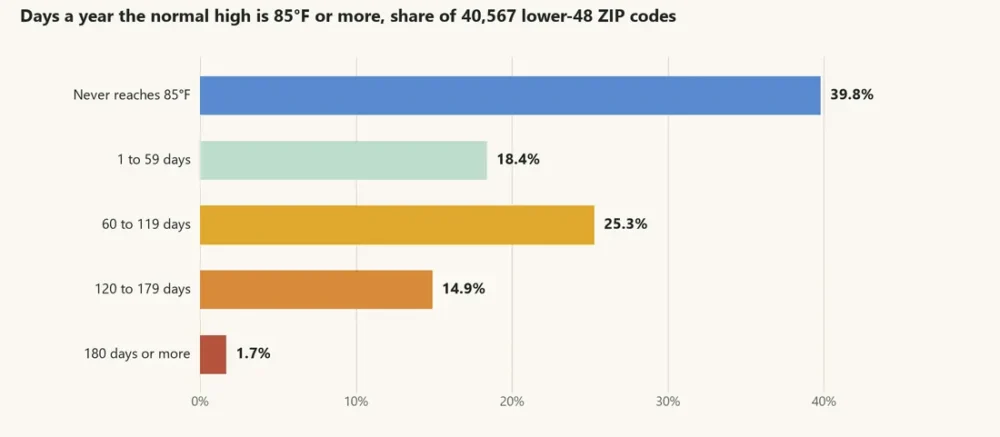
Table 5 gives 25 cities. Use it only if your lawn is a cool-season grass; we do not label any city as cool-season or warm-season, and your state extension service is the place to check. Four things the table shows. First, the gap between regions is large: Omaha has 60 days at 85°F or more, Kansas City 77, Nashville 91, Dallas 137 and Phoenix 196. Second, in the northern cities the normal high may never reach the line: Minneapolis peaks at a normal high of 83.1°F, Boston 82.1°F and Seattle 77.4°F, so there the raise is a matter of watching the forecast. Third, Chicago and Columbus touch 85.0°F for a single day, July 15. Fourth, a heat season that lasts four months or more, as in Dallas, Houston, Orlando and Phoenix, is outside what a cool-season rule was written for.
| City (ZIP) | Normal high reaches 80°F | Raise the deck: first day at 85°F | Back to normal height: last day at 85°F | Days at 85°F or more | Hottest month’s normal high (°F) |
|---|---|---|---|---|---|
| Phoenix, AZ (85001) | Mar 23 | Apr 13 | Oct 25 | 196 | 106.5 |
| Orlando, FL (32801) | Mar 26 | Apr 26 | Oct 11 | 169 | 91.9 |
| Houston, TX (77002) | Apr 19 | May 12 | Oct 3 | 145 | 94.3 |
| Dallas, TX (75201) | Apr 26 | May 16 | Sep 29 | 137 | 97.1 |
| Atlanta, GA (30303) | May 11 | Jun 4 | Sep 8 | 97 | 90.0 |
| Oklahoma City, OK (73102) | May 19 | Jun 6 | Sep 10 | 97 | 93.1 |
| Raleigh, NC (27601) | May 15 | Jun 6 | Sep 2 | 89 | 90.6 |
| Nashville, TN (37201) | May 16 | Jun 8 | Sep 6 | 91 | 89.3 |
| St. Louis, MO (63101) | May 25 | Jun 12 | Aug 30 | 80 | 89.6 |
| Kansas City, MO (64106) | May 28 | Jun 13 | Aug 28 | 77 | 90.2 |
| Richmond, VA (23219) | May 24 | Jun 13 | Aug 27 | 76 | 89.5 |
| Denver, CO (80202) | Jun 2 | Jun 15 | Sep 1 | 79 | 91.4 |
| Philadelphia, PA (19103) | May 30 | Jun 16 | Aug 24 | 70 | 89.3 |
| Omaha, NE (68102) | Jun 2 | Jun 20 | Aug 18 | 60 | 88.1 |
| Salt Lake City, UT (84101) | Jun 7 | Jun 23 | Aug 29 | 68 | 91.4 |
| Des Moines, IA (50309) | Jun 9 | Jul 11 | Jul 24 | 14 | 85.6 |
| Chicago, IL (60601) | Jun 13 | Jul 15 | Jul 15 | 1 | 85.0 |
| Columbus, OH (43215) | Jun 8 | Jul 15 | Jul 15 | 1 | 85.0 |
| New York, NY (10001) | Jun 17 | Never | — | 0 | 84.9 |
| Indianapolis, IN (46204) | Jun 12 | Never | — | 0 | 83.7 |
| Detroit, MI (48201) | Jun 21 | Never | — | 0 | 83.5 |
| Minneapolis, MN (55401) | Jun 25 | Never | — | 0 | 83.1 |
| Boston, MA (02108) | Jul 5 | Never | — | 0 | 82.1 |
| Portland, OR (97201) | Jul 14 | Never | — | 0 | 80.6 |
| Seattle, WA (98101) | Never | Never | — | 0 | 77.4 |

Warm-season lawns: heat is not the trigger
The same Kansas State newsletter says warm-season grasses grow best at 80 to 95°F and generally do not stress until temperatures reach 100°F.17 In the NOAA normals only 1.6% of ZIP codes (644) have a normal monthly high that reaches 100°F, so heat alone rarely asks a warm-season lawn to be raised. Normal highs are averages, and a real heat wave goes well above them. For warm-season grass the reasons to change height are cultivar and use, and the sources do not push a seasonal swing. Oklahoma State is the outlier, advising 0.5 to 0.75 inches for Bermuda in summer and 1 to 1.25 inches from fall to spring, when mowing is needed at all.18
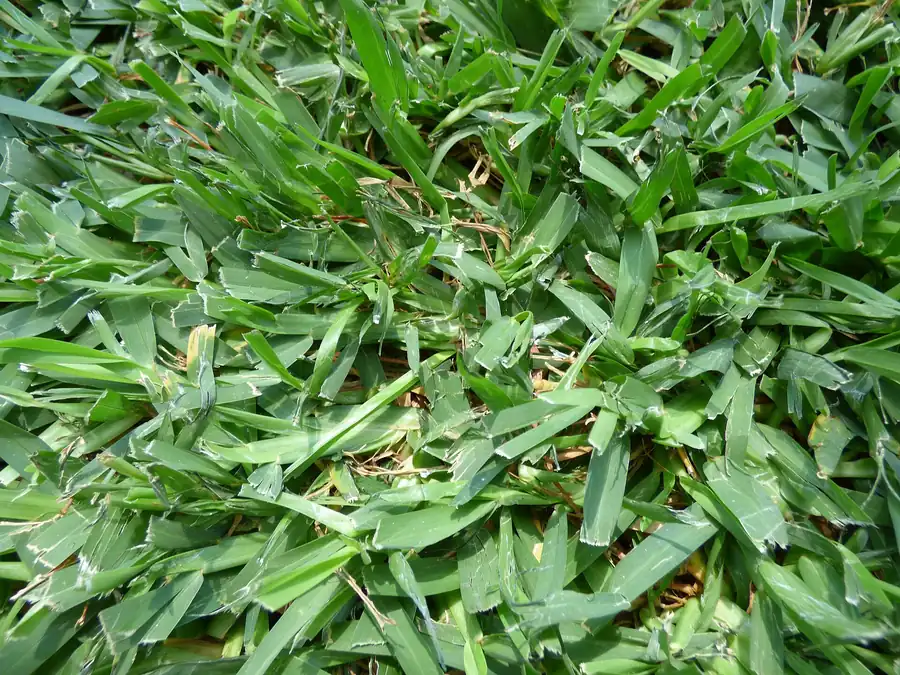

St. Augustine is the grass most often cut too short. Florida’s 3.5 to 4 inches for standard cultivars is the height that Clemson’s and NC State’s ranges also contain,8,7,13 and Florida mows centipede every 7 to 14 days while it grows, at 1.5 to 2.5 inches.9 Reel mowers are for the low end: Florida prefers one for fine-textured Bermuda below 1 inch,11 and NC State says the same for cuts under 1 inch.13 For when Bermuda wakes up and when to stop, see when Bermuda grass turns green and when to stop mowing.
The first and last mowing of the year
Illinois says the first and last mowings can be slightly shorter, as long as you do not scalp.2 Kansas State says to mow slightly shorter in spring before growth starts, to clear dead blades, then to make the last mowing at the normal height, neither too short nor too tall going into winter.3 Nebraska’s guide says to lower the height gradually as the season ends,21 so the sources are not all together on the fall change. We give last-mow dates and the last-mow height advice, with the snow-mold evidence, in when to stop mowing your lawn in fall and snow mold on your lawn. Leaves that fall before then are a mowing question too; see should you rake leaves.
Shade, new seed and dry spells
Shade is the clearest reason to go up. Ohio State says to consider raising the mowing height further for turf in shade, where light limits photosynthesis,4 and Oklahoma State likewise says shaded turf should be kept slightly higher to make up for the lower light.18 Newly seeded lawns have their own first-mow rules, covered in how long grass seed takes to grow and when to overseed. For dry spells, Purdue and Minnesota point in different directions (above); watering is a separate lever, which our guide to how much to water a lawn sizes from your ZIP’s rain.
How we calculated these dates
Daily normal highs are NOAA’s monthly normal highs for the station nearest each ZIP code, placed on the 15th of each month and joined by straight lines.1 The heat season is every day with a normal high of 85°F or more, taken from Kansas State and Minnesota.17,16 The first day is the raise date and the last day is the date to come back to your normal height; both are estimates from averages over 1991 to 2020, and a single year can differ by weeks. Smoothing monthly values also lowers the peak slightly, so places that peak just under 85°F may see 85°F days anyway. Mowing ranges come from the pages listed under Sources, read on October 23, 2026, and each is quoted as published. Anything we could not read is left out; the Michigan State and TruGreen pages blocked our automated requests.
 Related guideWhen to Stop Mowing Your Lawn in Fall: Dates by State and City
Next steps
Find your grass in Table 1, set the deck to the middle of its range, and mow when the lawn reaches 1.5 times that height. Add the dates from Table 5 to your calendar if you grow cool-season grass and irrigate. Look up your own frost dates with our frost date lookup and see more in our mowing and watering guides.
Frequently asked questions
It depends on the grass. Heights inside every extension range we compared: tall fescue 3 inches, Kentucky bluegrass and perennial ryegrass 2.5, common Bermuda 1 to 2, centipede 1.5 to 2, buffalograss 2 to 3 and standard St. Augustine 3.5 to 4. Minnesota says 3 inches or higher for typical Midwest lawns.
Not for every grass. Florida says standard St. Augustine goes at 3.5 to 4 inches, Utah State and Nebraska allow 2 to 4 for buffalograss, and Purdue and Ohio State put tall fescue up to 4. For Kentucky bluegrass, Illinois and Kansas State stop at 3.
For cool-season lawns, Minnesota says to delay mowing when daytime air is over 85°F, because the plants are not actively growing and probably do not need it. Kansas State says warm-season grass generally is not stressed until about 100°F. We found no extension source that addresses mowing at 100°F itself.
Yes for tall fescue, where 3 inches is the one height inside all six ranges we compared, and for most Midwest cool-season lawns (Minnesota: 3 inches or higher). It is too tall for Bermuda, zoysia and centipede, whose ranges top out at 2 to 3 inches.
For cool-season grass, Iowa State gives Kentucky bluegrass 3 to 3.5 inches in summer, Clemson gives tall fescue 3 to 3.5, and Minnesota says to add an inch in mid-summer. Oklahoma State gives 2.5 to 3. Warm-season grasses mostly keep one height; Oklahoma State cuts Bermuda lower in summer.
Iowa State gives Kentucky bluegrass 2.5 to 3 inches in spring and fall, and Oklahoma State gives 2 to 2.5 for cool-season grass from fall to spring. Illinois says the first and last mowing can be slightly shorter without scalping. Our stop-mowing guide covers the last mow.
Do not cut it to the target at once. Kansas State’s example is a 6-inch lawn with a 2-inch target: mow first at 4 inches, then again a few days later at a lower setting by the same one-third rule. An 8-inch lawn with a 3-inch target takes three mowings.
Kansas State says turf cut too short usually has a shallow root system, lacks density and often needs pesticides to hold off weeds and pests. Ohio State says taller mowing significantly reduces weed density, and Florida says repeated low mowing raises the risk of scalping.
Sources
- 1.U.S. Climate Normals 1991–2020. NOAA National Centers for Environmental Information, 2021. Used for: normal monthly highs for the station nearest each ZIP code, used for the 80°F and 85°F dates and the 100°F share Back to text
- 2.Mowing Your Lawn. University of Illinois Extension, n.d. Used for: heights for seven grasses; one-third rule; clippings; wet grass; set-and-leave strategy; first and last mowing Back to text
- 3.Mowing (Lawn Problem Solver). Kansas State University Turfgrass Science, 2026. Used for: heights table; one-third rule; step-down from an overgrown lawn; raise in heat; first and last mowing; costs of mowing short Back to text
- 4.Lawn Mowing (fact sheet). Ohio State University Extension (CFAES), 2023. Used for: Ohio heights table; summer height; shade; one-third rule with 3-inch example; weed density Back to text
- 5.Turf 101: Optimum mowing heights for turf, Zac Reicher. Purdue University Turfgrass Science, 2004. Used for: optimum ranges for Indiana Back to text
- 6.Don’t raise the mowing height during drought, Zac Reicher. Purdue University Turfgrass Science, 2007. Used for: recommended heights for lawns; season-long height; roots grow in spring and fall Back to text
- 7.Mowing Lawns (HGIC 1205), Robert F. Polomski and Debbie Shaughnessy. Clemson Cooperative Extension, Home & Garden Information Center, 1999. Used for: table of heights with winter and summer figures for cool-season grasses Back to text
- 8.St. Augustinegrass for Florida Lawns (ENH5/LH010). UF/IFAS Extension, n.d. Used for: standard cultivars 3.5 to 4 inches, dwarf 2.5; low mowing and scalping Back to text
- 9.Centipedegrass for Florida Lawns (ENH8/LH009). UF/IFAS Extension, n.d. Used for: 1.5 to 2.5 inches, every 7 to 14 days Back to text
- 10.Zoysiagrass for Florida Lawns (ENH11/LH011). UF/IFAS Extension, n.d. Used for: 1.75 to 2.5 inches by rotary mower for medium to coarse types; fine types below 1 inch Back to text
- 11.Bermudagrass for Florida Lawns (LH007). UF/IFAS Extension, n.d. Used for: 1 to 2 inches under low to moderate management; reel mower below 1 inch Back to text
- 12.Best Management Practices for Your Lawn. UF/IFAS Gardening Solutions, 2026. Used for: mow at the highest recommended height; one-third rule
- 13.Lawns, Chapter 9 in the North Carolina Extension Gardener Handbook. NC State Extension, 2022. Used for: cutting heights for tall fescue, bluegrass, Bermuda, zoysia, centipede, St. Augustine; reel mowers Back to text
- 14.Summer Lawn Care, Richard Jauron. Iowa State University Extension and Outreach, 2022. Used for: bluegrass 3 to 3.5 inches in summer, 2.5 to 3 in spring and fall Back to text
- 15.Mowing practices for healthy lawns, Sam Bauer and Jonah Reyes. University of Minnesota Extension, 2024. Used for: 3 inches or higher; add an inch in mid-summer; 4.5-inch rule Back to text
- 16.Home Lawn Care Newsletter, August 2026. University of Minnesota Turfgrass Science, 2026. Used for: heat stress as daytime air passes 85°F; delay mowing; raise to at least 3 inches Back to text
- 17.Summer Turf Wars: Battling Drought, Heat, and Seasonal Pests, Part 1, Ross Braun. Kansas State University Turf and Landscape Newsletter, 2026. Used for: cool-season stress above 85°F air; warm-season stress near 100°F; half an inch higher Back to text
- 18.Mow at the Right Height to Maintain Turf. Oklahoma State University Extension, 2022. Used for: summer and fall-to-spring heights for cool-season grass and Bermuda; shade Back to text
- 19.Basic Turfgrass Care. Utah State University Extension, 2011. Used for: 2 to 4 inches for Utah lawn grasses including buffalograss Back to text
- 20.Buffalo Grass. University of Nebraska–Lincoln Extension, n.d. Used for: buffalograss 2 to 4 inches Back to text
- 21.Mowing. University of Nebraska–Lincoln Extension, n.d. Used for: raise in hot, dry periods; lower gradually in fall Back to text
- 22.Photo: Starr-200117-7375 Stenotaphrum secundatum lawn and paths, Forest and Kim Starr (CC BY 2.0). Wikimedia Commons, 2020. Used for: hero photo
- 23.Photo: Starr-170321-0608 Stenotaphrum secundatum in lawn, Forest and Kim Starr (CC BY 3.0 US). Wikimedia Commons, 2017. Used for: St. Augustine close-up photo
- 24.Photo: Bouteloua dactyloides, Patrick Alexander (CC0). Wikimedia Commons, 2023. Used for: buffalograss photo
How this guide was made
- Written by the Yard & Garden Desk and reviewed by the Data & Methodology Desk.
- Data: normal monthly highs from NOAA NCEI U.S. Climate Normals 1991–2020 for the station nearest each ZIP code, joined into daily values by straight lines between the 15th of each month; heat thresholds from Kansas State (2026) and University of Minnesota Turfgrass Science (2026); mowing ranges as published by Illinois, Kansas State, Ohio State, Purdue, Clemson, Florida, NC State, Iowa State, Utah State and Nebraska. Air temperature only. See our methodology.
- AI use: AI tools help us research, draft and check this guide. Every figure is checked against the source cited for it, and calculated figures come from our own code, described on the methodology page.
- Spotted an error? Tell us — the form opens with this page’s address filled in.
Change log
- Oct 23, 2026Drafted. Mowing heights for eight grasses from ten universities, the heights inside every range, one-third rule and overgrown-lawn steps, nine statements on seasonal change, and normal-high 80°F and 85°F dates for 25 cities from NOAA 1991–2020 normals across 40,567 ZIP codes.
Covers lawns, gardens, frost and planting. We write the guides and maintain the tools that tell you when to seed, feed and plant for your ZIP.
Keep reading

When to Mow the Lawn the First Time in Spring: Dates by City
Start mowing when the grass reaches 4½ to 5¼ inches for a 3 to 3½ inch cut. Cool-season lawns wake when the daily average hits 48°F: about Apr 6 for the median US ZIP code.

Snow Mold on Your Lawn: Prevent It in Fall, Rake It in Spring
Gray snow mold needs 40 to 60 days of snow cover, and pink snow mold needs none. See how many snow-cover days your ZIP code gets in NOAA normals, which fall steps extension services back, and why sprays fail once the patches show.
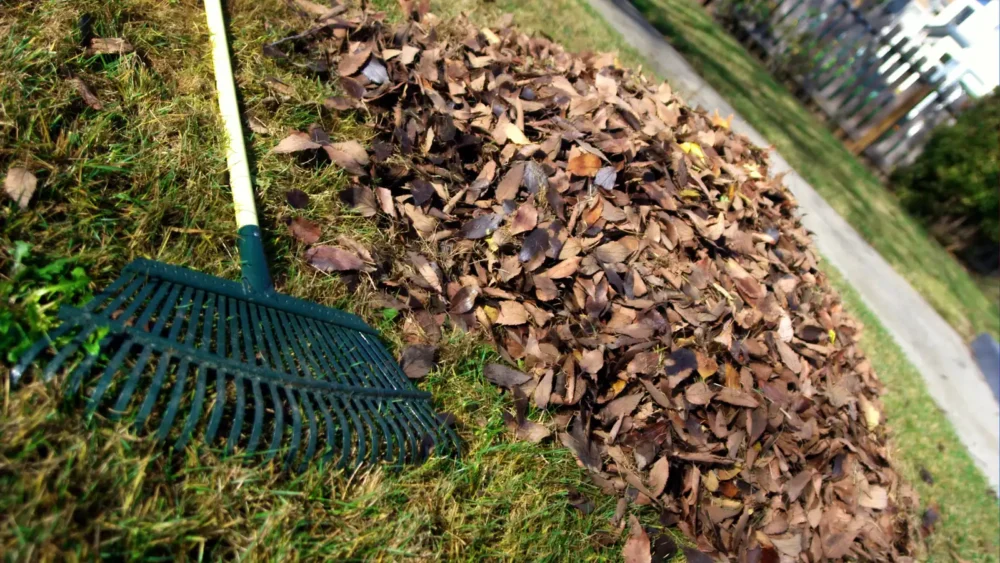
Should You Rake Leaves? When to Mulch, Rake or Leave Them
Usually not. Mow a light or moderate layer of leaves into the lawn until your last mow, and remove only what hides the grass. Extension thresholds, the research, and leaf deadlines for 20 US cities from NOAA normals.
Seasonal reminders for your ZIP
Get a short email when it’s time to overseed, start seeds, open the pool or service your furnace — timed to your climate.