When to Mow the Lawn the First Time in Spring: Dates by City
Extension services say there is no set date. We worked out when the lawn wakes up in 23 cool-season and 13 warm-season cities, and how often a frost is still coming at your first mow.
- Last reviewed Oct 23, 2026
- 24 cited sources
- 12 min read

Set your ZIP to see dates for your area.
- 1Mow for the first time when the grass reaches 1.5 times your deck setting, not on a date: 4½ to 5¼ inches for a 3 to 3½ inch cut (Iowa State). With a 2 to 2½ inch setting, start at 3 to 3¾ inches.
- 2Cool-season grass starts growing in earnest when the normal daily average reaches 48°F (soil about 50°F): Mar 22 in Washington, DC, Apr 7 in Indianapolis, Apr 10 in Chicago, Apr 22 in Minneapolis. The median US ZIP code is Apr 6 (Table 1).
- 3The lawn wakes before the median last frost in 93.9% of ZIP codes, a median of 16 days early, so do not scalp it. The most any extension source suggests is one notch lower, once (Kansas State).
- 4Bermuda and zoysia get one low mow, about 1 inch, just before green-up, then regular mowing (Clemson, NC State, Mississippi State). Normal nights reach 60°F a median 60 days after the last frost (Table 5).
- 5Mow only when the grass is dry and the blade is sharp. If you waited too long, do not cut straight to your target: Kansas State steps a 6-inch lawn down to 2 inches in two mowings.
Mow for the first time when the grass has grown to about one and a half times your mower’s deck setting: 4½ to 5¼ inches for a lawn you keep at 3 to 3½, according to Iowa State Extension.2 The calendar matters less than the growth. In a normal year cool-season grass starts growing in earnest when the daily average temperature reaches 48°F, which is when the soil is about 50°F: April 6 at the median US ZIP code, April 22 in Minneapolis, April 7 in Indianapolis and March 22 in Washington, DC. Bermuda and zoysia lawns get one deliberately low mow just as they green up.
Those dates come from NOAA’s 1991–2020 climate normals for the weather station nearest each ZIP code. We computed them for 23 cool-season cities and 13 warm-season cities and checked them against what extension services publish for their own states. Then we asked the question the other pages skip: how often is a hard frost still possible when you first mow?
Mow when the grass is a third taller than your deck setting
Iowa State’s answer is short: there is no calendar date.2
There is no set date to start mowing.
What it gives instead is arithmetic based on the one-third rule, which says never remove more than a third of the leaf blade at one mowing. With the mower set to 3 to 3½ inches, start once the grass reaches 4½ to 5¼ inches. With a 2 to 2½ inch setting, start at 3 to 3¾ inches.2 Mowing every 5 to 7 days is typical in spring, Iowa State adds.3
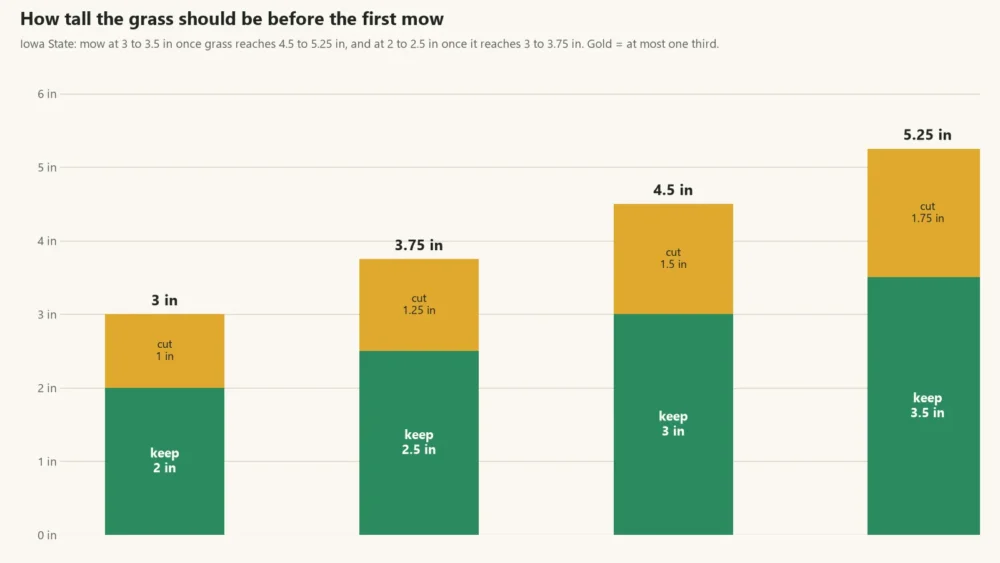
Competing pages disagree about the trigger. When we searched Google on October 23, 2026, one AI Overview said to mow at 3 to 4 inches, another at 4½ to 5 inches. They are the same rule applied to different decks: 3 to 4 inches is correct for a setting of 2 to 2.7 inches, and 4½ to 5¼ for the 3 to 3½ inch setting most cool-season lawns do best with. An Illinois Extension educator who cuts his own lawn just shy of 4 inches advises against waiting: “Once it’s tall enough to mow, start mowing—don’t wait.”4
Which setting to use is a separate question, covered in our guide to mowing and watering. Illinois puts cool-season lawns at 2 to 3 inches, with turf-type tall fescue at 3 to 4.4
When the cool-season lawn wakes up where you live
Grass cannot be mowed until it grows, and cool-season grass picks up speed as the soil warms. Rutgers’ turf program says growth becomes more vigorous once soil temperatures are consistently above 50°F,19 and Kansas State puts optimum growth at soil temperatures of 50 to 65°F.20 Our spring seeding guide converted that soil number into an air-temperature rule using NOAA’s measured soil data at 35 stations: soil at 50°F matches a normal daily average of about 48°F, with a typical miss of 4½ days (see when to plant grass seed in spring). Table 1 applies that rule to normal temperatures.
| City (ZIP) | Lawn wakes (daily mean 48°F) | Median last 32°F frost | Last frost in 1 year of 10 | Lawn wakes vs. median last frost |
|---|---|---|---|---|
| Portland, OR (97204) | Mar 16 | Feb 25 | Mar 21 | 19 days after |
| St. Louis, MO (63101) | Mar 20 | Apr 1 | Apr 18 | 12 days before |
| Salt Lake City, UT (84101) | Mar 21 | Mar 31 | Apr 19 | 10 days before |
| Washington, DC (20001) | Mar 22 | Mar 29 | Apr 11 | 7 days before |
| Kansas City, MO (64105) | Mar 22 | Apr 4 | Apr 20 | 13 days before |
| Seattle, WA (98101) | Mar 24 | Mar 13 | Apr 1 | 11 days after |
| Philadelphia, PA (19103) | Mar 26 | Mar 30 | Apr 12 | 4 days before |
| New York, NY (10001) | Apr 1 | Mar 30 | Apr 9 | 2 days after |
| Omaha, NE (68102) | Apr 5 | Apr 18 | Apr 30 | 13 days before |
| Columbus, OH (43215) | Apr 5 | Apr 20 | May 7 | 15 days before |
| Indianapolis, IN (46204) | Apr 7 | Apr 20 | May 5 | 13 days before |
| Pittsburgh, PA (15222) | Apr 7 | Apr 24 | May 11 | 17 days before |
| Denver, CO (80202) | Apr 7 | Apr 30 | May 13 | 23 days before |
| Des Moines, IA (50309) | Apr 8 | Apr 18 | May 2 | 10 days before |
| Chicago, IL (60601) | Apr 10 | Apr 10 | Apr 25 | Same day |
| West Lafayette, IN (47906) | Apr 11 | Apr 26 | May 11 | 15 days before |
| Boston, MA (02108) | Apr 15 | Apr 4 | Apr 17 | 11 days after |
| Detroit, MI (48201) | Apr 17 | Apr 21 | May 6 | 4 days before |
| Albany, NY (12207) | Apr 17 | Apr 27 | May 11 | 10 days before |
| Madison, WI (53703) | Apr 21 | May 1 | May 17 | 10 days before |
| Minneapolis, MN (55401) | Apr 22 | Apr 23 | May 7 | 1 days before |
| Boise, ID (83702) | Apr 22 | May 17 | Jun 10 | 25 days before |
| Fargo, ND (58102) | Apr 28 | May 10 | May 23 | 12 days before |

Across 34,629 lower-48 ZIP codes that have a cold enough winter, the median wake-up date is Apr 6, with the middle half between Mar 18 and Apr 20. In another 14.5% of ZIP codes the normal daily average never falls below 48°F, so there is no true winter stop; those are mostly in California, Florida, Texas, Louisiana and Arizona. This is a normal-year estimate. In our spring seeding guide, the date soil reached 50°F in the earliest and latest springs of 2014–2025 was a median of 31 days apart across 35 NOAA stations, so check the grass in your own yard.
Does it match extension calendars?
Few extension services publish a first-mowing date, because they know growth varies. Minnesota gives a week and Purdue gives a month.
| Place | Our date (NOAA normals) | What the extension service says |
|---|---|---|
| Minneapolis, MN | Lawn wakes Apr 22 | University of Minnesota Extension’s lawn care calendar lists “Mowing: Last week of April through early November.”11 |
| West Lafayette and Indianapolis, IN | Lawn wakes Apr 11 and Apr 7 | Purdue’s Indiana calendar has this in its April row: “Begin mowing as soon as lawn greens-up and begins growing.”10 |
| Charleston, SC (coast) | Nights reach 60°F Apr 18 | Clemson: Bermuda green-up “generally will occur sometime during April” in coastal and southern South Carolina.12 |
| Columbia, SC (inland) | Nights reach 60°F May 10 | Clemson: “further inland, this may be as late as mid-May.”12 |
None of these contradicts our dates. Our figures mark when growth becomes possible; the height trigger above decides the actual first mow, so expect your first mow within a week or two of the dates in Table 1 rather than exactly on them. We cannot compute how fast grass grows from air temperature alone, and no source we read gives one.
Frost is still likely at the first mow, so don’t scalp cool-season grass
The first mow usually comes before the last frost. In 93.9% of the 34,629 ZIP codes in our analysis, the lawn wakes up before the median last 32°F frost, a median of 16 days earlier. In 99.7% of them the last frost in 1 year of 10 falls after the wake-up date, a median of 31 days later.

That is why Kansas State’s Johnson County office warns against scalping in spring: low mowing opens sunlight to the soil, which brings out weed seed, and can damage the grass’s growing points, with possible harm if a late spring freeze occurs.7 Its advice is modest:
no more than one notch for the first mow of the season
Extension services do not all agree. Kansas State’s turf program says to mow slightly shorter before growth starts to remove dead blades,6 while Wisconsin says not to make the first mowing excessively short and Nebraska says to start with a higher setting.8,9
| Source | What it says | Direction |
|---|---|---|
| Kansas State (turf program) | Before the grass begins to grow, mow slightly shorter than normal to remove dead blades and debris; do not scalp; once growth starts, mow at the proper height.6 | Slightly shorter, once |
| Kansas State (Johnson County) | Drop the mowing height no more than one notch for the first mow, then return to the recommended height; about 3 inches for fescue and bluegrass.7 | One notch lower, once |
| Illinois Extension | The first and last mowing of the year can be slightly shorter, though not typically necessary; do not cut so short that you scalp the lawn.5 | Optional, slightly shorter |
| Wisconsin Extension | Mow at about 3 inches for the entire season and do not make the first mowing excessively short.8 | No change |
| Nebraska Extension | Begin mowing as soon as the grass starts growing; set the mower to a higher setting initially.9 | Higher at first |
| Iowa State Extension | Set mowers to 3 to 3½ inches; start when the grass reaches 4½ to 5¼ inches.2 | Normal height |
| Purdue Extension | April: mow at 2.5 to 3.5 inches and begin as soon as the lawn greens up and begins growing.10 | Normal height |
The pattern is that nobody recommends a deep cut for cool-season grass. If you want to trim winter debris, one notch lower, once, is the most any of them says. Then return to your normal setting.
Bermuda and zoysia: one low mow just before green-up
Warm-season lawns are handled the other way round. Clemson’s Bermuda calendar says to mow slightly lower than the regular summer height, about 1 inch, just before green-up, which usually comes in late April or early May in South Carolina; zoysia gets 1 to 1½ inches.12,13 Mississippi State’s turf specialist explains why this works and where it stops:
Scalping or close mowing should not be a continuous process throughout the season
He continues that it is done only once, when the lawn begins its initial spring growth, and that bermudagrass and zoysia can take it because their rhizomes and stolons rebuild the canopy once soil and air are warm enough for growth. Centipede and St. Augustine have only stolons, so they may be cut slightly lower than usual but should not be scalped.16
| Source | What it says |
|---|---|
| Clemson (Bermuda) | Mow slightly lower than summer height, about 1 inch, just before green-up, late April or early May; bag or rake the dead material.12 |
| Clemson (zoysia) | Mow at about 1 to 1½ inches just before green-up; be careful not to scalp.13 |
| NC State (Bermuda) | Mow when the lawn first turns green, as low as possible without scalping; before the grass grows taller than 2½ inches. This removes dormant tissue and sets the height for the year.14 |
| NC State (zoysia) | Mow when it first turns green, as low as possible without scalping, before it grows taller than 1½ to 2½ inches.15 |
| University of Arkansas (Bermuda) | Before growth starts you may mow slightly shorter to remove dead blades; it also warms the soil sooner. Begin regular mowing when the grass turns green and reaches the desired height.17 |
| Mississippi State | Bermuda and zoysia can be scalped once at initial spring growth; centipede and St. Augustine only slightly lower than usual, not scalped.16 |
The reason to wait for green-up is frost. Clemson says it is not unusual for Bermuda and zoysia to green up and be burnt back several times in late winter or early spring.12,13 The University of Arkansas adds that Bermuda never produces significant growth until nights are 60°F for about a week or more.18 Table 5 shows both dates.
| City (ZIP) | Median last 32°F frost | Last frost in 1 year of 10 | Nights reach 60°F (strong growth) | Days from 1-in-10 frost to 60°F nights |
|---|---|---|---|---|
| Jacksonville, FL (32202) | Feb 1 | Mar 3 | Apr 11 | 39 |
| Houston, TX (77002) | Feb 2 | Mar 5 | Apr 13 | 39 |
| New Orleans, LA (70112) | Feb 1 | Mar 6 | Apr 14 | 39 |
| Charleston, SC (29401) | Feb 4 | Mar 4 | Apr 18 | 45 |
| Austin, TX (78701) | Mar 10 | Mar 31 | Apr 21 | 21 |
| Dallas, TX (75201) | Mar 2 | Mar 19 | Apr 27 | 39 |
| Columbia, SC (29201) | Mar 16 | Apr 3 | May 10 | 37 |
| Memphis, TN (38103) | Mar 19 | Apr 7 | May 13 | 36 |
| Atlanta, GA (30303) | Mar 24 | Apr 10 | May 23 | 43 |
| Raleigh, NC (27601) | Mar 28 | Apr 12 | May 24 | 42 |
| Charlotte, NC (28202) | Mar 30 | Apr 14 | May 24 | 40 |
| Oklahoma City, OK (73102) | Apr 4 | Apr 20 | May 25 | 35 |
| Nashville, TN (37201) | Apr 1 | Apr 16 | Jun 2 | 47 |

Across 30,269 ZIP codes where nights reach 60°F and frost occurs, normal nights get there a median 60 days after the median last frost, and a median 43 days after the last frost in 1 year of 10; in every one of them the nights reach 60°F after that frost. Clemson’s timing is in line with Table 5 at both ends: green-up in coastal South Carolina “sometime during April” and “as late as mid-May” inland.12 Our Bermuda green-up guide has the full 33-city table, and the soil-temperature rules behind it.
Wait for a dry lawn and a sharp blade
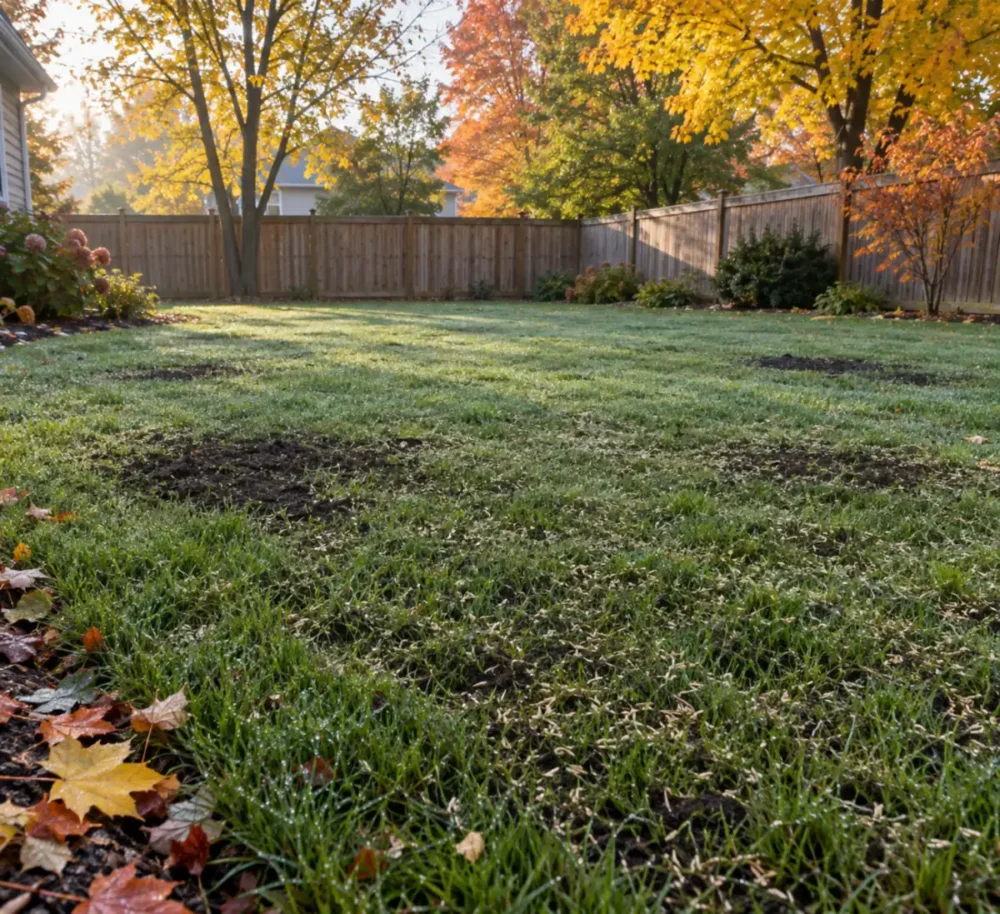
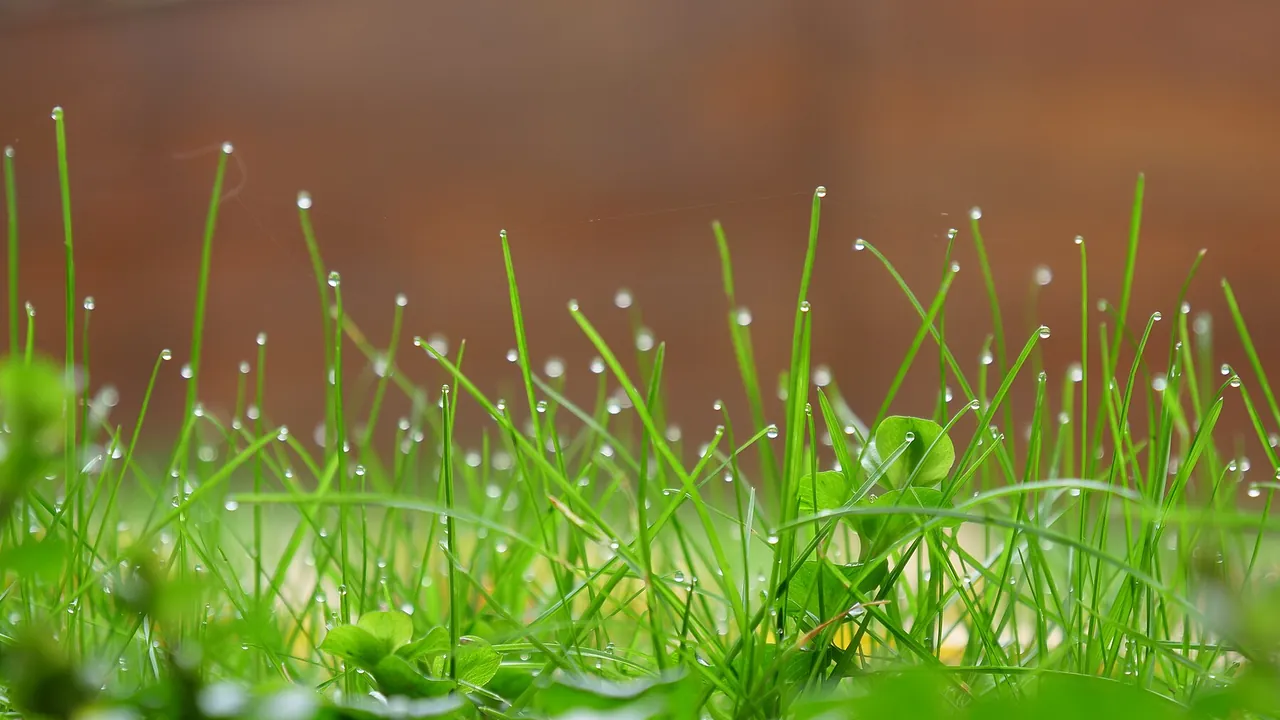
Illinois says it is never advisable to mow when the grass is wet.5 Morning dew counts, as the photo at the top of this page shows: wait until the blades are dry.
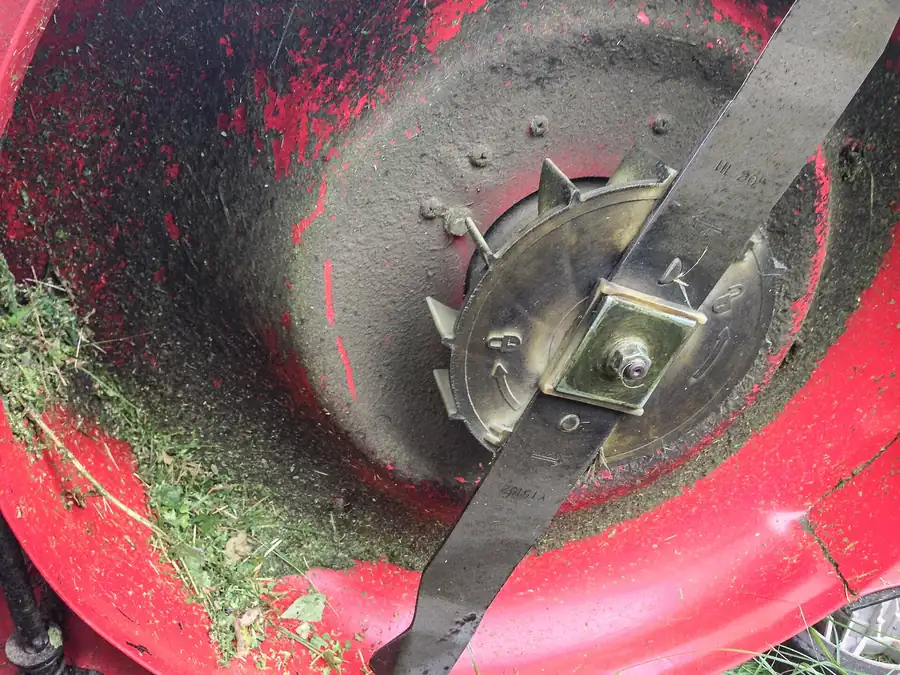
Iowa State also says to start the season with a sharp blade, because a dull one tears the grass, which invites disease and raises water use.3 Clippings from a first mow need not be bagged if the cut is within a third; Iowa State says piles from an overlong cut must be raked or bagged because they smother the grass beneath.3 Clemson suggests a bagger for the low Bermuda mow, to collect the dead material left from winter.12

If you waited too long
Do not drop the deck to your target in one pass. Kansas State’s example is a 6-inch lawn with a 2-inch target: mow first at 4 inches, then several days later at a lower setting under the same one-third rule, until the lawn is at the right height.6
What else belongs around the first mow
- Fertilizer. Illinois says to wait until mid-May,4 and Wisconsin says ideally to wait until the second mowing.8 See when to fertilize your lawn.
- Crabgrass preventer. Illinois advises against doing all spring lawn jobs at once.4 Our pre-emergent timing guide has the soil-temperature trigger and city dates; follow the product label.
- A lawn grown from seed. Its first mow follows different rules; see how long grass seed takes to grow.
- Peak growth. Penn State says you may need to mow more than once a week at the spring peak,22 and Virginia Tech suggests raising a cool-season lawn closer to 3 inches by Memorial Day.21
How we calculated these dates
Daily normal temperatures are NOAA’s monthly normals for the station nearest each ZIP code, placed on the middle of each month and joined by straight lines.1 The lawn wakes on the first spring day the normal daily average reaches 48°F, a rule calibrated against measured soil temperature in our spring seeding guide. The last frost dates are NOAA’s 50% and 10% dates for a 32°F frost, from our frost date lookup. For Bermuda and zoysia we use the first day the normal daily low reaches 60°F, the University of Arkansas marker.18 All of it is air temperature, estimated for a typical year; a single year can differ by weeks, and shade, slope and soil change how fast your yard warms. Quotes and figures from extension services were read on their pages on October 23, 2026; UMN and Purdue were read in a browser and a PDF, and Missouri’s calendar blocked our request, so it is not used. See our methodology page.
 Related guideWhen to Stop Mowing Your Lawn in Fall: Dates by State and City
Next steps
Find your grass type in our cool-season vs. warm-season guide, look up your own last frost dates, and start when the grass reaches 1½ times your deck setting. When the season ends, our when to stop mowing guide has the fall dates.
Frequently asked questions
Before growth starts there is little to cut, and frost is still likely: the cool-season lawn wakes before the median last frost in 93.9% of ZIP codes. Kansas State’s Johnson County office says to drop the mower no more than one notch for the first mow, and Wisconsin says not to make it excessively short. Mow once the grass reaches 1.5 times your deck setting (Iowa State).
No extension source we read names a month to avoid; they tie mowing to growth. Illinois says to mow according to the rate of grass growth, Purdue says to begin as soon as the lawn greens up, and Minnesota’s calendar lists the last week of April through early November.
Never remove more than a third of the leaf blade at one mowing. Iowa State’s examples: with the mower at 3 to 3½ inches, start when the grass is 4½ to 5¼ inches tall; at 2 to 2½ inches, start at 3 to 3¾ inches.
It can be, in spring. Iowa State says most gardeners mow every 5 to 7 days, and Illinois says spring mowing will likely be more than once a week. If the lawn has outgrown the one-third rule, Kansas State steps it down: a 6-inch lawn with a 2-inch target is mowed first at 4 inches, then again several days later.
Not if the cut is within a third; Iowa State says clippings then filter into the turf. If the grass was too tall and clippings pile up, Iowa State says to bag or rake them because they smother the turf beneath. Clemson suggests a bagger for the low mow of Bermuda and zoysia to collect dead winter material.
Not everything at once, says Illinois Extension. It says to wait until mid-May to fertilize, and Wisconsin says ideally to wait until the second mowing. Illinois says crabgrass germinates when soil stays above 55 to 60°F for a few consecutive days; follow the product label for any preventer.
Iowa State describes it as a conservation initiative to leave the lawn unmown for the month of May to help early pollinators. It says supporting pollinators is important but there are pros and cons to consider before locking the mower away for the entire month.
Once, low, just before green-up, says Clemson, which gives about 1 inch for Bermuda and 1 to 1½ inches for zoysia. Mississippi State says scalping should happen only once, at the start of spring growth, and not for centipede or St. Augustine.
Sources
- 1.U.S. Climate Normals 1991–2020. NOAA National Centers for Environmental Information, 2021. Used for: normal monthly mean and minimum temperatures and last-frost dates for the station nearest each ZIP code Back to text
- 2.When do I start mowing in spring?. Iowa State University Extension and Outreach (Yard and Garden), 2025. Used for: no set date; 4½ to 5¼ inch trigger for a 3 to 3½ inch setting; one-third rule Back to text
- 3.Mowing Tips for Spring, Aaron Steil. Iowa State University Extension and Outreach, 2023. Used for: every 5 to 7 days; clippings; No Mow May Back to text
- 4.Spring lawn care: What should you really be doing?, Chris Enroth and Ken Johnson. University of Illinois Extension, 2026. Used for: start mowing when tall enough; heights; fertilizer and crabgrass timing Back to text
- 5.Mowing Your Lawn. University of Illinois Extension, n.d. Used for: first and last mowing; never mow wet grass; spring frequency Back to text
- 6.Mowing (Lawn Problem Solver). Kansas State University Turfgrass Science, 2026. Used for: first mowing of the year; overgrown lawn step-down Back to text
- 7.Spring Lawn Care Commandments. K-State Research and Extension, Johnson County, n.d. Used for: do not scalp; one notch for the first mow; late freeze risk Back to text
- 8.Wisconsin Lawn Care Calendar. University of Wisconsin–Madison Extension Horticulture, n.d. Used for: 3 inches all season; first mowing not excessively short; second mowing before nitrogen Back to text
- 9.Mowing. University of Nebraska–Lincoln Extension, n.d. Used for: begin mowing as soon as grass starts growing; higher setting at first Back to text
- 10.AY-27 Maintenance Calendar for Indiana Lawns, Zac Reicher and Clark Throssell. Purdue University Extension, n.d. Used for: April: begin mowing as soon as the lawn greens up Back to text
- 11.Lawn care calendar. University of Minnesota Extension, n.d. Used for: mowing: last week of April through early November Back to text
- 12.Bermudagrass Yearly Maintenance Program (HGIC 1216). Clemson Cooperative Extension, Home & Garden Information Center, n.d. Used for: one low mow just before green-up; green-up timing; frost burn-back Back to text
- 13.Zoysiagrass Yearly Maintenance Program. Clemson Cooperative Extension, Home & Garden Information Center, n.d. Used for: 1 to 1½ inch mow before green-up; frost burn-back Back to text
- 14.Bermudagrass Lawn Maintenance Calendar. NC State Extension, n.d. Used for: mow when it first turns green; before 2½ inches Back to text
- 15.Zoysiagrass Lawn Maintenance Calendar. NC State Extension, n.d. Used for: mow when it first turns green; before 1½ to 2½ inches Back to text
- 16.Lawns First Mowing of Spring, Wayne Wells. Mississippi State University Extension, 2011. Used for: scalp once at initial spring growth; centipede and St. Augustine only slightly lower Back to text
- 17.Bermudagrass: Lawn Care in Arkansas. University of Arkansas System Division of Agriculture, Cooperative Extension Service, accessed 2026. Used for: mow slightly shorter before growth; begin regular mowing at green-up Back to text
- 18.Warm Nights Signal Time to Fertilize Bermudagrass, Jimmy Driggers. University of Arkansas Cooperative Extension Service, 2015. Used for: no significant growth until nights are 60°F for about a week Back to text
- 19.Spring Green-up. Rutgers Center for Turfgrass Science, n.d. Used for: cool-season growth more vigorous once soil is consistently above 50°F Back to text
- 20.Maintenance Selection (Lawn Problem Solver). Kansas State University Turfgrass Science, n.d. Used for: optimum cool-season growth at soil 50 to 65°F Back to text
- 21.Looking for a lush lawn this spring? Virginia Tech expert recommends patience and restraint. Virginia Tech Cooperative Extension, n.d. Used for: raise cool-season mowing height toward 3 inches by Memorial Day Back to text
- 22.Lawn Management through the Seasons. Penn State Extension, 2025. Used for: mow more than once a week at the spring peak Back to text
- 23.Photo: Grass at a lawn with morning dew 01, Leonhard Lenz (CC0). Wikimedia Commons, 2019. Used for: hero and dew photo
- 24.Photo: Lawn Mower Blade - Grass Clippings (17218096280), Tony Webster (CC BY 2.0). Wikimedia Commons, 2014. Used for: mower blade photo
How this guide was made
- Written by the Yard & Garden Desk and reviewed by the Data & Methodology Desk.
- Data: normal monthly mean and minimum temperatures from NOAA NCEI U.S. Climate Normals 1991–2020 for the station nearest each ZIP code, joined into daily values by straight lines between the middle of each month; last-frost dates are NOAA 50% and 10% dates for 32°F; the 48°F mean marks 50°F soil (calibrated against NOAA USCRN measured soil in our spring seeding guide); Bermuda and zoysia use the date the normal low reaches 60°F (University of Arkansas). Air temperature only; a normal-year estimate. See our methodology.
- AI use: AI tools help us research, draft and check this guide. Every figure is checked against the source cited for it, and calculated figures come from our own code, described on the methodology page.
- Spotted an error? Tell us — the form opens with this page’s address filled in.
Change log
- Oct 23, 2026Drafted. First-mow trigger from Iowa State, lawn wake-up and Bermuda frost/60°F-night dates for 36 cities and 40,567 ZIP codes from NOAA 1991–2020 normals, and two source comparisons of first-mow height.
Covers lawns, gardens, frost and planting. We write the guides and maintain the tools that tell you when to seed, feed and plant for your ZIP.
Keep reading

How High to Mow Your Lawn: Heights by Grass Type and Season
Every extension source we compared allows 3 inches for tall fescue, 2.5 for bluegrass and ryegrass, 1 to 2 for Bermuda. Plus the dates to raise the deck in 25 US cities.

Snow Mold on Your Lawn: Prevent It in Fall, Rake It in Spring
Gray snow mold needs 40 to 60 days of snow cover, and pink snow mold needs none. See how many snow-cover days your ZIP code gets in NOAA normals, which fall steps extension services back, and why sprays fail once the patches show.
Should You Rake Leaves? When to Mulch, Rake or Leave Them
Usually not. Mow a light or moderate layer of leaves into the lawn until your last mow, and remove only what hides the grass. Extension thresholds, the research, and leaf deadlines for 20 US cities from NOAA normals.
Seasonal reminders for your ZIP
Get a short email when it’s time to overseed, start seeds, open the pool or service your furnace — timed to your climate.