When to Dethatch Your Lawn: Dates by Grass Type and City
Measure the thatch first, then dethatch while the grass is growing hard. Dates for 22 cities from NOAA normals, checked against six extension services.
- Last reviewed Oct 13, 2026
- 13 cited sources
- 6 min read

- 1Dethatch only if the thatch layer is thicker than ½ inch (Minnesota, Clemson, UC IPM, K-State). Measure a 2–3 inch wedge of turf first.
- 2Cool-season lawns: mid-August through September in Minnesota, late summer to early fall elsewhere. Last day: Sep 11 in Minneapolis, Oct 2 in New York, Oct 15 in Washington, DC.
- 3Warm-season lawns: after green-up through early summer. K-State says June through July; the outer window in Manhattan, KS is May 29 to Aug 23.
- 4Sources differ: Oklahoma State says February to March for warm-season grass, and K-State prefers core aeration at ½ to ¾ inch of thatch.
- 5Skip weak or heat-stressed turf. Afterwards rake up the debris, water well and fertilize about a week later.
Dethatch a cool-season lawn (Kentucky bluegrass, fescue, ryegrass) in late summer to early fall, and a warm-season lawn (Bermuda, zoysia, St. Augustine) from spring green-up through early summer. But measure first: extension services say to dethatch only when the thatch layer is thicker than ½ inch, and many lawns never get there.
Below, we turn six extension calendars into dates for 22 US cities using NOAA’s 1991–2020 climate normals, and check them against published local windows.
Do you need to dethatch at all? Measure first
Thatch is the tightly woven layer of living and dead stems and roots between the green blades and the soil. A thin layer helps: Penn State says ½ inch or less insulates the lawn against temperature swings and dry spells.2 Cut a small wedge of turf 2 to 3 inches deep and measure the brown layer.3,8
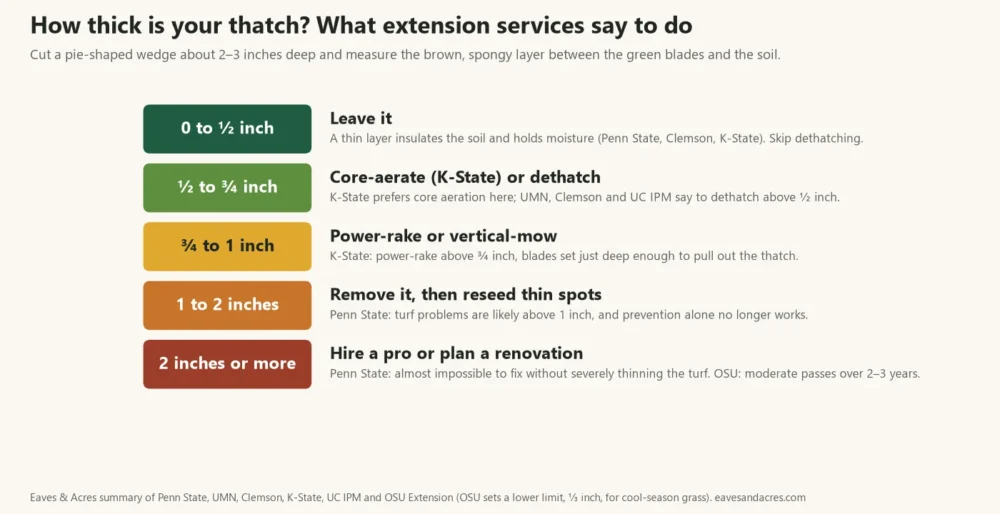
The services agree on the ½-inch trigger and differ on the details.
| Source | Thatch limit | Best time |
|---|---|---|
| Penn State | ½ inch or less is fine; problems likely above 1 inch | Cool-season: late summer to early fall |
| University of Minnesota | Act above ½ inch | Mid-August through September; vertical mowing late August to early October |
| Clemson | Dethatch above ½ inch | Cool-season: late summer to early fall. Warm-season: after spring green-up or in early summer |
| Kansas State | Core-aerate at ½ to ¾ inch; power-rake above ¾ inch | Warm-season: June through July. Cool-season: usually fall |
| Oklahoma State | Limit ⅓ inch cool-season, ½ inch warm-season | Cool-season: late September to mid-October. Warm-season: February to March, before green-up |
| UC IPM (California) | Dethatch above ½ inch | Both types: mid-to-late spring or early fall |
Grass type decides how often. Bermudagrass, bentgrass and Kentucky bluegrass can need dethatching yearly; tall fescue and perennial ryegrass may go several years.8 Overfeeding and acid soil (pH 5.5 or lower) speed thatch buildup, so check our guides to fertilizing and liming.2
The best time to dethatch: your grass type decides
Dethatching injures turf, so every source says to do it while the grass is growing hard and can heal. Not sure which grass you have? See cool-season vs. warm-season grass. For cool-season lawns, Penn State is direct:
Remove thatch from cool-season turfgrass stands during late summer/early fall.
Minnesota’s lawn calendar lists dethatching from mid-August through September.4 Fall also means fewer weeds: Minnesota notes that few weed seeds germinate from late August to early October,3 and Penn State says weeds are less likely to move in than after spring dethatching.2 Spring is the backup, and it overlaps crabgrass season, so check our pre-emergent dates first.
Warm-season lawns run on the opposite calendar. Kansas State puts the window in summer:
For warm-season grasses that time is June through July.
Clemson says after green-up or in early summer, and to avoid hot, dry periods.5 Oklahoma State is the outlier, advising February and March before green-up.7 Most services wait for growth, so treat that as a local exception. For your green-up date, see our Bermuda green-up guide.
Your dethatching window, city by city
We worked from temperature, not months. Cool-season grass grows best at daytime highs of 60–75°F and warm-season grass at 80–95°F, according to University of Tennessee and NC State Extension.9,10 And a dethatched lawn needs time to heal: Clemson asks for at least four weeks of good growing weather after aeration,11 and we apply the same margin to dethatching (our assumption, since both hurt the turf). For each city we took the normal daily high at the nearest NOAA station.1
Cool-season lawns: last fall day and spring backup
The fall deadline is 28 days before normal highs fall below 60°F. The spring window runs while highs sit between 60°F and 75°F: 38 to 56 days in these cities.

| City (ZIP) | Spring window (highs 60–75°F) | Last day in fall |
|---|---|---|
| Fargo, ND (58102) | Apr 29 to Jun 6 | Sep 11 |
| Minneapolis, MN (55401) | Apr 27 to Jun 5 | Sep 11 |
| State College, PA (16801) | Apr 19 to Jun 8 | Sep 20 |
| Madison, WI (53703) | Apr 23 to Jun 5 | Sep 21 |
| Detroit, MI (48201) | Apr 23 to Jun 3 | Sep 22 |
| Boston, MA (02108) | Apr 27 to Jun 13 | Sep 25 |
| Chicago, IL (60601) | Apr 17 to May 29 | Sep 26 |
| Columbus, OH (43215) | Apr 7 to May 20 | Oct 2 |
| New York, NY (10001) | Apr 12 to May 30 | Oct 2 |
| Manhattan, KS (66502) | Mar 28 to May 14 | Oct 8 |
| Denver, CO (80202) | Mar 27 to May 22 | Oct 9 |
| Washington, DC (20001) | Mar 27 to May 10 | Oct 15 |
| Oklahoma City, OK (73102) | Mar 7 to May 1 | Oct 22 |
| Nashville, TN (37201) | Mar 11 to Apr 28 | Oct 24 |
Warm-season lawns: the outer window
The window opens when normal highs reach 80°F and closes 28 days before they fall back below it. K-State’s June–July slot sits inside it.

| City (ZIP) | Normal highs reach 80°F | Last day |
|---|---|---|
| Manhattan, KS (66502) | May 29 | Aug 23 |
| Charlotte, NC (28202) | May 16 | Aug 28 |
| Oklahoma City, OK (73102) | May 20 | Aug 30 |
| Nashville, TN (37201) | May 17 | Aug 30 |
| Charleston, SC (29401) | May 22 | Aug 31 |
| Atlanta, GA (30303) | May 12 | Sep 1 |
| Birmingham, AL (35203) | May 8 | Sep 6 |
| Dallas, TX (75201) | Apr 27 | Sep 17 |
| Columbia, SC (29201) | Apr 14 | Sep 17 |
| Jacksonville, FL (32202) | Apr 14 | Sep 24 |
| Austin, TX (78701) | Apr 15 | Sep 26 |
How the dates compare with extension calendars
| Place | Our estimate | Extension window |
|---|---|---|
| Minneapolis, MN (cool-season) | Until Sep 11 | Mid-August through September (UMN) |
| State College, PA (cool-season) | Until Sep 20 | Late summer to early fall (Penn State) |
| Oklahoma City, OK (cool-season) | Until Oct 22 | Late September to mid-October (OSU) |
| Manhattan, KS (warm-season) | May 29 – Aug 23 | June through July (K-State) |
| Columbia, SC (warm-season) | Apr 14 – Sep 17 | After green-up or early summer (Clemson) |
Our end dates run up to three weeks past the published ones (Manhattan, KS), so treat them as limits, not targets. Coastal and mountain stations are the weak spot: let green-up open the warm-season window.
Conditions that decide the day
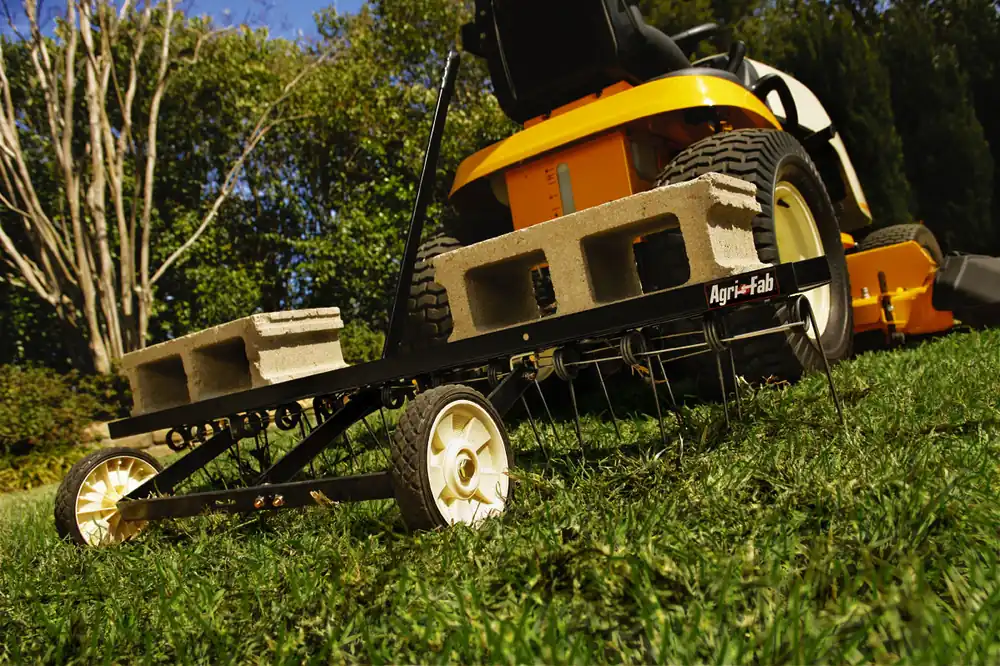
Do not dethatch weak turf or turf under heat or drought stress, Penn State warns.2 Rake or power-rake small jobs; for a vertical mower, space the blades 1 to 2 inches apart for Kentucky bluegrass, Bermuda and zoysia, and 2 to 3 inches for centipede and St. Augustine, which Clemson says to mow in one direction only.5 Minnesota advises against mower-mounted “power rake” attachments.3 Try the machine first on a low-visibility patch and set the blades high: removing too much can severely thin the stand.2

Afterwards, rake up the debris and water thoroughly.5 Clemson then adds 1 pound of nitrogen per 1,000 square feet a week later; Minnesota suggests ½ to ¾ pound.5,3 Follow your fertilizer label and reseed thin spots, the step Penn State expects above 2 inches of thatch.2
 Related guideWhen to Aerate Your Lawn: Dates by Grass Type and City
Dethatching or aerating? Often it is the other one
Between ½ and ¾ inch of thatch, K-State prefers core aeration, and Penn State calls regular core aeration a preventive practice for thatch control.6,2 Penn State also pairs late-summer thatch removal with aeration, fertilizing and seeding.2 For dates, see when to aerate and the last safe day to overseed.
Frequently asked questions
September for most cool-season lawns in the North; Minnesota’s lawn calendar says mid-August through September. For warm-season lawns, K-State says June through July. Tables 2 and 3 give dates for 22 cities.
No. Dethatch while the grass is growing hard and can recover. Penn State says not to dethatch weak turf or turf under heat or drought stress, and Clemson says to avoid hot, dry periods. Oklahoma State, which suggests February to March for warm-season lawns, is the exception.
When the thatch layer is ½ inch or less: a thin layer insulates the soil and holds moisture (Penn State, Clemson, K-State). Also skip it when the lawn is stressed by heat or drought.
Only when thatch builds past the limit. UC IPM says Bermudagrass, bentgrass and Kentucky bluegrass may need it yearly, while tall fescue and perennial ryegrass may need it only every few years. Measure first each year.
Fall for cool-season lawns (Penn State, Minnesota), with spring as the backup. Warm-season lawns do best from spring green-up through early summer (Clemson, K-State).
For cool-season lawns, Penn State says late-summer or early-fall thatch removal can go with aeration, fertilizing and seeding. Seed has its own deadline, so check the last safe day to overseed as well.
Sources
- 1.U.S. Climate Normals 1991–2020. NOAA National Centers for Environmental Information, 2021. Used for: normal daily highs for every city in Tables 2–4 Back to text
- 2.Managing Thatch in Lawns, Peter Landschoot. Penn State Extension, 2025. Used for: thatch limits, culprits, late summer/early fall for cool-season, weeds, equipment, 2-inch thatch, stress warning Back to text
- 3.How to control thatch in your lawn, Sam Bauer, Deborah Brown and Don Taylor. University of Minnesota Extension, 2024. Used for: ½ inch trigger, 2-inch wedge, late August to early October, few weed seeds, power-rake attachments, light nitrogen Back to text
- 4.Lawn care calendar. University of Minnesota Extension, 2024. Used for: dethatching mid-August through September Back to text
- 5.Controlling Thatch in Lawns (HGIC 2360), Nancy Doubrava. Clemson Cooperative Extension, Home & Garden Information Center, 2018. Used for: ½ inch trigger, timing by grass type, avoid hot dry periods, blade spacing, aftercare Back to text
- 6.Got Thatch? Ward Upham. Kansas State University Research and Extension, 2019. Used for: warm-season June through July, ½ to ¾ inch core aeration, over ¾ inch power-raking Back to text
- 7.Thatch Management in Lawns (HLA-6604), Dennis L. Martin. Oklahoma State University Extension, 2017. Used for: ⅓ and ½ inch limits, warm-season February to March, cool-season late September to mid-October Back to text
- 8.UC Healthy Lawns: Dethatching, When to dethatch. University of California Statewide IPM Program, accessed 2026. Used for: ½ inch trigger, 3-inch sample, mid-to-late spring or early fall, how often by grass Back to text
- 9.Chapter 10: Turfgrass Management in Tennessee. University of Tennessee Extension Master Gardener, accessed 2026. Used for: best daytime air temperatures: warm-season 80–95°F, cool-season 60–75°F Back to text
- 10.Turfgrasses. NC State Extension (TurfFiles), 2025. Used for: optimum growth temperatures, 60–75°F and 80–95°F Back to text
- 11.Aerating Lawns (HGIC 1200). Clemson Cooperative Extension, Home & Garden Information Center, 2020. Used for: four weeks of good growing weather to recover (background for the recovery margin) Back to text
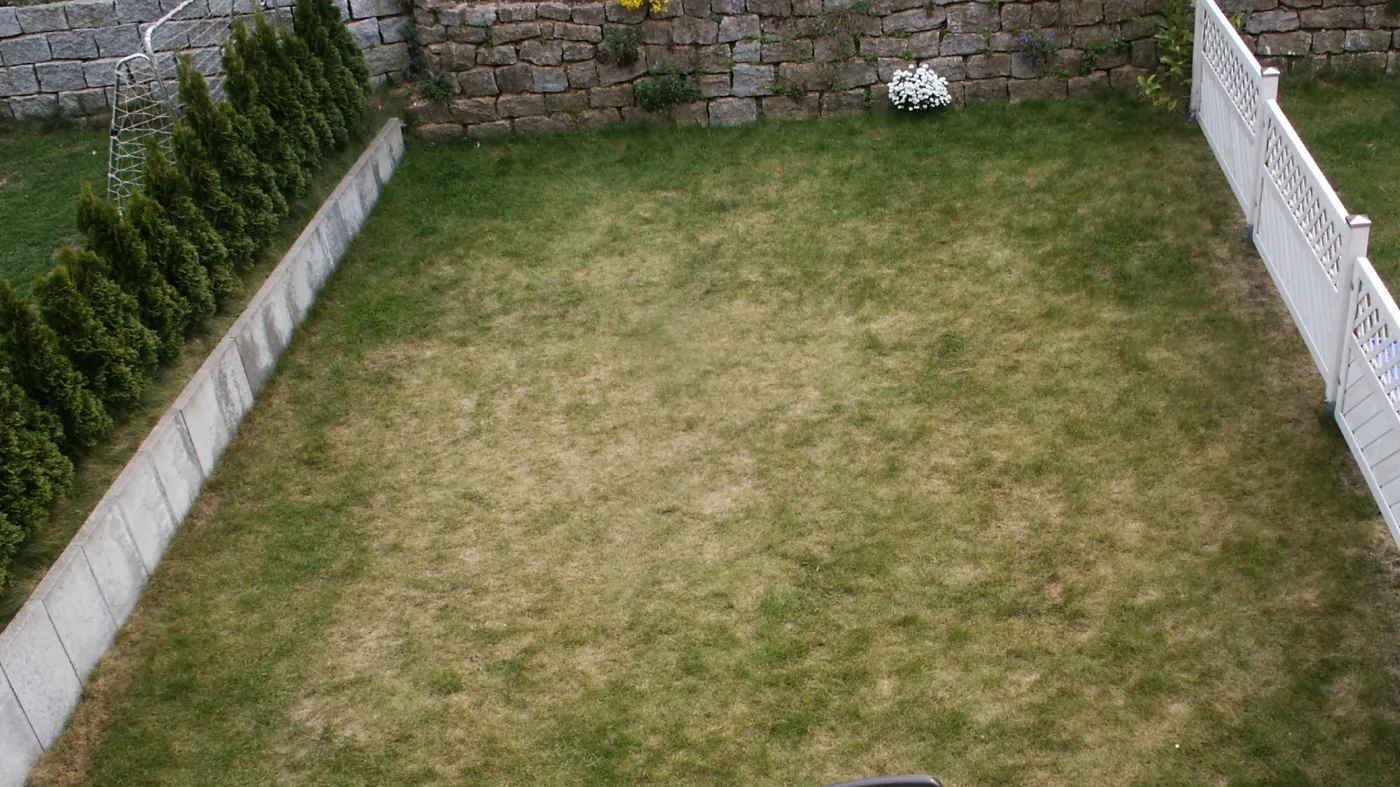
- 12.Lawn before vertical cutting (photo, Rasen vor dem Vertikutieren). Andreas Goerrings (Klugo), Wikimedia Commons, public domain, accessed 2026. Used for: hero photo, cropped and resized
- 13.Agri-Fab tine dethatcher (photo, Dethatcher2). Agri-Fab, Inc., Wikimedia Commons, CC0, accessed 2026. Used for: photo, resized
How this guide was made
- Written by the Yard & Garden Desk and reviewed by the Data & Methodology Desk.
- Data: dethatching windows are estimates for a normal year: normal daily highs interpolated from NOAA NCEI U.S. Climate Normals 1991–2020 for the station nearest each ZIP code, with the best-growth temperatures (60–75°F cool-season, 80–95°F warm-season) from University of Tennessee and NC State Extension and a four-week recovery margin taken from Clemson’s aeration guidance and applied to dethatching by our assumption. Thatch limits and timing come from Penn State, Minnesota, Clemson, K-State, Oklahoma State and UC IPM extension publications. See our methodology.
- AI use: AI tools help us research, draft and check this guide. Every figure is checked against the source cited for it, and calculated figures come from our own code, described on the methodology page.
- Spotted an error? Tell us — the form opens with this page’s address filled in.
Change log
- Oct 13, 2026Published. Thatch limits and timing from Penn State, Minnesota, Clemson, K-State, Oklahoma State and UC IPM; city windows computed from NOAA 1991–2020 normals with the University of Tennessee and NC State growth temperatures and a four-week recovery margin, checked against Minnesota, Penn State, Oklahoma State, K-State and Clemson windows.
Covers lawns, gardens, frost and planting. We write the guides and maintain the tools that tell you when to seed, feed and plant for your ZIP.
Keep reading

When to Plant Zoysia: Seed, Plugs and Sprigs by City
Plant zoysia plugs and sprigs from 65°F soil to early July and seed about 11 days later. Dates for 28 cities, tested against seven extension calendars.

How Often to Water New Grass Seed: Schedule by Stage and Weather
Two light waterings a day sits inside every extension range that gives a count, up to four in heat. Ten extension schedules plus NOAA rain and heat for 24 cities.

When to Lay Sod: Best Dates by Grass Type and City
Lay cool-season sod in early fall and warm-season sod from 55°F soil to one month before the first frost. Dates for 25 cities, checked against extension guides.
Seasonal reminders for your ZIP
Get a short email when it’s time to overseed, start seeds, open the pool or service your furnace — timed to your climate.