
When to Plant Spinach: Sow Early, Beat the Long Days
Spinach shrugs off hard frost but bolts when days lengthen and the air warms. We tested the published planting rules against NOAA normals for 37,563 ZIP codes, added the date daylight reaches 14 hours, and set ten published local windows beside them.
- Last reviewed Oct 14, 2026
- 18 cited sources
- 10 min read

Set your ZIP to see dates for your area.
- 1Sow spinach as soon as the soil can be worked, usually 4 to 6 weeks before your median last frost.
- 2Stop spring sowing about 42 days before normal highs reach 80°F: March 17 to May 2 in Chicago, January 5 to March 15 in Dallas.
- 3Day length is the other clock: daylight reaches 14 hours before highs hit 80°F in 76.1% of ZIP codes, so the earliest sowing matters most.
- 4For fall, wait until the air mean drops below 70°F, then finish 42 days before the first frost; eight weeks before frost is still too warm in 67.6% of ZIP codes.
- 5Seedlings survive 15 to 20°F, and the coldest month’s average low is 20°F or warmer in 59.1% of ZIP codes, so overwintering mulched plants is worth trying.
Sow spinach as soon as the soil can be worked, usually 4 to 6 weeks before your average last spring frost, and stop about six weeks before daytime highs normally reach 80°F. Sow again once late-summer air cools below 70°F. In Chicago that is March 17 to May 2 in spring and September 4 to 24 for fall; in Dallas it is January 5 to March 15 and October 13 to 18.
Spinach also bolts on day length, which most guides skip. We tested the published rules against NOAA 1991–2020 normals1 for 37,563 lower-48 ZIP codes and added the date daylight reaches 14 hours. Air temperature stands in for soil temperature, because our NOAA data has no soil readings.
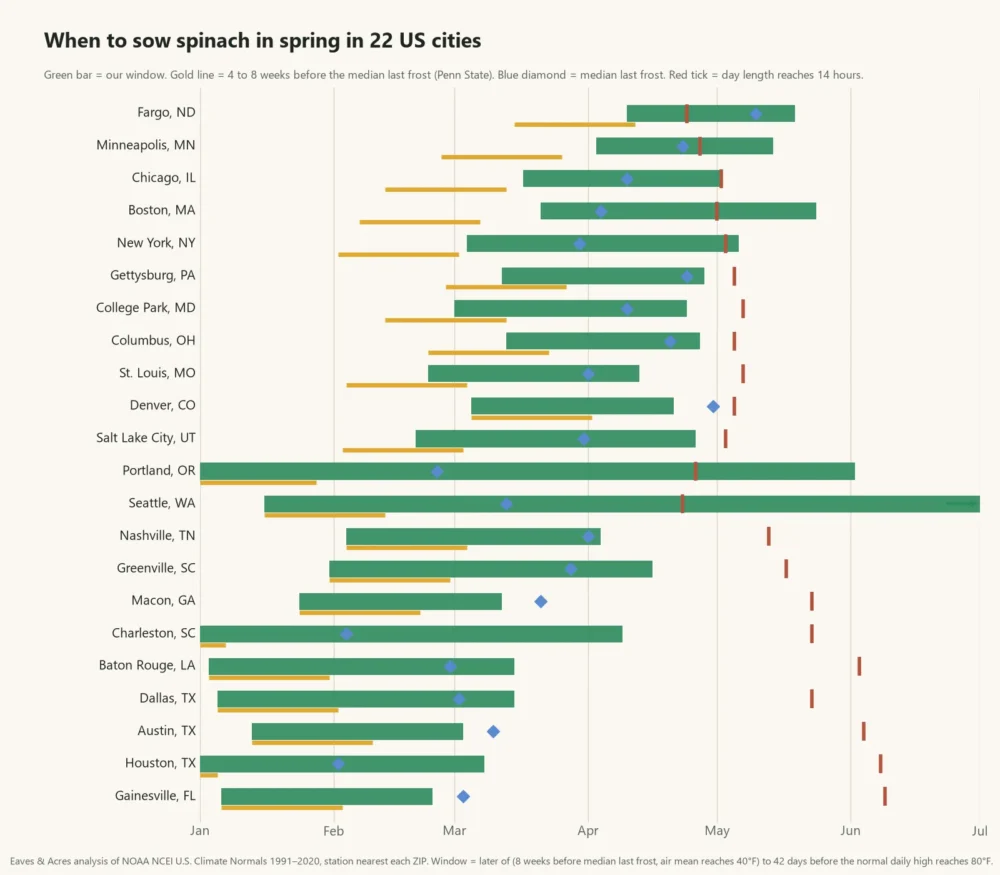
Spring spinach planting dates for 22 cities
Penn State Extension says to plant 4 to 8 weeks before the average last frost,2 Bonnie Plants says 4 to 6,11 Colorado State 2 to 46 and Utah State 2 to 3.4 Each window below opens on the later of two dates: eight weeks before the median last frost, or the day the normal daily mean air temperature reaches 40°F, the soil minimum Colorado State and Utah State give.6,4 It closes 42 days before normal daily highs reach 80°F: the Old Farmer’s Almanac says spinach needs six weeks of cool weather from seeding to harvest,3 and Penn State says it wants to bolt at 80°F.2
| City (ZIP) | Median last frost | Penn State window (4–8 weeks before) | Our window | Days open | Daylight reaches 14 h |
|---|---|---|---|---|---|
| Fargo, ND (58102) | May 10 | Mar 15 – Apr 12 | Apr 10 – May 19 | 39 | Apr 24 |
| Minneapolis, MN (55401) | Apr 23 | Feb 26 – Mar 26 | Apr 3 – May 14 | 41 | Apr 27 |
| Chicago, IL (60601) | Apr 10 | Feb 13 – Mar 13 | Mar 17 – May 2 | 46 | May 2 |
| Boston, MA (02108) | Apr 4 | Feb 7 – Mar 7 | Mar 21 – May 24 | 64 | May 1 |
| New York, NY (10001) | Mar 30 | Feb 2 – Mar 2 | Mar 4 – May 6 | 63 | May 3 |
| Gettysburg, PA (17325) | Apr 24 | Feb 27 – Mar 27 | Mar 12 – Apr 28 | 47 | May 5 |
| College Park, MD (20742) | Apr 10 | Feb 13 – Mar 13 | Mar 1 – Apr 24 | 54 | May 7 |
| Columbus, OH (43215) | Apr 20 | Feb 23 – Mar 23 | Mar 13 – Apr 27 | 45 | May 5 |
| St. Louis, MO (63101) | Apr 1 | Feb 4 – Mar 4 | Feb 23 – Apr 13 | 49 | May 7 |
| Denver, CO (80202) | Apr 30 | Mar 5 – Apr 2 | Mar 5 – Apr 21 | 47 | May 5 |
| Salt Lake City, UT (84101) | Mar 31 | Feb 3 – Mar 3 | Feb 20 – Apr 26 | 65 | May 3 |
| Portland, OR (97201) | Feb 25 | Dec 31 – Jan 28 | Dec 31 – Jun 2 | 153 | Apr 26 |
| Seattle, WA (98101) | Mar 13 | Jan 16 – Feb 13 | Jan 16 – No 80°F limit | No limit | Apr 23 |
| Nashville, TN (37201) | Apr 1 | Feb 4 – Mar 4 | Feb 4 – Apr 4 | 59 | May 13 |
| Greenville, SC (29601) | Mar 28 | Jan 31 – Feb 28 | Jan 31 – Apr 16 | 75 | May 17 |
| Macon, GA (31201) | Mar 21 | Jan 24 – Feb 21 | Jan 24 – Mar 12 | 47 | May 23 |
| Charleston, SC (29401) | Feb 4 | Dec 10 – Jan 7 | Dec 10 – Apr 9 | 120 | May 23 |
| Baton Rouge, LA (70802) | Feb 28 | Jan 3 – Jan 31 | Jan 3 – Mar 15 | 71 | Jun 3 |
| Dallas, TX (75201) | Mar 2 | Jan 5 – Feb 2 | Jan 5 – Mar 15 | 69 | May 23 |
| Austin, TX (78701) | Mar 10 | Jan 13 – Feb 10 | Jan 13 – Mar 3 | 49 | Jun 4 |
| Houston, TX (77002) | Feb 2 | Dec 8 – Jan 5 | Dec 8 – Mar 8 | 90 | Jun 8 |
| Gainesville, FL (32601) | Mar 3 | Jan 6 – Feb 3 | Jan 6 – Feb 24 | 49 | Jun 9 |
The median window is 52 days, and 98.6% of ZIP codes with 80°F highs get at least 30. Fargo has 39 (April 10 to May 19). Gulf and Atlantic coast gardens start in December: Houston from December 8 to March 8, Charleston from December 10 to April 9.
Cold: how early is too early
Across the lower 48, eight weeks before the median last frost falls before the normal air mean reaches 40°F in 64.3% of ZIP codes; four weeks before does so in only 9.6%. So the outer end of Penn State’s range is too early for most gardens. Frost is not the obstacle: Penn State says young seedlings tolerate 15 to 20°F.2
Day length and heat: why spring spinach ends early
Day length is the first clock, heat the second. The Almanac ties bolting to about 14 hours of daylight or more, with warmth,3 and Penn State calls spinach day-length sensitive:2
It will bolt in June even if the temperatures are cool.
Daylight reaches 14 hours on April 27 in Minneapolis, May 2 in Chicago and May 23 in Macon, a date set only by latitude.17 Where highs reach 80°F (91% of ZIP codes), daylight arrives first in 76.1%, and 42 days after the median last frost the days are already 14 hours or longer in 74.8%. Sowing on the last-frost date also runs past the 80°F deadline in 19.8% of those (4.5% two weeks before, 1.0% four weeks before). The earliest sowing matters most.
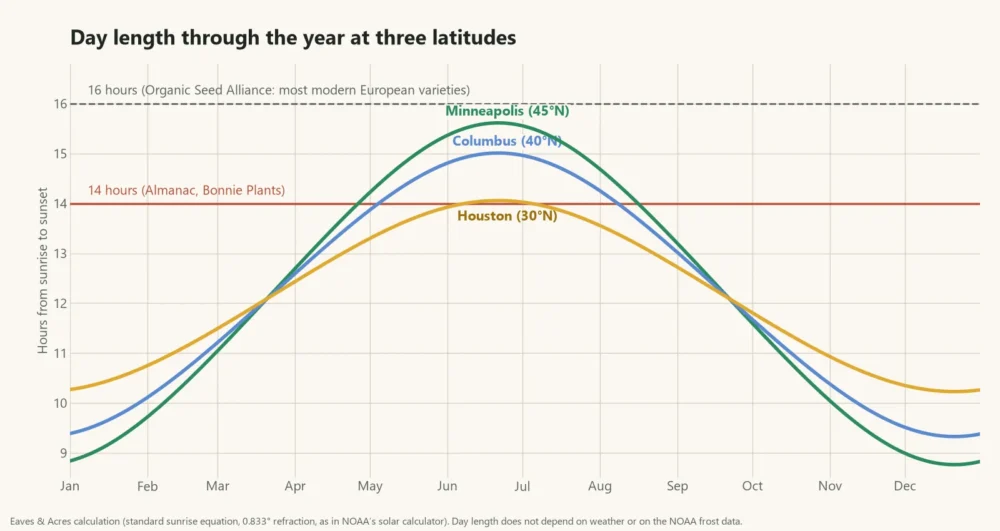
The Organic Seed Alliance says most modern European varieties do not initiate bolting until day length reaches close to 16 hours;13 98.4% of lower-48 ZIP codes never get that long a day. Clemson stresses slow-bolting varieties for spring and overwintered crops.5
How hot is too hot: ten temperature rules compared
Every source agrees spinach is a cool-season crop, but the germination ceiling runs from 68°F to 100°F. Maryland rates days to maturity at 28 to 55.7
| Source | Germination (soil) | Heat and bolting | Cold |
|---|---|---|---|
| Penn State Extension | Best at 45–68°F; seed sprouts in 7–10 days | Shade cloth at 70°F; wants to bolt at 80°F; day-length sensitive | Seedlings tolerate 15–20°F |
| Colorado State Extension | 40°F minimum; 70°F optimum; 70°F maximum; 6–14 days | — | Hardy; 2–4 weeks before last frost |
| Utah State Extension | Sow after soil reaches 40°F; best 55–65°F; above 80°F reduces germination | Grows best at or below 75°F; bitter above 75°F | 32°F does not seriously damage young plants |
| Clemson Extension | Optimum 70°F; above 85°F inhibits | Long days and high temperatures cause bolting | Survives 20°F without injury |
| Old Farmer’s Almanac | Spring: ground at 40°F. Fall: soil 70°F or cooler | About 14 hours of daylight or more, with warmth | Survives 15°F |
| Bonnie Plants | — | Bolts when days exceed 14 hours; prefers 35–75°F | Teens to low 20s°F once established |
| Texas A&M AgriLife | Seed-zone soil below 100°F | Optimum 65–75°F days, 40–45°F nights | Low 20s°F |
| University of Maryland | Sow after soil reaches 45°F; 28–55 days to maturity | Bolts as day length and temperature rise | Hardy; heavy frosts in spring and fall |
| University of Illinois | Chill seed 1–2 weeks for summer or fall sowing | Bolts quickly in long late-spring days | Seedlings survive winter in the South |
| Sustainable Market Farming | Wait for 68°F soil, or freeze seed two weeks | — | — |
Fall spinach planting dates: wait for the cool, then count back
The Almanac says to sow about two months before the first hard frost,12 and Penn State and Bonnie say 6 to 8 weeks before the first frost.2,11 A count back from frost ignores summer. Among ZIP codes that reach a 70°F summer mean, eight weeks before the median first frost is still 70°F or warmer in 67.6%, and six weeks before in 18.5%. The Almanac also says to sow in fall when soil is 70°F or cooler.3 Pam Dawling, who writes the Sustainable Market Farming blog from central Virginia, puts it simply:15
Spinach does not germinate in hot soil!
Our fall window opens on the first day after the summer peak that the normal air mean falls below 70°F, an air stand-in for the 68–70°F ceilings from Penn State and Colorado State, and closes 42 days before the median first 32°F frost. Illinois Extension suggests chilling seed in the refrigerator for 1 or 2 weeks before fall planting.8 About 15% of ZIP codes never reach a 70°F mean and need no gate.
| City (ZIP) | Median first frost (32°F) | Almanac and Penn State (6–8 weeks before) | Window opens | Last sow (42 days) | Window | Last sow, Utah State (36 days) |
|---|---|---|---|---|---|---|
| Minneapolis, MN (55401) | Oct 16 | Aug 21 – Sep 4 | Aug 19 | Sep 4 | 16 days | Sep 10 |
| Chicago, IL (60601) | Nov 5 | Sep 10 – Sep 24 | Sep 4 | Sep 24 | 20 days | Sep 30 |
| Boston, MA (02108) | Nov 9 | Sep 14 – Sep 28 | Aug 27 | Sep 28 | 32 days | Oct 4 |
| New York, NY (10001) | Nov 20 | Sep 25 – Oct 9 | Sep 12 | Oct 9 | 27 days | Oct 15 |
| Gettysburg, PA (17325) | Oct 21 | Aug 26 – Sep 9 | Aug 28 | Sep 9 | 12 days | Sep 15 |
| Dover, DE (19901) | Nov 4 | Sep 9 – Sep 23 | Sep 16 | Sep 23 | 7 days | Sep 29 |
| Columbus, OH (43215) | Oct 24 | Aug 29 – Sep 12 | Aug 30 | Sep 12 | 13 days | Sep 18 |
| Denver, CO (80202) | Oct 12 | Aug 17 – Aug 31 | Sep 2 | Aug 31 | None (2 days short) | Sep 6 |
| Salt Lake City, UT (84101) | Nov 8 | Sep 13 – Sep 27 | Sep 12 | Sep 27 | 15 days | Oct 3 |
| Nashville, TN (37201) | Oct 31 | Sep 5 – Sep 19 | Sep 19 | Sep 19 | 0 days | Sep 25 |
| Greenville, SC (29601) | Nov 7 | Sep 12 – Sep 26 | Sep 18 | Sep 26 | 8 days | Oct 2 |
| Macon, GA (31201) | Nov 10 | Sep 15 – Sep 29 | Oct 4 | Sep 29 | None (5 days short) | Oct 5 |
| Charleston, SC (29401) | Dec 30 | Nov 4 – Nov 18 | Oct 13 | Nov 18 | 36 days | Nov 24 |
| Baton Rouge, LA (70802) | Nov 26 | Oct 1 – Oct 15 | Oct 11 | Oct 15 | 4 days | Oct 21 |
| Dallas, TX (75201) | Nov 29 | Oct 4 – Oct 18 | Oct 13 | Oct 18 | 5 days | Oct 24 |
| Austin, TX (78701) | Nov 17 | Sep 22 – Oct 6 | Oct 20 | Oct 6 | None (14 days short) | Oct 12 |
| Houston, TX (77002) | Dec 25 | Oct 30 – Nov 13 | Oct 23 | Nov 13 | 21 days | Nov 19 |
| Gainesville, FL (32601) | Dec 2 | Oct 7 – Oct 21 | Oct 20 | Oct 21 | 1 days | Oct 27 |
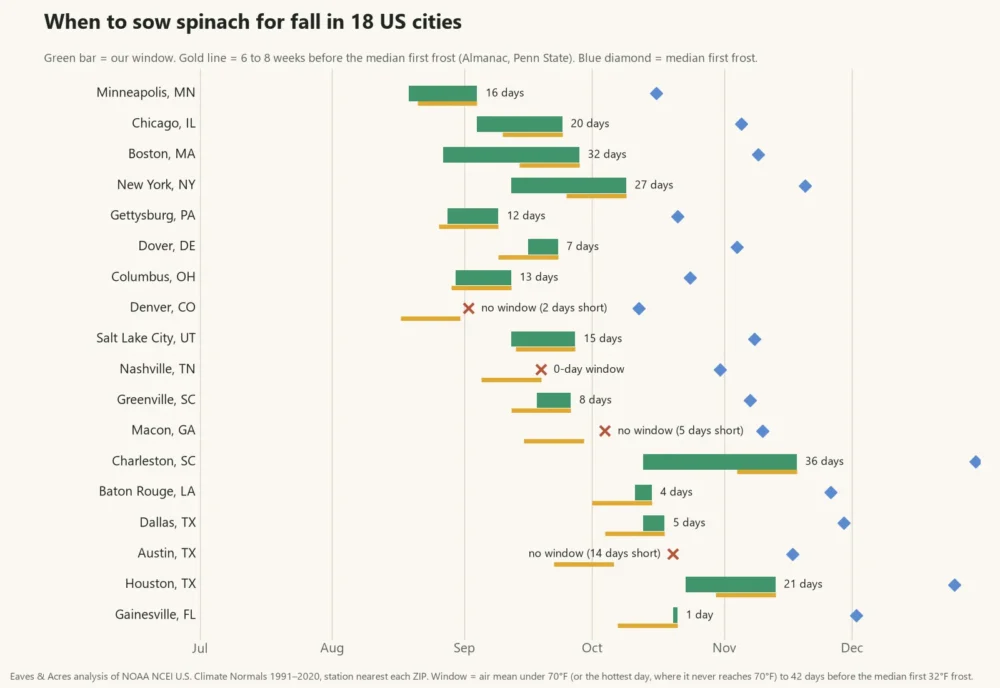
The median fall window is 8 days, and 18.5% of ZIP codes have none, because the air cools only just before the six-week deadline. Utah State is more generous: plant 50 to 75 days before maturity, with maturity 1 to 2 weeks after first frost.4 That puts the last sowing 36 days before first frost, which gives a median of 14 days and 2.9% with none.
Overwintering spinach: sow small, mulch, wait
Utah State says:4
Spinach will easily over-winter for an early spring crop
That holds if the plant has 4 to 5 true leaves formed late in the year and is heavily mulched.4 A Fairfax County Master Gardener who overwinters spinach in northern Virginia sows around early October, says two to six leaves by Thanksgiving is enough, and begins harvesting in late February or early March.14
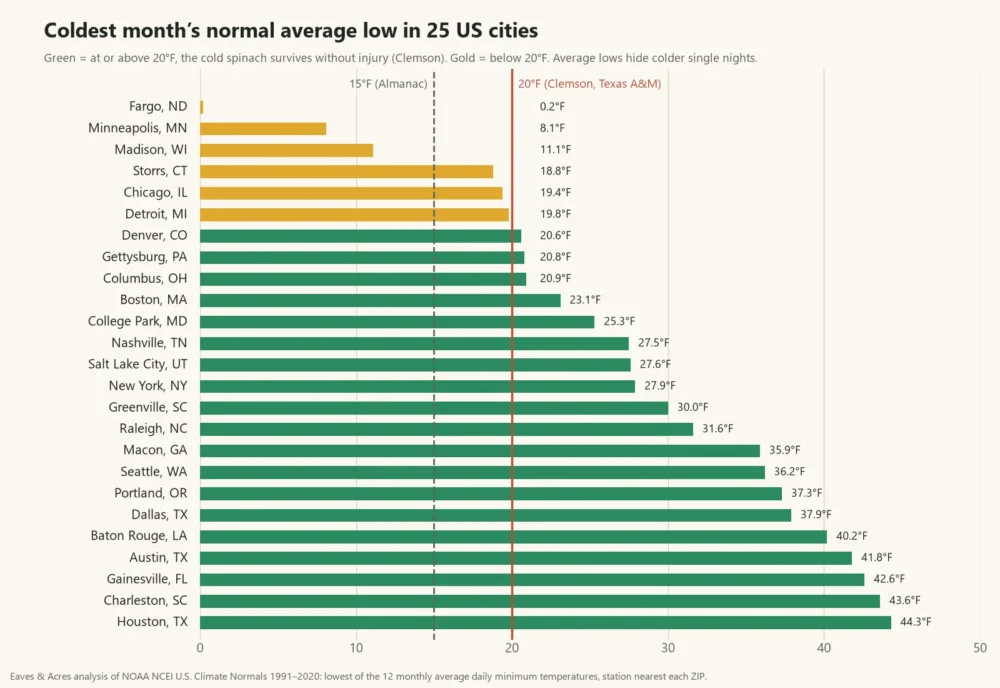
Across the lower 48, the coldest month’s normal average low is 20°F or warmer in 59.1% of ZIP codes, and 15°F or warmer, the Almanac’s limit,3 in 78.0%. Single nights run colder, so treat it as a sign, not a guarantee.
How published local calendars compare
Six places have a published window we could convert to dates, ten windows in all. Penn State’s fall count in Gettysburg nearly matches ours. In the South the published fall calendars open earlier than our heat gate: Clemson’s Piedmont window by 48 days, UGA’s middle Georgia window by 33 days (ours is empty there).5,9 Clemson’s coastal window ends October 15; ours runs to November 18.
| Place | Published guidance | Dates it gives | Our window | Comparison |
|---|---|---|---|---|
| Gettysburg, PA (spring) | Penn State Extension: 4 to 8 weeks before the average last frost | Feb 27 to Mar 27 | Mar 12 to Apr 28 | Ours opens 13 days later; ours ends 32 days after theirs |
| Denver, CO (spring) | Colorado State Extension: 2 to 4 weeks before the average last frost | Apr 2 to Apr 16 | Mar 5 to Apr 21 | Published dates sit inside ours |
| Salt Lake City, UT (spring) | Utah State Extension: 2 to 3 weeks before the last frost | Mar 10 to Mar 17 | Feb 20 to Apr 26 | Published dates sit inside ours |
| Greenville, SC (spring) | Clemson HGIC: Piedmont spring | Mar 15 to Apr 15 | Jan 31 to Apr 16 | Published dates sit inside ours |
| Macon, GA (spring) | UGA Extension: middle Georgia spring | Jan 15 to Mar 15 | Jan 24 to Mar 12 | Ours opens 9 days later; theirs ends 3 days after ours |
| Charleston, SC (spring) | Clemson HGIC: Coastal Plain spring | Feb 1 to Apr 1 | Dec 10 to Apr 9 | Published dates sit inside ours |
| Gettysburg, PA (fall) | Penn State Extension: 6 to 8 weeks before the average first frost | Aug 26 to Sep 9 | Aug 28 to Sep 9 | Ours opens 2 days later |
| Greenville, SC (fall) | Clemson HGIC: Piedmont fall | Aug 1 to Sep 30 | Sep 18 to Sep 26 | Ours opens 48 days later; theirs ends 4 days after ours |
| Macon, GA (fall) | UGA Extension: middle Georgia fall | Sep 1 to Oct 15 | Oct 4 to Sep 29 | Our window is empty: the air is still above 70°F when the six-week deadline arrives |
| Charleston, SC (fall) | Clemson HGIC: Coastal Plain fall | Aug 15 to Oct 15 | Oct 13 to Nov 18 | Ours opens 59 days later; ours ends 34 days after theirs |
How we calculated these dates
Daily temperatures are NOAA’s monthly normals placed on the 15th and interpolated, for the station nearest each ZIP code.1 Frost dates are medians for 32°F. Day length uses the standard sunrise equation with 0.833° of refraction, as NOAA’s solar calculator does.17 Day counts and temperature lines come from the sources above, applied to air, not soil. Years vary by weeks.
Next steps
Look up your own dates with our frost date lookup. Spinach shares its early window with carrots, lettuce and peas; see fall vegetable planting dates, frost covers and winter sowing, or all vegetable guides.
Frequently asked questions
As soon as the soil can be worked, usually 4 to 6 weeks before your last frost (Bonnie Plants; Penn State says 4 to 8). Stop about 42 days before daily highs reach 80°F. In Chicago that is March 17 to May 2.
Wait until the air mean drops below 70°F, because spinach seed struggles in hot soil, then finish 6 weeks before the first frost. In Chicago that is September 4 to 24.
In the North it can be: our Minneapolis window closes September 4 and Chicago’s September 24. The Almanac’s fall guide says last sowings come in early September in the North, mid-September in the Midwest and late September in the South.
In the South, yes: our windows run October 13 to 18 in Dallas and October 13 to November 18 in Charleston. Further north an October sowing is for overwintering small plants.
A zone can’t decide it alone: the USDA map is based on the average annual extreme minimum winter temperature, not spring frost, heat or day length. Use your ZIP code’s median last frost and the 80°F heat deadline; Tables 1 and 3 give 22 and 18 cities.
Not in most places. Heat and long days end spring spinach, and the Almanac suggests New Zealand or Malabar spinach for summer. Fall sowings can overwinter under mulch for an early spring crop where winters allow.
Sources
- 1.U.S. Climate Normals 1991–2020. NOAA National Centers for Environmental Information, 2021. Used for: median last- and first-frost dates and monthly temperature normals (average, high, low) for every ZIP code Back to text
- 2.Growing Spinach, A Cool-Season Vegetable. Penn State Extension, 2026. Used for: plant 4 to 8 weeks before the last frost and 6 to 8 before the first; germination best 45 to 68°F; seedlings tolerate 15 to 20°F; bolts at 80°F and by day length Back to text
- 3.How to Grow Spinach: Planting, Growing, and Harvesting Guide, Catherine Boeckmann. The Old Farmer’s Almanac, 2026. Used for: six weeks of cool weather from seeding to harvest; sow when ground reaches 40°F in spring and soil is 70°F or cooler in fall; survives 15°F; bolting with about 14 hours of daylight or more Back to text
- 4.How to Grow Spinach in Your Garden, Dan Drost. Utah State University Extension, 2020. Used for: seed 2 to 3 weeks before last frost; sow after soil reaches 40°F; above 80°F reduces germination; best below 75°F; fall planting 50 to 75 days before maturity; overwintering with 4 to 5 true leaves Back to text
- 5.Spinach (HGIC 1320). Clemson Cooperative Extension Home & Garden Information Center, 2020. Used for: South Carolina planting dates; optimum soil 70°F, inhibited above 85°F; survives 20°F; slow-bolting varieties Back to text
- 6.Cool Season Vegetables. Colorado State University Extension, 2024. Used for: hardy vegetables 2 to 4 weeks before the average last frost; spinach germination 40°F minimum, 70°F optimum and maximum, 6 to 14 days Back to text
- 7.Growing Spinach in a Home Garden. University of Maryland Extension, 2023. Used for: sow after soil reaches 45°F; days to maturity 28 to 55; bolts as day length and temperature increase; overwinters in mild areas Back to text
- 8.Spinach (Home Vegetable Gardening). University of Illinois Extension, n.d. Used for: chill seed 1 to 2 weeks for summer or fall plantings; seedlings survive winter in southern locations; bolts in long days Back to text
- 9.Vegetable Planting Chart (Bulletin 577). University of Georgia Cooperative Extension, 2026. Used for: middle Georgia spinach: 40 to 45 days, January 15 to March 15 and September 1 to October 15 Back to text
- 10.Spinach, Joe Masabni. Texas A&M AgriLife Extension Service, 2011. Used for: optimum 65 to 75°F days and 40 to 45°F nights; withstands low 20s; seed-zone soil below 100°F
- 11.Growing Spinach. Bonnie Plants, n.d. Used for: plant 4 to 6 weeks before last frost and 6 to 8 before first; bolts when days exceed 14 hours; hardy to the teens or low 20s; overwintering in zones 8 and south Back to text
- 12.When to Plant Spinach and Lettuce in the Fall, Celeste Longacre. The Old Farmer’s Almanac, 2026. Used for: plant about 2 months before the expected fall hard frost; last fall planting early September North, mid-September Midwest, late September South Back to text
- 13.Principles and Practices of Organic Spinach Seed Production in the Pacific Northwest. Organic Seed Alliance (Western SARE), n.d. Used for: most modern European varieties do not initiate bolting until day length reaches close to 16 hours Back to text
- 14.Spinach (interview with a Fairfax County Master Gardener). Fairfax County Master Gardener Association, 2020. Used for: sowing around early October to overwinter; two to six leaves by Thanksgiving; harvest from late February or March; hardy to 15°F or less Back to text
- 15.Success with Spinach for Fall, Winter and Spring, Pam Dawling. Sustainable Market Farming, 2023. Used for: spinach does not germinate in hot soil; wait for 68°F soil or chill seed Back to text
- 16.USDA Plant Hardiness Zone Map. USDA Agricultural Research Service, 2023. Used for: zones are based on average annual extreme minimum winter temperature
- 17.Solar Calculation Details. NOAA Global Monitoring Laboratory, n.d. Used for: sunrise and sunset calculation method; 0.833 degrees of atmospheric refraction Back to text
- 18.Photo: Spinach leaves, Nillerdk (CC BY 3.0). Wikimedia Commons, 2008. Used for: hero photo
How this guide was made
- Written by the Yard & Garden Desk and reviewed by the Data & Methodology Desk.
- Data: median last- and first-frost dates and monthly average, high and low temperature normals from NOAA NCEI U.S. Climate Normals 1991–2020 for the station nearest each ZIP code, with daily values interpolated from the monthly normals; day length computed from latitude with the standard sunrise equation; planting rules and published calendars from Penn State, the Old Farmer’s Almanac, Utah State, Clemson, Colorado State, the University of Maryland, the University of Illinois, the University of Georgia, Texas A&M and the Organic Seed Alliance. Air temperature stands in for soil temperature. See our methodology.
- AI use: AI tools help us research, draft and check this guide. Every figure is checked against the source cited for it, and calculated figures come from our own code, described on the methodology page.
- Spotted an error? Tell us — the form opens with this page’s address filled in.
Change log
- Oct 14, 2026Published. Spring sowing windows for 22 cities and fall windows for 18 cities from NOAA 1991–2020 normals, day-length dates computed for each, ten published local windows compared, and the rules tested across 37,563 lower-48 ZIP codes.
Covers lawns, gardens, frost and planting. We write the guides and maintain the tools that tell you when to seed, feed and plant for your ZIP.
Keep reading
When to Plant Pumpkins: Count Back From Halloween, Not Forward From Frost
Sow pumpkins once the soil reaches about 65°F, a median 37 days after the last frost, then count back 90 to 120 days from Halloween or the first frost. Dates for 24 cities.
When to Plant Corn: Match the Date to the Type, Not Just the Frost
Sow standard sweet corn once the soil reaches about 55°F, sugar-enhanced at 60°F and supersweet at 65°F: a median April 25, May 9 and May 25. Dates for 28 spring and 21 fall cities.
When to Harvest Pumpkins: Ripeness Signs and the Freeze Deadline
Pick pumpkins when the rind resists a fingernail and the stem is dry, before a 28°F hard freeze. Median frost and freeze dates for 23 cities, plus curing and storage.
Seasonal reminders for your ZIP
Get a short email when it’s time to overseed, start seeds, open the pool or service your furnace — timed to your climate.