
When to Plant Lettuce: Sow Early, Finish Before the Heat
Lettuce likes cool weather and shrugs off light frost, but heat ends the crop fast. We tested the common planting rules against NOAA normals for 37,563 ZIP codes and set nine published local windows beside them.
- Last reviewed Oct 13, 2026
- 22 cited sources
- 12 min read

Set your ZIP to see dates for your area.
- 1Sow lettuce as soon as the soil can be worked, 2 to 4 weeks before your median last frost (Old Farmer’s Almanac); Utah State says 2 to 3.
- 2Stop spring sowing about 50 days before the normal air mean reaches 70°F: March 17 to April 22 in Chicago, February 2 to March 7 in Dallas.
- 3The frost count holds up in spring but not in fall: eight weeks before the first frost is still 70°F or warmer in 67.6% of the ZIP codes that reach a 70°F summer mean.
- 4For fall, wait until the air mean drops below 75°F, then finish 64 days before your first 28°F freeze: August 7 to September 12 in Chicago.
- 5Sources put the germination ceiling at 70°F to 95°F; sow after the soil cools below about 80°F, or use primed seed.
Sow lettuce as soon as the soil can be worked, about 2 to 4 weeks before your average last spring frost, and stop about 50 days before your normal daily temperature reaches 70°F. Sow again once late-summer heat breaks, and finish about nine weeks before your first hard freeze. In Chicago that is March 17 to April 22 in spring and August 7 to September 12 for fall; in Dallas it is February 2 to March 7 and September 29 to October 9.
Most guides stop at a count of weeks before frost. We tested those counts against NOAA 1991–2020 normals1 for 37,563 lower-48 ZIP codes, set nine published local windows beside them, and built dates for 22 cities in spring and 18 in fall. Everything below uses air temperature as a stand-in for soil temperature, because our NOAA data has no soil readings.
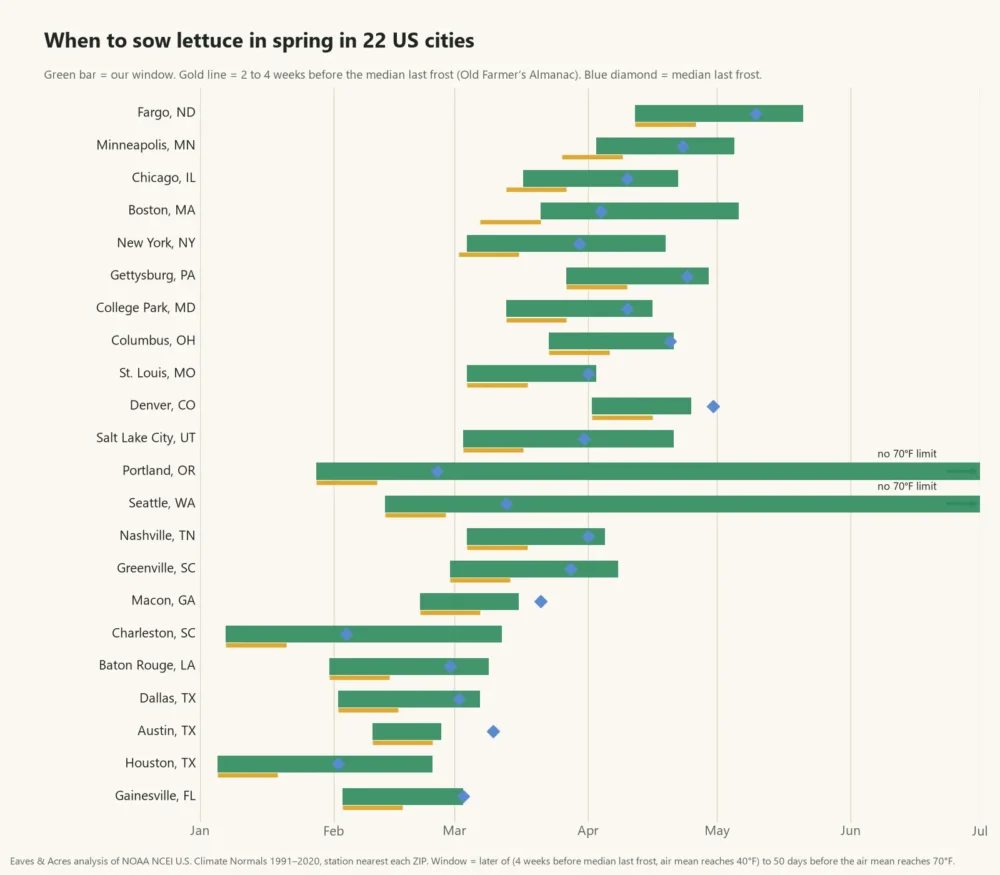
Spring lettuce planting dates for 22 cities
Published counts cluster around 2 to 4 weeks before the last frost: the Old Farmer’s Almanac says to direct-seed then,2 Colorado State lists lettuce among hardy crops that can go in 2 to 4 weeks ahead,11 and Utah State says 2 to 3.6 Each window below opens on the later of two dates: four weeks before the median last frost, or the day the normal daily mean air temperature reaches 40°F, the soil floor named by Utah State,6 Texas A&M13 and Illinois Extension.5
It closes 50 days before the daily mean reaches 70°F. Illinois Extension says leaf lettuce reaches full size in 50 to 60 days4 and gives the comfort zone:
thrives when the average daily temperature is between 60 and 70°F
| City (ZIP) | Median last frost | Almanac window (2–4 weeks before) | Our window | Days open |
|---|---|---|---|---|
| Fargo, ND (58102) | May 10 | Apr 12 – Apr 26 | Apr 12 – May 21 | 39 |
| Minneapolis, MN (55401) | Apr 23 | Mar 26 – Apr 9 | Apr 3 – May 5 | 32 |
| Chicago, IL (60601) | Apr 10 | Mar 13 – Mar 27 | Mar 17 – Apr 22 | 36 |
| Boston, MA (02108) | Apr 4 | Mar 7 – Mar 21 | Mar 21 – May 6 | 46 |
| New York, NY (10001) | Mar 30 | Mar 2 – Mar 16 | Mar 4 – Apr 19 | 46 |
| Gettysburg, PA (17325) | Apr 24 | Mar 27 – Apr 10 | Mar 27 – Apr 29 | 33 |
| College Park, MD (20742) | Apr 10 | Mar 13 – Mar 27 | Mar 13 – Apr 16 | 34 |
| Columbus, OH (43215) | Apr 20 | Mar 23 – Apr 6 | Mar 23 – Apr 21 | 29 |
| St. Louis, MO (63101) | Apr 1 | Mar 4 – Mar 18 | Mar 4 – Apr 3 | 30 |
| Denver, CO (80202) | Apr 30 | Apr 2 – Apr 16 | Apr 2 – Apr 25 | 23 |
| Salt Lake City, UT (84101) | Mar 31 | Mar 3 – Mar 17 | Mar 3 – Apr 21 | 49 |
| Portland, OR (97201) | Feb 25 | Jan 28 – Feb 11 | Jan 28 – No 70°F limit | No limit |
| Seattle, WA (98101) | Mar 13 | Feb 13 – Feb 27 | Feb 13 – No 70°F limit | No limit |
| Nashville, TN (37201) | Apr 1 | Mar 4 – Mar 18 | Mar 4 – Apr 5 | 32 |
| Greenville, SC (29601) | Mar 28 | Feb 28 – Mar 14 | Feb 28 – Apr 8 | 39 |
| Macon, GA (31201) | Mar 21 | Feb 21 – Mar 7 | Feb 21 – Mar 16 | 23 |
| Charleston, SC (29401) | Feb 4 | Jan 7 – Jan 21 | Jan 7 – Mar 12 | 64 |
| Baton Rouge, LA (70802) | Feb 28 | Jan 31 – Feb 14 | Jan 31 – Mar 9 | 37 |
| Dallas, TX (75201) | Mar 2 | Feb 2 – Feb 16 | Feb 2 – Mar 7 | 33 |
| Austin, TX (78701) | Mar 10 | Feb 10 – Feb 24 | Feb 10 – Feb 26 | 16 |
| Houston, TX (77002) | Feb 2 | Jan 5 – Jan 19 | Jan 5 – Feb 24 | 50 |
| Gainesville, FL (32601) | Mar 3 | Feb 3 – Feb 17 | Feb 3 – Mar 3 | 28 |
On the northern Plains the window runs 39 days (Fargo, April 12 to May 21). Gulf and Atlantic coast gardens start in winter: Houston from January 5 to February 24, Charleston from January 7 to March 12. Central Texas is tight, with 16 days in Austin. Portland and Seattle never reach a 70°F normal mean, so they have no heat deadline at all.
Cold: how early is too early
Across the lower 48, four weeks before the median last frost falls before the normal air mean reaches 40°F in 9.6% of ZIP codes. Colorado State lists leaf lettuce germinating from a 35°F minimum, with seedlings up in 4 to 10 days,11 and Utah State says seed sown into 55–65°F soil emerges in 7 to 10 days.6
Frost is rarely the problem. Utah State says temperatures down to 32°F do not seriously damage young plants,6 and Maryland’s commercial guide says properly hardened transplants tolerate 20 to 25°F.9 Our frost-cover guide groups lettuce with crops that suffer in the upper 20s°F. For an indoor start, the Almanac counts 6 to 8 weeks before the last frost and sets transplants out 3 to 4 weeks before it;2 our seed-starting guide compares other schedules.
Heat: the spring deadline
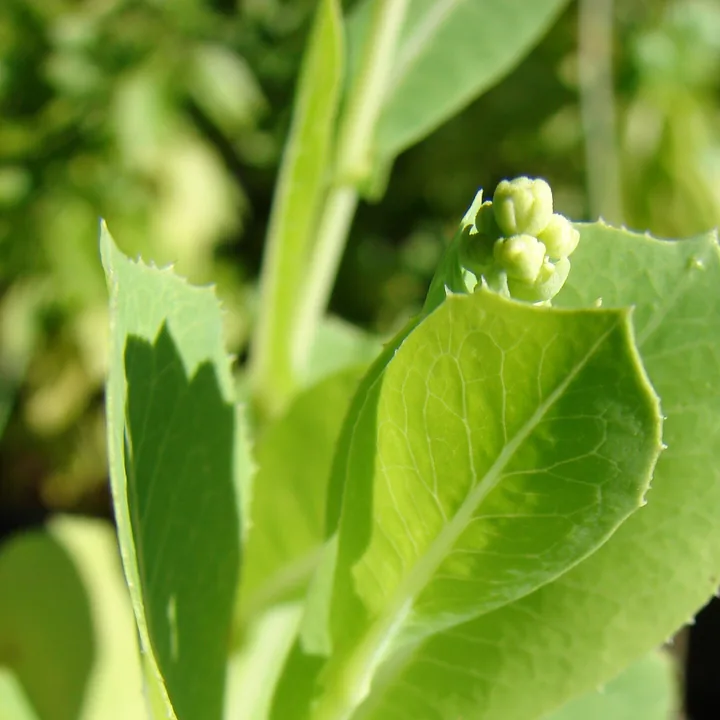
Warmth ends the crop. Maryland Extension says increasing day length and high summer temperatures usually cause seedstalk formation, called bolting, and a bitter flavor.3 Utah State puts the goal plainly:6
Lettuce tastes best when plants grow rapidly and mature before the heat of summer.
Sowing on the median last-frost date is too late for a 50-day crop in 21.7% of the ZIP codes that reach a 70°F mean, because 50 days later the mean is already above 70°F. Sowing on the last day of the Almanac’s window, two weeks before the last frost, fails in only 0.6%, and for baby greens (the Almanac gives 25 to 40 days) sowing on the last-frost date fails in 2.0%. So the common rule holds up in spring. Where a 70°F mean occurs (84.6% of ZIP codes), the median window is 33 days and 68% get 30 days or more.

How hot is too hot: nine temperature rules compared
Every source agrees lettuce is a cool-season crop, but the numbers differ. This table sets them side by side. The widest gap is the germination ceiling, anywhere from 70°F to 95°F.
| Source | Sowing and germination | Heat limit | Cold |
|---|---|---|---|
| Colorado State Extension | Leaf types: 35°F minimum, 70°F optimum, 70°F maximum; 4 to 10 days | — | Hardy; sow 2 to 4 weeks before the last frost |
| Utah State Extension | Sow after soil reaches 40°F; best at 55–65°F; above 80°F reduces germination | Grows best when temperatures do not exceed 75°F | Down to 32°F does not seriously damage young plants |
| Illinois Extension | Plant once soil is above 40°F; best at 55–65°F | Thrives at an average daily temperature of 60–70°F | — |
| Clemson Extension | Best at 60–80°F; raw seed will not germinate above 95°F | Best growth at 55–65°F; Bibb turns bitter above 75°F | Withstands light frosts |
| UC IPM | Best at 68–77°F; inhibited above 86°F | Best at 73°F days and 45°F nights; may bolt and turn bitter when warmer | Near freezing: no damage, slow growth |
| Texas A&M AgriLife | Spring: soil above 40°F. Fall: soil below 90°F | Optimum mean 55–60°F; above 80°F induces seed stalks | — |
| University of Maryland (commercial guide) | Seed dormancy above 85°F | Above 85°F for several days causes bolting | Hardened transplants tolerate 20–25°F |
| UF/IFAS | — | Prefers 50–75°F; shade above 85°F | Tolerates light frost; cover below 40°F |
| Old Farmer’s Almanac | Soil 45–65°F is ideal | Bolting over 70°F or with changing day length | Some varieties tolerate light frost |
The 95°F figure from Clemson is for raw seed, and Clemson says primed seed ensures optimum germination at varying temperatures.7 The University of California’s guidelines say germination is inhibited above 86°F.10 Maryland’s guide says seed enters dormancy above 85°F and that many vendors offer primed seed.9 For a home garden, the safe reading is to sow after the soil cools below about 80°F, the figure Utah State gives for reduced germination and Texas A&M for seed-stalk formation.6,13
Fall lettuce planting dates: wait for the cool, then count back
Fall lettuce is easier to ruin by sowing too early than too late. The published counts differ: the Almanac says 6 to 8 weeks before the first fall frost,2 Bonnie Plants says 4 to 8,16 Utah State says to plant 50 to 75 days before maturity and finish 1 to 2 weeks before the first fall frost,6 and one gardening blog says 60 days.18 Google’s AI Overview for “when to plant lettuce for fall” gave 6 to 8 weeks when we checked on October 14, 2026.
A count back from frost ignores summer. Among ZIP codes that reach a 70°F summer mean, eight weeks before the median first frost falls while the normal mean is still 70°F or higher in 67.6%, and still 75°F or higher in 9.3%. Delaware Extension explains why that matters: in southern Delaware average daily soil temperatures are typically above 80°F through the third week of August, and heat can induce thermal dormancy that prevents germination.8
83% of the varieties fully or partially bolted
That was a trial in which transplants went out inside Delaware’s recommended August window; the specialist concludes growers should use heat-tolerant varieties for fall.8 Our fall window therefore opens on the first day after the summer peak when the normal mean falls below 75°F, an air-temperature proxy for soil under the 80°F germination limit, and where the mean never reaches 75°F, on the hottest normal day. It closes 64 days before the median first 28°F freeze: 50 days to size, plus 14 because fall growth slows, the same count-back as our fall vegetable planting guide.
Across the 31,789 ZIP codes with a 70°F summer mean, the median fall window is 25 days; 4.6% have none and 31.7% have less than two weeks. About 15% of ZIP codes never reach a 70°F mean and need no fall window. Overall, 57.8% of ZIP codes have both a spring and a fall window of at least two weeks.
| City (ZIP) | Median first frost (32°F) | Almanac window (6–8 weeks before) | Window opens | Last sow date | Window |
|---|---|---|---|---|---|
| Minneapolis, MN (55401) | Oct 16 | Aug 21 – Sep 4 | Jul 15* | Aug 24 | 40 days |
| Chicago, IL (60601) | Nov 5 | Sep 10 – Sep 24 | Aug 7 | Sep 12 | 36 days |
| Boston, MA (02108) | Nov 9 | Sep 14 – Sep 28 | Jul 15* | Sep 18 | 65 days |
| New York, NY (10001) | Nov 20 | Sep 25 – Oct 9 | Aug 20 | Sep 28 | 39 days |
| Gettysburg, PA (17325) | Oct 21 | Aug 26 – Sep 9 | Jul 15* | Aug 29 | 45 days |
| Dover, DE (19901) | Nov 4 | Sep 9 – Sep 23 | Aug 22 | Sep 13 | 22 days |
| Columbus, OH (43215) | Oct 24 | Aug 29 – Sep 12 | Jul 15* | Aug 31 | 47 days |
| Denver, CO (80202) | Oct 12 | Aug 17 – Aug 31 | Aug 12 | Aug 18 | 6 days |
| Salt Lake City, UT (84101) | Nov 8 | Sep 13 – Sep 27 | Aug 28 | Sep 15 | 18 days |
| Nashville, TN (37201) | Oct 31 | Sep 5 – Sep 19 | Aug 29 | Sep 6 | 8 days |
| Greenville, SC (29601) | Nov 7 | Sep 12 – Sep 26 | Aug 25 | Sep 19 | 25 days |
| Macon, GA (31201) | Nov 10 | Sep 15 – Sep 29 | Sep 19 | Sep 21 | 2 days |
| Charleston, SC (29401) | Dec 30 | Nov 4 – Nov 18 | Sep 25 | Nov 5 | 41 days |
| Baton Rouge, LA (70802) | Nov 26 | Oct 1 – Oct 15 | Sep 25 | Oct 13 | 18 days |
| Dallas, TX (75201) | Nov 29 | Oct 4 – Oct 18 | Sep 29 | Oct 9 | 10 days |
| Austin, TX (78701) | Nov 17 | Sep 22 – Oct 6 | Oct 4 | Sep 28 | None (6 days short) |
| Houston, TX (77002) | Dec 25 | Oct 30 – Nov 13 | Oct 6 | Nov 2 | 27 days |
| Gainesville, FL (32601) | Dec 2 | Oct 7 – Oct 21 | Oct 1 | Oct 22 | 21 days |
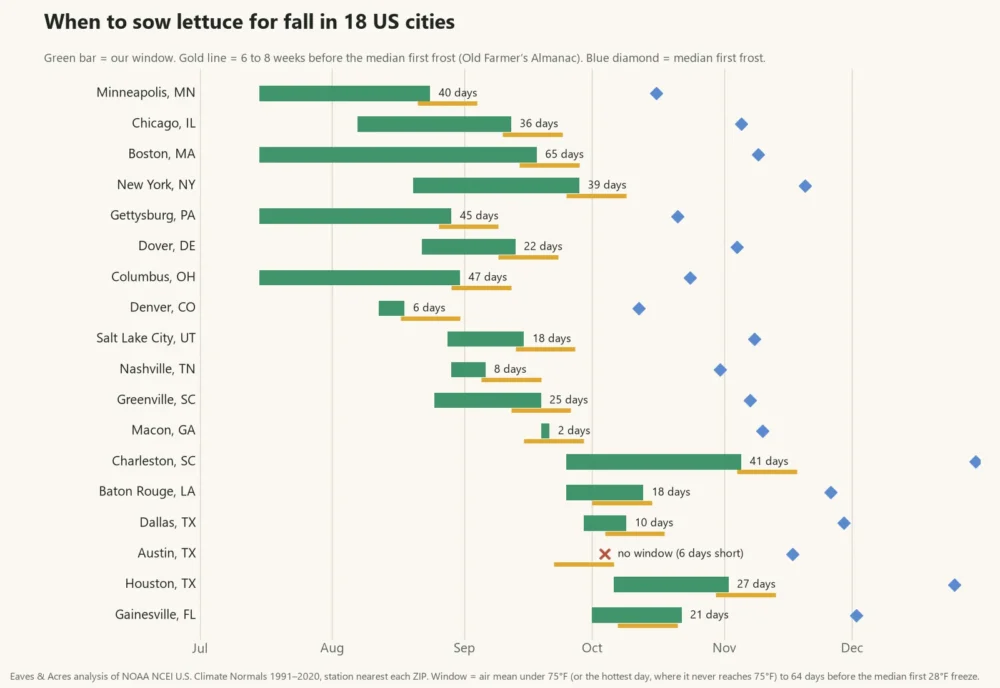
Boston has the longest window in the table, 65 days: its summer mean never reaches 75°F, so the window opens on the hottest normal day, July 15. In the South the squeeze is real: Nashville has 8 days, Macon 2, and Austin none (6 days short). Table 3 skips Portland and Seattle, which never reach a 70°F mean and can sow lettuce through summer; their last sowing dates are October 17 and September 29.
How published local calendars compare
Seven places have a published window we could convert to dates, nine windows in all. Colorado State’s and Utah State’s spring rules sit inside ours, and so does Maryland’s fall window for Pennsylvania. Clemson’s Piedmont spring window runs 37 days past our heat deadline in Greenville, and UGA’s Macon spring window opens 37 days before ours. Delaware’s August window for head lettuce ends two days before ours opens, because its advice assumes heat-tolerant varieties.8
| Place | Published guidance | Dates it gives | Our window | Comparison |
|---|---|---|---|---|
| Denver, CO (spring) | Colorado State Extension: 2 to 4 weeks before the average last frost | Apr 2 to Apr 16 | Apr 2 to Apr 25 | Published dates sit inside ours |
| Salt Lake City, UT (spring) | Utah State Extension: 2 to 3 weeks before the last frost | Mar 10 to Mar 17 | Mar 3 to Apr 21 | Published dates sit inside ours |
| Greenville, SC (spring) | Clemson HGIC: Piedmont spring | Mar 1 to May 15 | Feb 28 to Apr 8 | Opens 1 days later; ends 37 days after ours |
| Macon, GA (spring) | UGA Extension: middle Georgia spring | Jan 15 to Mar 1 | Feb 21 to Mar 16 | Opens 37 days earlier; ends 15 days before ours |
| Charleston, SC (spring) | Clemson HGIC: Coastal Plain spring | Feb 1 to Apr 15 | Jan 7 to Mar 12 | Opens 25 days later; ends 34 days after ours |
| Gettysburg, PA (fall) | University of Maryland Extension: PA and other cool areas | Jul 25 to Aug 10 | Jul 15 to Aug 29 | Published dates sit inside ours |
| Dover, DE (fall) | University of Delaware Extension: head lettuce, direct seeded | Aug 1 to Aug 20 | Aug 22 to Sep 13 | Ends 2 days before our window opens (assumes heat-tolerant varieties) |
| Macon, GA (fall) | UGA Extension: middle Georgia fall | Sep 1 to Oct 1 | Sep 19 to Sep 21 | Opens 18 days earlier; ends 10 days after ours |
| Charleston, SC (fall) | Clemson HGIC: Coastal Plain fall | Sep 5 to Nov 1 | Sep 25 to Nov 5 | Opens 20 days earlier; ends 4 days before ours |
Treat the overlap as the safe core and the edges as judgment calls. Clemson says fall planting is not recommended in the Piedmont and gives September 5 to November 1 on the coast, where our test gives September 25 to November 5.7
Mild winters, cool coasts and frost-free ZIP codes
Where winters are mild, lettuce is a winter crop. UF/IFAS says winter is the perfect time to grow lettuce in Florida,14 and our windows fall in two parts: Houston October 6 to November 2 and January 5 to February 24, Gainesville October 1 to October 22 and February 3 to March 3. The gap between them is closed in our test because a median freeze arrives before a 64-day crop sizes up.
Frost-free ZIP codes have no frost count to use, so look at the months. The normal mean stays under 70°F from November through March in Phoenix (ZIP 85001) and in all twelve months in San Francisco (94103), but only in January and February in Miami (33101). In San Francisco, Portland and Seattle the heat limit never bites; in Phoenix and Miami lettuce is a winter crop.
Types, varieties and ways to stretch the window
Days to maturity set how late you can sow. Illinois Extension gives leaf lettuce 50 to 60 days and butterhead 60 to 70,4 the Alabama Cooperative Extension System gives crisphead 70 to 85,15 and the Almanac says baby greens can be picked at 25 to 40 days.2 Maryland rates the whole group at 40 to 80 days,3 and UGA lists lettuce at 60 to 85 for middle Georgia.12
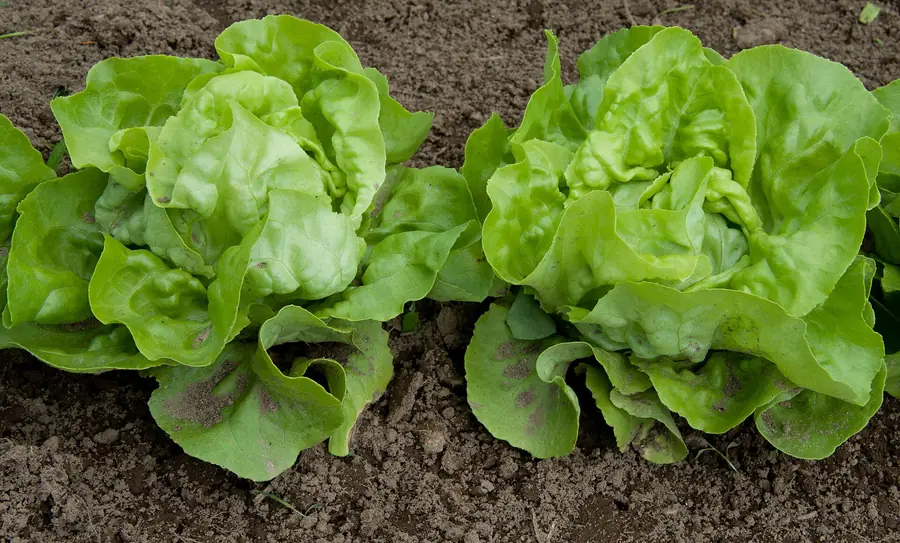

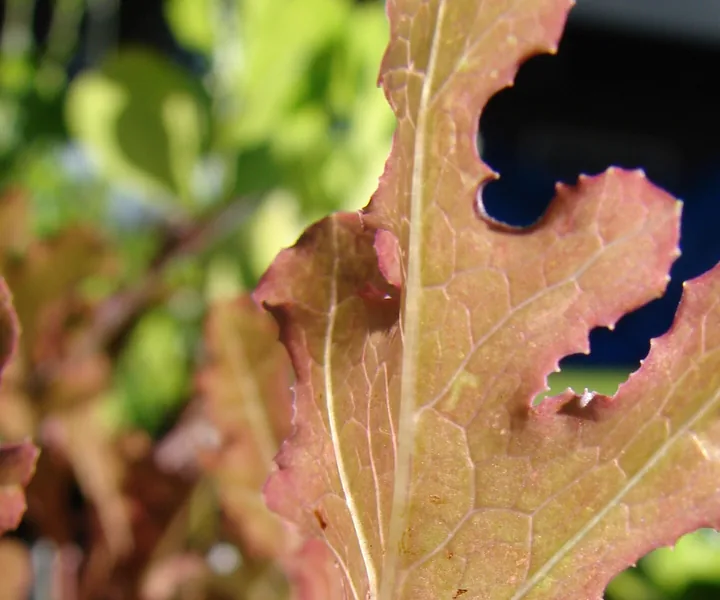
- Pick heat-tolerant types for the edges. Maryland recommends slow-bolting or heat-resistant varieties, such as oak-leaf types, to extend the season.3 The Almanac cautions that red leaf varieties are not recommended for hot weather, because the red pigment absorbs more heat.2
- Use primed seed in warm soil. Clemson and Maryland both describe priming as a fix for seed that will not sprout in heat.7,9
- Sow in small batches. Illinois Extension suggests successive plantings 10 to 14 days apart.5
- Protect the late crop. Maryland says row covers or cold frames extend lettuce later into fall, and that some cultivars overwinter from transplants set out around October 15.3

How we calculated these dates
Daily temperatures are NOAA’s monthly normals placed on the 15th of each month and interpolated linearly, for the station nearest each ZIP code.1 Frost and freeze dates are the median dates for 32°F and 28°F. The day counts and the 40°F, 70°F and 75°F lines are the published rules above, applied to air temperature, not soil. Individual years vary by weeks, so treat each window as a planning range.
Next steps
Look up your own frost dates with our frost date lookup and read what a last frost date means. Lettuce shares its early spring window with carrots, peas and onions, and in cold months winter sowing starts it outdoors in containers. More crops are in our vegetable guides.
Frequently asked questions
As soon as the soil can be worked, about 2 to 4 weeks before your last frost (Old Farmer’s Almanac) or 2 to 3 weeks (Utah State). Stop about 50 days before the normal air mean reaches 70°F. In Chicago that is March 17 to April 22.
The Almanac says 6 to 8 weeks before the first fall frost, but let the heat break first: Delaware Extension says southern Delaware soil is typically above 80°F through the third week of August. Our window opens when the air mean drops below 75°F and closes 64 days before the first 28°F freeze: August 7 to September 12 in Chicago.
By our count, 64 days before your median first 28°F freeze for a full-size leaf crop (Dallas: October 9). Baby greens take 25 to 40 days, the Almanac says, so they can go in later.
In the South, yes: our windows run October 6 to November 2 in Houston and October 1 to 22 in Gainesville. In Chicago, where the median first frost is November 5, it is too late for a full crop.
The Almanac ties bolting to temperatures over 70°F, Clemson says Bibb lettuce turns bitter above 75°F, and Maryland Extension says temperatures above 85°F for several days cause bolting.
A zone can’t decide it alone: the USDA map is based on the average annual extreme minimum winter temperature, not spring frost or summer heat. Use your ZIP code’s median last frost and the 70°F heat deadline; Tables 1 and 3 give 22 and 18 cities.
Illinois Extension gives leaf lettuce 50 to 60 days and butterhead 60 to 70, and the Alabama Cooperative Extension System gives crisphead 70 to 85. Baby greens can be picked at 25 to 40 days (Almanac).
Sources
- 1.U.S. Climate Normals 1991–2020. NOAA National Centers for Environmental Information, 2021. Used for: median last- and first-frost dates, 28°F freeze dates and monthly temperature normals for every ZIP code Back to text
- 2.How to Grow Lettuce: Planting, Growing, and Harvesting Lettuce, Catherine Boeckmann. The Old Farmer’s Almanac, 2026. Used for: direct-seed 2 to 4 weeks before the last spring frost; fall 6 to 8 weeks before the first frost; indoor start 6 to 8 weeks; bolting over 70°F; baby greens 25 to 40 days; red types and heat Back to text
- 3.Growing Lettuce in a Home Garden. University of Maryland Extension, 2026. Used for: sow as soon as soil can be worked; days to maturity 40 to 80; day length and heat cause bolting; row covers; overwintering from October 15 transplants Back to text
- 4.Lettuce (Home Vegetable Gardening). University of Illinois Extension, n.d. Used for: thrives at average daily temperature of 60 to 70°F; leaf lettuce 50 to 60 days, butterhead 60 to 70 Back to text
- 5.How to Grow Lettuce (Good Growing blog). University of Illinois Extension, 2020. Used for: plant once soil is above 40°F; successive plantings 10 to 14 days apart Back to text
- 6.How to Grow Lettuce in Your Garden. Utah State University Extension, n.d. Used for: seed 2 to 3 weeks before last frost; above 80°F reduces germination; best below 75°F; fall planting 50 to 75 days before maturity Back to text
- 7.Lettuce (HGIC 1312). Clemson Cooperative Extension Home & Garden Information Center, 2023. Used for: South Carolina planting dates; raw seed will not germinate above 95°F; Bibb bitter above 75°F; primed seed Back to text
- 8.Heat Tolerant Lettuce Varieties and Preparing for Fall Lettuce Planting, Emmalea Ernest. University of Delaware Cooperative Extension, 2023. Used for: fall head lettuce Aug 1 to 20; soil above 80°F through the third week of August; 83% of varieties bolted in the 2012 trial Back to text
- 9.Lettuce, Endive and Escarole (commercial vegetable production recommendations). University of Maryland Extension, 2026. Used for: hardened transplants tolerate 20 to 25°F; above 85°F for several days causes bolting; seed dormancy above 85°F; fall seeding July 25 to August 10 in PA and cool areas; primed seed Back to text
- 10.Cultural Tips for Growing Lettuce. University of California Statewide IPM Program, n.d. Used for: germination optimum 68 to 77°F; inhibited above 86°F Back to text
- 11.Cool Season Vegetables. Colorado State University Extension, 2024. Used for: hardy vegetables including lettuce 2 to 4 weeks before the average last spring frost; leaf lettuce germination 35°F minimum, 4 to 10 days Back to text
- 12.Vegetable Planting Chart (Bulletin 577). University of Georgia Cooperative Extension, 2026. Used for: middle Georgia lettuce: 60 to 85 days, January 15 to March 1 and September 1 to October 1 Back to text
- 13.Lettuce, Joe Masabni. Texas A&M AgriLife Extension Service, 2011. Used for: spring soil above 40°F, fall below 90°F; above 80°F induces seed stalks Back to text
- 14.Lettuce. UF/IFAS Gardening Solutions, n.d. Used for: winter is the perfect time to grow lettuce in Florida; prefers 50 to 75°F; tolerates light frost Back to text
- 15.Growing Lettuce in Spring or Fall. Alabama Cooperative Extension System, 2025. Used for: optimum day temperature 55 to 65°F; crisphead 70 to 85 days Back to text
- 16.Growing Lettuce. Bonnie Plants, n.d. Used for: set out plants about a month before the last frost; fall lettuce 4 to 8 weeks before the first frost Back to text
- 17.USDA Plant Hardiness Zone Map. USDA Agricultural Research Service, 2023. Used for: zones are based on average annual extreme minimum winter temperature
- 18.Growing Lettuce in the Fall & Early Winter. Our Stoney Acres (gardening blog), 2022. Used for: one published fall rule of 60 days before the first frost Back to text
- 19.Photo: Starr-120608-7315 Lactuca sativa seedlings, Forest & Kim Starr (CC BY 3.0 US). Wikimedia Commons, 2012. Used for: hero photo
- 20.Photo: Starr-081031-0394 Lactuca sativa lettuce bolting, Forest & Kim Starr (CC BY 3.0 US). Wikimedia Commons, 2008. Used for: bolting photo
- 21.Photo: Lettuce Mini Heads, Dwight Sipler (CC BY 2.0). Wikimedia Commons, 2012. Used for: butterhead photo
- 22.Photo: Starr-081031-0399 Lactuca sativa red oak leaf lettuce, Forest & Kim Starr (CC BY 3.0 US). Wikimedia Commons, 2008. Used for: red oak leaf photo
How this guide was made
- Written by the Yard & Garden Desk and reviewed by the Data & Methodology Desk.
- Data: median last- and first-frost dates, 28°F freeze dates and monthly temperature normals from NOAA NCEI U.S. Climate Normals 1991–2020 for the station nearest each ZIP code, with daily values interpolated from the monthly normals; planting rules and published calendars from the Old Farmer’s Almanac, University of Maryland, University of Illinois, Utah State, Clemson, University of Delaware, University of California, Colorado State, University of Georgia, Texas A&M, UF/IFAS and the Alabama Cooperative Extension System. Air temperature stands in for soil temperature. See our methodology.
- AI use: AI tools help us research, draft and check this guide. Every figure is checked against the source cited for it, and calculated figures come from our own code, described on the methodology page.
- Spotted an error? Tell us — the form opens with this page’s address filled in.
Change log
- Oct 13, 2026Published. Spring sowing windows for 22 cities and fall windows for 18 cities from NOAA 1991–2020 normals, nine published local windows compared, and the rules tested across 37,563 lower-48 ZIP codes.
Covers lawns, gardens, frost and planting. We write the guides and maintain the tools that tell you when to seed, feed and plant for your ZIP.
Keep reading
When to Plant Pumpkins: Count Back From Halloween, Not Forward From Frost
Sow pumpkins once the soil reaches about 65°F, a median 37 days after the last frost, then count back 90 to 120 days from Halloween or the first frost. Dates for 24 cities.
When to Plant Corn: Match the Date to the Type, Not Just the Frost
Sow standard sweet corn once the soil reaches about 55°F, sugar-enhanced at 60°F and supersweet at 65°F: a median April 25, May 9 and May 25. Dates for 28 spring and 21 fall cities.
When to Harvest Pumpkins: Ripeness Signs and the Freeze Deadline
Pick pumpkins when the rind resists a fingernail and the stem is dry, before a 28°F hard freeze. Median frost and freeze dates for 23 cities, plus curing and storage.
Seasonal reminders for your ZIP
Get a short email when it’s time to overseed, start seeds, open the pool or service your furnace — timed to your climate.