When to Plant Carrots: Sow Early, Allow for Slow Seedlings
Carrots take frost but come up slowly and sour in heat. We tested the common planting counts against NOAA normals for 37,563 ZIP codes and set twelve published local windows beside them.
- Last reviewed Oct 14, 2026
- 20 cited sources
- 14 min read

Set your ZIP to see dates for your area.
- 1Sow about 3 weeks before your median last frost, once the soil is 40°F: the Almanac and Utah State say 2 to 3 weeks, Colorado State 0 to 2, Bonnie Plants 4 to 6. Seeds need 14 to 21 days to emerge.
- 2Stop spring sowing about 70 days before the air mean reaches 75°F: March 20 to April 28 in Chicago. Sowing on the last-frost date finishes late in 23.3% of ZIP codes that reach 75°F; 47.8% never reach it.
- 3For fall, the last sowing for a full crop is 74 days before your first frost: August 23 in Chicago, September 16 in Dallas. By September 1 it has passed in 83.8% of ZIP codes.
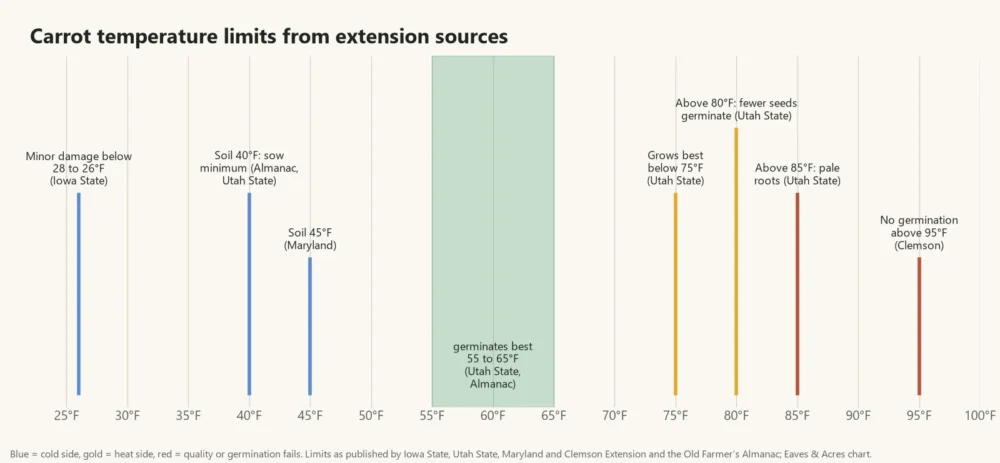
- 4Carrots take frost down to 28 to 26°F (Iowa State), and heavy mulch lets you harvest through winter until the ground freezes solid (Illinois).
Sow carrots about 3 weeks before your average last spring frost, once the soil is at least 40°F, and allow 14 to 21 days for them to come up. Finish a spring sowing about 70 days before your normal daily temperature reaches 75°F, and for fall stop about 74 days before your first frost. In Chicago that is March 20 to April 28 in spring and any day up to August 23 for fall; in Dallas it is February 9 to March 5 in spring and about September 16 for fall.
Carrots differ from lettuce or broccoli: they are sown where they will grow, and they are slow to come up, so the soil sets the start date and a crusted seedbed can cancel a sowing. We tested the common counts against NOAA 1991–2020 normals1 for 37,563 lower-48 ZIP codes, set twelve published local windows beside them, and built dates for 22 cities in spring and 18 in fall. Everything uses air temperature as a stand-in for soil temperature, because our NOAA data has no soil readings.
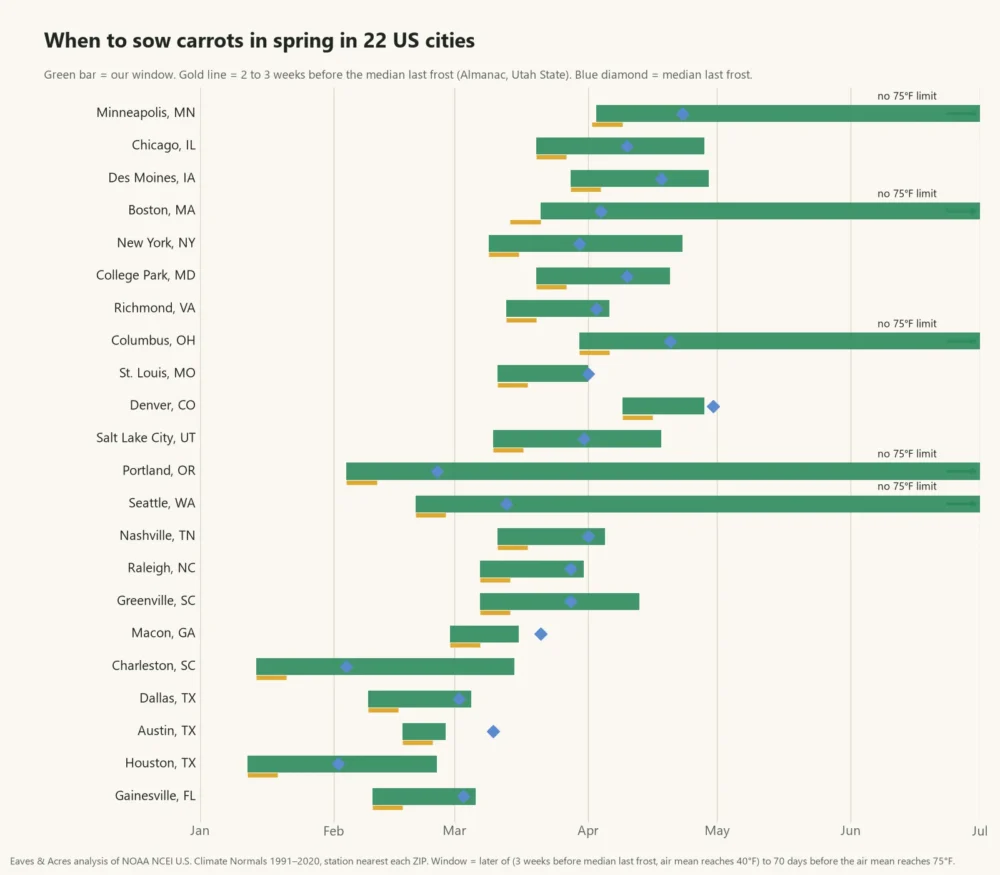
Spring carrot sowing dates for 22 cities
Published lead times range from none to six weeks. The Old Farmer’s Almanac and Utah State say 2 to 3 weeks before the last frost,2,7 Colorado State lists carrots as semi-hardy and says 0 to 2 weeks,12 and Bonnie Plants says 4 to 6.14 Illinois Extension simply says as soon as the soil can be worked.5 Each window below opens on the later of two dates: three weeks before the median last frost, or the day the normal daily mean air temperature reaches 40°F, the soil minimum named by the Almanac and Utah State.2,7
It closes 70 days before the daily mean reaches 75°F. Colorado State gives 70 days to harvest, Maryland 65 to 75 and Clemson 65 to 75,12,8,9 and Utah State says carrots grow best when temperatures do not exceed 75°F.7 A sowing after that date finishes in the hot weeks, which the heat section covers.
| City (ZIP) | Median last frost | Almanac start (3 weeks before) | Our window | Days open |
|---|---|---|---|---|
| Minneapolis, MN (55401) | Apr 23 | Apr 2 (air mean 39.9°F) | Apr 3 – No 75°F limit | No limit |
| Chicago, IL (60601) | Apr 10 | Mar 20 (air mean 41.4°F) | Mar 20 – Apr 28 | 39 |
| Des Moines, IA (50309) | Apr 18 | Mar 28 (air mean 44.4°F) | Mar 28 – Apr 29 | 32 |
| Boston, MA (02108) | Apr 4 | Mar 14 (air mean 38.1°F) | Mar 21 – No 75°F limit | No limit |
| New York, NY (10001) | Mar 30 | Mar 9 (air mean 41.3°F) | Mar 9 – Apr 23 | 45 |
| College Park, MD (20742) | Apr 10 | Mar 20 (air mean 45.4°F) | Mar 20 – Apr 20 | 31 |
| Richmond, VA (23219) | Apr 3 | Mar 13 (air mean 47.9°F) | Mar 13 – Apr 6 | 24 |
| Columbus, OH (43215) | Apr 20 | Mar 30 (air mean 46.5°F) | Mar 30 – No 75°F limit | No limit |
| St. Louis, MO (63101) | Apr 1 | Mar 11 (air mean 45.6°F) | Mar 11 – Apr 1 | 21 |
| Denver, CO (80202) | Apr 30 | Apr 9 (air mean 48.9°F) | Apr 9 – Apr 28 | 19 |
| Salt Lake City, UT (84101) | Mar 31 | Mar 10 (air mean 45.7°F) | Mar 10 – Apr 18 | 39 |
| Portland, OR (97201) | Feb 25 | Feb 4 (air mean 43.8°F) | Feb 4 – No 75°F limit | No limit |
| Seattle, WA (98101) | Mar 13 | Feb 20 (air mean 44.3°F) | Feb 20 – No 75°F limit | No limit |
| Nashville, TN (37201) | Apr 1 | Mar 11 (air mean 49.0°F) | Mar 11 – Apr 5 | 25 |
| Raleigh, NC (27601) | Mar 28 | Mar 7 (air mean 49.3°F) | Mar 7 – Mar 31 | 24 |
| Greenville, SC (29601) | Mar 28 | Mar 7 (air mean 49.1°F) | Mar 7 – Apr 13 | 37 |
| Macon, GA (31201) | Mar 21 | Feb 28 (air mean 54.2°F) | Feb 28 – Mar 16 | 16 |
| Charleston, SC (29401) | Feb 4 | Jan 14 (air mean 50.9°F) | Jan 14 – Mar 15 | 60 |
| Dallas, TX (75201) | Mar 2 | Feb 9 (air mean 51.2°F) | Feb 9 – Mar 5 | 24 |
| Austin, TX (78701) | Mar 10 | Feb 17 (air mean 56.6°F) | Feb 17 – Feb 27 | 10 |
| Houston, TX (77002) | Feb 2 | Jan 12 (air mean 53.8°F) | Jan 12 – Feb 25 | 44 |
| Gainesville, FL (32601) | Mar 3 | Feb 10 (air mean 57.8°F) | Feb 10 – Mar 6 | 24 |
The window is short in the South and long in the North. Charleston has 60 days (January 14 to March 15) and Houston 44, while Austin has 10 and Macon 16. Minneapolis, Boston, Columbus, Portland and Seattle never reach a 75°F normal mean, so they have no heat deadline at all.

Cold: how early is too early
Three weeks before the median last frost, the normal air mean is under 45°F in 28.5% of lower-48 ZIP codes and under 40°F in 1.2%. Bonnie’s six weeks is under 40°F in 47.4%. Maryland says to plant when the soil has reached at least 45°F,8 so the 40°F floor we use is the lower of the two published numbers. Using 45°F instead moves our opening date by 0 days in the median ZIP code.
Cold soil also stretches the wait. Utah State says carrots need 14 to 21 days to emerge, Colorado State 10 to 17, and Iowa State and Minnesota say up to three weeks, Iowa State adding that cold soil makes it worse.7,12,3,13 The cost of going too early is not only a slow start. Utah State answers the question of why a carrot flowers instead of forming a root:
Carrots require cold weather (chilling) to form flowers.
It adds that this can occur if they are planted too early.7 The safe habit is to sow at the opening date or later, not before it, and to sow a little every few weeks: Utah State and the Almanac both say every 4 weeks through midsummer, and Iowa State says every 2 to 3 weeks.7,2,3
Heat: when a spring sowing is too late
Utah State says high summer temperatures reduce growth, decrease quality and cause bitter or off flavors, and that roots turn pale in hot soil when temperatures go above 85°F. Clemson says carrots near maturity in high temperatures tend to develop a strong flavor and roots that are coarse and fibrous.7,9 We turned that into a deadline: the last sowing whose roots finish before the air mean reaches 75°F.
The test is mostly a deadline for the South and the Plains. Of the 19,615 ZIP codes whose mean reaches 75°F (52.2% of the 37,563), sowing on the median last-frost date finishes late in 23.3%, while the end of the Almanac’s range (two weeks before the last frost) finishes late in only 1.6%. The median window is 27 days; 7.5% have less than two weeks and 36.2% have 30 days or more. The other 47.8% of ZIP codes never reach a 75°F mean, so for them carrots can be sown in succession all summer without a spring deadline.
Slow germination and crusting
Carrot seed is tiny and slow, which is why most failed sowings are not a calendar problem. Iowa State names the usual cause, especially for summer sowings:3
Crusting of the soil surface and dry soil conditions may result in poor germination.
Iowa State says to lightly cover the row with vermiculite, sawdust or peat moss and water gently in dry weather. Utah State says to put the seed on the surface and cover it with compost or fine sand, and Clemson mixes the seed with dry sand and covers it 1/8 inch deep with sawdust, vermiculite or potting soil.3,7,9 Illinois adds that heavy rain after sowing can pack the surface so that no seedlings emerge, and that clear polyethylene film warms the soil and holds moisture until seedlings appear, when it must come off at once.5
Radishes help twice: Iowa State says they germinate quickly to mark the row and to help prevent crusting, and they are harvested in 3 to 5 weeks.3 Do not start carrots indoors; Iowa State says they do not transplant easily, and our indoor seed-starting guide lists root crops as ones to sow in the garden.3
Fall carrots: the last sowing date for a full crop
Published fall counts agree more than spring ones. The Almanac says to start about 10 weeks before the first fall frost, and Maryland says 10 to 12 weeks.2,8 Iowa State gives a date for central Iowa instead: the last practical planting date is August 1.3 We use 74 days, the same count-back our fall vegetable planting guide uses for carrots (60 days to harvest plus 14 for slow fall growth), which is 10.6 weeks.
Where summers are hot, a second line applies: Utah State says temperatures above 80°F reduce seed germination.7 In places whose mean reaches 80°F, we open the window on the day the mean falls back under it.
| City (ZIP) | Median first frost (32°F) | Last date (74 days) | 10–12 weeks before (Almanac, Maryland) | Air-mean heat line | January mean |
|---|---|---|---|---|---|
| Minneapolis, MN (55401) | Oct 16 | Aug 3 | Jul 24 – Aug 7 | Never reaches 80°F | 14.9°F |
| Chicago, IL (60601) | Nov 5 | Aug 23 | Aug 13 – Aug 27 | Never reaches 80°F | 26.0°F |
| Des Moines, IA (50309) | Oct 20 | Aug 7 | Jul 28 – Aug 11 | Never reaches 80°F | 22.3°F |
| Boston, MA (02108) | Nov 9 | Aug 27 | Aug 17 – Aug 31 | Never reaches 80°F | 29.9°F |
| New York, NY (10001) | Nov 20 | Sep 7 | Aug 28 – Sep 11 | Never reaches 80°F | 33.7°F |
| College Park, MD (20742) | Nov 1 | Aug 19 | Aug 9 – Aug 23 | Never reaches 80°F | 34.0°F |
| Columbus, OH (43215) | Oct 24 | Aug 11 | Aug 1 – Aug 15 | Never reaches 80°F | 28.7°F |
| Denver, CO (80202) | Oct 12 | Jul 30 | Jul 20 – Aug 3 | Never reaches 80°F | 34.9°F |
| Salt Lake City, UT (84101) | Nov 8 | Aug 26 | Aug 16 – Aug 30 | Under 80°F from Jul 26 | 33.7°F |
| Nashville, TN (37201) | Oct 31 | Aug 18 | Aug 8 – Aug 22 | Never reaches 80°F | 37.8°F |
| Raleigh, NC (27601) | Nov 8 | Aug 26 | Aug 16 – Aug 30 | Under 80°F from Jul 23 | 41.7°F |
| Greenville, SC (29601) | Nov 7 | Aug 25 | Aug 15 – Aug 29 | Never reaches 80°F | 40.7°F |
| Macon, GA (31201) | Nov 10 | Aug 28 | Aug 18 – Sep 1 | Under 80°F from Aug 24 | 47.6°F |
| Charleston, SC (29401) | Dec 30 | Oct 17 | Oct 7 – Oct 21 | Under 80°F from Aug 27 | 50.8°F |
| Baton Rouge, LA (70802) | Nov 26 | Sep 13 | Sep 3 – Sep 17 | Under 80°F from Aug 29 | 50.4°F |
| Dallas, TX (75201) | Nov 29 | Sep 16 | Sep 6 – Sep 20 | Under 80°F from Sep 16 | 47.8°F |
| Houston, TX (77002) | Dec 25 | Oct 12 | Oct 2 – Oct 16 | Under 80°F from Sep 18 | 53.6°F |
| Gainesville, FL (32601) | Dec 2 | Sep 19 | Sep 9 – Sep 23 | Under 80°F from Sep 1 | 54.8°F |
Only 23.6% of ZIP codes reach an 80°F mean, so most of the country has no heat gate and can sow from midsummer. Where there is one, the heat line and the count-back leave a median of 9 days, and 16.3% have no date that meets both. Austin shows it: the heat line is September 18, 14 days after the count-back date of September 4. Texas A&M’s commercial crop brief says Texas carrots are planted from August to November, which fits sowing into the heat and harvesting in winter.15
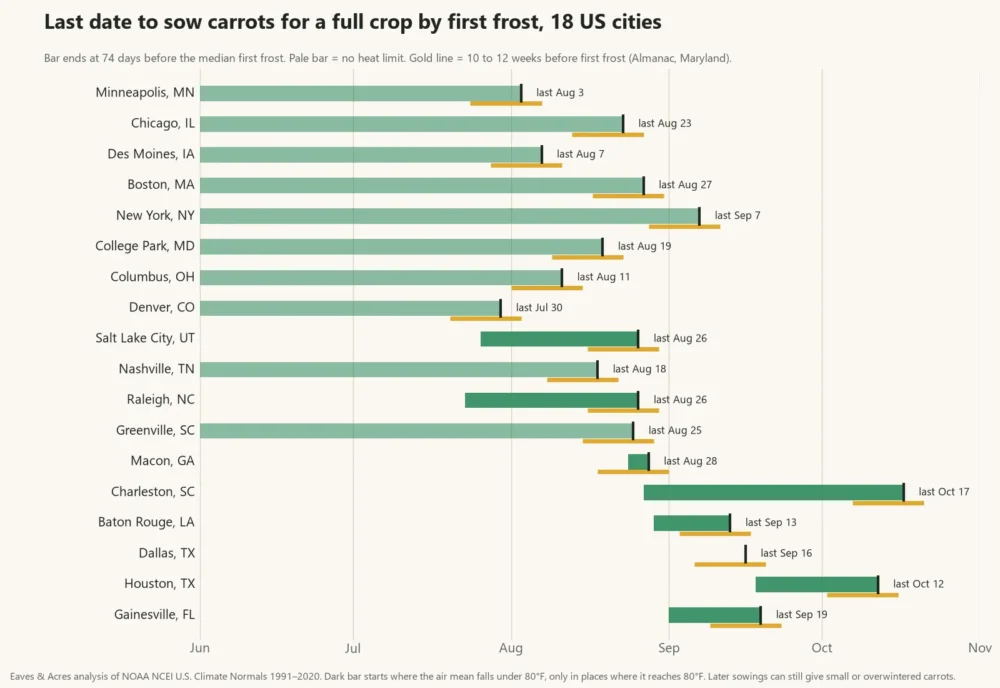
The last date arrives early. By August 1 it has passed in 26.1% of lower-48 ZIP codes, by September 1 in 83.8% and by October 1 in 98.8%; the median last date is August 11. Carrots are hardier than most guides imply, though. Iowa State lists them among very hardy vegetables that take only minor damage below 28 to 26°F, while Maryland calls them semi-hardy and says light frosts are fine but not heavy ones.4,8 The median 28°F freeze comes 11 days after the first 32°F frost, and a sowing a few weeks past our date still makes small roots.
Leaving carrots in the ground over winter
Three extension sources say mulch lets you keep harvesting. Illinois says a heavy mulch allows harvest throughout the winter in many areas, but also that straw-mulched rows can be harvested until the ground freezes solid. Maryland says fall-planted carrots can be harvested all winter if mulched with straw or shredded leaves before the ground freezes, and Utah State says many gardeners overwinter them under heavy mulch.5,8,7 Illinois suggests mulch, row cover or a low tunnel to keep snow off, and digging when temperatures are above freezing.5
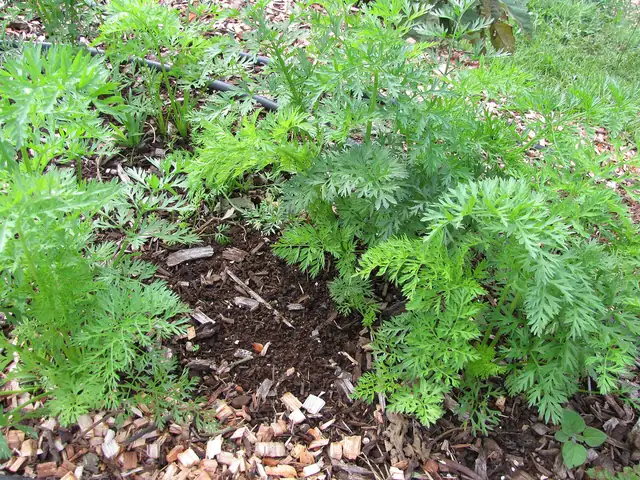

Our January normals show where that works. The January mean is under 32°F in 51.8% of lower-48 ZIP codes and under 20°F in 12.3%, so in half the country expect the ground to freeze for stretches and plan on weeks of mulch harvest, not the whole winter; that is our reading, not a published limit. The January mean is 45°F or higher in 14.5%, where carrots can stay in the garden as a winter crop, as UF/IFAS’s August to March planting range for north and central Florida suggests.11 There is a taste reward: Illinois Extension’s blog says the sweetness is the carrot’s defense against cold.6
The carrot produces more sugars to prevent against ice crystal formation in the cells.
Do not leave them past spring. Carrots are biennials, and the Almanac says the tops flower and set seed the next year if you do not harvest.2
What ten sources say about timing and temperature
The published rules are close but not identical, and they sit in different places: some are about soil, some about air, some about frost dates.
| Source | When to sow | Germination and temperature limits | Days to harvest |
|---|---|---|---|
| Old Farmer’s Almanac | 2 to 3 weeks before the last frost; fall about 10 weeks before the first frost | Soil 40°F minimum; best 55 to 65°F, up to 75°F; 14 to 21 days to emerge | About 2 months to first roots |
| Utah State Extension | 2 to 3 weeks before the last frost; every 4 weeks through midsummer | Soil 40°F; best 55 to 65°F; above 80°F fewer seeds germinate; best below 75°F; pale above 85°F; chilling can cause flowering | 70 to 100 days |
| Colorado State Extension | Semi-hardy: 0 to 2 weeks before the last frost | Germination 40°F minimum, 80°F optimum, 90°F maximum; 10 to 17 days | 70 days |
| University of Maryland Extension | Soil at least 45°F; fall 10 to 12 weeks before the first frost | Semi-hardy: light frosts, not heavy ones; does not grow well in hot weather | 65 to 75 days |
| Iowa State Extension | Early April in Iowa, then every 2 to 3 weeks; last practical date August 1 | Up to three weeks to emerge in cold soil; very hardy to 28–26°F | 50 to 60 days |
| Illinois Extension | As soon as the soil can be worked | Germination up to two weeks; hot summer seedlings may need shade | 50 to 70 days |
| Clemson Extension | South Carolina: Piedmont March 1–15, Coastal December 15–January 30 | Best at 60 to 65°F; soil 55 to 75°F; none above 95°F; heat makes roots coarse | 65 to 75 days |
| University of Georgia Extension | Middle Georgia: January 15 to March 20; fall August 20 to September 15 | — | 70 to 80 days |
| UF/IFAS | North and central Florida August to March; south Florida September to March | Slow to germinate | 70 to 120 days |
| Bonnie Plants | 4 to 6 weeks before the last frost; again in midsummer for fall | — | — |
Our windows against published local calendars
Twelve published windows from extension services, converted to dates with the NOAA median frost, show where the air-temperature rules help and where they miss.
| Place | Published guidance | Dates it gives | Our window | Comparison |
|---|---|---|---|---|
| Des Moines, IA (spring) | Iowa State Extension: early April in Iowa | Early April (read here as Apr 1 to Apr 10) | Mar 28 to Apr 29 | Published dates sit inside ours |
| Salt Lake City, UT (spring) | Utah State Extension: 2 to 3 weeks before the last frost | Mar 10 to Mar 17 | Mar 10 to Apr 18 | Published dates sit inside ours |
| Denver, CO (spring) | Colorado State Extension: 0 to 2 weeks before the last frost | Apr 16 to Apr 30 | Apr 9 to Apr 28 | Opens 7 days after ours; ends 2 days after ours |
| Greenville, SC (spring) | Clemson HGIC: Piedmont spring | Mar 1 to Mar 15 | Mar 7 to Apr 13 | Opens 6 days earlier; ends 29 days before ours |
| Macon, GA (spring) | UGA Extension: middle Georgia spring | Jan 15 to Mar 20 | Feb 28 to Mar 16 | Opens 44 days earlier; ends 4 days after ours |
| Charleston, SC (spring) | Clemson HGIC: Coastal spring | Dec 15 to Jan 30 | Jan 14 to Mar 15 | Opens 30 days earlier; ends 44 days before ours |
| Des Moines, IA (fall) | Iowa State Extension: last practical date | Aug 1 | no heat gate to Aug 7 | Published date is 6 days before our last date |
| College Park, MD (fall) | University of Maryland Extension: 10 to 12 weeks before the first frost | Aug 9 to Aug 23 | no heat gate to Aug 19 | Our last date sits inside the range |
| Greenville, SC (fall) | Clemson HGIC: Piedmont fall | Jul 1 to Jul 30 | no heat gate to Aug 25 | Published dates sit inside ours |
| Macon, GA (fall) | UGA Extension: middle Georgia fall | Aug 20 to Sep 15 | Aug 24 to Aug 28 | Starts 4 days earlier; ends 18 days after ours |
| Charleston, SC (fall) | Clemson HGIC: Coastal fall | Aug 1 to Aug 20 | Aug 27 to Oct 17 | Starts 26 days earlier; ends 58 days before ours |
| Gainesville, FL (fall) | UF/IFAS: north and central Florida | August to March | Sep 1 to Sep 19 | Starts 31 days earlier; runs 193 days past ours |
Our dates are inside or close to the Iowa State, Utah State, Colorado State and Maryland guidance. They are weakest where the published calendars sow into heat: Clemson’s Coastal fall dates start 26 days before our 80°F line in Charleston, and UF/IFAS’s August start is a month ahead of ours in Gainesville, which fits Illinois’s note that midsummer seedlings may need some shade.5 For Florida and the Gulf coast, follow UF/IFAS and your county office.

Frost-free ZIP codes and Hawaii
Where a ZIP code has no last-frost date, the frost counts cannot be applied, so use the temperature line only. San Francisco and Los Angeles have a normal mean under 75°F in all 12 months, so heat never closes a carrot window there. Phoenix and Miami are under 75°F only in January to April, November and December: those are the carrot months. Our table has no frost dates for 104 of Hawaii’s 135 ZIP codes, so we give no Hawaii dates; ask your county Extension office.
Next steps
Look up your own frost dates with our frost date lookup and read what a last frost date means. Carrots take a frost better than tender crops, as the frost cover guide shows. They share their early spring window with peas, lettuce, spinach and broccoli. More crops are in our vegetable guides.
Frequently asked questions
Sow about 3 weeks before your last frost, once the soil is at least 40°F, and stop about 70 days before the normal air mean reaches 75°F. In Chicago that is March 20 to April 28; in Des Moines March 28 to April 29.
Only in mild winters. UF/IFAS says carrots can be planted from August to March in north and central Florida, and our count-back closes October 12 in Houston. In Chicago the last date is August 23 and the ground freezes, so by our count a November sowing will not make a full crop there.
For a full-size crop by your first frost, 74 days before it: August 23 in Chicago, August 3 in Minneapolis and September 7 in New York. Iowa State says August 1 is the last practical date in Iowa.
Utah State says carrots grow best when temperatures do not exceed 75°F, fewer seeds germinate above 80°F, and roots turn pale above 85°F. Clemson says seed will not germinate above 95°F.
They are slow: 14 to 21 days according to Utah State and the Almanac, up to three weeks in cold soil according to Iowa State. A crusted surface or dry seedbed is the usual cause of a poor stand; cover the row with vermiculite, sawdust, peat moss or fine sand and keep it moist.
Carrots are biennials, and the Almanac says the tops flower and set seed the next year if you do not harvest. In summer heat, Clemson says roots left in the ground turn strong-flavored, coarse and fibrous.
A zone cannot decide it alone: the USDA map is based on the average annual extreme minimum winter temperature, not spring frost or summer heat. Use your ZIP code’s median last frost and the 75°F heat line in Table 1, and the first-frost count in Table 2.
Sources
- 1.U.S. Climate Normals 1991–2020. NOAA National Centers for Environmental Information, 2021. Used for: median last- and first-frost dates, 28°F freeze dates and monthly temperature normals for every ZIP code Back to text
- 2.Planting and Growing Carrots, Catherine Boeckmann. The Old Farmer’s Almanac, 2026. Used for: sow 2 to 3 weeks before the last spring frost; soil 40°F minimum, germination best 55 to 65°F, 14 to 21 days to emerge; fall about 10 weeks before the first frost; tops flower the second year Back to text
- 3.Growing Carrots and Parsnips, Aaron Steil. Iowa State University Extension and Outreach, 2024. Used for: plant in early April and every 2 to 3 weeks; last practical date August 1; up to three weeks to emerge in cold soil; crusting; radishes; do not transplant Back to text
- 4.Cold and Freeze Damage to Garden Plants. Iowa State University Extension and Outreach, 2026. Used for: very hardy cool-season vegetables including carrots take only minor damage below 28 to 26°F Back to text
- 5.Carrots (Home Vegetable Gardening). University of Illinois Extension, n.d. Used for: plant as soon as the soil can be worked; germination up to two weeks; heavy rain can pack the surface; mulch for winter harvest until the ground freezes solid Back to text
- 6.Fall Carrots for a Holiday Harvest (Flowers, Fruits, and Frass). University of Illinois Extension, 2018. Used for: carrots sweeten in the cold; 50 to 80 days; mulched carrots harvested until the ground freezes Back to text
- 7.How to Grow Carrots in Your Garden, Dan Drost. Utah State University Extension, 2020. Used for: sow 2 to 3 weeks before the last frost after soils reach 40°F; best germination 55 to 65°F in 14 to 21 days; above 80°F fewer seeds germinate; best below 75°F; pale roots above 85°F; chilling causes flowering; overwintering under heavy mulch Back to text
- 8.Growing Carrots in a Home Garden. University of Maryland Extension, 2023. Used for: plant when soil is at least 45°F; semi-hardy; fall 10 to 12 weeks before the first frost; 65 to 75 days; mulched fall carrots harvested through winter Back to text
- 9.Carrot, Beet, Radish and Parsnip (HGIC 1305). Clemson Cooperative Extension Home & Garden Information Center, 2016. Used for: best at 60 to 65°F; seed will not germinate above 95°F; South Carolina spring and fall planting dates; heat makes roots strong and coarse; 65 to 75 days Back to text
- 10.Home Garden Planting Chart (Bulletin 577). University of Georgia Cooperative Extension, 2026. Used for: middle Georgia carrot: 70 to 80 days, spring January 15 to March 20, fall August 20 to September 15
- 11.Carrots. UF/IFAS Gardening Solutions, n.d. Used for: plant August to March in north and central Florida, September to March in south Florida; slow to germinate; 70 to 120 days Back to text
- 12.Vegetable Planting Guide. Colorado State University Extension, 2024. Used for: carrots semi-hardy, 0 to 2 weeks before the last frost; germination 40°F minimum, 80°F optimum, 90°F maximum; 10 to 17 days; 70 days to harvest Back to text
- 13.Growing Carrots and Parsnips in Home Gardens. University of Minnesota Extension, 2022. Used for: seeds can take up to three weeks to germinate; plant directly in the garden Back to text
- 14.Carrots (zone planting guide). Bonnie Plants, n.d. Used for: direct sow 4 to 6 weeks before the average last frost, again in midsummer for fall Back to text
- 15.Carrots in Texas (Crop Brief). Texas A&M AgriLife Extension, 2000. Used for: commercial Texas carrots planted August to November, harvested December to May Back to text
- 16.USDA Plant Hardiness Zone Map. USDA Agricultural Research Service, 2023. Used for: zones are based on average annual extreme minimum winter temperature
- 17.Photo: Carrots are up, Dwight Sipler (CC BY 2.0). Wikimedia Commons, 2008. Used for: hero photo
- 18.Photo: Starr-170604-9026 carrot veggie garden, Forest & Kim Starr (CC BY 3.0 US). Wikimedia Commons, 2017. Used for: garden row photo
- 19.Photo: Starr-100508-6082 carrot habit in vegetable garden, Forest & Kim Starr (CC BY 3.0 US). Wikimedia Commons, 2010. Used for: mulched bed photo
- 20.Photo: Carrots of many colors, Stephen Ausmus, USDA ARS (public domain). Wikimedia Commons, n.d. Used for: colored carrots photo
How this guide was made
- Written by the Yard & Garden Desk and reviewed by the Data & Methodology Desk.
- Data: median last- and first-frost dates and monthly temperature normals from NOAA NCEI U.S. Climate Normals 1991–2020 for the station nearest each ZIP code, with daily values interpolated from the monthly normals; planting rules and published calendars from the Old Farmer’s Almanac, Iowa State, Illinois, Utah State, Maryland, Clemson, Georgia, UF/IFAS, Colorado State, Minnesota and Bonnie Plants. Air temperature stands in for soil temperature. See our methodology.
- AI use: AI tools help us research, draft and check this guide. Every figure is checked against the source cited for it, and calculated figures come from our own code, described on the methodology page.
- Spotted an error? Tell us — the form opens with this page’s address filled in.
Change log
- Oct 14, 2026Published. Spring sowing windows for 22 cities and fall last-sowing dates for 18 cities from NOAA 1991–2020 normals, twelve published local windows compared, and the rules tested across 37,563 lower-48 ZIP codes.
Covers lawns, gardens, frost and planting. We write the guides and maintain the tools that tell you when to seed, feed and plant for your ZIP.
Keep reading
When to Plant Pumpkins: Count Back From Halloween, Not Forward From Frost
Sow pumpkins once the soil reaches about 65°F, a median 37 days after the last frost, then count back 90 to 120 days from Halloween or the first frost. Dates for 24 cities.
When to Plant Corn: Match the Date to the Type, Not Just the Frost
Sow standard sweet corn once the soil reaches about 55°F, sugar-enhanced at 60°F and supersweet at 65°F: a median April 25, May 9 and May 25. Dates for 28 spring and 21 fall cities.
When to Harvest Pumpkins: Ripeness Signs and the Freeze Deadline
Pick pumpkins when the rind resists a fingernail and the stem is dry, before a 28°F hard freeze. Median frost and freeze dates for 23 cities, plus curing and storage.
Seasonal reminders for your ZIP
Get a short email when it’s time to overseed, start seeds, open the pool or service your furnace — timed to your climate.