When to Prune Apple Trees: Dormant Window Dates by City and Zone
Every extension source says late winter and gives months that fit only its own state. We turned the rule into dormant-window dates from NOAA normals for 31 cities and 40,557 ZIP codes, tested them against twelve extension calendars, and treated summer pruning as its own job.
- 26 cited sources
- 17 min read

Set your ZIP to see dates for your area.
- 1Prune apple trees in late winter, after the coldest weeks and before the buds swell. In NOAA normals the window runs from about January 29 to a median of April 8 in the 48.1% of lower-48 ZIP codes with freezing winters, and to March 6 in the 31.1% with milder ones.
- 2Our window covers at least 75% of the published window in 8 of 12 extension calendars and closes within 14 days of the published end in 7. It misses Little Rock, where the 45°F line closes the window 42 days early.
- 3Fall and early-winter cuts are the risky ones: in freezing-winter ZIP codes the median first freeze (October 14) comes 106 days before the window opens, and Maine says it takes two weeks to regain hardiness lost to pruning.
- 4Summer pruning is a lighter second job. Published last dates run from July 31 to August 31, which is 43 to 102 days before the median first freeze at the places the sources cover, so check your own state before you cut.
Prune apple trees in late winter, after the coldest weeks of the year and before the buds swell. In NOAA’s 1991–2020 normals that is from about January 29 to about April 8 in the 48.1% of lower-48 ZIP codes with freezing winters, and a shorter stretch ending around March 6 in the 31.1% with milder ones. Fall and early-winter cuts are the ones extension services warn against, and summer pruning is a separate, lighter job with its own last date.
Extension services agree on the rule but state it in months that fit only their own state. We turned it into dates for 31 cities and for every ZIP code using NOAA 1991–2020 normals1 for 40,557 ZIP codes, tested the dates against twelve published calendars, and counted how many ZIP codes have a late-winter window at all. Everything uses air temperature in place of the temperature of the wood, and our window is a fit to those calendars, not a published rule. Google and Bing suggestions for this query name Colorado, Michigan, Wisconsin, Minnesota, North Carolina, Ohio, Oregon and Pennsylvania, so Table 4 covers those states.
Late winter, after the cold and before the buds swell
Every extension source we read puts the main pruning of an apple tree in the dormant season and moves it toward the end of that season. Oregon State says it most plainly:
Late winter, just before spring, is the best time to prune apple trees.
The reasoning is the same from state to state. Oregon State says the worst of the cold has passed, which lowers the risk of frost damage to fresh cuts.4 Utah State adds the mechanism: pruning temporarily decreases the cold hardiness of the tissue around a cut.3 It puts both edges of the window in one sentence, saying dormant pruning should be done:
after the coldest part of the winter, but before spring bud swell.
Colorado State draws the same lines and names a threshold: late winter, after the high potential for extreme cold, temperatures below zero, has passed, but before bud swell and flowering.6 Iowa State prefers dormant pruning in late winter or early spring because it promotes rapid wound healing and lets you see the structure of the tree.9 The University of Minnesota gives a third advantage: a cut made just before spring growth stays exposed only briefly before new growth begins to seal it.8
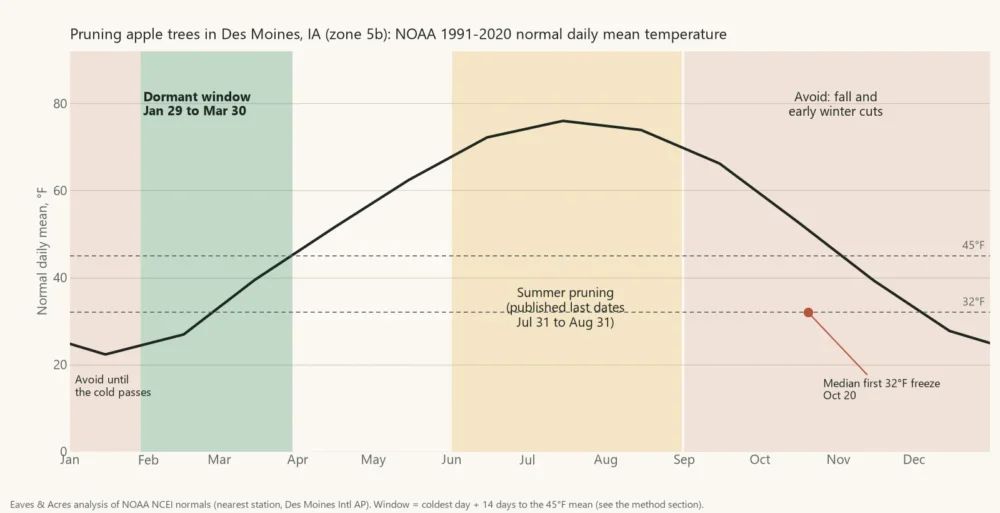
The states that name months show how the window slides with the length of winter. Iowa says March and early April,10 Wisconsin March and April,12 Maryland February or March,15 Nebraska January through March,17 and Minnesota and New Hampshire February to early April and February to April.8,13 Kansas says March for much of the state and, in southern Kansas, from around Valentine’s Day through early March.18 The chart shows a whole year for Des Moines: the dormant window, the summer period and the months to avoid.
Dormant pruning dates for 31 cities
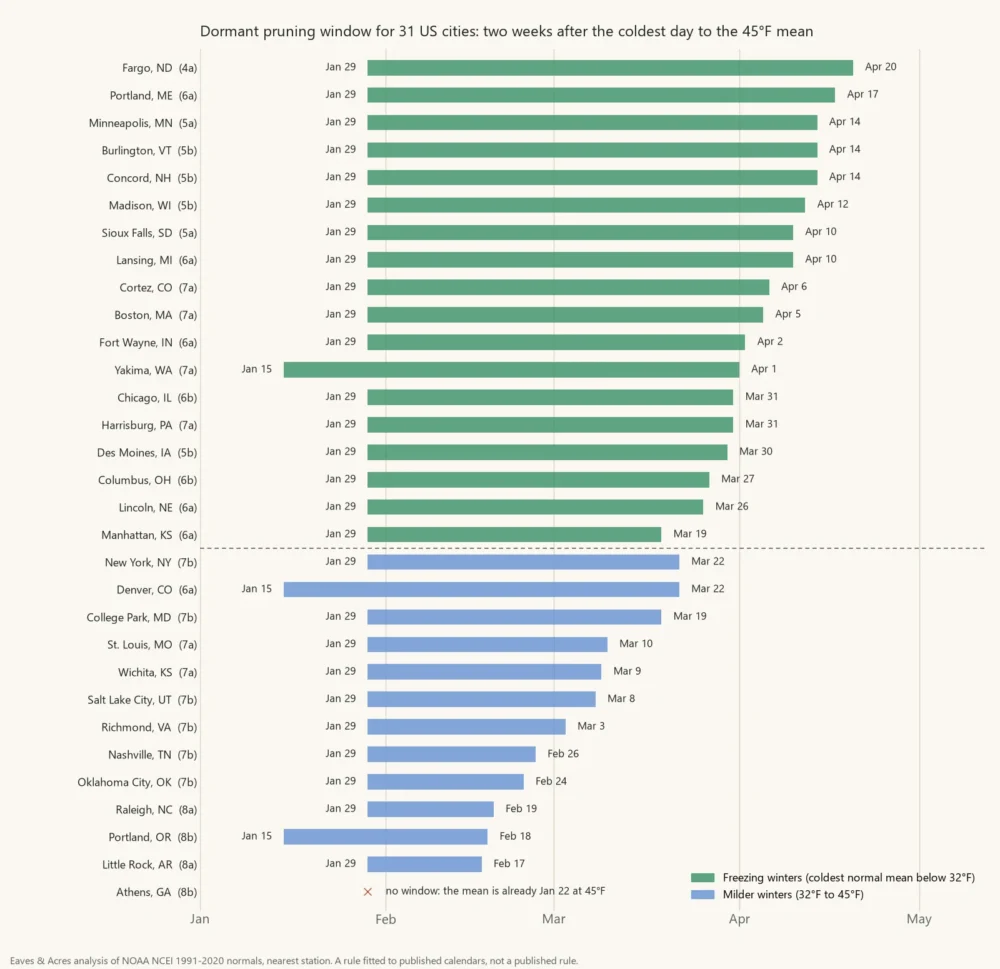
To put dates on “after the coldest part, before bud swell” we used two NOAA markers. The window opens two weeks after the coldest day of the normal year, because the University of Maine says pruning lessens winter hardiness and that it takes two weeks to regain what it lost.5 It closes on the first day after that when the normal daily mean air temperature reaches 45°F, our stand-in for bud swell and the same line we calibrated for planting in when to plant fruit trees. Table 1 gives both dates for each city, with the median first 32°F freeze (our frost vs freeze guide explains the difference) so you can see how far fall is from the opening.
| City (ZIP, zone) | Coldest normal daily mean | Window opens | Window closes (air mean 45°F) | Days open | Median first 32°F freeze | Days from first freeze to opening |
|---|---|---|---|---|---|---|
| Fargo, ND (58102, zone 4a) | 9.2°F | Jan 29 | Apr 20 | 81 | Sep 30 | 121 |
| Portland, ME (04101, zone 6a) | 24.0°F | Jan 29 | Apr 17 | 78 | Oct 15 | 106 |
| Minneapolis, MN (55401, zone 5a) | 14.9°F | Jan 29 | Apr 14 | 75 | Oct 16 | 105 |
| Burlington, VT (05401, zone 5b) | 20.9°F | Jan 29 | Apr 14 | 75 | Oct 15 | 106 |
| Concord, NH (03301, zone 5b) | 22.3°F | Jan 29 | Apr 14 | 75 | Oct 3 | 118 |
| Madison, WI (53703, zone 5b) | 19.4°F | Jan 29 | Apr 12 | 73 | Oct 9 | 112 |
| Sioux Falls, SD (57104, zone 5a) | 17.9°F | Jan 29 | Apr 10 | 71 | Oct 6 | 115 |
| Lansing, MI (48906, zone 6a) | 23.9°F | Jan 29 | Apr 10 | 71 | Oct 13 | 108 |
| Cortez, CO (81321, zone 7a) | 27.7°F | Jan 29 | Apr 6 | 67 | Sep 28 | 123 |
| Boston, MA (02108, zone 7a) | 29.9°F | Jan 29 | Apr 5 | 66 | Nov 9 | 81 |
| Fort Wayne, IN (46802, zone 6a) | 25.5°F | Jan 29 | Apr 2 | 63 | Oct 21 | 100 |
| Yakima, WA (98901, zone 7a) | 29.2°F | Jan 15 | Apr 1 | 76 | Oct 4 | 103 |
| Chicago, IL (60601, zone 6b) | 26.0°F | Jan 29 | Mar 31 | 61 | Nov 5 | 85 |
| Harrisburg, PA (17101, zone 7a) | 29.2°F | Jan 29 | Mar 31 | 61 | Oct 23 | 98 |
| Des Moines, IA (50309, zone 5b) | 22.3°F | Jan 29 | Mar 30 | 60 | Oct 20 | 101 |
| Columbus, OH (43215, zone 6b) | 28.7°F | Jan 29 | Mar 27 | 57 | Oct 24 | 97 |
| Lincoln, NE (68508, zone 6a) | 25.0°F | Jan 29 | Mar 26 | 56 | Oct 13 | 108 |
| Manhattan, KS (66502, zone 6a) | 29.1°F | Jan 29 | Mar 19 | 49 | Oct 19 | 102 |
| New York, NY (10001, zone 7b) | 33.7°F | Jan 29 | Mar 22 | 52 | Nov 20 | 70 |
| Denver, CO (80202, zone 6a) | 34.5°F | Jan 15 | Mar 22 | 66 | Oct 12 | 95 |
| College Park, MD (20742, zone 7b) | 34.0°F | Jan 29 | Mar 19 | 49 | Nov 1 | 89 |
| St. Louis, MO (63101, zone 7a) | 32.6°F | Jan 29 | Mar 10 | 40 | Nov 4 | 86 |
| Wichita, KS (67202, zone 7a) | 33.2°F | Jan 29 | Mar 9 | 39 | Oct 29 | 92 |
| Salt Lake City, UT (84101, zone 7b) | 33.7°F | Jan 29 | Mar 8 | 38 | Nov 8 | 82 |
| Richmond, VA (23219, zone 7b) | 38.3°F | Jan 29 | Mar 3 | 33 | Nov 4 | 86 |
| Nashville, TN (37201, zone 7b) | 37.8°F | Jan 29 | Feb 26 | 28 | Oct 31 | 90 |
| Oklahoma City, OK (73102, zone 7b) | 38.2°F | Jan 29 | Feb 24 | 26 | Nov 2 | 88 |
| Raleigh, NC (27601, zone 8a) | 41.7°F | Jan 29 | Feb 19 | 21 | Nov 8 | 82 |
| Portland, OR (97201, zone 8b) | 41.9°F | Jan 15 | Feb 18 | 34 | Dec 1 | 45 |
| Little Rock, AR (72201, zone 8a) | 40.7°F | Jan 29 | Feb 17 | 19 | Nov 10 | 80 |
| Athens, GA (30601, zone 8b) | 44.3°F | Jan 29 | None: mean is already 45°F on Jan 22 | — | Nov 10 | 80 |
In the 19,518 ZIP codes with a freezing winter (coldest normal daily mean below 32°F) the window opens January 29 and closes on a median of April 8; the middle 80% close between March 24 and April 24, and the median window is 69 days. Fargo closes April 20, Des Moines March 30 and Lincoln March 26. In the 12,631 ZIP codes with a milder winter (32°F to 45°F) the median close is March 6 after 37 days, and 40.5% of them close before March 1: Raleigh on February 19 and Little Rock on February 17. Athens, Georgia, has no window by this rule, because its normal mean is already at 45°F on January 22, a week before ours would open. Across all 40,557 ZIP codes, 77.1% get a window, 20.7% never average below 45°F in the normals, and the rest fall between.
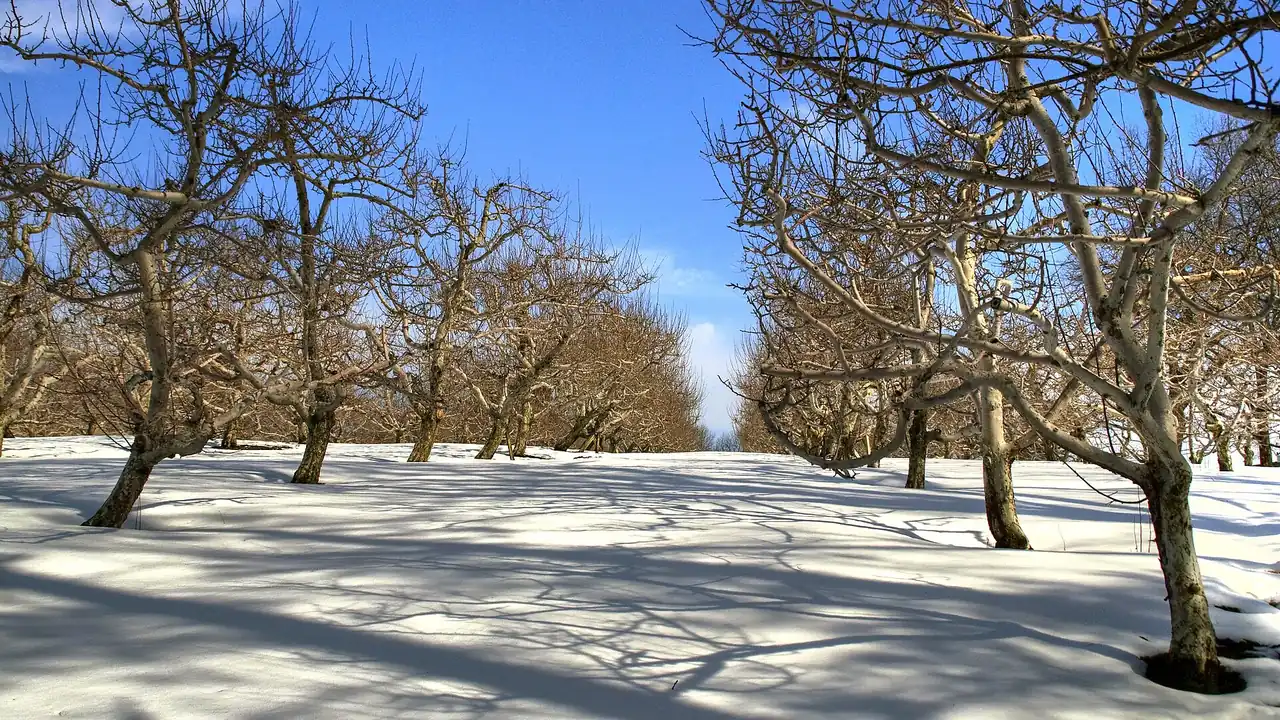
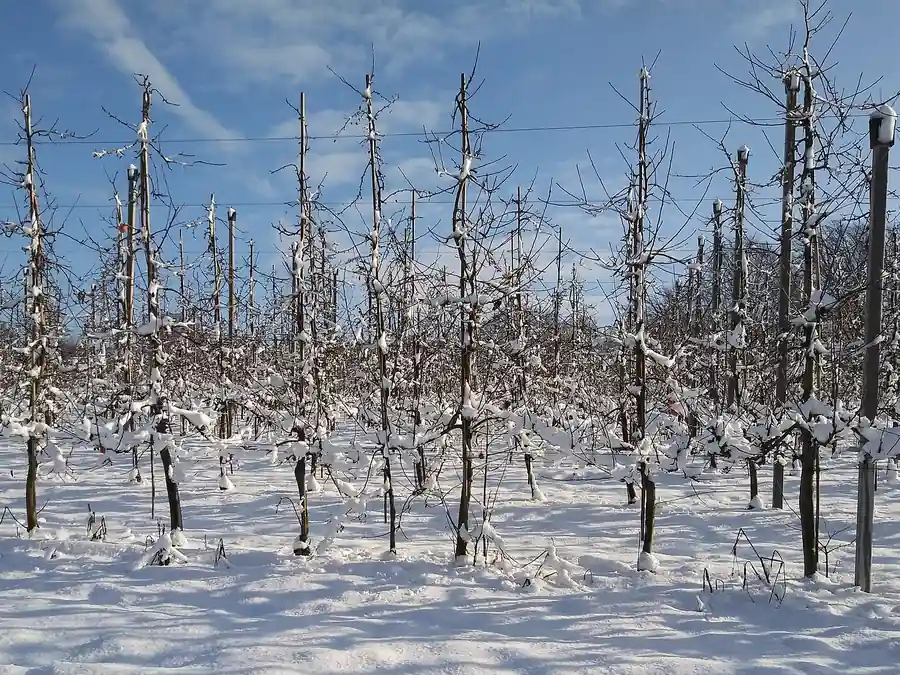
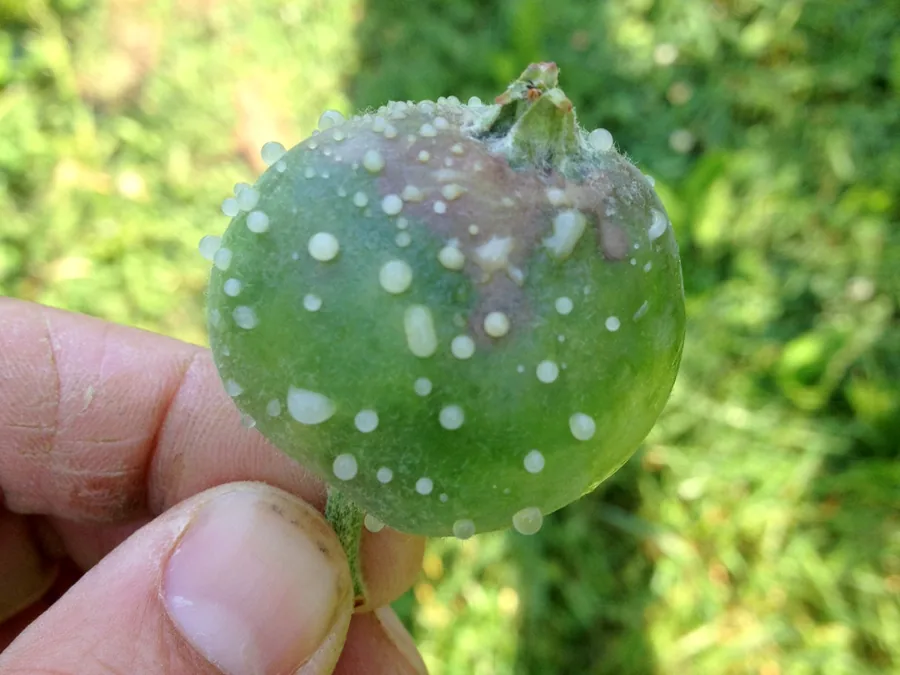
These are windows for the dormant trees you see in a leafless orchard in winter, such as the one below, and they are the part of the calendar most readers need.

How the window compares with twelve extension calendars
Twelve published calendars gave us something to test. Table 2 reads each as dates, taking a month name as the whole month, “early” as the 7th and “late” as the 25th, and sets it beside our window for the same place. Our window covers at least 75% of the published window in 8 of the 12 comparisons and at least half in 11, an average of 78%. Our closing date lands within 14 days of the published end in 7 of the 12, with a median miss of 13 days.
The start is the looser half, because published windows describe the best weeks as often as the earliest safe ones. Five of the twelve start on February 1, three days after ours; Nebraska starts on January 1; the other six start 16 to 31 days later. Nebraska pairs its January start with two cautions: do not prune any fruit tree before January, and prune varieties susceptible to winter injury in late spring before growth begins.17
| Source (place) | Published wording (read as) | Our window | Inside ours | Close vs published end |
|---|---|---|---|---|
| University of Minnesota Extension (Minneapolis, MN) | Late winter (February-early April) (Feb 1 to Apr 7) | Jan 29 to Apr 14 | 100% | +7 |
| Iowa State Extension (Des Moines, IA) | March and early April (Mar 1 to Apr 7) | Jan 29 to Mar 30 | 79% | −8 |
| UW-Madison Extension (Madison, WI) | March and April are best (Mar 1 to Apr 30) | Jan 29 to Apr 12 | 70% | −18 |
| UNH Extension (Concord, NH) | Between February and April (Feb 1 to Apr 30) | Jan 29 to Apr 14 | 82% | −16 |
| UVM Extension (Burlington, VT) | Late winter, March (Mar 1 to Mar 31) | Jan 29 to Apr 14 | 100% | +14 |
| University of Maryland Extension (College Park, MD) | Late winter (February or March) (Feb 1 to Mar 31) | Jan 29 to Mar 19 | 80% | −12 |
| Purdue Extension (DeKalb Co.) (Fort Wayne, IN) | Late February into early March (Feb 25 to Mar 7) | Jan 29 to Apr 2 | 100% | +26 |
| Nebraska Extension (Lincoln, NE) | January through March (Jan 1 to Mar 31) | Jan 29 to Mar 26 | 63% | −5 |
| K-State Research and Extension (Manhattan, KS) | March in much of Kansas (Mar 1 to Mar 31) | Jan 29 to Mar 19 | 61% | −12 |
| K-State Research and Extension (Wichita, KS) | Southern Kansas: Valentine’s Day to early March (Feb 14 to Mar 7) | Jan 29 to Mar 9 | 100% | +2 |
| SDSU Extension (Sioux Falls, SD) | Anytime between February and April (Feb 1 to Apr 30) | Jan 29 to Apr 10 | 78% | −20 |
| Arkansas Division of Agriculture (Little Rock, AR) | Late winter (February or March) (Feb 1 to Mar 31) | Jan 29 to Feb 17 | 29% | −42 |
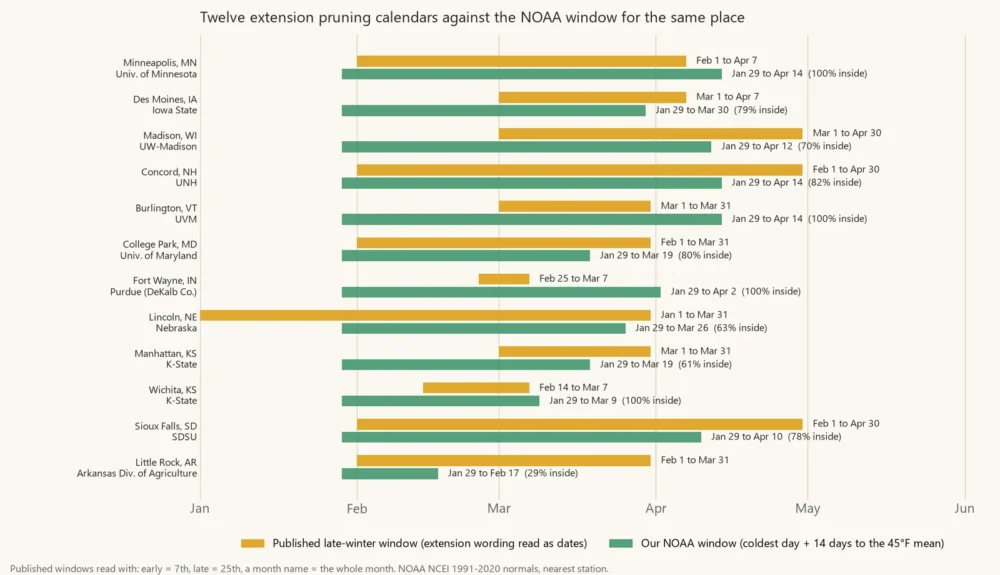
The miss is Little Rock. Arkansas says to prune every year in late winter, February or March,20 but the mean in Little Rock reaches 45°F on February 17, 42 days before the end of March. Where winters are mild a tree has to get its winter chill before it wakes, and we do not compute chill, so 45°F closes the window too early there. The choice of line matters less elsewhere. A 40°F line lands within 14 days of the published end in 4 of 12 (median miss 24 days), a 50°F line in 7 of 12 (median miss 9 days) and the median last frost in 6 of 12 (median miss 14 days). We kept 45°F because it fits as often as 50°F and closes earlier: in freezing-winter ZIP codes the median close would be April 22 at 50°F instead of April 8.
Where the window closes: silver tip, not the calendar
Buds, not dates, end the window. The University of Vermont says apple and pear trees should be pruned at “silver tip”, when buds turn from dark brown to a fuzzy silvery gray, and before the tips turn green, to avoid diseases such as fireblight.14 Utah State says pruning after bud swell can knock blossoms and buds off the remaining branches and reduce vigor.3 Arkansas says to time large jobs to finish just before bud break, and that it does not harm trees if sap is beginning to flow when you prune.21 Maryland adds an age rule: young trees should never be pruned during or after bloom, while older trees tolerate a later pruning.15


A warm spell can wake the buds early. The University of Vermont’s March 2024 note was written for gardeners who feared that unusually warm temperatures had woken their trees and made pruning too late; its answer was that it was not too late, and that trees that have just broken dormancy are at silver tip, the stage to prune in before the tips turn green.14 Read the buds on your own tree and let our dates tell you when to start looking.
Why fall and early-winter cuts are the risky ones
The warning is nearly unanimous. UNH says to avoid fall or early winter pruning, which increases the risk of severe winter injury;13 Iowa State says early winter pruning increases the risk of cold injury;9 SDSU says pruning early in the winter may cause severe winter injury;19 and the University of Minnesota says autumn or early winter pruning is more likely to result in drying and die-back at pruning sites.8 The University of Maine supplies the number behind the warning:
Pruning lessens winter hardiness to a small degree
and, Maine adds, early-winter pruning can lead to injury when severely cold temperatures follow, because it takes two weeks for the tree to regain the hardiness it lost.5 NC State says pruning may temporarily and slightly reduce cold hardiness, so delay dormant pruning until late winter, and also says to avoid pruning in fall when fire blight is active.23 Colorado State’s Dolores County guide says not to prune in early to mid winter because healing will not occur,7 and Nebraska says not to prune any fruit tree before January.17
How long a stretch is that? In the freezing-winter ZIP codes the median first 32°F freeze is October 14 and our window opens January 29, a gap of 106 days. The middle half of those ZIP codes have gaps between 99 and 115 days, and 95.4% have more than 90.1 Table 1 gives the gap for each city. It is the stretch the sources steer you away from, and it is why the late-winter window matters more than the calendar month.
Day-to-day cold matters inside the window too. SDSU says to stop pruning three to four days before an extended forecast of temperatures below 0°F and to wait two to three days after the temperature is above 10°F,19 and Virginia Tech says not to prune during or just before extremely cold weather.26 The coldest month’s average low is 10°F or colder in 10.5% of lower-48 ZIP codes and 0°F or colder in 1.5%. In those places, our reading is that the forecast, not the calendar, decides the first cut.
Summer pruning: a second, lighter job with its own deadline
Summer pruning is a different job from the winter one. Sources use it to remove vigorous water sprouts and to slow a tree that is too vigorous. Iowa State says to use it sparingly,9 K-State says early summer is the time to remove water sprouts and suckers,18 and Oregon State says water sprouts should be pruned out each summer.4 Utah State says summer pruning reduces vigor where dormant pruning increases it,3 and UGA says summer pruning devigorates the tree by reducing the carbohydrates it stores.22 Not every source agrees that it works: Virginia Tech says recent research from Virginia and other regions indicates shoot growth is not suppressed more by summer than by dormant pruning.26
The sources disagree most on the last date. UGA says summer pruning runs from early bud growth to the end of July,22 and NC State says summer pruning generally starts once growth is several inches long and should not be done after the end of July.23 Colorado State’s Dolores County guide says not after August 1.7 Nebraska says not after the end of August and adds that the greatest benefit comes from finishing in early summer, when fruit are still small.17 Clemson says early summer or after harvest between late August and early September,24 Oklahoma State says August,25 and the University of Maine says late July or August, warning that severe pruning then weakens the tree.5 The reason given is winter injury: UGA says pruning into late summer and early fall can increase the potential for it.22
Table 3 converts each limit into days before the median first freeze at the place the source covers.
| Place | Source and wording | Limit used | Median first 32°F freeze | Days between |
|---|---|---|---|---|
| Lincoln, NE | Nebraska Extension (EC1233): not after the end of August | Aug 31 | Oct 13 | 43 |
| Portland, ME | UMaine Extension: late July or August (Aug 31 used) | Aug 31 | Oct 15 | 45 |
| Clemson, SC | Clemson HGIC 1351: late August to early September (Sep 7 used) | Sep 7 | Nov 3 | 57 |
| Cortez, CO | Colorado State Extension (Dolores County): do not prune after August 1 | Aug 1 | Sep 28 | 58 |
| Oklahoma City, OK | Oklahoma State (HLA-6265): best timing sometime during August (Aug 31 used) | Aug 31 | Nov 2 | 63 |
| Raleigh, NC | NC State Extension Gardener Handbook: not after the end of July | Jul 31 | Nov 8 | 100 |
| Athens, GA | UGA Extension (C 1087): summer pruning may run to the end of July | Jul 31 | Nov 10 | 102 |
The published limits are not a fixed margin. They run from 43 days before the median first freeze (Nebraska’s end-of-August limit at Lincoln) to 102 days (UGA’s end of July at Athens). Nationally, a July 31 limit leaves a median 83 days before the first freeze, with the middle half between 72 and 92, and an August 31 limit leaves 52 days (41 to 61). In 32.3% of ZIP codes with a freeze date the first freeze arrives less than 45 days after August 31, the margin Nebraska’s own limit leaves at Lincoln. Where your first freeze comes early, our reading is that the earlier limits are the conservative ones.1

Fire blight complicates the summer job. The University of Minnesota says spring or summer pruning increases the chances for infection and spread of the bacterial disease fireblight,8 and Utah State says that if fire blight has been a problem in your tree, wait to summer prune until conditions are hot and dry.3 Clemson advises the opposite emphasis, saying summer pruning is advised especially for removing waterspouts, rootsuckers and fire-blight-infected wood.24 None of the three gives a date, so ask your state extension office about fire blight where it has occurred.

Young, bearing and neglected trees
Tree age changes the how much and, in places, the when. Iowa State says to prune newly planted trees immediately after planting and that pruning in the first three to five years builds the framework,10,9 and Oregon State says not to expect significant fruit for the first four or five years while pruning establishes the framework.4 NC State says younger trees are more prone to winter injury from early pruning, so prune the oldest trees first, and because apple blooms late it says to prune apple trees before cherry, peach and plum.23
For an established tree, the limit is on how much, not when. The University of Vermont says to aim to remove no more than one-third of the branches in a year,14 Oklahoma State says not to remove more than a third of the wood in dormant-season pruning and to expect vigorous regrowth,25 and NC State says not to remove more than 30% of a neglected tree’s top.23 For a neglected tree Iowa State says to reduce the height gradually over 2 to 3 years, and to prune from late February to early April;11,9 Clemson says the same corrective work may be spread over two to three seasons.24 Purdue’s DeKalb County office calls late February into early March a perfect time for an overgrown apple tree.16
Dates by state and USDA zone
Table 4 summarizes the window for the states that searchers name with this query, across every ZIP code in each. Colorado shows the problem with one date per state: its median close is April 4, but the middle 80% run from March 22 to May 13. Michigan, Wisconsin and Minnesota are all freezing-winter states, and North Carolina closes in late February, seven to eight weeks before they do.
| State | ZIP codes | Freezing winter | Median window closes | Middle 80% close | Median days open |
|---|---|---|---|---|---|
| Colorado | 645 | 80% | Apr 4 | Mar 22 to May 13 | 76 |
| Michigan | 1,159 | 100% | Apr 14 | Apr 7 to Apr 29 | 75 |
| Wisconsin | 896 | 100% | Apr 18 | Apr 11 to Apr 26 | 79 |
| Minnesota | 992 | 100% | Apr 18 | Apr 13 to Apr 30 | 79 |
| North Carolina | 1,081 | 2% | Feb 21 | Feb 9 to Mar 9 | 23 |
| Ohio | 1,416 | 94% | Mar 31 | Mar 23 to Apr 7 | 61 |
| Oregon | 481 | 18% | Mar 6 | Feb 18 to Apr 21 | 48 |
| Pennsylvania | 2,176 | 90% | Apr 2 | Mar 24 to Apr 14 | 63 |
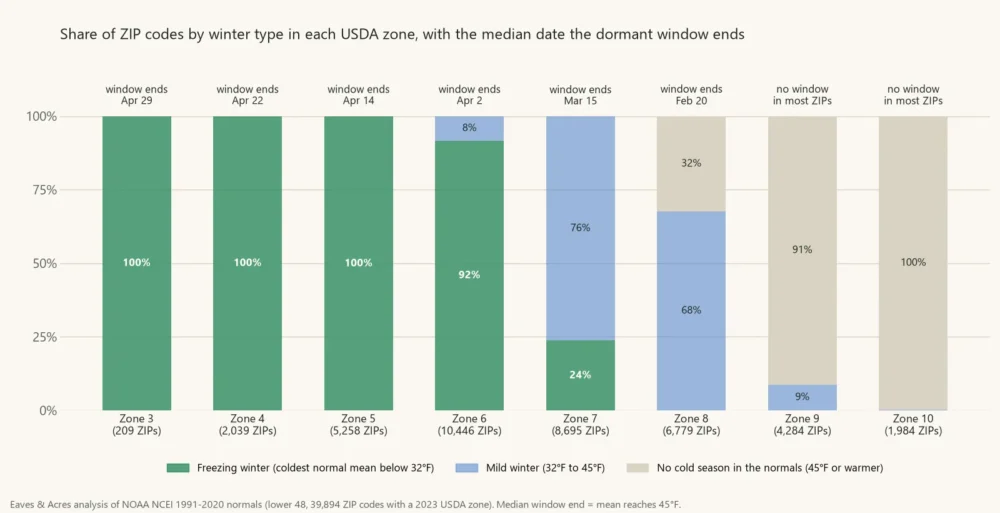
Zone gives a cleaner split than state (see planting zone vs frost date for why the two differ). Zones 3 to 5 are all freezing winters and close between April 14 and April 29; zone 6 is 92% freezing winters and closes April 2; zone 7 is the pivot, 24% freezing and 76% mild, closing March 15. Zone 8 has 32% of its ZIP codes with no cold season at all, and zones 9 and 10 are 91% and 99.8% no-cold-season, so the late-winter rule does not describe them.2
| Zone | ZIP codes | Below 32°F: freezing | 32 to 45°F: mild | 45°F or more: no cold season | Median window | Median first 32°F freeze |
|---|---|---|---|---|---|---|
| Zone 3 | 209 | 100% | 0% | 0% | Jan 29 to Apr 29 | Sep 24 |
| Zone 4 | 2,039 | 100% | 0% | 0% | Jan 29 to Apr 22 | Sep 30 |
| Zone 5 | 5,258 | 100% | 0% | 0% | Jan 29 to Apr 14 | Oct 7 |
| Zone 6 | 10,446 | 92% | 8% | 0% | Jan 29 to Apr 2 | Oct 19 |
| Zone 7 | 8,695 | 24% | 76% | 0% | Jan 29 to Mar 15 | Oct 29 |
| Zone 8 | 6,779 | 0% | 68% | 32% | Jan 29 to Feb 20 | Nov 10 |
| Zone 9 | 4,284 | 0% | 9% | 91% | No cold season in most ZIP codes | Dec 4 |
| Zone 10 | 1,984 | 0% | 0% | 100% | No cold season in most ZIP codes | Dec 25 |
How we calculated these dates, and what they cannot tell you
Daily temperatures are NOAA’s monthly normals placed on the 15th of each month and interpolated linearly, for the station nearest each ZIP code.1 The coldest day is searched between January 1 and February 28; because the curve is linear between monthly values it falls on January 15 in 86.4% of ZIP codes, so the window opens on January 29 almost everywhere and the place-to-place difference is in the closing date. First-freeze dates in January to June are counted in the following year. Groups use each ZIP code’s coldest normal daily mean: below 32°F, 32°F to 45°F, and 45°F or more. Zones are the 2023 USDA map,2 and what changed in 2023 is covered separately.
Treat the window as a planning range. Air stands in for the wood, a single winter can run weeks ahead of or behind the normal, and the 45°F closing line is a fit to the published calendars, not a published rule. We do not predict bud break or count chill hours, so mild-winter places such as Little Rock are the least reliable. We also do not cover cutting technique beyond what the sources above say, other fruit trees, espalier or crabapples, or the pruning of apple trees outside the United States.
 Related guideWhen to Plant Trees and Shrubs: Fall Dates Counted From Your Freeze
Next steps
Look up your frost dates with the frost date lookup and your zone with the planting zone tool. Blossoms on a freshly pruned tree are still exposed to a late freeze; see when to cover plants for frost. Our other pruning-timing guides cover roses and hydrangeas, and when to plant trees covers getting a tree into the ground.
Frequently asked questions
Late winter, before the buds swell. Iowa says March and early April, Wisconsin March and April, Maryland and Arkansas February or March, and Nebraska January through March. In NOAA normals our window runs from about January 29 to a median of April 8 in freezing-winter ZIP codes and to March 6 in milder ones.
Late winter yes, early winter no. UNH, Iowa State and SDSU warn that early-winter pruning raises the risk of winter injury, and Maine says it takes two weeks for a tree to regain hardiness lost to pruning. In freezing-winter ZIP codes the median first freeze comes 106 days before our window opens.
Lightly. Sources use summer pruning to remove water sprouts and suckers, with last dates from July 31 (UGA, NC State) to August 31 (Nebraska). Virginia Tech says research does not show that summer pruning suppresses vigor more than dormant pruning, and fire blight years call for extra care.
The sources advise against it. Minnesota says autumn or early winter pruning is more likely to cause drying and die-back, and NC State says to avoid pruning in fall when fire blight is active. Nebraska says suckers, water sprouts and diseased or damaged wood can be removed anytime during the year.
Iowa State says to prune immediately after planting and to spend the first three to five years building the framework, then follow the late-winter window. Maryland says young trees should never be pruned during or after bloom, and NC State says to prune the youngest trees last because they are more prone to winter injury.
In the same late-winter window, spread over time. Iowa State says late February to early April and a gradual reduction over 2 to 3 years, Clemson says two to three seasons, NC State says no more than 30% of the top, and Oklahoma State says no more than a third of the wood, expecting vigorous regrowth.
The window opens about January 29 everywhere. Median closing dates across each state’s ZIP codes are April 14 in Michigan, April 18 in Wisconsin and Minnesota, March 31 in Ohio, April 2 in Pennsylvania, April 4 in Colorado (March 22 to May 13 across the state), March 6 in Oregon and February 21 in North Carolina.
Utah State says pruning after bud swell can knock blossoms and buds off the remaining branches. The University of Vermont says to prune at silver tip, before the tips turn green, and Maryland says young trees should never be pruned during or after bloom.
Sources
- 1.U.S. Climate Normals 1991–2020. NOAA National Centers for Environmental Information, 2021. Used for: monthly temperature normals and median last- and first-frost dates for every ZIP code Back to text
- 2.2023 USDA Plant Hardiness Zone Map. USDA Agricultural Research Service, 2023. Used for: zones based on the average annual extreme minimum winter temperature; zone by ZIP code Back to text
- 3.Training and Pruning Apple Trees. Utah State University Extension, 2017. Used for: dormant pruning after the coldest part of winter and before bud swell; summer pruning and vigor; fire blight and hot, dry weather Back to text
- 4.Prune apple trees in late winter for stronger growth and better fruit. Oregon State University Extension Service, 2025. Used for: late winter is the best time; the worst of the cold has passed; first four or five years; water sprouts each summer Back to text
- 5.Pruning, Growing Fruit Trees in Maine. University of Maine Cooperative Extension, 2024. Used for: pruning lessens winter hardiness; two weeks to regain it; late July or August summer pruning Back to text
- 6.Growing Tree Fruit in Colorado Gardens. Colorado State University Extension, 2026. Used for: pruning in late winter after the high potential for extreme cold has passed and before bud swell Back to text
- 7.The Art of Fruit Tree Pruning. Colorado State University Extension, Dolores County, n.d. Used for: January start, March best; finish before bud swell; not after August 1; not early-to-mid winter Back to text
- 8.Pruning trees and shrubs. University of Minnesota Extension, 2026. Used for: apple trees in late winter (February to early April); fireblight and spring or summer pruning; autumn or early winter drying and die-back Back to text
- 9.Pruning Apple Trees. Iowa State University Extension and Outreach, 2026. Used for: dormant pruning in late winter or early spring; avoid early winter; summer pruning sparingly; young and neglected trees Back to text
- 10.How to Prune and Train Young Apple Trees. Iowa State University Extension and Outreach, 2023. Used for: March and early April in Iowa; prune newly planted trees immediately Back to text
- 11.How to Prune Neglected Apple Trees. Iowa State University Extension and Outreach, 2023. Used for: late February to early April; rejuvenation over 2 to 3 years Back to text
- 12.Training and Pruning Apple Trees. University of Wisconsin-Madison Division of Extension, n.d. Used for: late winter or early spring; March and April are best Back to text
- 13.Growing Fruits: Care of Mature Backyard Apple Trees. University of New Hampshire Extension, 2017. Used for: ideal time February to April; avoid fall or early winter pruning Back to text
- 14.Pruning Your Fruit Trees: It’s Not Too Late. University of Vermont Extension, 2024. Used for: March a great time; silver tip stage; one-third of branches per year Back to text
- 15.Growing Apple and Pear Trees in a Home Garden. University of Maryland Extension, 2026. Used for: late winter (February or March); young trees never during or after bloom Back to text
- 16.Pruning Overgrown Apple Trees. Purdue Extension, DeKalb County, 2023. Used for: late February into early March for an overgrown tree Back to text
- 17.Fruit Trees for the Home Landscape, EC1233. University of Nebraska-Lincoln Extension, 2018. Used for: dormant window January through March; no pruning before January; summer pruning not after the end of August Back to text
- 18.Pruning Apple and Pear Trees, MF3450. Kansas State University Research and Extension, 2019. Used for: March in much of Kansas; southern Kansas from around Valentine’s Day; early summer water sprouts Back to text
- 19.Pruning Fruit Trees. South Dakota State University Extension, 2018. Used for: February to April; avoid early winter; stop before forecasts below 0°F Back to text
- 20.Apple Production in the Home Garden, FSA6058. University of Arkansas Division of Agriculture, 2009. Used for: prune every year in late winter (February or March) Back to text
- 21.Pruning Fruit Trees, FSA6042. University of Arkansas Division of Agriculture, n.d. Used for: finish just before bud break; sap flow does not harm Back to text
- 22.Home Fruit Orchard Pruning Techniques, C 1087. University of Georgia Cooperative Extension, 2020. Used for: dormant pruning in late winter or early spring; summer pruning from early bud growth to the end of July Back to text
- 23.Tree Fruit and Nuts, Extension Gardener Handbook ch. 15. NC State Extension, n.d. Used for: delay dormant pruning until late winter; no summer pruning after the end of July; prune oldest trees first; avoid fall pruning when fire blight is active Back to text
- 24.Pruning & Training Apple & Pear Trees, HGIC 1351. Clemson Cooperative Extension, 2019. Used for: dormant season before active growth; summer pruning for waterspouts and fire-blight wood; spread correction over two to three seasons Back to text
- 25.Growing Apples in the Home Garden, HLA-6265. Oklahoma State University Extension, 2026. Used for: prune in late winter; not more than a third of the wood; summer pruning in August Back to text
- 26.Training and Pruning Apple Trees, 422-021. Virginia Cooperative Extension, Virginia Tech, 2025. Used for: late winter after the threat of severe cold; not during or just before extreme cold; summer pruning not shown to suppress vigor Back to text
How this guide was made
- Written by the Yard & Garden Desk and reviewed by the Data & Methodology Desk.
- Data: monthly temperature normals and median last- and first-frost dates from NOAA NCEI U.S. Climate Normals 1991–2020 for the station nearest each ZIP code, with daily values interpolated from the monthly normals; USDA 2023 Plant Hardiness Zone Map; pruning windows and limits from Utah State, Oregon State, Maine, Colorado State, Minnesota, Iowa State, Wisconsin, New Hampshire, Vermont, Maryland, Purdue, Nebraska, Kansas State, South Dakota State, Arkansas, Georgia, NC State, Clemson, Oklahoma State and Virginia Tech extension. Air temperature stands in for the temperature of the wood, chill hours and bud break are not modeled, and the 45°F closing line is a fit to published calendars, not a published rule. See our methodology.
- AI use: AI tools help us research, draft and check this guide. Every figure is checked against the source cited for it, and calculated figures come from our own code, described on the methodology page.
- Spotted an error? Tell us and the form opens with this page’s address filled in.
Change log
- Nov 25, 2026Published.
- Oct 27, 2026Drafted. Dormant pruning windows for 31 cities, 8 states and USDA zones 3 to 10 from NOAA 1991–2020 normals for 40,557 lower-48 ZIP codes, tested against twelve extension calendar statements; summer pruning limits from seven sources.
Covers lawns, gardens, frost and planting. We write the guides that tell you when to seed, feed and plant for your ZIP, using the frost-date and zone lookups that the Data & Methodology Desk maintains.
Keep reading
Winter Sowing: When to Start and What to Sow Where You Live
Sow seeds outdoors in covered jugs in winter and let the cold break their dormancy. Extension timing by seed type, plus the last start date for 30- and 60-day seeds in 22 cities from NOAA normals.
When to Plant Tomatoes Outdoors: Dates for Where You Live
Plant tomatoes once frost risk is low and nights reach 50°F, usually 3–4 weeks after the average last frost. Dates for 26 cities from NOAA normals.
When to Plant Pumpkins: Count Back From Halloween, Not Forward From Frost
Sow pumpkins once the soil reaches about 65°F, a median 37 days after the last frost, then count back 90 to 120 days from Halloween or the first frost. Dates for 24 cities.
Seasonal reminders for your ZIP
Get a short email when it’s time to overseed, start seeds, open the pool or service your furnace, timed to your climate.