When to Plant Blueberry Bushes: Dates by City and Zone
Blueberry type, chilling hours and zone each limit the calendar. We tested twelve extension calendars against NOAA normals for 40,557 ZIP codes to find where spring, fall or late winter is the planting season.
- 26 cited sources
- 15 min read

Set your ZIP to see dates for your area.
- 1Plant blueberries dormant: in spring, after the thaw and before the buds break, where winters freeze, and from late fall to late winter where they are mild. Minnesota says late April or early May; UF/IFAS says mid-December to mid-February.
- 2Your coldest stretch sets the season: 48.2% of lower-48 ZIP codes (coldest daily mean below 32°F) plant in spring, 30.0% (40°F or more) from late fall to late winter, and 21.8% sit between. Zone 7 is the pivot: 24% spring, 73% in between.
- 3In the warm group the median freeze season runs November 20 to March 10. It covers at least 80% of the published window in 7 of 11 extension comparisons and misses Oregon State’s early October.
- 4Test the soil first: only pH 4.5 to 4.8 sits inside the ranges of all 14 sources, sulfur takes months to work, and the flowers come off for the first year or two.
Plant blueberry bushes while they are dormant: in spring, as soon as the soil thaws and before the buds break, where winters are cold, and from late fall through late winter where they are mild. Your coldest stretch decides which. In NOAA’s normals, 48.2% of lower-48 ZIP codes have a coldest daily mean below 32°F and plant in spring, 30.0% never average below 40°F and plant from late fall to late winter, and 21.8% sit between the two.
Extension sources agree on the rules and leave you to turn them into dates. We set them beside NOAA 1991–2020 normals1 for 40,557 ZIP codes, tested the dates against twelve published calendars, and checked each blueberry type against the 2023 USDA hardiness zone map.2 Everything uses air temperature in place of soil temperature, because our NOAA data has no soil readings, and our 45°F spring line is a calibration to other crops, not a published blueberry rule. Google’s AI Overview, when we checked on October 26, 2026, said early spring before bud break or late fall, March through April in the Midwest and Northeast, and fall or late winter in the South.
The type you buy changes the calendar
Three types reach US gardeners. Northern highbush is the most cold-hardy, southern highbush hybrids break dormancy earlier and take heat and drought better, and rabbiteye is a southern species, the University of Maryland says.21 Oregon State rates northern highbush cultivars for zones 4 to 8 and rabbiteye for zones 7 to 9,8 and the University of Georgia calls rabbiteye the best choice for home gardens in that state.16 Table 1 puts each type’s chilling need, hardiness and planting window side by side.
| Type | Chilling hours (below 45°F) | Hardiness zones | Planting window in the sources |
|---|---|---|---|
| Northern highbush | 800 to 1,000 (UC Cooperative Extension) | 4 to 8 (Oregon State); 4 to 7 (UConn) | Spring before bud break (UConn, Maine, Arbor Day, Penn State); late April or early May in zones 3 and 4 (Minnesota); January to March in northwest Washington |
| Southern highbush | 150 to 800 (UC); 300 to 550 for the cultivars Clemson lists | Not suited to any region of Oregon: blooms in February in the Willamette Valley (Oregon State) | Mid-December to mid-February in Florida (UF/IFAS); November to February in Mississippi |
| Rabbiteye | 350 to 700 (Texas A&M, Table 1) | 7 to 9 (Oregon State) | Late fall through late winter in Alabama; fall in North Carolina (NC State); February to March in Wilson County, NC; winter in Georgia |
Chilling hours are the hours below 45°F a plant needs each winter to bloom and leaf out normally, as UC Cooperative Extension and Clemson both define them.20,18 Texas A&M advises choosing a variety whose requirement is within 150 hours of your area’s average.19 Our data holds monthly averages, not hourly readings, so we do not count chilling hours; check the variety against your county extension office.
Cold winters: plant in spring, between the thaw and the last frost
The extension sources for Minnesota, Maine, Connecticut and Pennsylvania all put blueberries in the ground in spring. UConn says to plant before bud break,5 the University of Maine says early spring with two- or three-year-old plants,4 the Arbor Day Foundation says to plant a new northern highbush in early spring as soon as it arrives,7 and Penn State says to test and amend the soil in early fall for spring planting.6 The University of Minnesota is the one that gives a date, for zone 3 and 4 gardens:3
Plant young blueberry bushes in late April or early May.
Bare-root plants from online nurseries arrive dormant, and Minnesota says most nurseries ship them at the right time for early spring planting.3 Table 2 turns the rule into dates for the cold-winter and in-between cities in our set: the first day the normal daily mean air temperature reaches 45°F, then the median and 10% last-frost dates.
| City (ZIP, zone) | Air mean reaches 45°F | Median last 32°F frost | 10% chance of frost after | Coldest normal daily mean |
|---|---|---|---|---|
| Boise, ID (83702, zone 7a) | Apr 4 | May 17 | Jun 10 | 30.1°F |
| Grand Rapids, MI (49503, zone 6a) | Apr 13 | May 6 | May 23 | 23.8°F |
| Madison, WI (53703, zone 5b) | Apr 12 | May 1 | May 17 | 19.4°F |
| Denver, CO (80202, zone 6a) | Mar 22 | Apr 30 | May 13 | 34.0°F |
| Burlington, VT (05401, zone 5b) | Apr 14 | Apr 29 | May 11 | 20.9°F |
| Portland, ME (04101, zone 6a) | Apr 17 | Apr 26 | May 7 | 24.0°F |
| Minneapolis, MN (55401, zone 5a) | Apr 14 | Apr 23 | May 7 | 14.9°F |
| State College, PA (16801, zone 6b) | Apr 5 | Apr 20 | May 6 | 27.2°F |
| Columbus, OH (43215, zone 6b) | Mar 27 | Apr 20 | May 7 | 28.7°F |
| Hartford, CT (06103, zone 6b) | Apr 2 | Apr 17 | May 1 | 28.6°F |
| College Park, MD (20742, zone 7b) | Mar 19 | Apr 10 | May 1 | 34.0°F |
| Boston, MA (02108, zone 7a) | Apr 5 | Apr 4 | Apr 17 | 29.9°F |
| Richmond, VA (23219, zone 7b) | Mar 3 | Apr 3 | Apr 18 | 38.3°F |
| Nashville, TN (37201, zone 7b) | Feb 26 | Apr 1 | Apr 16 | 37.8°F |
| Louisville, KY (40202, zone 7a) | Mar 10 | Mar 31 | Apr 14 | 34.6°F |
| New York, NY (10001, zone 7b) | Mar 22 | Mar 30 | Apr 9 | 33.7°F |
| Mount Vernon, WA (98273, zone 8b) | Mar 12 | Mar 24 | Apr 14 | 39.5°F |
Across the 19,548 ZIP codes in the spring group the median 45°F date is April 8 and the middle 80% run from March 24 to April 24. The median last 32°F frost is April 29 and the 10% date is May 14, so the median gardener has 21 days between thaw and last frost, and in 99.5% of these ZIP codes the thaw comes first.1 Minneapolis shows where Minnesota’s dates fall: late April to early May, read as April 20 to May 10, lands within 3 days of the median last frost (April 23) and the 10% date (May 7), six days after our April 14 thaw date. In the coldest zones, then, the published date is the last-frost end of the window, and the thaw date is the earliest a dormant plant could go in.
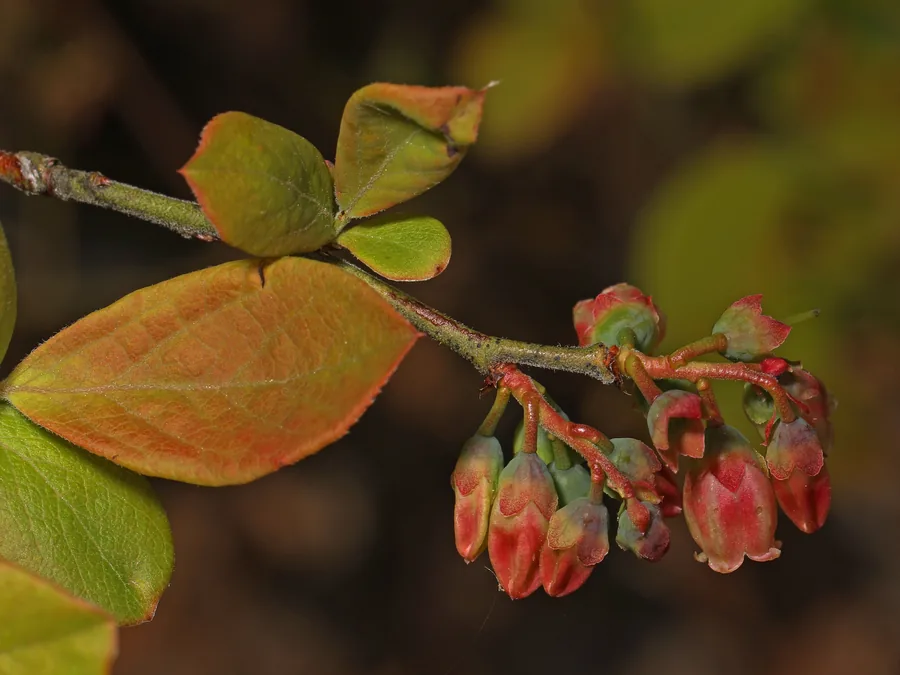

Our data cannot predict bud break, so we give no end date. Check the buds on the plant in your hand and plant while they are still tight.
Mild winters: plant from late fall through late winter
Where the ground does not stay frozen, the sources move the window into the dormant season. UF/IFAS gives the tightest dates:10
The best time to plant blueberries in Florida is from mid-December to mid-February.
Mississippi State says you can plant between November and February, with the ideal time before the end of December so roots establish before spring.11 Alabama Extension says late fall through late winter,12 NC State’s blueberry program calls fall the ideal planting time,13 and the Wilson County agent says late winter, February to March.14 The University of Georgia says winter is a good time to plant, the earlier the better, because dormant planting means less shock and wetter soil,15 and LSU AgCenter says fall through early spring suits blueberries, so plants establish before summer heat.17 UC Cooperative Extension says blueberries are often planted in the dormant season, mainly December and January,20 and Washington State’s Skagit County office says January to March.9
These windows share an edge: freezing nights. We took the median first 32°F freeze as the start of the dormant season and the median last 32°F frost as its end. Table 3 gives both for 24 cities.
| City (ZIP, zone) | Median first 32°F freeze | Median last 32°F frost | Days between | Coldest normal daily mean |
|---|---|---|---|---|
| Denver, CO (80202, zone 6a) | Oct 12 | Apr 30 | 200 | 34.0°F |
| Corvallis, OR (97330, zone 8b) | Oct 28 | Apr 17 | 171 | 40.3°F |
| Nashville, TN (37201, zone 7b) | Oct 31 | Apr 1 | 152 | 37.8°F |
| College Park, MD (20742, zone 7b) | Nov 1 | Apr 10 | 160 | 34.0°F |
| Salem, OR (97301, zone 8b) | Nov 1 | Apr 3 | 153 | 41.3°F |
| Mount Vernon, WA (98273, zone 8b) | Nov 3 | Mar 24 | 141 | 39.5°F |
| Richmond, VA (23219, zone 7b) | Nov 4 | Apr 3 | 150 | 38.3°F |
| Atlanta, GA (30303, zone 8a) | Nov 8 | Mar 24 | 136 | 43.6°F |
| Raleigh, NC (27601, zone 8a) | Nov 8 | Mar 28 | 140 | 41.7°F |
| Starkville, MS (39759, zone 8a) | Nov 8 | Mar 23 | 135 | 43.7°F |
| Louisville, KY (40202, zone 7a) | Nov 9 | Mar 31 | 142 | 34.6°F |
| Little Rock, AR (72201, zone 8a) | Nov 10 | Mar 21 | 131 | 40.7°F |
| Wilson, NC (27893, zone 8a) | Nov 12 | Mar 22 | 130 | 42.4°F |
| Auburn, AL (36830, zone 8b) | Nov 17 | Mar 13 | 116 | 45.7°F |
| Seattle, WA (98101, zone 9a) | Nov 17 | Mar 13 | 116 | 42.0°F |
| Hammond, LA (70401, zone 9a) | Nov 19 | Mar 8 | 109 | 49.9°F |
| Jackson, MS (39201, zone 8b) | Nov 19 | Mar 6 | 107 | 47.4°F |
| New York, NY (10001, zone 7b) | Nov 20 | Mar 30 | 130 | 33.7°F |
| Tyler, TX (75701, zone 8b) | Nov 21 | Mar 7 | 106 | 48.2°F |
| Reidsville, GA (30453, zone 9a) | Nov 24 | Mar 9 | 105 | 49.0°F |
| College Station, TX (77840, zone 9a) | Nov 30 | Feb 27 | 89 | 51.5°F |
| Portland, OR (97201, zone 8b) | Dec 1 | Feb 25 | 86 | 41.6°F |
| Gainesville, FL (32601, zone 9a) | Dec 2 | Mar 3 | 91 | 54.8°F |
| Sacramento, CA (95814, zone 9b) | Dec 16 | Jan 12 | 27 | 48.5°F |
Across the 10,638 ZIP codes in the warm group that have both dates, the median freeze season runs from November 20 to March 10, 111 days; 68.0% have 90 days or more and 41.1% have 120 or more.1 NOAA lists no median freeze for the other 1,540, where frost is rare. In the in-between group the season is longer, 160 days from October 30 to April 8, but the soil is colder; Washington State’s January-to-March calendar fits Mount Vernon, which is in this group (coldest normal mean 39.5°F). The chart shows both windows for every city.

How our dates compare with published calendars
Twelve comparisons gave us something to test. Table 4 reads each published window as shown against our freeze season, or against Minnesota’s last-frost dates. Our dormant season covers at least 80% of the published window in 7 of the 11 freeze-season comparisons. It is narrower than LSU’s fall through early spring (58% covered) and UC’s December and January (45%), because those sources describe longer seasons than the freeze dates do, and it misses Oregon State’s early October entirely. Minneapolis matches Minnesota’s late April to early May to within 3 days at both ends.
| Source (place) | Published window | Our date | Fit |
|---|---|---|---|
| UF/IFAS Blueberry Gardener’s Guide (Florida) (Gainesville, FL) | Mid-December to mid-February | Dec 2 to Mar 3 | All inside ours |
| Mississippi State Extension (Jackson, MS) | November to February; ideal before the end of December | Nov 19 to Mar 6 | 85% inside ours |
| Mississippi State Extension (Starkville, MS) | November to February; ideal before the end of December | Nov 8 to Mar 23 | 94% inside ours |
| Alabama Extension (ANR-1078) (Auburn, AL) | Late fall through late winter (read as Nov 1 to Mar 20) | Nov 17 to Mar 13 | 84% inside ours |
| NC State Extension, Wilson County (Wilson, NC) | Late winter (February to March) | Nov 12 to Mar 22 | 85% inside ours |
| UGA Extension, Tattnall County (Reidsville, GA) | Winter, the earlier the better (read as Dec 1 to Feb 28) | Nov 24 to Mar 9 | All inside ours |
| LSU AgCenter (Hammond, LA) | Fall through early spring (read as Sep 22 to Mar 31) | Nov 19 to Mar 8 | 58% inside ours |
| UC Cooperative Extension, Sacramento (EHN 88) (Sacramento, CA) | Dormant season, mainly December and January | Dec 16 to Jan 12 | 45% inside ours |
| WSU Extension, Skagit County (Mount Vernon, WA) | January to March | Nov 3 to Mar 24 | 92% inside ours |
| Oregon State Extension (EC 1304), fall (Corvallis, OR) | Fall: early October (read as Oct 1 to Oct 10) | Oct 28 to Apr 17 | None inside ours; published date is earlier |
| Oregon State Extension (EC 1304), fall (Portland, OR) | Fall: early October (read as Oct 1 to Oct 10) | Dec 1 to Feb 25 | None inside ours; published date is earlier |
| University of Minnesota Extension (Minneapolis, MN) | Late April or early May (read as Apr 20 to May 10) | Thaw Apr 14; last frost Apr 23 (50%), May 7 (10%) | Within 3 days of both last-frost dates |
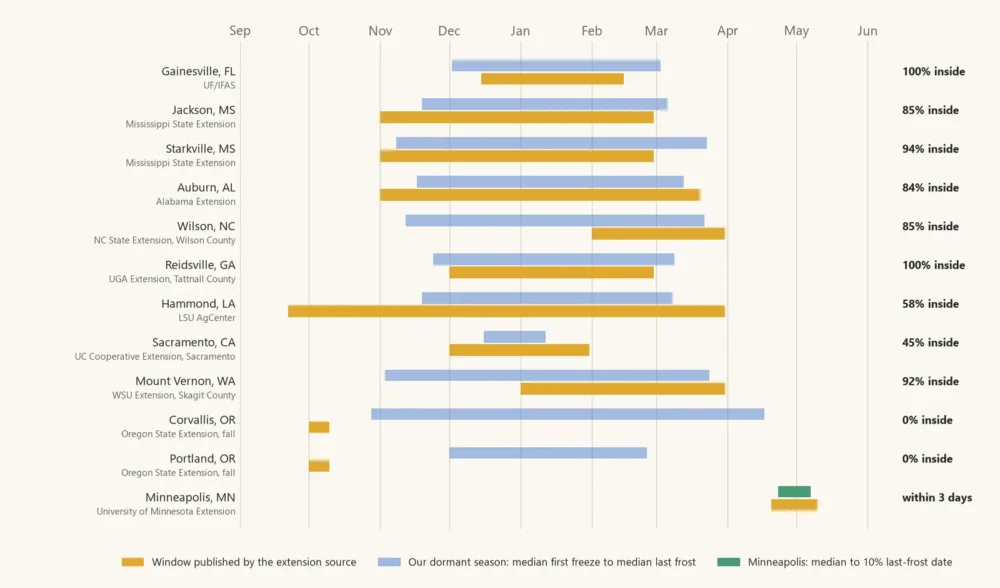
Oregon is the limit of the rule. Oregon State says you may plant blueberries in the fall (early October) in the Willamette Valley or in spring in all regions, and most nursery plants are sold in spring.8 Counted back from the median first freeze, early October is 27 days ahead at Corvallis (October 28) and 61 days ahead at Portland (December 1), so a rule that starts at the first freeze cannot reach it. One popular rule fails the other way. Martha Stewart’s guide advises fall planting 60 to 90 days before the first hard frost;23 on our median 28°F dates that is July 29 to August 28 in Minneapolis and August 25 to September 24 in Raleigh, dates none of the extension sources we read recommend.
Hardiness zone fit and the spring-or-fall split
A hardiness zone says whether a blueberry survives your winter, not when to plant it: the USDA map is based on the average annual extreme minimum winter temperature.2 Oregon State rates northern highbush cultivars for zones 4 to 8 and rabbiteye for zones 7 to 9,8 UConn says bushes are hardy in zones 4 to 7 with a few varieties to zone 3,5 and Minnesota grows its varieties in zones 3 and 4.3 On the 2023 map, zones 4 to 8 cover 83.3% of the 39,894 lower-48 ZIP codes with a zone, zones 4 to 7 cover 66.3%, and zones 7 to 9 cover 49.5%. Zones 7 and 8, where both types are rated, hold 38.8%, and only 6.0% fall outside every range. Table 5 adds the planting season for each zone.
| Zone | ZIP codes | Below 32°F: spring | 32 to 40°F: either | 40°F or more: fall to late winter | Median spring start (air mean 45°F) | Median first freeze to last frost |
|---|---|---|---|---|---|---|
| Zone 3 | 209 | 100% | 0% | 0% | Apr 29 | Ground freezes: plant in spring |
| Zone 4 | 2,039 | 100% | 0% | 0% | Apr 22 | Ground freezes: plant in spring |
| Zone 5 | 5,258 | 100% | 0% | 0% | Apr 14 | Ground freezes: plant in spring |
| Zone 6 | 10,446 | 92% | 8% | 0% | Apr 2 | Ground freezes: plant in spring |
| Zone 7 | 8,695 | 24% | 73% | 3% | Mar 15 | Oct 29 to Apr 11 (164 days) |
| Zone 8 | 6,779 | 0% | 21% | 79% | Feb 16 (68% of ZIP codes; the rest never below 45°F) | Nov 10 to Mar 24 (135 days) |
| Zone 9 | 4,284 | 0% | 1% | 99% | None: no day averages below 45°F | Dec 4 to Feb 21 (78 days) |
| Zone 10 | 1,984 | 0% | 0% | 100% | None: no day averages below 45°F | Dec 25 to Jan 17 (16 days) |

Zones 3 to 5 are spring-only in all but 0.1% of ZIP codes, and zone 6 is 92% spring. Zone 7 is the pivot: 24% spring, 73% in between and 3% fall to late winter, with a median spring start of March 15 and a median freeze season from October 29 to April 11. Zone 8 is 79% fall to late winter, and zones 9 and 10 are 99% or more. Look up your zone with our planting zone by ZIP code tool, read why zone and frost date answer different questions, and see what changed on the 2023 map.
Bare-root or container
Blueberries are sold bare-root or in pots. Bare-root plants arrive dormant and should go in at once: the Arbor Day Foundation says to keep new arrivals cool with moist roots until planting and to soak the roots for 3 to 6 hours first,7 and Minnesota says a couple of hours.3 UF/IFAS says either form works in its mid-December to mid-February window, with bare-root roots kept moist but not overly wet.10 Texas A&M says to cut bare-root tops back by half, with lighter pruning enough for container stock,19 and the Wilson County agent says about two-thirds on bare-root plants and half on potted ones.14
Potted plants are the flexible form. UC Cooperative Extension says potted plants can be planted anytime,20 and Oregon State says a spring planting should be pruned at once even if it has started to flower.8 The cost of anytime is summer: LSU AgCenter says to get plants in while the weather is cool so they establish before summer heat.17
Test the soil before you buy the plant
Soil pH matters more than the date. The 14 extension sources we read give 14 different ranges, from 4.0 at the low end to 5.5 at the high end, and only 4.5 to 4.8 sits inside all of them; 13 of the 14 cover 4.5 to 5.0. Table 6 lists them. Sulfur takes months to work, so spring planting starts the autumn before: Maryland says pH adjustments are best done six months before planting,21 Georgia says six months,16 Minnesota says amend in the fall before planting,3 and Oregon State says to test a year ahead.8
| Source | pH range | As stated |
|---|---|---|
| UConn | 4.0 to 4.8 | pH should be in the 4.0-4.8 range |
| University of Minnesota | 4.0 to 5.0 | Planting section: pH 4.0 to 5.0 (the same page also says 4.0 to 5.5) |
| Arbor Day Foundation | 4.0 to 5.2 | highbush: pH of 4.0-5.2 |
| Texas A&M AgriLife | 4.0 to 5.5 | rabbiteye: 4.0 to 5.5 |
| UF/IFAS | 4.0 to 5.5 | soil pH of 4.0-5.5 |
| Washington State (Skagit) | 4.2 to 5.5 | pH of 4.2 to 5.5 |
| Penn State | 4.5 to 5.0 | ideal pH between 4.5 and 5.0 |
| University of Maine | 4.5 to 5.2 | within the range of 4.5 to 5.2 |
| LSU AgCenter | 4.5 to 5.2 | about 4.5 and 5.2 (up to 5.5 is OK for rabbiteye) |
| University of Georgia | 4.5 to 5.2 | 4.5 to 5.2 |
| University of Maryland | 4.5 to 5.5 | 4.5-5.5 range |
| Oregon State | 4.5 to 5.5 | pH of 4.5 to 5.5 |
| UC Cooperative Extension | 4.5 to 5.5 | pH of 4.5 to 5.5 |
| Mississippi State | 4.5 to 5.5 | Ideal pH is 4.5 to 5.5 |

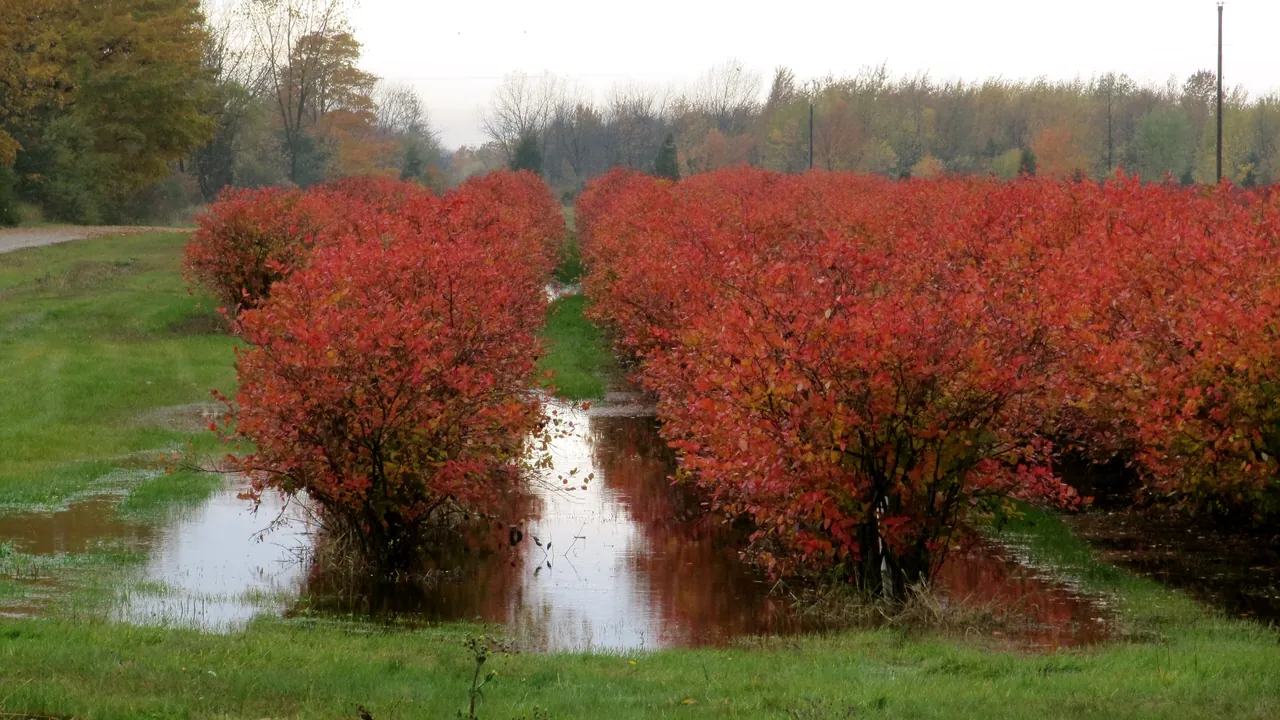
Rain is a clue to whether you need to amend. University of Wyoming Extension says alkaline soils occur where annual rainfall is under about 20 inches.22 In NOAA normals 13.8% of lower-48 ZIP codes (5,609) are under that line: at least 80% of ZIP codes in Arizona, Colorado, Montana, New Mexico, Nevada, Utah and Wyoming, and none in 31 states and the District of Columbia.1 It is only a clue. No Minnesota ZIP code is under 20 inches, yet Minnesota says most of its garden soils have a higher pH and must be amended.3 Sacramento’s normal is 19.1 inches, and UC says the soil blueberries need is not found naturally there.20 Oregon State says soils in many parts of central and eastern Oregon are naturally alkaline and points those gardeners to raised beds or containers with an acidic mix,8 and LSU AgCenter warns that typical potting mixes are not acidic enough.17 If water stands after rain, as in the photo above, UF/IFAS says to plant on raised beds, because roots in saturated soil for more than a few days risk Phytophthora root rot.10 Our guide to when to apply lime to a lawn covers the opposite problem.
Pick off the flowers the first year or two
The planting date also sets the date of the first harvest, because every source says to remove the flowers first. UF/IFAS says to remove all flowers before fruit set in the first growing season,10 and Georgia says the same for the first year and nearly all flower buds in the second.16 Washington State says the first year or two,9 Minnesota and Maine say the first two years,3,4 Penn State says two years and up to half the third,6 and UConn says the year of planting and the next.5 Maine says to leave a few clusters in year three for a small crop and allow a full crop four or five years after planting,4 and Mississippi State says to expect two to three years before a harvestable amount of fruit.11


How we calculated these dates
Daily temperatures are NOAA’s monthly normals placed on the 15th of each month and interpolated linearly, for the station nearest each ZIP code.1 The spring start is the first day the normal daily mean reaches 45°F after the coldest day of the year, the same line we calibrated for fruit trees. The dormant season runs from the median first 32°F freeze to the median last 32°F frost; first-freeze dates in January to June are counted in the following year. Groups use each ZIP code’s coldest normal daily mean: below 32°F, 32 to 40°F, and 40°F or more. Zones are the 2023 USDA map.2 Soil lags air, and a single year can run weeks ahead of or behind the normal.
 Related guideWhen to Plant Trees and Shrubs: Fall Dates Counted From Your Freeze
Next steps
Look up your frost dates with the frost date lookup. Early bloomers are exposed in a late freeze, and Alabama says to plant in a protected site away from frost pockets;12 see when to cover plants for frost. Other small fruit have their own windows: when to plant strawberries, when to plant fruit trees and when to mulch.
Frequently asked questions
It depends on your winter. Minnesota Extension says late April or early May for zones 3 and 4, UF/IFAS says mid-December to mid-February in Florida, and Mississippi State says November to February, ideally before the end of December. In NOAA normals 48.2% of lower-48 ZIP codes are spring-planting climates and 30.0% plant from late fall to late winter.
Spring where winters freeze hard: UConn, Maine, Minnesota and Penn State all point to spring. Fall through late winter where winters are mild: NC State calls fall ideal and Alabama says late fall through late winter. Zone 7 is the pivot, with 73% of its ZIP codes in the in-between group, so check your county extension office.
Yes where the soil is not frozen. The University of Georgia says winter is a good time, the earlier the better; Washington State says January to March; UF/IFAS says mid-December to mid-February. In the 10,638 warmest ZIP codes with a freeze date the median freeze season runs from November 20 to March 10.
Potted plants can be planted anytime, UC Cooperative Extension says, but LSU AgCenter advises planting while the weather is cool so roots establish before summer heat. None of the sources we read names summer as the best time.
Yes. UF/IFAS, Georgia, Washington State, Minnesota, Maine, Penn State and UConn all say to remove flowers in the first year or longer: two years for Minnesota, Maine and Penn State. Maine allows a few clusters in year three.
Mississippi State says two to three years for a harvestable amount, and Minnesota says large harvests come after 2 or 3 years. UConn says plants begin to fruit in the third year but are not fully productive until year 6.
Plant two or more varieties. UConn says cross-pollination gives earlier and larger berries and recommends 2 to 3 varieties, LSU AgCenter says to buy more than one plant of any type, and Texas A&M says most rabbiteye varieties need a pollenizer nearby.
Container production is an alternative for home gardeners, UF/IFAS says. Use an acidic mix: LSU AgCenter says aged pine bark instead of standard potting mix, which usually contains lime. UC says potted plants can go in anytime, and Oregon State says to prune a spring planting at once.
Sources
Sources labeled Compared are popular pages we checked our answer against. They are not extension, government, standards or manufacturer sources. How we choose sources
- 1.U.S. Climate Normals 1991–2020. NOAA National Centers for Environmental Information, 2021. Used for: monthly temperature and precipitation normals and median last- and first-frost dates for every ZIP code Back to text
- 2.2023 USDA Plant Hardiness Zone Map. USDA Agricultural Research Service, 2023. Used for: zones based on the average annual extreme minimum winter temperature; zone by ZIP code Back to text
- 3.Growing blueberries in the home garden. University of Minnesota Extension, 2026. Used for: plant in late April or early May; bare-root ships for early spring; pH 4.0 to 5.0; amend with sulfur in fall; remove flowers first two years Back to text
- 4.Bulletin #2253, Growing Highbush Blueberries. University of Maine Cooperative Extension, n.d. Used for: plant in early spring; pH 4.5 to 5.2; no fruit first two years; few clusters in year three Back to text
- 5.Blueberries. UConn Home & Garden Education Center, 2022. Used for: plant in spring before bud break; zones 4 to 7; pH 4.0 to 4.8; flower buds removed year of planting and next; fruit from year three Back to text
- 6.Blueberries in the Garden and the Kitchen. Penn State Extension, 2026. Used for: amend soil in early fall for spring planting; pH 4.5 to 5.0; remove flowers first two years and half the third Back to text
- 7.Blueberry Bush Planting & Care Instructions. Arbor Day Foundation, n.d. Used for: plant in early spring as soon as plants arrive; soak roots 3 to 6 hours; pH 4.0 to 5.2; remove fruit buds first year Back to text
- 8.Growing blueberries in your home garden, EC 1304. Oregon State University Extension Service, 2025. Used for: fall (early October) in the Willamette Valley or spring in all regions; zones 4 to 8 and 7 to 9; pH 4.5 to 5.5; alkaline central and eastern Oregon; raised beds Back to text
- 9.Growing blueberries: Start with the right soil, Kari Ranten. Washington State University Extension, Skagit County, 2025. Used for: plant January to March; pH 4.2 to 5.5; remove flowers first year or two Back to text
- 10.Blueberry Gardener’s Guide, CIR1192, J. G. Williamson and D. A. Phillips. UF/IFAS Extension, 2012. Used for: best time mid-December to mid-February; bare-root or container; pH 4.0 to 5.5; raised beds; remove flowers first season Back to text
- 11.How to Plant Blueberry Bushes, Susan Collins-Smith. Mississippi State University Extension Service, n.d. Used for: plant November to February, ideal before the end of December; pH 4.5 to 5.5; two to three years to a harvestable amount Back to text
- 12.Home Gardening: Rabbiteye Blueberries, ANR-1078. Alabama Cooperative Extension System, 2021. Used for: best time late fall through late winter; plant in a protected site away from frost pockets Back to text
- 13.Home Gardeners: Blueberries. NC State Extension, 2023. Used for: fall is the ideal planting time Back to text
- 14.Growing Blueberries in the Home Garden, Cyndi Lauderdale. NC State Extension, Wilson County Center, 2022. Used for: plant in late winter (February to March); prune two-thirds of bare-root tops and half of potted; no flowers first year Back to text
- 15.Home Garden Blueberries (Tattnall County). University of Georgia Cooperative Extension, Tattnall County, 2026. Used for: winter is a good time, the earlier the better; dormant planting means less shock and wetter soil Back to text
- 16.Home Garden Blueberries, Circular 946, S. NeSmith and G. Krewer. University of Georgia Cooperative Extension, 2017. Used for: rabbiteye best for home gardens; pH 4.5 to 5.2; sulfur six months before planting; remove flowers first year and most in second Back to text
- 17.Now’s a good time to plant blueberries, Olivia McClure. LSU AgCenter, 2026. Used for: fall through early spring; pH 4.5 to 5.2; pine bark instead of potting mix; plant before summer heat Back to text
- 18.Blueberry, HGIC 1401. Clemson Cooperative Extension Home & Garden Information Center, 2023. Used for: chilling hours below 45°F; 400 to 600 hours near the South Carolina coast to 1000 to 1200 in the upper Piedmont; cultivar requirements Back to text
- 19.Texas Fruit and Nut Production: Blueberries, E-603. Texas A&M AgriLife Extension Service, 2013. Used for: rabbiteye chill hours 350 to 700; choose within 150 hours of local chilling; pH 4.0 to 5.5; cut bare-root tops by half Back to text
- 20.Growing Blueberries in the Sacramento Region, EHN 88. UC Cooperative Extension, Sacramento County, 2012. Used for: northern highbush 800 to 1000 chilling hours, southern highbush 150 to 800; dormant-season planting mainly December and January; potted plants anytime; pH 4.5 to 5.5 Back to text
- 21.Growing Blueberries in a Home Garden. University of Maryland Extension, 2026. Used for: three types; pH 4.5 to 5.5; adjust pH six months before planting Back to text
- 22.B-1358 Alkaline soils in Wyoming. University of Wyoming Extension, n.d. Used for: alkaline soils occur where annual rainfall is less than about 20 inches Back to text
- 23.Compared When to Plant Blueberry Bushes for the Best Harvest. Martha Stewart (Dotdash Meredith), 2026. Used for: early spring or fall; fall planting 60 to 90 days before the first hard frost (rule tested against NOAA dates) Back to text
- 24.Photo: Blueberry farm Allegan County Michigan, Rachel Kramer (CC BY 2.0). Wikimedia Commons, 2009. Used for: hero photo
- 25.Photo: 366 Highbush Blueberry - Vaccinium corymbosum, Leesylvania State Park, Woodbridge, Virginia, Judy Gallagher (CC BY 2.0). Wikimedia Commons, 2020. Used for: flower buds photo
- 26.Photo: Blueberry flowers, Thomas Kriese (CC BY 2.0). Wikimedia Commons, 2008. Used for: flower cluster photo
How this guide was made
- Written by the Yard & Garden Desk and reviewed by the Data & Methodology Desk.
- Data: monthly temperature and precipitation normals and median last- and first-frost dates from NOAA NCEI U.S. Climate Normals 1991–2020 for the station nearest each ZIP code, with daily values interpolated from the monthly normals; USDA 2023 Plant Hardiness Zone Map; planting windows, pH ranges and chilling hours from University of Minnesota, Maine, UConn, Penn State, Oregon State, Washington State, UF/IFAS, Mississippi State, Alabama, NC State, Georgia, LSU, Clemson, Texas A&M, UC and Maryland extension and the Arbor Day Foundation. Air temperature stands in for soil temperature, chilling hours are not computed, and the 45°F spring line is calibrated to other crops, not published for blueberries. See our methodology.
- AI use: AI tools help us research, draft and check this guide. Every figure is checked against the source cited for it, and calculated figures come from our own code, described on the methodology page.
- Spotted an error? Tell us and the form opens with this page’s address filled in.
Change log
- Nov 15, 2026Published.
- Oct 26, 2026Drafted. Spring and dormant-season dates for 34 cities and by USDA zone from NOAA 1991–2020 normals for 40,557 lower-48 ZIP codes, tested against twelve extension calendar statements; soil pH ranges from 14 sources.
Covers lawns, gardens, frost and planting. We write the guides that tell you when to seed, feed and plant for your ZIP, using the frost-date and zone lookups that the Data & Methodology Desk maintains.
Keep reading
Winter Sowing: When to Start and What to Sow Where You Live
Sow seeds outdoors in covered jugs in winter and let the cold break their dormancy. Extension timing by seed type, plus the last start date for 30- and 60-day seeds in 22 cities from NOAA normals.
When to Plant Tomatoes Outdoors: Dates for Where You Live
Plant tomatoes once frost risk is low and nights reach 50°F, usually 3–4 weeks after the average last frost. Dates for 26 cities from NOAA normals.
When to Plant Pumpkins: Count Back From Halloween, Not Forward From Frost
Sow pumpkins once the soil reaches about 65°F, a median 37 days after the last frost, then count back 90 to 120 days from Halloween or the first frost. Dates for 24 cities.
Seasonal reminders for your ZIP
Get a short email when it’s time to overseed, start seeds, open the pool or service your furnace, timed to your climate.