

What Size Furnace Do I Need? Input, Output and Size Charts Tested in 30 Cities
We converted furnace input to output with AFUE, applied DOE’s Manual J model houses to 99% design temperatures in 30 cities and 40,565 ZIP codes, and tested five popular furnace size charts against the result.
- 20 cited sources
- 14 min read
- 1Furnace size means heat output; labels show input. Output is about input × AFUE, so a 60,000 Btu/h furnace delivers 48,000 at 80% and 57,000 at 95%.
- 2Size comes from a Manual J heating load; DOE’s guide says Manual S keeps the furnace within 140% of that load, and ENERGY STAR uses 100% to 140%.
- 3For a 2,000 sq ft code-built home our estimate is 15,000 to 63,000 Btu/h from Phoenix to Fargo; a 40,000 input furnace at 95% covers it in 32% to 83% of ZIP codes.
- 4Charts that multiply square feet by 30 to 60 give 60,000 to 120,000 for 2,000 sq ft, about 1.4 to 3.5 times our estimate in cold and moderate cities.
- 5Do not just copy the old furnace’s size; ask for a written heat-loss worksheet and the furnace’s output as a percent of the load.
The right furnace size is the one whose heat output covers your home’s calculated design heating load without going more than about 40% over it, which is the Manual S limit DOE’s sizing guide describes.1 For a 2,000 sq ft home built to recent energy code, our estimate is 15,000 to 63,000 Btu per hour of output across 29 cities from Phoenix to Fargo. That is usually a 40,000 or 60,000 Btu/h input furnace, not the 60,000 to 120,000 that charts multiplying square feet by 30 to 60 suggest.10 What we added: each city’s 99% design temperature and NOAA normals, DOE’s own Manual J model houses, a test of five published size charts, and a share for 40,565 ZIP codes. It is an estimate for comparing quotes, not a load calculation.
Furnace size is output, but the label shows input
Furnaces are sold by input: the fuel they burn per hour. The heat that reaches your rooms is smaller, because some of it goes up the vent. DOE’s Building America sizing guide puts it plainly:1
rated as the input Btu/h, but the capacity is derated by the efficiency level
Its example is a 60,000 Btu/h furnace at 92.5% efficiency delivering about 55,500 Btu/h.1 The efficiency number is AFUE, which DOE defines as the ratio of a furnace’s annual heat output to the fuel energy it uses in a year; at 90%, the other 10% escapes up the chimney and elsewhere.6 DOE lists older furnaces at 56% to 70% AFUE, mid-efficiency ones at 80% to 83% and condensing ones at 90% to 98.5%.6
Federal rules set the floor. The efficiency standards in 10 CFR 430.32 require 80% AFUE for non-weatherized gas furnaces today and 95% for those manufactured on and after December 18, 2028, as the text read on October 27, 2026.5 So the same “60,000” label can mean 48,000 or 57,000 Btu/h of heat (Table 1).
| Input, Btu/h | 80% (federal minimum today) | 90% | 95% (minimum from Dec. 18, 2028) | 98.5% (top of DOE’s range) |
|---|---|---|---|---|
| 40,000 | 32,000 | 36,000 | 38,000 | 39,400 |
| 60,000 | 48,000 | 54,000 | 57,000 | 59,100 |
| 80,000 | 64,000 | 72,000 | 76,000 | 78,800 |
| 100,000 | 80,000 | 90,000 | 95,000 | 98,500 |
| 120,000 | 96,000 | 108,000 | 114,000 | 118,200 |
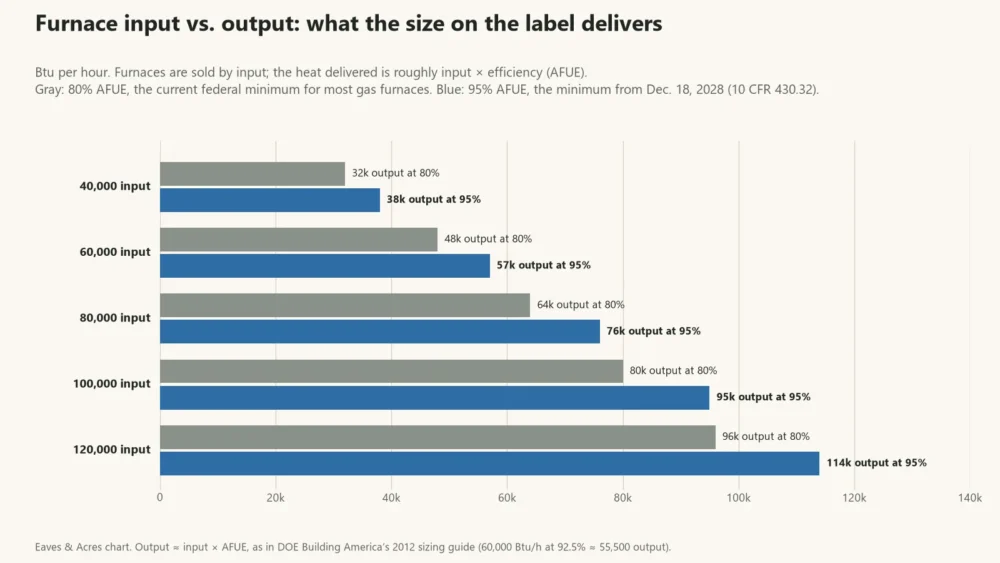
Electric furnaces are rated in kilowatts. One kilowatt-hour is 3,412 Btu,19 so divide a load in Btu/h by 3,412 for kilowatts: a 50,000 Btu/h load is about 14.7 kW of heat. A heat pump is sized differently again; our heat pump vs. furnace guide compares the two.
Even makers phrase this differently. Carrier says furnaces are rated by AFUE and by their size or heating output capacity in BTU/h,11 while DOE says the rating is input.1 When you compare quotes, ask which number each one shows and convert both to output.
Checking the size of the furnace you have now
Your current furnace is a clue, not the answer. Find its input rating and AFUE in its documentation or on its label; the Federal Trade Commission requires new furnaces to display their AFUE.6 Older units can be far less efficient: DOE puts older natural-draft furnaces with a continuous pilot light at 56% to 70% AFUE.6 Multiply input by AFUE for output and set it against Table 3.
An older furnace in a 2,000 sq ft Chicago house
- Scenario
- Nameplate input 100,000 Btu/h, rated 80% AFUE. Our code-built estimate for Chicago: 36,000 to 50,000 Btu/h.
- Math
- 100,000 × 0.80 = 80,000 Btu/h of output. 80,000 ÷ 50,000 = 1.6; 80,000 ÷ 36,000 = 2.2.
- Answer
- The old furnace delivers 1.6 to 2.2 times the estimate. An older, leakier house can need more than a code-built one, so the replacement still needs its own Manual J.
How a contractor sizes a furnace: Manual J, then Manual S
Sizing has two steps. ACCA’s Manual J calculates the heating load, and ACCA says a Manual J load calculation is required by national building codes and most state and local jurisdictions.4 Manual S then picks equipment from manufacturer performance data. DOE’s 2012 guide says Manual S recommends the furnace size stay within 140% of the peak heating load estimate, and that the furnace capacity must meet the Manual J heating load.1 The ENERGY STAR National HVAC Design Report uses the same 100% to 140% band for heating-only furnaces and, for two-stage and modulating models, checks the maximum output.3 When the furnace is paired with cooling, it allows up to 400%.3 DOE explains why: the blower must move enough air across the cooling coil, and selecting equipment for the cooling load may lead to a furnace that is oversized for heating.1 ACCA has since released a third edition of Manual S, which we did not read.20
DOE's Chicago model house
- Scenario
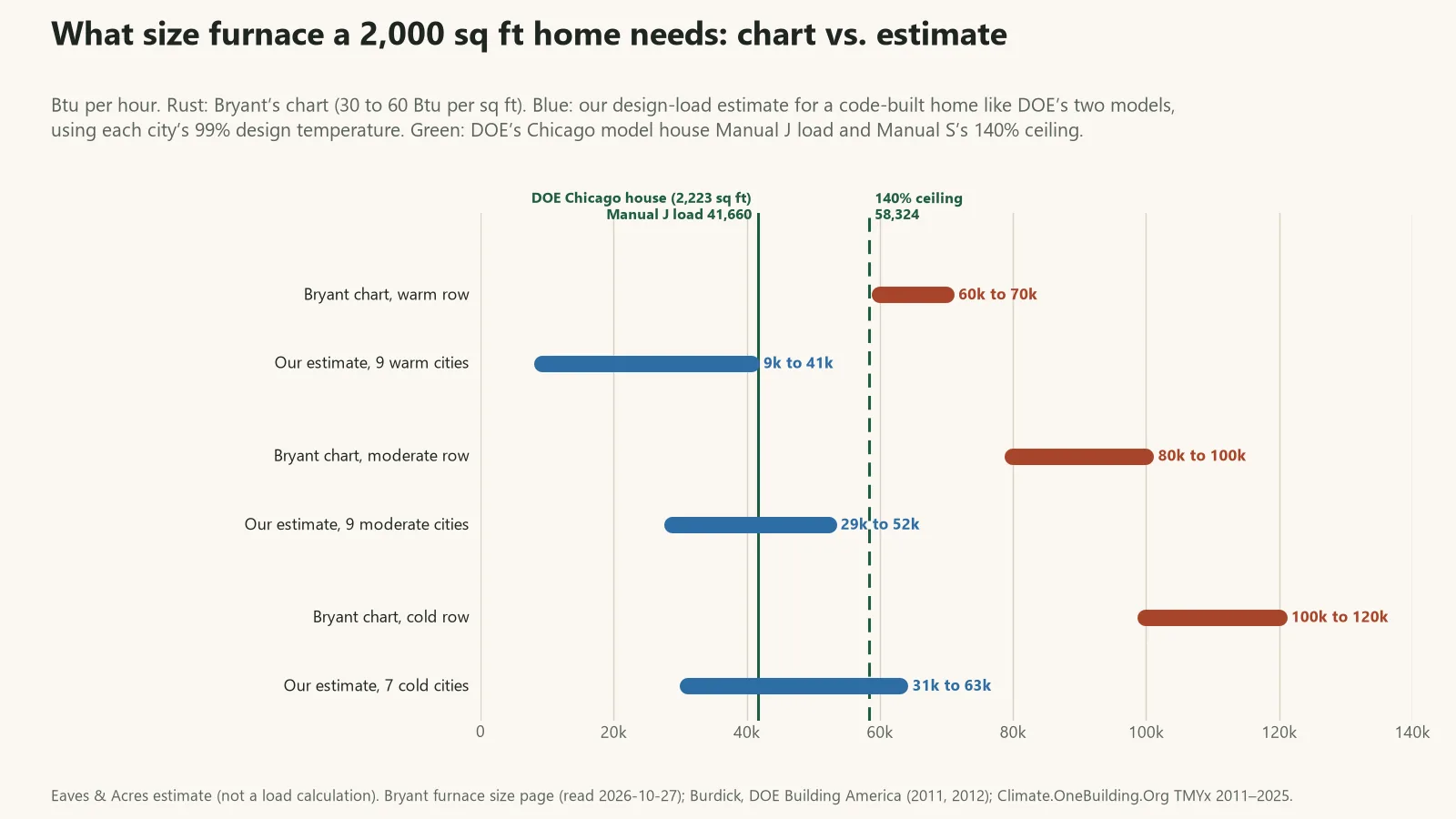
- A 2,223 sq ft above-grade house built to the 2009 energy code, with a conditioned basement. Manual J heating load: 41,660 Btu/h.
- Math
- Upper limit: 41,660 × 1.4 = 58,324 Btu/h of output. A 60,000 Btu/h input furnace at 92.5% gives 55,500, inside the window. At 80% it gives 48,000, also inside. An 80,000 input furnace at 80% gives 64,000, over the limit.
- Answer
- A 60,000 Btu/h input furnace fits this house, not the 100,000 to 120,000 a cold-climate chart gives for 2,000 sq ft.
DOE also notes a quirk of the product range: one manufacturer’s line may run 60,000, 80,000 and 120,000 Btu/h, and a two-stage furnace rated 60,000 on high can run at 39,000 on low.1

Furnace size by home size and climate
Table 2 applies the same method to common home sizes in six cities from mild to very cold. For each one we multiply floor area by a heat-loss rate and by the gap between 70°F indoors and the city airport’s 99% heating design temperature, the outdoor temperature a place stays above for 99% of the hours in a year. The heat-loss rates come from DOE’s two Manual J model houses, both built to the 2009 International Energy Conservation Code: 41,700 Btu/h at a 2°F design temperature in Chicago and 23,600 Btu/h at 42°F in Orlando, each 2,223 sq ft above grade.2 Per degree and square foot that is 0.276 (Chicago model) and 0.379 (Orlando model) Btu/h. Design temperatures come from the TMYx 2011 to 2025 weather files at Climate.OneBuilding.Org, built from NOAA hourly data.18 We then divide by AFUE and round up to the next common input size, 40,000 to 120,000 in 20,000 steps, the range Bryant lists.10
| Home size | Atlanta (27°F) | Nashville (20°F) | Kansas City (8°F) | Chicago (4°F) | Minneapolis (-5°F) | Fargo (-13°F) |
|---|---|---|---|---|---|---|
| 1,000 sq ft | 12k–16k out; 40k / 40k† | 14k–19k out; 40k / 40k† | 17k–24k out; 40k / 40k† | 18k–25k out; 40k / 40k† | 21k–28k out; 40k / 40k | 23k–32k out; 40k / 40k |
| 1,200 sq ft | 14k–20k out; 40k / 40k† | 16k–23k out; 40k / 40k† | 21k–28k out; 40k / 40k | 22k–30k out; 40k / 40k | 25k–34k out; 40k / 60k | 28k–38k out; 40k / 60k |
| 1,500 sq ft | 18k–24k out; 40k / 40k† | 21k–28k out; 40k / 40k | 26k–35k out; 40k / 60k | 27k–37k out; 40k / 60k | 31k–43k out; 60k / 60k | 34k–47k out; 60k / 60k |
| 1,800 sq ft | 21k–29k out; 40k / 40k | 25k–34k out; 40k / 60k | 31k–42k out; 60k / 60k | 33k–45k out; 60k / 60k | 37k–51k out; 60k / 80k | 41k–57k out; 60k / 80k |
| 2,000 sq ft | 24k–33k out; 40k / 60k | 27k–38k out; 40k / 60k | 34k–47k out; 60k / 60k | 36k–50k out; 60k / 80k | 41k–57k out; 60k / 80k | 46k–63k out; 80k / 80k |
| 2,500 sq ft | 30k–41k out; 60k / 60k | 34k–47k out; 60k / 60k | 43k–59k out; 80k / 80k | 45k–62k out; 80k / 80k | 52k–71k out; 80k / 100k | 57k–79k out; 100k / 100k |
| 3,000 sq ft | 36k–49k out; 60k / 80k | 41k–57k out; 60k / 80k | 51k–71k out; 80k / 100k | 54k–75k out; 80k / 100k | 62k–85k out; 100k / 120k | 69k–95k out; 100k / 120k |
A dagger marks cells where even the smallest common furnace, 40,000 input at 95% (38,000 Btu/h of output), is more than 140% of the upper estimate. There a two-stage or modulating model is worth asking about. Small homes in mild places hit this first: 38,000 Btu/h is more than twice the upper estimate for a 1,000 sq ft code-built home in Atlanta.
Furnace size for a 2,000 sq ft home in 30 cities
Table 3 holds the floor area fixed at 2,000 sq ft and changes the city. Heating degree days for each ZIP’s nearest station come from NOAA’s 1991 to 2020 normals and set how long the furnace runs; the design temperature sets how big it must be.17 See our heating degree days guide for the difference. Seattle shows it: about 4,340 heating degree days, 56% more than Atlanta’s 2,775, yet a 30°F design temperature that gives it a slightly smaller design load than Atlanta. A long, mild winter needs fuel, not a bigger furnace.
| City (ZIP) | Design °F | HDD | Load, Btu/h | Input at 95% | Input at 80% | 40,000 at 95% vs. 140% limit |
|---|---|---|---|---|---|---|
| Fargo, ND (58102) | -13.2 | 8,806 | 46,000 to 63,000 | 80,000 | 80,000 | Within |
| Minneapolis, MN (55401) | -5.1 | 7,699 | 41,000 to 57,000 | 60,000 | 80,000 | Within |
| Madison, WI (53703) | -1.1 | 7,096 | 39,000 to 54,000 | 60,000 | 80,000 | Within |
| Burlington, VT (05401) | -0.6 | 6,960 | 39,000 to 54,000 | 60,000 | 80,000 | Within |
| Des Moines, IA (50309) | 1.0 | 6,178 | 38,000 to 52,000 | 60,000 | 80,000 | Within |
| Omaha, NE (68102) | 2.3 | 5,833 | 37,000 to 51,000 | 60,000 | 80,000 | Within |
| Chicago, IL (60602) | 4.5 | 6,018 | 36,000 to 50,000 | 60,000 | 80,000 | Within |
| Albany, NY (12207) | 5.4 | 6,357 | 36,000 to 49,000 | 60,000 | 80,000 | Within |
| Portland ME, ME (04101) | 5.9 | 6,795 | 35,000 to 49,000 | 60,000 | 80,000 | Within |
| Denver, CO (80202) | 6.4 | 5,262 | 35,000 to 48,000 | 60,000 | 80,000 | Within |
| Kansas City, MO (64106) | 7.9 | 4,613 | 34,000 to 47,000 | 60,000 | 60,000 | Within |
| Detroit, MI (48226) | 8.4 | 6,106 | 34,000 to 47,000 | 60,000 | 60,000 | Within |
| Indianapolis, IN (46204) | 9.0 | 5,704 | 34,000 to 46,000 | 60,000 | 60,000 | Within |
| Pittsburgh, PA (15222) | 10.0 | 5,379 | 33,000 to 45,000 | 60,000 | 60,000 | Within |
| St. Louis, MO (63101) | 13.1 | 4,292 | 31,000 to 43,000 | 60,000 | 60,000 | Within |
| Boston, MA (02108) | 13.6 | 5,545 | 31,000 to 43,000 | 60,000 | 60,000 | Within |
| Salt Lake City, UT (84101) | 16.0 | 4,724 | 30,000 to 41,000 | 60,000 | 60,000 | Within |
| Louisville, KY (40202) | 16.3 | 4,141 | 30,000 to 41,000 | 60,000 | 60,000 | Within |
| New York, NY (10001) | 17.6 | 4,553 | 29,000 to 40,000 | 60,000 | 60,000 | Within |
| Nashville, TN (37201) | 20.3 | 3,648 | 27,000 to 38,000 | 40,000 | 60,000 | Within |
| Charlotte, NC (28202) | 25.3 | 3,058 | 25,000 to 34,000 | 40,000 | 60,000 | Over at the tighter rate |
| Atlanta, GA (30303) | 27.1 | 2,775 | 24,000 to 33,000 | 40,000 | 60,000 | Over at the tighter rate |
| Dallas, TX (75201) | 27.7 | 1,992 | 23,000 to 32,000 | 40,000 | 60,000 | Over at the tighter rate |
| Portland, OR (97204) | 29.5 | 4,167 | 22,000 to 31,000 | 40,000 | 40,000 | Over at the tighter rate |
| Seattle, WA (98101) | 30.2 | 4,340 | 22,000 to 30,000 | 40,000 | 40,000 | Over at the tighter rate |
| Sacramento, CA (95814) | 32.7 | 2,138 | 21,000 to 28,000 | 40,000 | 40,000 | Over at the tighter rate |
| Houston, TX (77002) | 34.7 | 1,222 | 19,000 to 27,000 | 40,000 | 40,000 | Over at both rates |
| Las Vegas, NV (89101) | 35.8 | 1,839 | 19,000 to 26,000 | 40,000 | 40,000 | Over at both rates |
| Phoenix, AZ (85004) | 42.3 | 874 | 15,000 to 21,000 | 40,000 | 40,000 | Over at both rates |
| Miami, FL (33130) | 53.1 | 214 | 9,000 to 13,000 | 40,000 | 40,000 | Over at both rates |

Across the country the pattern holds. We estimated each ZIP code’s design temperature from its NOAA coldest-month average low with a straight-line fit to 39 airports (R² 0.97, typical error 2.6°F). For a 2,000 sq ft code-built home, a 40,000 Btu/h input furnace at 95% covers the load in 32% to 83% of 40,565 contiguous-US and DC ZIP codes, depending on which DOE model rate you use, and a 60,000 covers it in 92% to 100%. No ZIP needs more than 80,000. With every design temperature 5°F colder, the 40,000 share falls to 23% to 71%.

Two limits matter. DOE’s houses are new, code-built homes; an older, leakier house can lose heat much faster, and we found no sourced heat-loss rate for older homes to add. And ENERGY STAR’s county limits take the lowest heating design temperature among a county’s stations, so a contractor’s design temperature can be colder than our airport value. Treat these numbers as a check on a quote, not a purchase size. Our BTU per square foot guide tests the same rules room by room. Our methodology page covers the NOAA data.
How popular furnace size charts compare
We read five charts that rank for this question and lined each up against Table 3.
| Source | Type | What it says | Our estimate |
|---|---|---|---|
| Bryant | Manufacturer | 30–35, 40–50 and 50–60 BTU per sq ft: 60,000–70,000 warm, 80,000–100,000 moderate, 100,000–120,000 cold; does not say input or output10 | Warm row cities 9,000 to 41,000; moderate 29,000 to 52,000; cold 31,000 to 63,000 |
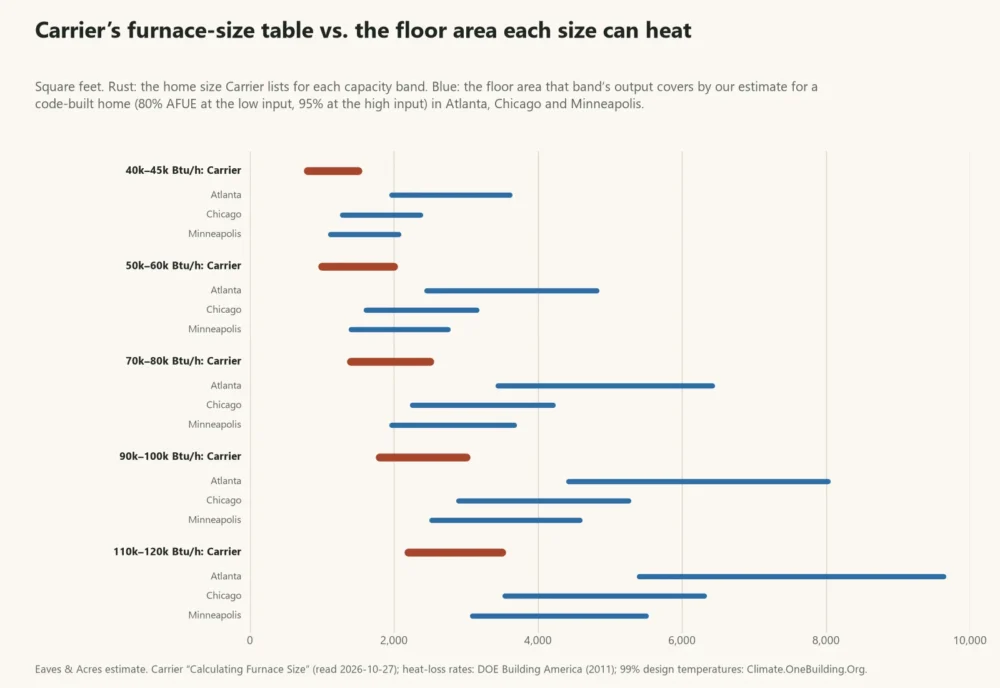
| Carrier | Manufacturer | 50,000–60,000 Btu/h for about 1,000–2,000 sq ft; 60,000 for about 1,200–2,00011 | The same band covers 1,600–3,200 sq ft in Chicago |
| HVAC Load Calculate | Calculator site | Output 50,000 (zone 2) to 90,000 (zones 7–8) for 2,000 sq ft, at 25 to 45 BTU per sq ft13 | Its mildest column is above our upper estimate in 24 of 30 cities |
| Refcon HVAC | Contractor calculator | Input at 80% AFUE: 60,000–75,000 warm, 80,000–100,000 moderate, 110,000–140,000 cold14 | Cold row output (88,000–112,000) vs. our cold-city 31,000 to 63,000 |
| HVACBase | Calculator site (own heat-loss model) | 35,640 Btu/h output at a 10°F design low, average insulation: a 40,000 input furnace at 95%15 | Close to our Chicago-model end for a similar design temperature |
| DOE Building America | Federal program, Manual J | Chicago model house: 41,660 Btu/h for 2,223 sq ft above grade plus a conditioned basement1 | Basis of our heat-loss rates |
Bryant’s quick formula is 30 to 60 BTU per square foot, and its own page calls the ranges general estimates and adds this caution:10
nominal BTU rating is not the same thing as the home’s calculated heating load
The chart’s 2,000 sq ft rows run 1.7 to 3.5 times our estimate in the seven cold-row cities and 1.7 to 3.1 in the nine moderate-row cities, if its numbers are output; read as 80% furnace input, 1.4 to 2.8 and 1.4 to 2.5. Bryant does not say which. Put another way, the chart is right only for a house that loses heat that many times faster than DOE’s code-built models. Carrier’s table runs the other way, from furnace size to floor area: a 50,000 to 60,000 Btu/h furnace for 1,000 to 2,000 sq ft. By our estimate the same band covers 1,600 to 3,200 sq ft of code-built home in Chicago and 1,400 to 2,800 in Minneapolis. Carrier calls its ranges general reference ranges, not equipment-sizing recommendations, and says a Manual J load calculation should decide.11
One chart is close to ours: HVACBase builds its own heat-loss model and shows a 2,000 sq ft home with average insulation at a 10°F design low needing 35,640 Btu/h, a 40,000 input furnace at 95%.15 Its method, not its multiplier, is what makes the difference.
What happens when a furnace is too big or too small
An oversized furnace reaches the thermostat setting fast and shuts off, so it starts and stops more. A 2002 DOE technology fact sheet says the efficiency of a furnace is reduced by excessive cycling, that more starts and stops accelerate wear, and that oversized systems use more blower power.7 The same sheet reports that in one large survey nearly 40% of contractors said they purposely over-sized equipment, citing reasons such as “to reduce call backs.”7 Bryant and Carrier list short cycling, uneven temperatures and extra wear for oversized units, and constant running in cold weather for undersized ones.10,11 Our furnace lifespan guide covers what shortens a furnace’s life.
The State of Illinois heating guide says the most common mistake is buying a system too large, and that “there are no simple rules for furnace sizing.”9 It asks any contractor who estimates from square footage alone to do a true heat loss calculation.9
Single-stage, two-stage and modulating furnaces
A single-stage furnace has one firing rate: on at full output or off. A two-stage furnace adds a low rate; in DOE’s example, 39,000 Btu/h on low from a furnace rated 60,000 on high, and DOE says multiple-stage equipment can partly fill the gaps between a maker’s sizes.1 A modulating furnace changes its output in small steps; Carrier says the modulating gas valve on its top model, paired with its Infinity control, can adjust in 1% increments.12 ENERGY STAR checks the 140% limit against the maximum output, so staging does not make an oversized furnace pass.3 Where the smallest common furnace is already well over the load, as in the 10 cities flagged in Table 3 and the daggered cells in Table 2, a lower first stage is the main way to run closer to the load.
Replacing a furnace: why the old size is not the answer
Minnesota’s Department of Commerce warns against a new unit larger than the old one and against automatically installing the same size, especially after insulation, air sealing or new windows.8 DOE’s furnace guide is blunter about existing equipment:6
Newer systems may be more efficient but are still likely to be oversized
DOE adds that energy upgrades made first can let you buy a smaller unit.6 Ducts are part of the size question too. Minnesota Commerce says the ductwork must be properly sized for the furnace,8 and Lennox notes that leaky or undersized ducts can leave some rooms colder than others even with a well-sized furnace.16 Its furnace replacement guide also covers efficiency choices. Our winterizing guide covers the low-cost sealing steps, and the winter thermostat guide covers setbacks, which a correctly sized furnace handles without a bigger one.


What the contractor’s load calculation should show
Minnesota Commerce gives the simplest rule:8 “Insist on a heat-loss calculation worksheet as part of any contract.” ENERGY STAR’s design report lists what a complete one contains (Table 5).3 Compare the total heat loss with Table 3; if the quote’s furnace output is far above 140% of it, ask why.
| Item | What to look for |
|---|---|
| Method | Room-by-room loads by unabridged ACCA Manual J 8 or ASHRAE Fundamentals (item 3.1) |
| Indoor design temperature | 70°F for heating (item 3.2) |
| Outdoor design temperature | The county and heating value used, within ENERGY STAR’s county limit (item 3.3) |
| House inputs | Occupants, conditioned floor area, window area, window SHGC, infiltration and ventilation rates (items 3.4 to 3.9) |
| Total heat loss | The design heating load in kBtu/h (item 3.14) |
| Furnace | Make and model, rated AFUE and total output capacity; maximum output for two-stage and modulating (items 4.17 to 4.19) |
| Heating sizing % | Output ÷ heat loss: 100% to 140% heating-only; up to 400% allowed when paired with cooling (items 4.20 to 4.22) |
Two other numbers come from the same visit. The filter size and access matter for upkeep (see how often to change a furnace filter), and the blower’s watts set backup power needs; our generator-for-a-furnace guide and generator size calculator use them.
 Related guideWhat Humidity Should a House Be in Winter? 30–40%, Lower on Cold Nights
Next step
Find your city or the nearest climate in Table 3, note the output range for your floor area, and ask for a written Manual J and Manual S before you sign. If you are weighing a heat pump instead, the cold-weather heat pump guide compares capacity with the same design temperatures.
Frequently asked questions
For a code-built home our estimate is about 24,000 to 33,000 Btu/h of output in Atlanta, 36,000 to 50,000 in Chicago and 46,000 to 63,000 in Fargo. That is a 40,000 or 60,000 input furnace at 95% AFUE in 29 of our 30 cities (Fargo needs 80,000), or 40,000 to 80,000 at 80%. Older, leakier homes can need more; a Manual J decides.
Our code-built estimates for 1,500 sq ft run 18,000 to 24,000 Btu/h in Atlanta and 31,000 to 43,000 in Minneapolis, so a 40,000 or 60,000 input furnace. At 1,000 to 1,200 sq ft even the smallest common furnace, 40,000 input, can be more than 140% of the load in mild climates.
For 3,000 sq ft our estimate is 36,000 to 49,000 Btu/h in Atlanta, 54,000 to 75,000 in Chicago and 69,000 to 95,000 in Fargo: about 60,000 to 120,000 input depending on climate, AFUE and how tight the house is.
Carrier lists about 1,200 to 2,000 sq ft for 60,000 Btu/h. By our estimate for a code-built home, a 50,000 to 60,000 Btu/h furnace covers about 1,600 to 3,200 sq ft in Chicago and 2,500 to 4,800 in Atlanta. Check whether the number is input or output.
Neither. A furnace must meet the Manual J heating load, and DOE’s guide says Manual S keeps it within 140% of that load. A DOE fact sheet says oversized units lose efficiency to excessive cycling and wear faster; undersized ones run constantly on the coldest days.
Input is the fuel a furnace burns per hour; output is the heat it delivers. DOE says furnaces are rated by input and derated by efficiency: a 60,000 Btu/h furnace at 92.5% gives about 55,500 Btu/h.
Not automatically. Minnesota Commerce warns against a larger unit and against copying the old size, especially after insulation, air sealing or new windows, and DOE says many existing furnaces are likely oversized. Ask for a heat-loss calculation.
A ZIP code gives the design temperature, which sets how big the furnace must be; it cannot see your walls, windows or air leaks. Our 30-city and 40,565-ZIP estimates are a check on a quote; the contractor’s Manual J is the sizing calculation.
Sources
Sources labeled Compared are popular pages we checked our answer against. They are not extension, government, standards or manufacturer sources. How we choose sources
- 1.Strategy Guideline: HVAC Equipment Sizing. Arlan Burdick, IBACOS, for U.S. DOE Building America, 2012. Used for: furnaces rated by input and derated by efficiency (60,000 at 92.5% about 55,500); Manual S within 140% of peak heating load; Chicago House 41,660 x 1.4 = 58,324; two-stage 60,000 high / 39,000 low; furnace line 60,000/80,000/120,000; cooling-based selection may oversize the furnace Back to text
- 2.Strategy Guideline: Accurate Heating and Cooling Load Calculations (NREL/SR-5500-51603). Arlan Burdick, IBACOS, for U.S. DOE Building America / NREL, 2011. Used for: two 2009 IECC houses, 2,223 sq ft above grade; Chicago 41,700 Btu/h (with conditioned basement), Orlando 23,600 Btu/h; heat-loss rates used in our estimate Back to text
- 3.ENERGY STAR Single-Family New Homes National HVAC Design Report, Version 3.1 / 3.2 / 3.3 (Rev. 14). ENERGY STAR (U.S. EPA), 2025. Used for: items 3.1 to 3.14 and 4.17 to 4.22; heating-only 100 to 140%, paired with cooling allowed 100 to 400%; two-stage and modulating at maximum output Back to text
- 4.Manual J Residential Load Calculation. Air Conditioning Contractors of America (ACCA), read 2026-10-27. Used for: ANSI-recognized standard for equipment sizing loads; required by national building codes and most state and local jurisdictions Back to text
- 5.10 CFR 430.32(e), energy conservation standards for furnaces. U.S. DOE, Electronic Code of Federal Regulations, read 2026-10-27. Used for: 80.0% AFUE non-weatherized gas furnaces now; 95.0% for those manufactured on and after December 18, 2028 Back to text
- 6.Energy Saver: Furnaces and Boilers (archived copy of 2026-05-31; the live page has been removed). U.S. Department of Energy, 2026. Used for: AFUE definition; FTC requires AFUE display; 56 to 70%, 80 to 83%, 90 to 98.5% AFUE; newer systems still likely oversized; efficiency upgrades let you buy a smaller unit Back to text
- 7.Technology Fact Sheet: Right-Size Heating and Cooling Equipment (DOE/GO-102002-1490). U.S. DOE, Office of Building Technology, State and Community Programs, 2002. Used for: efficiency reduced by excessive cycling; starts and stops accelerate wear; more blower power; nearly 40 percent of surveyed contractors purposely over-sized Back to text
- 8.Home Energy Guide: Furnace Replacement. Minnesota Department of Commerce, undated. Used for: do not buy larger than the old unit or automatically the same size; insist on a heat-loss calculation worksheet; ductwork sized for the furnace Back to text
- 9.Heating Systems. State of Illinois (Keep Warm Illinois), undated. Used for: most common mistake is a system too large; no simple rules for furnace sizing; ask for a true heat loss calculation Back to text
- 10.What Size Furnace Do I Need? A Homeowner’s Guide to BTU Sizing. Bryant (Travis Baugh; reviewed by Seth Faber), read 2026-10-27. Used for: 30 to 60 BTU per sq ft; 2,000 sq ft 60,000 to 120,000; models about 40,000 to 120,000+; nominal rating not the calculated load; oversized and undersized symptoms Back to text
- 11.Calculating Furnace Size. Carrier (Ryan Mayes; reviewed by Seth Faber), read 2026-10-27. Used for: capacity vs home size table; general reference ranges, not equipment-sizing recommendations; rated by AFUE and heating output capacity; undersized units run continuously Back to text
- 12.Infinity 98 Gas Furnace 59MN7. Carrier, read 2026-10-27. Used for: modulating gas valve with Infinity control adjusts in 1% increments Back to text
- 13.Compared Furnace Sizing Calculator. HVAC Load Calculate, read 2026-10-27. Used for: output 25 to 45 BTU per sq ft by zone; 2,000 sq ft 50,000 to 90,000 Back to text
- 14.Compared Furnace Size Calculator. Refcon HVAC, 2026. Used for: input at 80% AFUE: 2,000 sq ft 60,000 to 140,000 by region Back to text
- 15.Furnace Size Calculator: What Size Furnace Do I Need? HVACBase (Marko Visic), updated 2026-10-22. Used for: 2,000 sq ft, average insulation, 10 F design low: 35,640 Btu/h, 40,000 input at 95% Back to text
- 16.Calculating Furnace Size. Lennox, 2026. Used for: leaky or undersized ducts can leave rooms colder; oversized furnaces short-cycle Back to text
- 17.U.S. Climate Normals 1991-2020 (annual heating degree days, monthly normals). NOAA NCEI, 2021. Used for: HDD and coldest-month average low by station; same values as wp_ea_climate Back to text
- 18.TMYx 2011-2025 weather files with .ddy design conditions (99% heating dry-bulb, 39 airports). Climate.OneBuilding.Org, 2025. Used for: design temperatures from design-day files built from NOAA ISD hourly data; third-party, not ASHRAE tables Back to text
- 19.Units and calculators explained: British thermal units. U.S. Energy Information Administration, read 2026-10-27. Used for: 1 kWh = 3,412 Btu Back to text
- 20.Manual S Residential Equipment Selection. Air Conditioning Contractors of America (ACCA), read 2026-10-27. Used for: third edition newly released (not read for this guide) Back to text
How this guide was made
- Written by the Home Systems Desk and reviewed by the Data & Methodology Desk.
- Data: Design heating load (output) = floor area × heat-loss rate × (70°F − 99% heating design temperature). Heat-loss rates: DOE Building America’s Chicago and Orlando Manual J model houses (0.276 and 0.379 Btu/h per °F per above-grade sq ft; 2009 IECC). Design temperatures: Climate.OneBuilding.Org TMYx 2011–2025 airport files (30 cities). HDD: NOAA NCEI 1991–2020 normals, nearest station. Input = output ÷ AFUE, rounded up to 40,000–120,000 in 20,000 steps. ZIP design temperature = -14.79 + 1.183 × coldest-month average low (R² 0.97, RMSE 2.6°F) for 40,565 contiguous-US and DC ZIPs. Estimates are not Manual J load calculations; older houses can lose heat faster. See our methodology.
- AI use: AI tools help us research, draft and check this guide. Every figure is checked against the source cited for it, and calculated figures come from our own code, described on the methodology page.
- Spotted an error? Tell us and the form opens with this page’s address filled in.
Change log
- Nov 23, 2026Published.
- Oct 27, 2026Written as a draft. DOE Building America (2011, 2012), DOE fact sheet (2002) and Energy Saver, ENERGY STAR design report, ACCA, eCFR 430.32, Minnesota and Illinois guides, and five size charts read; 30-city and 40,565-ZIP estimates computed from NOAA normals and 99% design temperatures.
Covers heating, cooling, generators and water heaters. We maintain the generator sizing calculator and write the guides that explain what a number means before you call a contractor.
Keep reading
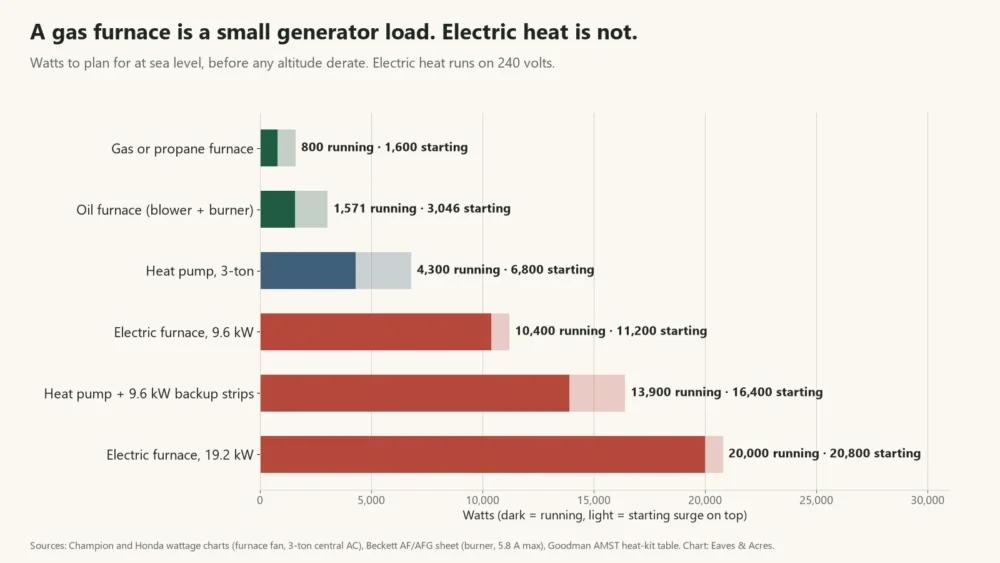
What Size Generator to Run a Furnace? Watts for Gas, Oil and Electric Heat
A gas or propane furnace needs about 300–875 running and 1,600–2,350 starting watts. What oil furnaces, electric furnaces and heat pumps draw, from generator charts and furnace spec sheets, with the altitude derate for 15 cold-winter cities.
What Temperature Should a Water Heater Be Set At? 120°F, and When to Go Higher
Most homes should run a water heater at 120°F. What DOE, CDC, CPSC, EPA and OSHA each say, how fast hotter water burns, and what a lower setting really saves.
Portable Generator Safety: The Rules and the CPSC Data Behind Them
Outdoors only, 20 feet from the house, exhaust away, CO alarms on every level. CPSC records of 789 generator CO deaths show why each rule exists.
Seasonal reminders for your ZIP
Get a short email when it’s time to overseed, start seeds, open the pool or service your furnace, timed to your climate.